
Trolley
You have no items in your shopping cart

 Budgets
 Dumbers
 Discs
Discs
 Benches
 Racks and Rigs
 Weights Holders
 Isotonic machines
 Calisthenics
 Cardio
 Kettlebells
 Flooring
 Gym Set
 Accessories
 Combat
 ARTI MARZIALI
 CONTAINER GYM
 Tug-Of-War
 Used Gym Equipment
 PILATES MACCHINARI
 GINNASTICA ARTISTICA
 CAMPI DA PADEL
 Prodotti in Pronta Consegna
 Informazioni
 IRONMAN
 Gift Card
- Donatif
- General information
- 0 I like it
- 474 Views
- 0 comments
- gym flooring, safety flooring, gym safety, shock-absorbing materials
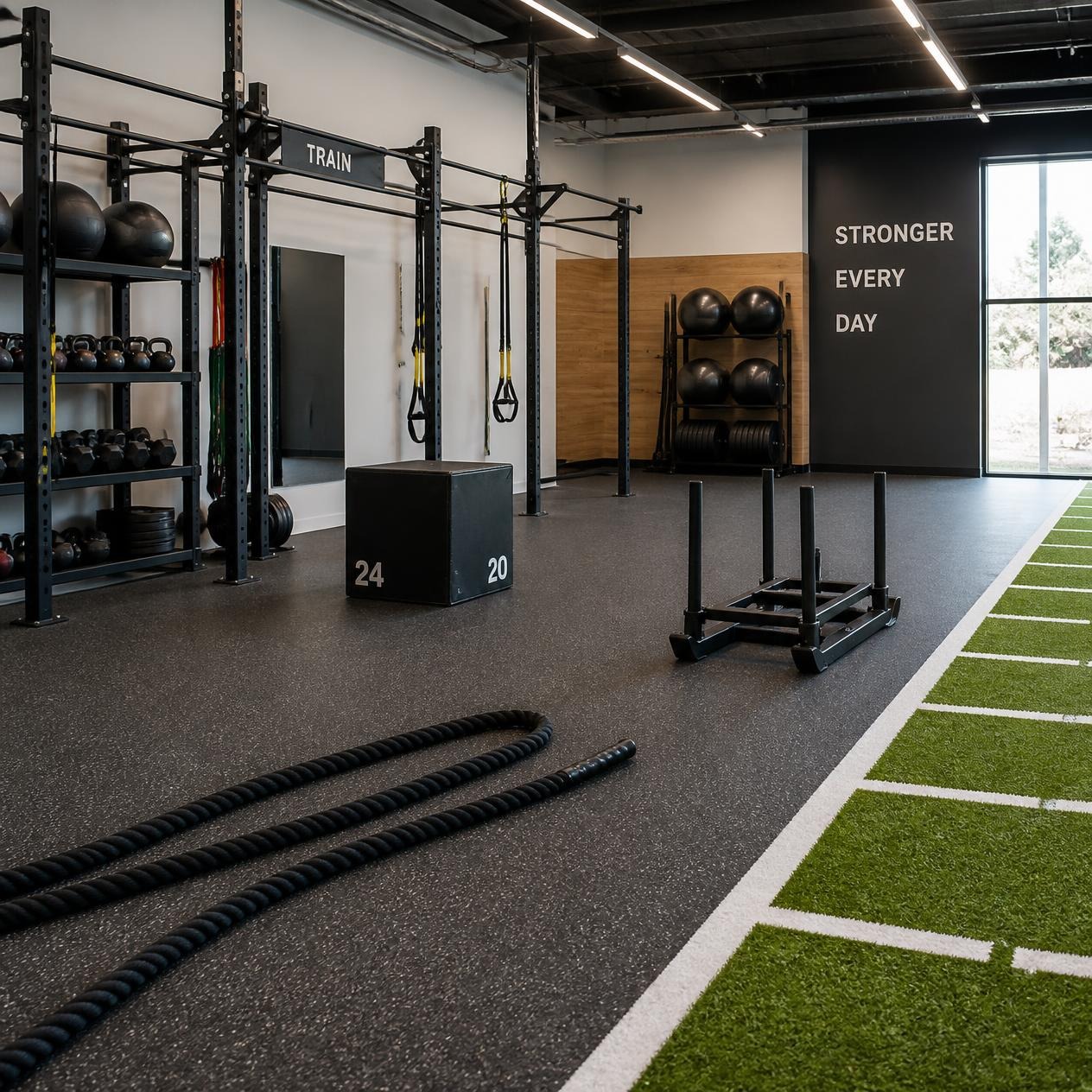
Setting Up a Functional Area in the Gym: A Complete Guide for Owners
In recent years, functional training has gone from being a simple trend to representing one of the most requested services within modern fitness centers. Users are looking for dynamic, engaging, and results-oriented workouts, while gym managers have the opportunity to enhance surfaces that, if designed correctly, can increase the number of members, improve retention, and boost the facility's profitability.
However, creating a zone dedicated to functional training requires much more than buying a few kettlebells and some accessories. The effectiveness of the area depends on the design of the spaces, the choice of equipment, the safety of the training paths, and the ability to create a versatile environment that can host individual sessions, small groups, and organized classes throughout the day.
In this guide, we analyze all the fundamental aspects for designing a gym functional area, from the distribution of spaces to the choice of equipment, including flooring, workflows, safety, and return on investment. The goal is to help gym owners create a modern, efficient area capable of standing out from the competition.
- Why invest in a functional area
- How to design the spaces
- Essential equipment
- The importance of flooring
- Optimizing user flow
- Customizing the project
- Errors to avoid
- Maximizing return on investment
Why invest in a functional area
Functional training represents one of the services with the best ratio between occupied surface area and generated value. A single area can be used simultaneously for individual workouts, group classes, athletic preparation, personal training, and activities dedicated to functional recovery.
This versatility allows for increasing the productivity of every square meter of the gym. Unlike traditional isotonic machines, which are often used by only one client at a time, a functional zone allows for engaging multiple people simultaneously while maintaining a high-quality experience.
From a commercial point of view, a modern area also represents a strong distinguishing element. Images of a well-organized space improve online communication, enhance the gym's brand, and favor the acquisition of new members interested in dynamic and complete workouts.
More value per square meter
A well-designed functional area allows for numerous different activities to be carried out throughout the day, increasing the space utilization rate and improving the overall profitability of the fitness center.
A concrete competitive advantage
Offering a space dedicated to functional training allows you to intercept new customer segments and strengthen the structure's positioning in an increasingly competitive market.
How to design the spaces
Design represents the most important phase of the entire investment. Before choosing the equipment, it is necessary to define the available dimensions, movement paths, areas dedicated to different exercises, and safety distances between one station and another.
Good design also considers the future evolution of the gym. Preparing modular spaces allows, in fact, for adding new equipment or modifying the layout without having to intervene on the structure again.
Many managers underestimate the importance of preliminary planning. In reality, a correct distribution of elements improves user comfort, facilitates the work of instructors, and increases the operational capacity of the entire area.
Organizing the layout
Zones dedicated to dynamic movements must be separated from areas used for static exercises, ensuring fluid paths and reducing the risk of interference between users.
The importance of digital design
A 3D gym design allows you to visualize the final result in advance, verify dimensions, simulate movement flows, and optimize every square meter before purchasing equipment.
Essential equipment
The choice of equipment determines the versatility of the entire functional area. It is fundamental to prioritize professional, robust tools capable of supporting intensive daily use.
Kettlebells, dumbbells, sandbags, slam balls, battle ropes, plyometric boxes, Olympic barbells, multifunctional racks, and resistance bands represent the foundation of any modern project. The final selection depends on the gym's target audience, the type of classes offered, and the average level of the users.
It is advisable to organize the tools in an orderly manner using dedicated racks. This improves safety, speeds up changes during workouts, and contributes to keeping the environment professional at all times.
The rack as an operational center
A multifunctional rack allows you to concentrate numerous activities in a single structure, offering stations for pull-ups, squats, suspensions, and accessories dedicated to functional training.
Purchasing with a strategic vision
Evaluating suppliers specialized in wholesale functional equipment allows you to obtain greater uniformity, construction quality, and more efficient management of the entire project.
The importance of flooring
Flooring represents a structural element and not a simple accessory. During functional workouts, the floor must absorb impacts, ensure stability, and protect both users and equipment.
A technical surface also improves comfort during explosive movements, reduces noise, and contributes to the longevity of the investment. Choosing certified materials means limiting maintenance interventions and maintaining high performance over time.
The thickness must be evaluated based on the planned activities. Zones dedicated to weightlifting require different characteristics compared to areas intended for bodyweight exercises or metabolic training.
Why choose professional surfaces
A functional rubber flooring improves safety, protects the subfloor, and contributes to creating a comfortable environment even during the most intense workouts.
Durability and maintenance
Quality materials maintain elasticity, resistance, and ease of cleaning over time, reducing the overall cost of managing the gym.
Optimizing user flow
An effective functional area must allow multiple people to train simultaneously without getting in each other's way. This requires a logical arrangement of equipment and careful design of movement paths.
Separating stations dedicated to explosive exercises from those used for technical work improves safety and makes organizing classes easier. The position of accessories also influences the speed with which users can change exercises.
Providing free multifunctional spaces also allows you to quickly adapt the area to different lessons, increasing the operational flexibility of the center.
Individual and small group workouts
Intelligent design allows the same area to be used for both personal training and group lessons, maximizing the occupancy rate throughout the day.
Safety in paths
Maintaining adequate distances between stations reduces the risk of collisions and improves the overall user experience.
Customizing the project
Every gym possesses different characteristics. Dimensions, target, budget, and services offered influence the ideal configuration of the functional area. For this reason, standard solutions are rarely the best choice.
A personalized project allows you to integrate corporate colors, specific equipment, dedicated paths, and layouts studied based on the actual needs of the structure. This contributes to strengthening the brand identity and creating a recognizable environment.
Collaborating with specialized partners also allows you to receive technical advice, support in design, and indications on the best solutions available for every investment bracket.
Enhancing construction quality
Equipment designed with high quality standards guarantees greater reliability, a better user experience, and superior durability even in the presence of intensive use.
Thinking about future growth
Preparing an easily expandable area allows you to introduce new services without completely modifying the existing layout.
Errors to avoid
One of the most frequent errors consists of purchasing equipment without an overall strategy. Accumulating tools disconnected from each other often produces messy, non-functional areas that are difficult to manage during lessons.
Another error concerns the under-dimensioning of free spaces. Functional training requires movement and freedom of execution: filling every square meter with equipment reduces the quality of the experience and limits the versatility of the area.
Finally, choosing products exclusively based on the initial price can translate into higher maintenance costs, frequent replacements, and a less professional perception by members.
Avoid overcrowding
An orderly and well-organized space is much more efficient compared to an area full of equipment but difficult to use.
Quality reduces future costs
Investing from the beginning in professional equipment allows you to limit machine downtime, improve safety, and offer a higher-level service.
Maximizing return on investment
A modern gym functional area represents much more than a simple zone dedicated to functional exercises. It is a strategic tool capable of increasing the perceived value of the structure, differentiating the commercial offer, and improving the overall profitability of the fitness center.
To obtain the maximum result, it is fundamental to rely on partners capable of following all phases of the project, from initial consultation to the choice of equipment, up to the final realization. Through accurate design, it is possible to create efficient, safe environments perfectly adapted to the needs of your business. To learn more about dedicated solutions, you can consult the range of professional gym equipment and evaluate personalized projects for fitness centers of any size.
Investing today in intelligent design means building a space capable of generating value for many years, improving the user experience, optimizing staff work, and transforming every square meter into a concrete opportunity for growth for the gym.
Comments (0)