
Trolley
You have no items in your shopping cart

 Budgets
 Dumbers
 Discs
Discs
 Benches
 Racks and Rigs
 Weights Holders
 Isotonic machines
 Calisthenics
 Cardio
 Kettlebells
 Flooring
 Gym Set
 Accessories
 Combat
 ARTI MARZIALI
 CONTAINER GYM
 Tug-Of-War
 Used Gym Equipment
 PILATES MACCHINARI
 GINNASTICA ARTISTICA
 CAMPI DA PADEL
 Prodotti in Pronta Consegna
 Informazioni
 IRONMAN
 Gift Card
- Donatif
- General information
- 0 I like it
- 85 Views
- 0 comments
- gym flooring, safety flooring, gym safety, shock-absorbing materials
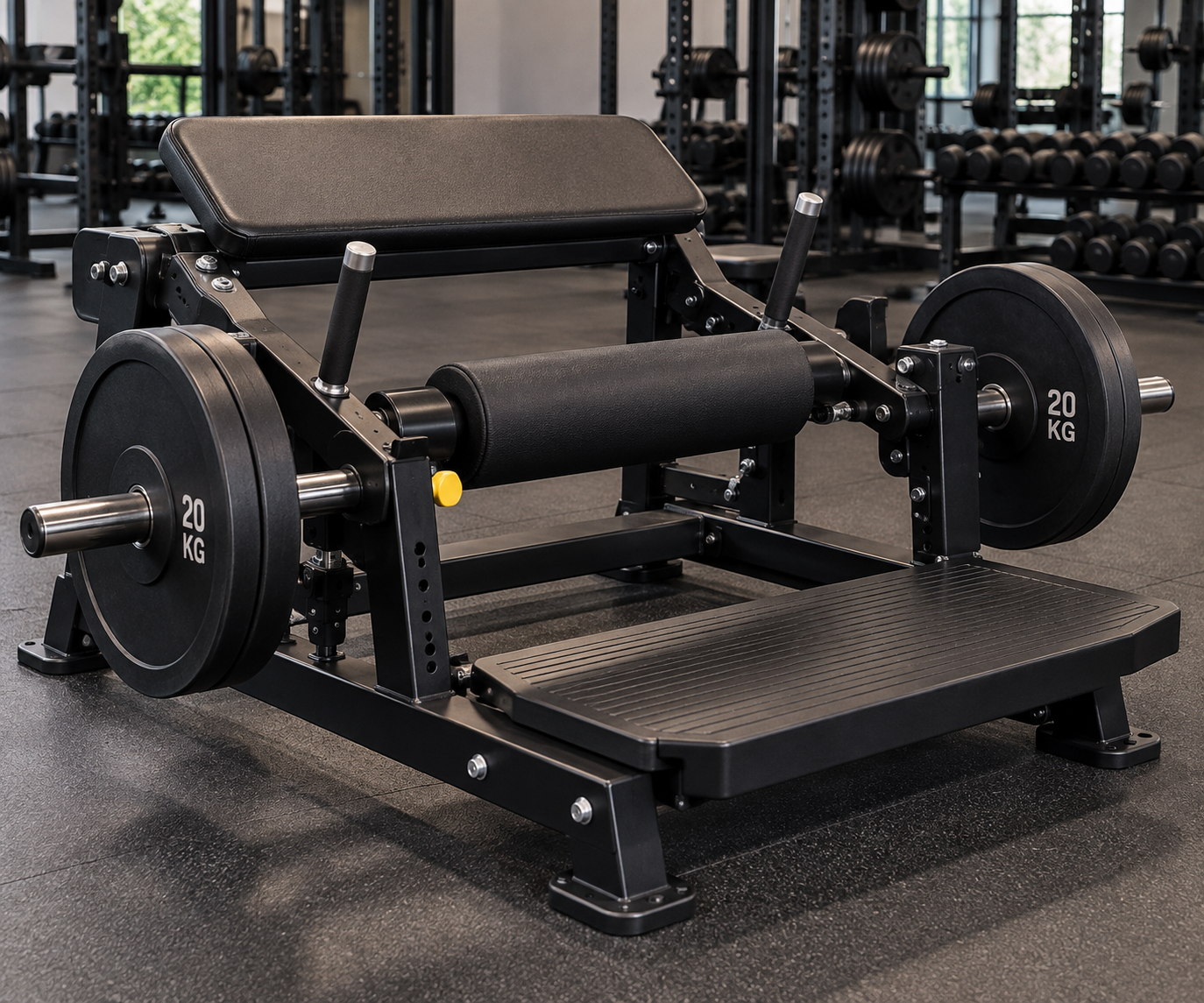
Adjustments of the hip thrust machine: how to set it up correctly
The adjustments of the hip thrust machine aim to adapt the machine to the user's characteristics, improving comfort, stability, and movement repeatability. Before each use, it is advisable to check the position of the supports, locking systems, and adjustments provided by the manufacturer, always following the equipment manual.
Each model can offer different configurations. Some machines allow you to adjust the backrest, footplate, starting position, and belt, while others feature fewer settings. For this reason, it is essential to know the specific characteristics of the installed model.
This guide describes the main criteria to use for correctly setting up a hip thrust machine, highlighting the most common errors and the aspects to check before starting the workout.
- Why are adjustments important?
- Which adjustments should be checked?
- How to make the adjustments
- How to adapt the machine to the user
- Errors to avoid
- Safety checks
- Summary table
- How to choose a machine with good adjustments
Why are the hip thrust machine adjustments important?
Adjustments allow the machine to be adapted to users with different anthropometric characteristics, making it easier to assume a stable position during the exercise.
Appropriate adjustment also facilitates training repeatability, especially in gyms where the same machine is used by different people throughout the day.
Before starting each set, it is advisable to check that all settings are correctly locked and comply with the manufacturer's instructions.
Why is ergonomics essential?
An ergonomic configuration allows the machine to be better adapted to the user's characteristics and helps improve comfort during the exercise.
Why always keep the same adjustments?
Whenever possible, using settings consistent with your characteristics facilitates training repeatability and makes it easier to compare different sessions.
Which adjustments must be checked?
The available adjustments depend on the machine's design, but generally include the starting position of the movement, locking systems, belt, supports, and, in some models, the backrest or footplate.
All adjustable elements must be securely fixable without abnormal play or unwanted movement.
Before use, it is also useful to check the ease of access to the adjustment systems and the presence of easily readable indicators.
How to check the backrest?
When adjustable, the backrest must be correctly locked and allow a stable position according to the manufacturer's instructions.
Does the footplate require adjustments?
In models that feature it, it is advisable to check the correct positioning and complete locking of the system before starting the exercise.
How to make the adjustments correctly?
Adjustments should be performed with the machine unloaded or following the procedure indicated in the manufacturer's manual.
Every modification must be completed by verifying that levers, pins, and locking systems are fully engaged.
After each adjustment, it is advisable to perform a visual check before applying the expected load for the workout.
What is the recommended sequence?
First, the main supports are adjusted, then any containment systems, and finally, all locking points are checked.
Is a final check needed?
Yes. A quick visual check allows you to confirm that all adjustments are correctly engaged before use.
How to adapt the machine to different users?
Differences in height and body proportions make it necessary to modify the adjustments from one user to another.
A machine with numerous adjustment possibilities can facilitate management in gyms with a very heterogeneous clientele.
To learn about the different solutions available, you can consult the isotonic machines category.
Do adjustments change for beginners?
Beginners can benefit from simple and easily identifiable adjustments, always following the manufacturer's instructions.
How to manage a machine used by many people?
It is good practice to check all settings before each use, even when the machine was used a few minutes earlier by another user.
Which errors to avoid?
One of the most frequent errors consists of using the machine without checking the adjustments set by the previous user.
It is also advisable to avoid adjustments made with components under load when the manufacturer does not allow it.
Neglecting the correct locking of adjustable systems can compromise the normal functioning of the machine.
Why avoid rushed adjustments?
An accurate check takes a few seconds and allows you to ascertain that all systems are correctly fixed.
Why always consult the manual?
Each model features specific characteristics and different procedures that must be respected during adjustments.
Which safety checks should be performed?
Before the workout, it is advisable to check the machine's stability, the correct functioning of the hip thrust machine adjustments, and the absence of worn components.
The loading system as well, whether it is free weight or weight stack, should be checked before use according to the manufacturer's instructions.
It is also advisable to check that the surrounding space and the flooring are suitable for the intended use.
What is the most important check?
Ensuring that all adjustment systems are fully locked represents one of the fundamental checks before starting the exercise.
What to do in the presence of anomalies?
If mechanical play, difficulty in adjustments, or damaged components are detected, it is advisable to stop use until a technical check is performed.
Compact adjustment table
| Element | Recommended check |
|---|---|
| Backrest | Position and locking |
| Belt | Adjustment and integrity |
| Footplate | Correct positioning |
| Pins | Complete insertion |
| Loading system | Correct configuration |
| Frame | General stability |
This table represents a useful operational reminder for preliminary checks and does not replace the procedures indicated in the official manufacturer documentation.
Adjustment methods can vary significantly between different models and must always be compared with the specific equipment manual.
Which sources to consult?
The installation, use, and maintenance manuals provided by the manufacturer constitute the main reference for knowing the adjustments, operating limits, and control methods of the machine.
Which criteria to evaluate before purchase?
Number of available adjustments, simplicity of locking systems, ergonomics, ease of use, and availability of spare parts represent useful elements to compare different models.
How to choose a hip thrust machine with effective adjustments?
A hip thrust machine should offer simple, easily identifiable, and stable adjustments during use. The ability to quickly adapt the machine to different users represents an advantage, especially in gyms with high training frequency.
Before purchasing, it is advisable to compare technical documentation, the number of available adjustments, accessibility of locking systems, ease of maintenance, and availability of spare parts. This approach allows the machine to be evaluated based on concrete and verifiable criteria rather than exclusively on commercial features.
FAQ
Do adjustments need to be checked before each use? Yes. It is good practice to check all settings before starting the workout, especially in shared gyms.
Does every model offer the same adjustments? No. Configurations depend on the manufacturer's design and can vary significantly.
Is it possible to modify adjustments with the machine under load? You must strictly follow the procedures reported in the manufacturer's manual.
What is the most important document? The installation, use, and maintenance manual represents the main reference for adjustments, checks, and the correct use of the machine.
Comments (0)