
Trolley
You have no items in your shopping cart

 Budgets
 Dumbers
 Discs
Discs
 Benches
 Racks and Rigs
 Weights Holders
 Isotonic machines
 Calisthenics
 Cardio
 Kettlebells
 Flooring
 Gym Set
 Accessories
 Combat
 ARTI MARZIALI
 CONTAINER GYM
 Tug-Of-War
 Used Gym Equipment
 PILATES MACCHINARI
 GINNASTICA ARTISTICA
 CAMPI DA PADEL
 Prodotti in Pronta Consegna
 Informazioni
 IRONMAN
 Gift Card
- Donatif
- General information
- 0 I like it
- 321 Views
- 0 comments
- gym flooring, safety flooring, gym safety, shock-absorbing materials
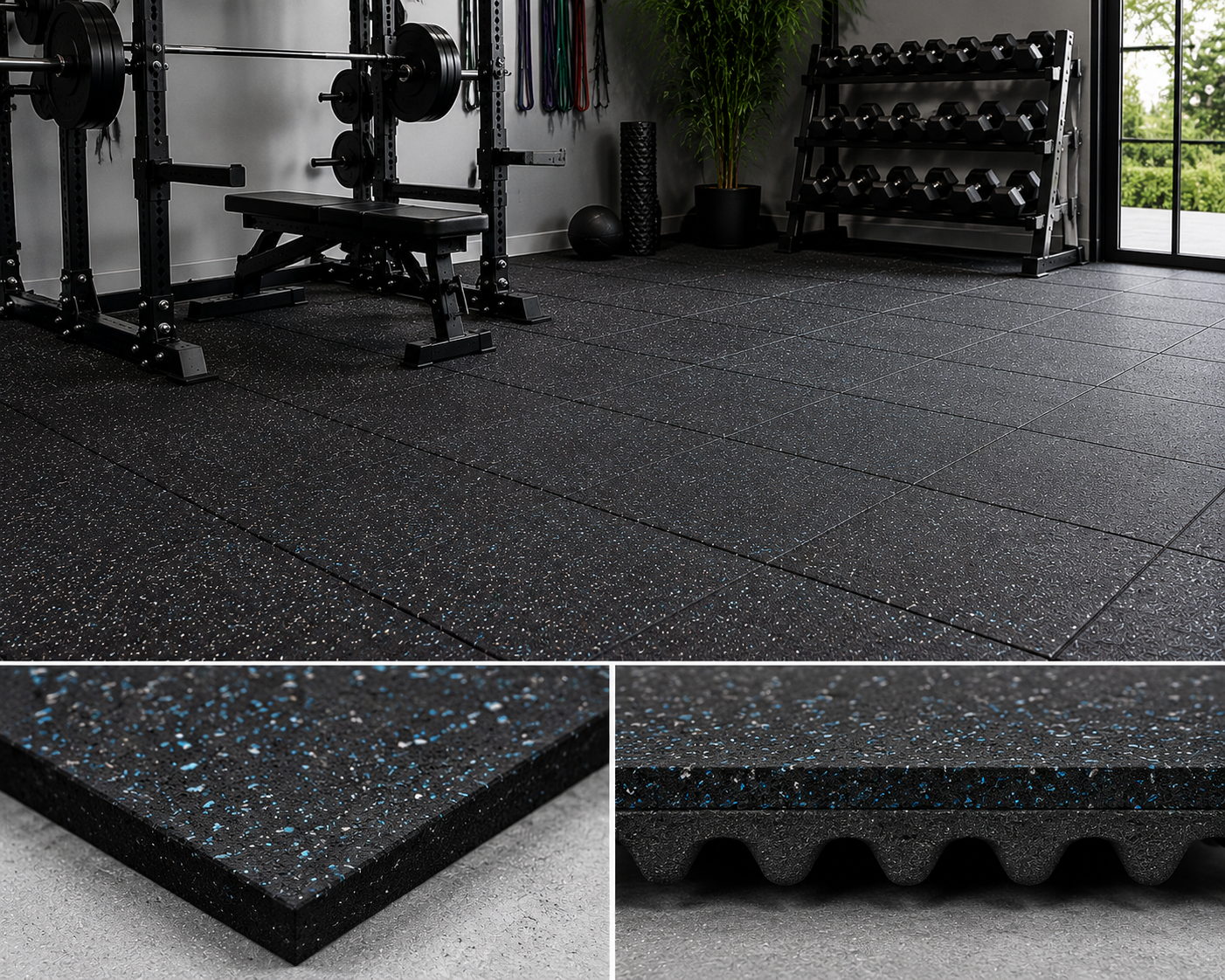
Anti-Shock Flooring for Cross Training: Thickness and Density
When building a home gym or a box dedicated to Cross Training, one of the most common mistakes is underestimating the importance of flooring. Many athletes choose a simple rubber mat thinking it is sufficient for any type of workout, only to find cracks in the screed, damaged tiles, or a deformed floor after a few months of use. In reality, choosing the correct gym anti-shock flooring thickness is one of the most important investments to protect both the building structure and the equipment used.
Weightlifting, Powerlifting, and Cross Training generate very high impacts, especially during the controlled or accidental release of the barbell. The force developed during a drop can exceed the static weight of the load many times over, transferring an enormous amount of energy to the floor. For this reason, rubber thickness, material density, and construction quality become determining factors.
In this guide, we analyze in detail when to choose a 20 mm thickness, when to move up to 30 mm, and in which situations it is advisable to install 40 mm flooring, highlighting advantages, limitations, and selection criteria for creating a truly safe and durable home gym.
- Why thickness is fundamental
- When to choose 20 mm
- When to move up to 30 mm
- When 40 mm is needed
- The role of rubber density
- Most common mistakes
- Installation and screed protection
- How to choose the best flooring
Why thickness is fundamental
Flooring thickness does not only affect comfort during training, but above all, it determines the material's ability to absorb the energy generated by impacts. When a barbell falls to the ground, even if equipped with bumper plates, the force transmitted to the floor is considerable and can damage the screed, the underlying coating, or cause vibrations that propagate throughout the entire building.
Flooring that is too thin tends to compress rapidly until it transfers almost the entire load to the underlying structure. Conversely, an adequate thickness distributes forces better and significantly reduces the risk of permanent damage.
For this reason, the choice should never be based exclusively on price or aesthetics, but on the type of training actually performed and the loads habitually used.
The energy developed during a drop
When a barbell is dropped from a height of a few centimeters after a deadlift or a clean, the kinetic energy developed is much higher than the simple static weight. This phenomenon explains why apparently robust flooring can deteriorate rapidly if it is not designed to withstand repeated impacts.
Protecting the garage and the screed
Those building a gym in a garage or basement must consider that repairing a damaged screed can be much more expensive than the initial purchase of adequate flooring. Investing in the right solution means avoiding demolition and restoration work in the future.
When to choose 20 mm flooring
The 20 mm thickness represents a valid solution for home gyms dedicated primarily to functional training, cardio, bodyweight exercises, and moderate weight usage.
It may also be sufficient for exercises with relatively light dumbbells and barbells, provided that frequent drops or Olympic lifts with heavy loads are not performed.
For those who use their home gym occasionally, this thickness offers a good compromise between protection, cost, and ease of installation.
The advantages of 20 mm
20 mm flooring is generally cheaper, easier to move, and suitable for multifunctional environments where high-impact disciplines are not practiced.
When it is not enough
If workouts include Weightlifting or intense Cross Training, 20 mm might be insufficient to correctly absorb the shocks produced by the barbell.
Why many choose 30 mm
30mm crossfit tiles currently represent one of the most popular solutions among functional training enthusiasts and home boxes.
This thickness offers an excellent balance between absorption capacity, stability, and durability, making it suitable for most sessions with barbells and bumper plates.
For many athletes, it represents the ideal choice because it allows for intense training while significantly reducing the risk of damaging the subfloor.
Perfect for Cross Training
Workouts that include cleans, snatches, deadlifts, and thrusters find in 30 mm a solution capable of combining safety and comfort without compromising stability during lifts.
Greater durability
The greater thickness helps slow down surface wear and improves resistance to repeated impacts over the years.
When it is advisable to install 40 mm
For those who practice competitive Weightlifting, use very heavy loads, or frequently drop the barbell, 40 mm flooring is often the most recommended choice.
The additional thickness significantly improves shock absorption, limits the propagation of vibrations, and protects the screed even during particularly intense workouts.
It is also a recommended solution when the gym is located on upper floors or in environments where it is important to reduce noise transmission.
Ideal for the garage
In private garages, where the screed is often directly connected to the building structure, 40 mm provides particularly effective additional protection.
Professional training
Athletes who work regularly with heavy loads can benefit from a surface designed to withstand even the most demanding usage conditions over time.
The role of rubber density
Thickness alone is not enough to determine the quality of the flooring. The density of the material also deeply affects performance.
Rubber that is too soft tends to deform rapidly, while rubber that is excessively rigid transfers a significant part of the shock to the floor below.
For this reason, it is important to choose weightlifting rubber specifically designed for professional sports applications.
High density
Higher density improves stability, wear resistance, and long-term durability without compromising impact absorption.
Why quality matters
Products made with selected recycled materials and controlled production processes guarantee more consistent performance compared to cheap solutions.
Mistakes to avoid
Many users buy generic mats intended for yoga or light fitness, thinking they can also be used for weightlifting.
Others choose exclusively based on price, without considering the density, certifications, and intended use of the material.
These decisions can quickly lead to the appearance of deformations, cuts, and permanent damage to the underlying floor.
Looking only at the cost
Saving money today can mean facing expensive repairs tomorrow, especially when the screed suffers structural damage.
Neglecting installation
Proper installation ensures stability, prevents tile movement, and significantly extends the life of the flooring.
Installation and screed protection
A perfectly leveled surface is the starting point for achieving optimal performance. Any unevenness can compromise load distribution and increase rubber wear.
In the presence of very intense workouts, it is possible to create dedicated platforms by combining different thicknesses in impact zones and athlete support areas.
Careful planning improves the overall safety of the gym and extends the life of both the flooring and the building structure.
Olympic platforms
Dedicated platforms allow for concentrating maximum protection in areas subjected to the greatest loads.
Cleaning and maintenance
Regular maintenance keeps surface performance high and helps preserve its appearance over time.
How to choose the best flooring
The choice of ideal flooring depends on the intensity of the workout, the weight of the barbells used, the frequency of sessions, and the characteristics of the environment in which it will be installed.
Relying on specialized suppliers allows you to identify the most suitable solution, avoiding inadequate or oversized purchases. A professional proposal like gym anti-shock flooring thickness allows you to choose materials specifically designed for fitness and Weightlifting.
Protecting your home floor means preserving the value of the property, training safely, and being able to tackle even the most intense sessions with the peace of mind of using a surface designed to last over time. Correctly evaluating thickness, density, construction quality, and installation methods is therefore the smartest decision for any home gym dedicated to Cross Training.
Comments (0)