
Trolley
You have no items in your shopping cart

 Budgets
 Dumbers
 Discs
Discs
 Benches
 Racks and Rigs
 Weights Holders
 Isotonic machines
 Calisthenics
 Cardio
 Kettlebells
 Flooring
 Gym Set
 Accessories
 Combat
 ARTI MARZIALI
 CONTAINER GYM
 Tug-Of-War
 Used Gym Equipment
 PILATES MACCHINARI
 GINNASTICA ARTISTICA
 CAMPI DA PADEL
 Prodotti in Pronta Consegna
 Informazioni
 IRONMAN
 Gift Card
- Donatif
- General information
- 0 I like it
- 10 Views
- 0 comments
- gym flooring, safety flooring, gym safety, shock-absorbing materials
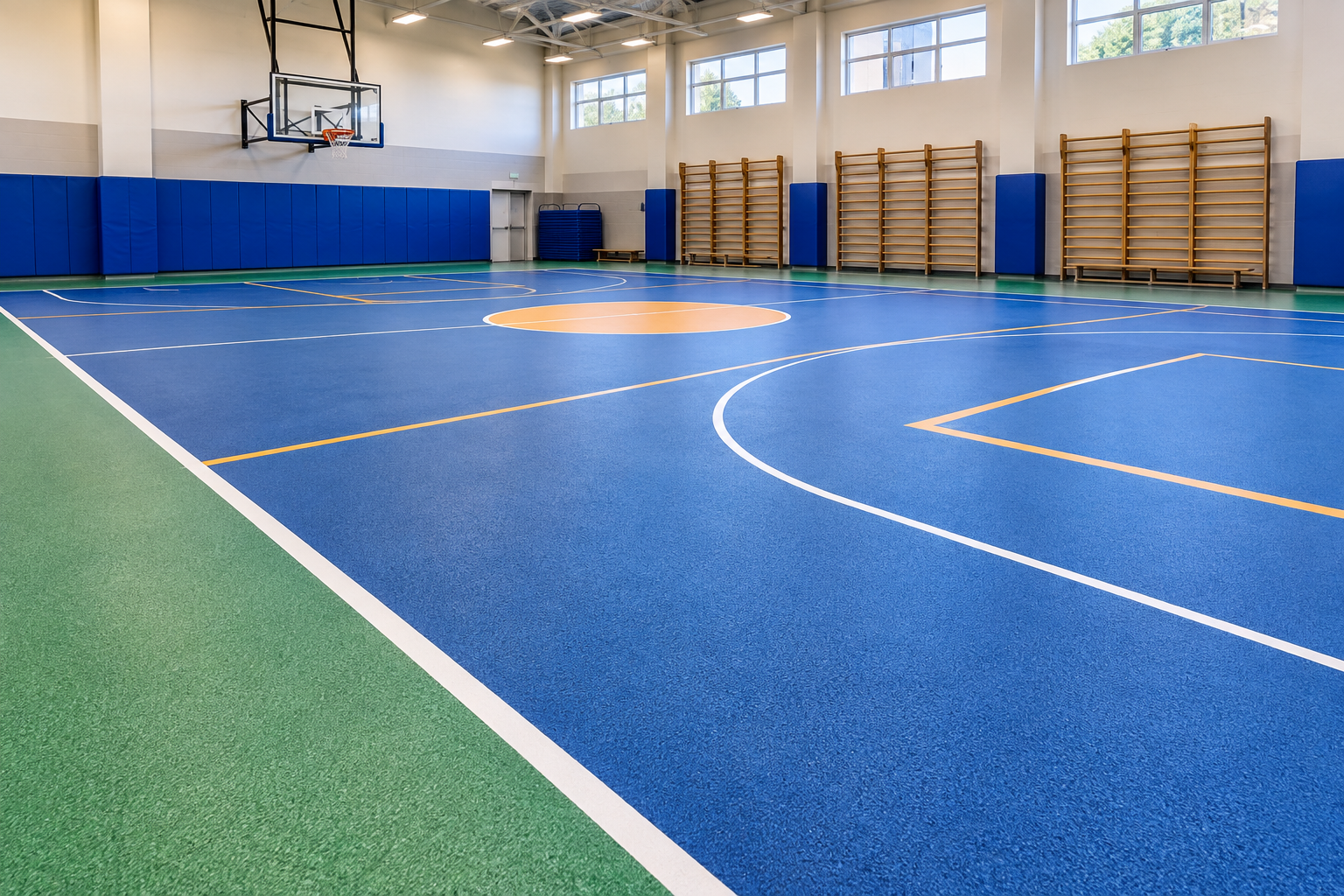
Anti-shock flooring for schools: selection criteria and configuration
Anti-shock flooring represents one of the most important elements in the design of school spaces dedicated to motor activities. School gymnasiums, multipurpose areas, and spaces intended for recreational activities require surfaces capable of guaranteeing safety, comfort, and durability over time, maintaining consistent performance even with intensive use.
The choice of material should not be based solely on cost or aesthetic appearance. Instead, it is necessary to evaluate verifiable technical criteria such as thickness, density, format, intended use, ease of maintenance, and the ability to attenuate noise and vibrations. In fact, every school environment presents different needs that require a specific configuration.
Proper planning also makes it possible to simplify maintenance, increase the durability of the surface, and offer a safer environment for students and staff. The selection of the flooring must therefore be an integral part of the overall design of the space.
- Quick answer
- How to choose anti-shock flooring
- What thickness to choose
- Rolls or tiles
- Configuration of school spaces
- Noise reduction
- Installation and maintenance
- Design errors to avoid
- Evaluating the investment
What criteria allow you to choose anti-shock flooring for a school?
The choice of anti-shock flooring should start from the intended use of the space, the type of activities planned, and the mechanical loads that the surface will have to bear. In fact, very different environments coexist within a school, ranging from gymnasiums dedicated to physical education to areas used for light motor activities.
The main criteria include impact safety, surface stability, wear resistance, ease of cleaning, and compatibility with the existing subfloor. When applicable, reference technical standards and the manufacturer's installation instructions must also be considered.
Effective planning also evaluates the life cycle of the flooring, considering not only the initial cost but also maintenance, future replacements, and the continuity of use of the spaces.
Which aspects to verify before purchase
Before making a choice, it is advisable to define the number of users, the type of sporting activities, the frequency of use, and the potential presence of heavy equipment.
What technical references to consider
Depending on the project, European technical standards such as the EN 14904 series for indoor sports surfaces and standards relating to impact absorption or playground flooring when relevant may be applicable to sports environments. Verification must always be carried out using the manufacturer's documentation.
How to choose anti-shock flooring for a school gymnasium?
The choice depends mainly on the intended use. A school gymnasium intended exclusively for light motor activities has different needs compared to a multipurpose space that hosts workouts with small equipment.
Among the available materials, the rubber floor represents one of the most widespread solutions thanks to its wear resistance, ease of maintenance, and the availability of numerous thicknesses.
For those wishing to learn more about the available solutions, it is useful to consult the section dedicated to anti-shock flooring, where the main types of surfaces used in sports facilities are gathered.
The intended use influences the choice
Gymnastic activities, functional exercises, group classes, and the use of small equipment require different configurations in terms of thickness and density.
Durativity and resistance
A surface intended for school environments should maintain constant performance even in the presence of high daily traffic and frequent cleaning operations.
What thickness should the gym floor have?
There is no universal thickness valid for every school. The correct value depends on the activities performed, the type of subfloor, and the presence of equipment.
In general, environments intended exclusively for light motor activities may require different characteristics compared to rooms where weights or sports equipment are moved. The thickness must therefore be defined within the technical project.
The flooring manufacturer normally provides precise indications on the recommended applications and the limits of use of the different models.
Why density also matters
Thickness alone does not determine the performance of the flooring. The density of the material also influences the ability to absorb shocks and maintain stability over time.
Importance of the subfloor
A regular and stable subfloor allows the flooring to work correctly and contributes to the durability of the entire system.
Is rubber roll flooring or tiles better?
Both solutions have specific advantages. Rolls generally allow for a more continuous surface and reduce the number of visible joints.
Tiles, on the other hand, are particularly practical when it is necessary to replace single damaged areas or to install the flooring in already existing environments with limited interventions.
The final decision depends on the size of the space, the available budget, and the methods of use of the school gymnasium.
When to choose rolls
Rolls are indicated for large, continuous surfaces where you want to reduce the number of joints.
When to prefer tiles
Tiles facilitate localized interventions and allow greater flexibility in future configuration modifications.
How to correctly configure school spaces?
Effective planning distinguishes the various functional areas based on the activities performed. Zones dedicated to gymnastics, motor pathways, and multipurpose spaces can require different surfaces.
The layout of the equipment should maintain adequate passage routes and facilitate the supervision of students during activities.
The accessories present in the space must also be considered in the design to avoid concentrated wear and correctly distribute loads.
Layout organization
The arrangement of spaces should favor safety, accessibility, and simplicity of use during school activities.
Multipurpose spaces
Many schools use the same gymnasium for different disciplines. A flexible configuration makes it possible to quickly adapt the environments.
Does anti-shock flooring reduce noise?
One of the most appreciated characteristics concerns the ability to attenuate part of the impact noise and vibrations generated during physical activity.
However, the effectiveness depends on the combination of material, thickness, density, and subfloor characteristics. There is no single value valid for all installations.
When noise control is a design requirement, it is advisable to request technical documentation regarding the acoustic performance of the installed system from the manufacturer.
Benefits for the school
Better acoustic comfort helps make the use of spaces more pleasant and limits the propagation of noise in adjacent environments.
What to really expect
Flooring can contribute to noise reduction but does not replace any acoustic treatment interventions on the building.
How to install and maintain the gym floor?
Installation must strictly follow the manufacturer's instructions and provide a properly prepared, dry, and regular subfloor.
Routine maintenance includes periodic cleaning with compatible products and visual checks of the joints and most stressed areas.
Correct maintenance makes it possible to preserve the characteristics of the surface and reduce the probability of extraordinary interventions.
Correct installation
Each flooring system provides specific installation methods that must be respected to obtain the declared performance.
Routine cleaning
It is advisable to use detergents compatible with the material, avoiding products that could alter its surface characteristics.
What design errors are best avoided?
One of the most frequent errors consists in choosing flooring exclusively on the basis of thickness without considering density, intended use, and material quality.
Another critical issue concerns the failure to check the subfloor before installation, a situation that can compromise the durability of the entire system.
Neglecting future maintenance needs or the possibility of replacing individual portions of the surface can also increase costs in the long run.
Inadequate material
The choice between rubber and EVA should be made by evaluating the actual intended use and the characteristics required by the project.
Lack of planning
Incomplete design can make the management of school spaces more complex in subsequent years.
How to evaluate the investment in the long term?
The choice of flooring should not be considered exclusively as an initial expense item, but as an investment destined to influence safety, maintenance, and the continuity of use of the environments.
Comparing materials, technical documentation, warranties offered by the manufacturer, and the ease of replacing individual parts allows for more conscious decisions.
A well-dimensioned project helps reduce extraordinary maintenance interventions, improve the management of school spaces, and keep the performance of the surface high over time.
Comments (0)