
Trolley
You have no items in your shopping cart

 Budgets
 Dumbers
 Discs
Discs
 Benches
 Racks and Rigs
 Weights Holders
 Isotonic machines
 Calisthenics
 Cardio
 Kettlebells
 Flooring
 Gym Set
 Accessories
 Combat
 ARTI MARZIALI
 CONTAINER GYM
 Tug-Of-War
 Used Gym Equipment
 PILATES MACCHINARI
 GINNASTICA ARTISTICA
 CAMPI DA PADEL
 Prodotti in Pronta Consegna
 Informazioni
 IRONMAN
 Gift Card
- Donatif
- General information
- 0 I like it
- 651 Views
- 0 comments
- gym flooring, safety flooring, gym safety, shock-absorbing materials
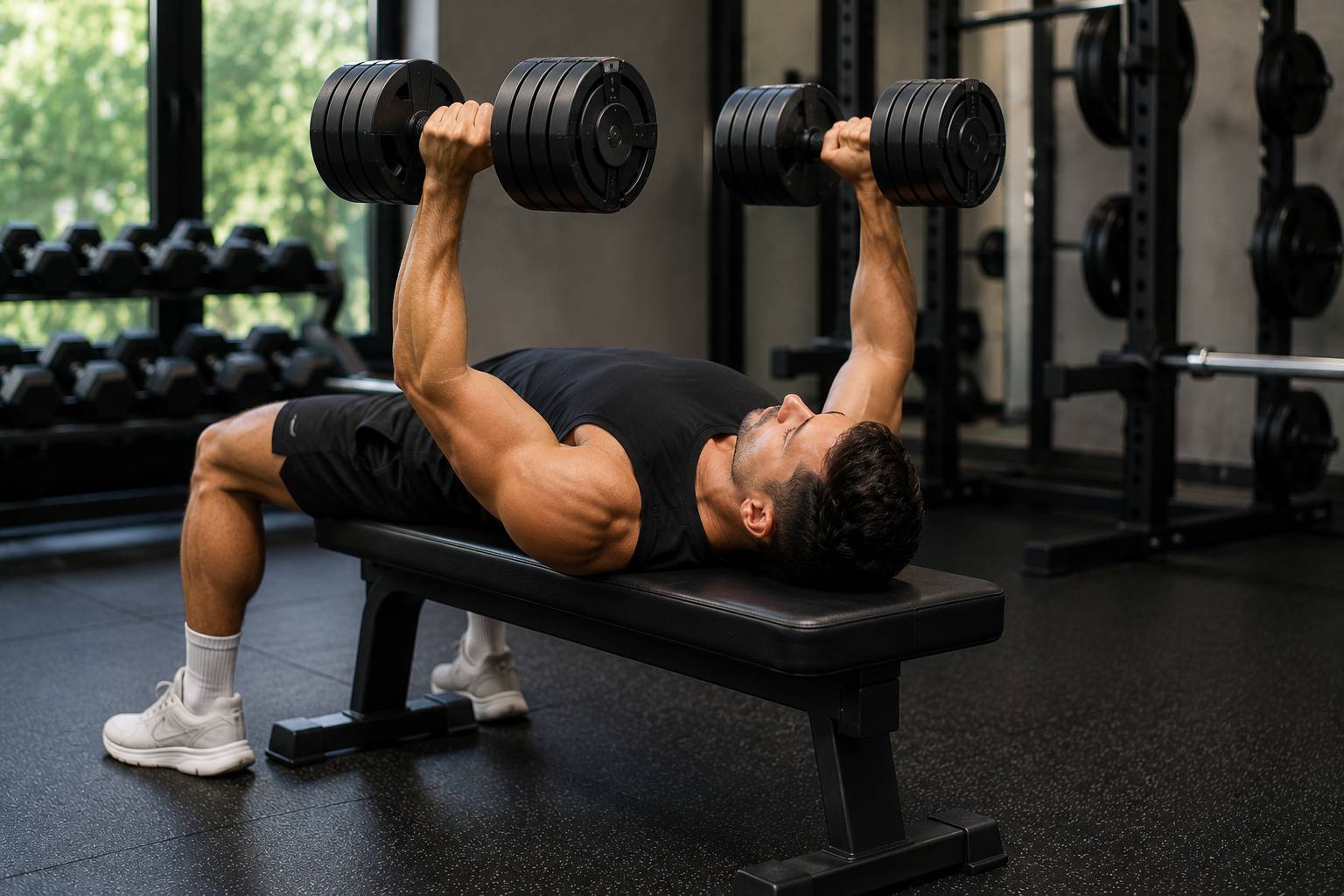
Flat bench press with dumbbells vs. barbell: which one to choose for the chest
The flat bench press is one of the most well-known and used exercises for developing the chest, but the choice of tool used to perform it can profoundly change the training experience. The comparison between dumbbell flat bench press and barbell does not only concern the amount of weight lifted, but involves technical aspects such as freedom of movement, joint stability, muscle activation, and the ability to adapt the exercise to one's physical structure.
For many bodybuilding enthusiasts, the barbell represents the symbol of strength in the flat bench press thanks to the possibility of using heavy loads and easily measuring progress. However, dumbbells offer different characteristics that can be particularly advantageous for those seeking greater control of movement and more balanced muscle development.
Understanding the difference between these two variations allows you to choose the tool best suited to your personal goals. There is not necessarily one superior solution in absolute terms: the value of each method depends on the technique used, the athlete's physical build, and how the exercise is incorporated into the training program.
- Differences between flat bench press with dumbbells and barbell
- Advantages of the flat bench press with dumbbells
- Range of motion and movement control
- Muscle activation and pectoral hypertrophy
- Stability and safety in execution
- When to prefer the barbell
- How to integrate dumbbells and barbell into the program
- Choosing the variant best suited to your goal
Differences between flat bench press with dumbbells and barbell
The main difference between the dumbbell bench press and the barbell bench press concerns the way the body manages the load. With the barbell, the two hands are connected by a single bar, creating a more stable system that generally allows for heavier weights to be used. With dumbbells, however, each arm must independently control its own load.
This characteristic changes the type of stimulus received by the muscles. The barbell allows for greater absolute force production, while dumbbells require more coordination and stabilization capacity.
The choice between the two variations should therefore consider the main goal of the training: increasing the maximum load, improving muscle symmetry, or obtaining greater control of movement.
Dumbbell vs. barbell difference in load management
With the barbell, the total load can be higher because the movement is more stable and allows force to be distributed through a single structure. This makes the exercise very interesting for those who want to focus on strength progression.
With dumbbells, the weight used is generally lower, but the demand for control increases because each side must work independently.
Freedom of movement and individual adaptation
Dumbbells allow for greater freedom in hand position and elbow trajectory. This allows the movement to be adapted to the individual characteristics of the athlete.
This possibility can be particularly useful for those who have anatomical differences, specific mobility needs, or prefer a more natural feeling during the push.
Advantages of the flat bench press with dumbbells
The flat bench press with dumbbells offers several advantages for pectoral development. The first concerns the independent work of the two sides of the body, which helps reduce any compensations and improve muscle balance.
When using a barbell, the stronger side can contribute more to the push without the athlete noticing. With dumbbells, this possibility decreases because each arm must complete its own movement.
This makes the variation particularly interesting for those who focus on technical detail and want to build a more harmonious physique.
Better muscle symmetry
Working with two separate loads helps identify any differences between the right and left sides. In the long run, this can promote more balanced development of the pectorals.
Symmetry is not just about aesthetics, but also about the quality of movement and the ability to produce force uniformly.
Greater involvement of stabilizers
Dumbbells require greater participation from the muscles that control the position of the shoulder and arm. The body must stabilize two independent weights throughout the entire repetition.
This increases the technical complexity of the exercise and improves general control of the movement.
Range of motion and movement control
One of the most important aspects in the comparison between dumbbells and barbell concerns the range of motion, i.e., the amplitude of the movement. Dumbbells generally allow for a deeper descent because there is no bar limiting the final position of the hands.
A greater ROM can increase the mechanical stimulus on the muscle, especially in the stretching phase of the pectoral. However, it must always be managed in relation to the mobility and stability of the joint.
The goal is not simply to go down as much as possible, but to use a complete and controlled movement.
Pectoral stretching under load
During the negative phase of the dumbbell bench press, the pectoral is brought into a position of greater stretch compared to the barbell variant. This characteristic can help create an effective stimulus for hypertrophy.
Controlling the descent therefore becomes a fundamental element to exploit this advantage.
Importance of technique in deep ROM
A greater range of motion requires good management of the position of the shoulders and shoulder blades. Going down too far without control can increase joint stress instead of improving the effectiveness of the exercise.
The quality of movement must always precede the search for maximum amplitude.
Muscle activation and pectoral hypertrophy
The main goal of many athletes during the bench press is to increase chest muscle mass. Hypertrophy depends on several factors, including mechanical tension, volume of work, and the ability to correctly stimulate the muscle.
Dumbbells can be a very effective tool because they allow you to focus more on the contraction and the natural trajectory of the movement.
Muscle growth does not depend exclusively on the maximum load, but on the quality of the stimulus produced.
Pectoral hypertrophy with dumbbells and muscle tension
Pectoral hypertrophy with dumbbells can be favored by controlled execution that keeps tension high throughout the entire repetition. The ability to slightly modify angles and trajectories allows you to find an effective position for your own body.
This makes dumbbells a versatile tool within programs oriented toward muscle growth.
Mind-muscle connection and quality of contraction
The ability to perceive the work of the pectoral is important to prevent other muscles, such as the anterior deltoids and triceps, from taking on an excessive role.
A controlled movement improves the quality of the contraction and makes the exercise more effective.
Stability and safety in execution
Stability represents one of the most discussed elements in the comparison between dumbbells and barbell. The barbell offers a more stable structure, while dumbbells require a greater capacity for control.
This difference does not automatically mean that one variant is safer than the other. Safety depends above all on technique, the choice of load, and the athlete's ability to manage the movement.
Correct execution allows you to take advantage of the benefits of both solutions.
Shoulder control and scapular position
During the dumbbell bench press, it is important to maintain good stability of the shoulder blades and a controlled position of the shoulder. This allows you to create a solid base for the push.
Correct technique reduces unwanted movements and improves the efficiency of the exercise.
Choosing the appropriate load
Using an excessive weight can compromise control of the movement and reduce the benefits of the exercise. An appropriate load allows you to maintain a precise trajectory.
Progression must be gradual and based on the quality of the repetitions.
When to prefer the barbell
Despite the numerous advantages of dumbbells, the barbell remains an extremely valid tool for strength development. Greater stability often allows for the use of heavier loads and easy measurement of progress.
For athletes interested primarily in maximal pushing performance, the barbell can be a strategic choice.
The decision must be based on the main goal of the training.
Advantages of progression with a barbell
The barbell allows for load increments that are easier to monitor. This makes it very useful in programs oriented toward pure strength.
The stability of the movement allows you to focus on force production without having to manage two independent trajectories.
Combined use with dumbbells
Many effective programs use both tools. The barbell can be used to build strength, while dumbbells can complete the work by improving control and symmetry.
Integrating both variants allows you to exploit different characteristics.
How to integrate dumbbells and barbell into the program
A complete chest program can benefit from the combined use of multiple tools. The choice should not be seen as a competition between dumbbells and barbell, but as an opportunity to use the most suitable method in each phase.
The variety of stimuli helps keep training quality high and allows for addressing different needs.
Programming must always start from the athlete's goals.
Alternating strength and hypertrophy
The barbell can be useful in phases dedicated to strength, while dumbbells can be advantageous in periods where you are looking for greater control and volume of work.
This combination allows for a more complete approach.
Adapting the exercise to your build
Every athlete has different anatomical characteristics. Limb length, mobility, and shoulder structure influence how an exercise is perceived.
Choosing the variant best suited to your build can improve comfort and effectiveness.
Choosing the variant best suited to your goal
The comparison between flat bench press with dumbbells and barbell shows that both solutions can be effective tools for developing the chest. The barbell offers advantages in managing heavy loads and strength progression, while dumbbells allow for greater freedom of movement, control, and the ability to work on symmetry.
The best choice therefore depends on the individual goal, technique, and the physical characteristics of the athlete. An intelligent program does not necessarily seek to eliminate one tool, but uses each piece of equipment to leverage its strengths.
Choosing versatile tools like adjustable dumbbells allows you to create a complete and adaptable gym, capable of supporting both strength development and hypertrophy improvement over time.
Comments (0)