
Trolley
You have no items in your shopping cart

 Budgets
 Dumbers
 Discs
Discs
 Benches
 Racks and Rigs
 Weights Holders
 Isotonic machines
 Calisthenics
 Cardio
 Kettlebells
 Flooring
 Gym Set
 Accessories
 Combat
 ARTI MARZIALI
 CONTAINER GYM
 Tug-Of-War
 Used Gym Equipment
 PILATES MACCHINARI
 GINNASTICA ARTISTICA
 CAMPI DA PADEL
 Prodotti in Pronta Consegna
 Informazioni
 IRONMAN
 Gift Card
- Donatif
- General information
- 0 I like it
- 8 Views
- 0 comments
- gym flooring, safety flooring, gym safety, shock-absorbing materials
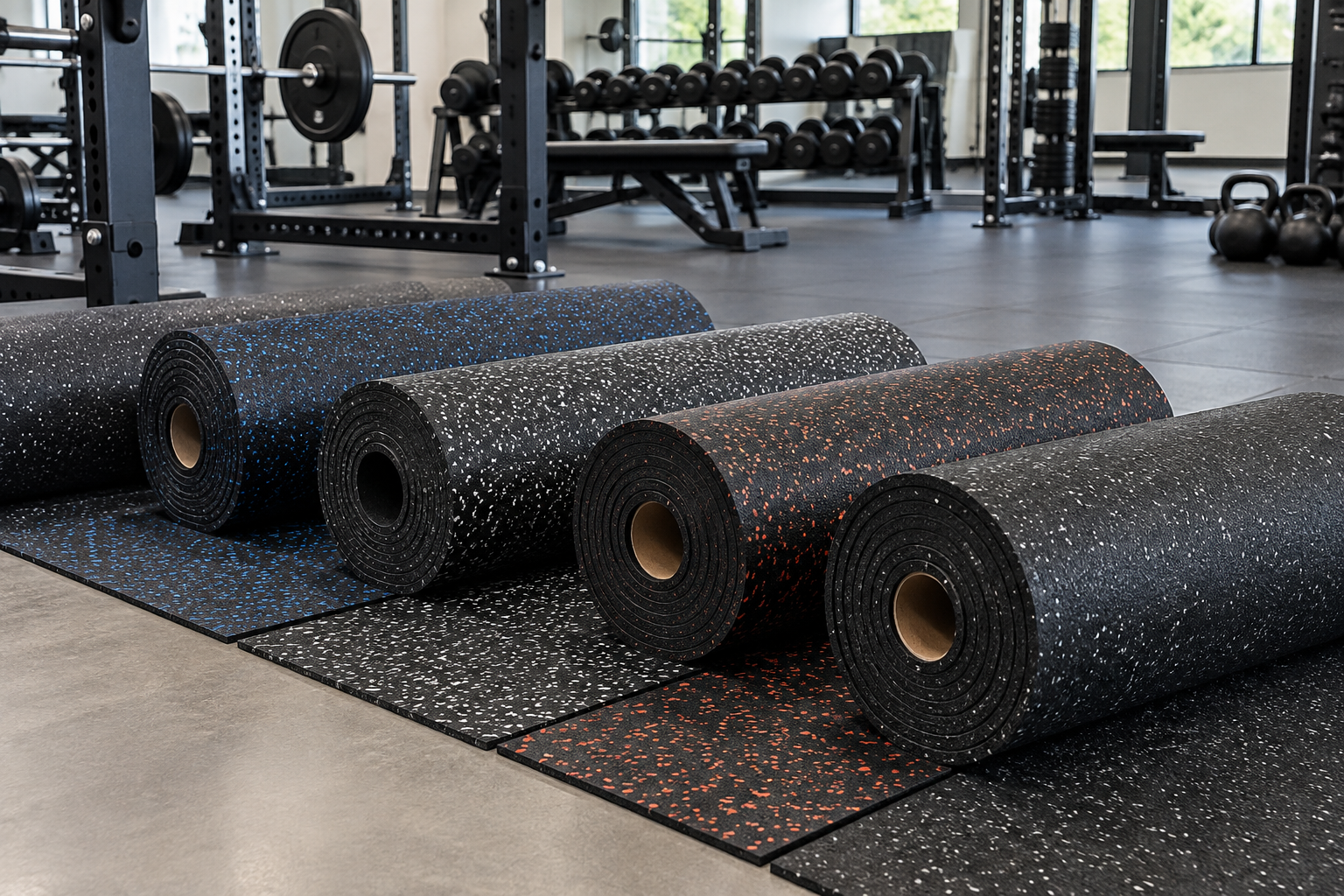
Tiles vs rolls: which safety flooring to choose?
The choice between safety flooring in tiles or in rolls is one of the most frequent decisions when designing a gym, a fitness room, or an area dedicated to functional training. Both solutions can offer high performance, but they present different characteristics in terms of installation, maintenance, modularity, and management over time.
There is no single best solution. The correct choice depends on the intended use, the type of activities performed, the size of the space, the presence of heavy equipment, and the project's objectives. Evaluating solely the initial price risks leading to inefficient decisions in the long run.
This guide analyzes the main technical criteria that allow for an objective comparison between rolls and tiles, providing useful operational indications to choose the most suitable configuration without oversizing or undersizing the flooring.
- Quick answer
- What are the main differences
- How to choose
- When to choose rolls
- When to choose tiles
- Thickness and density
- Noise and comfort
- Mistakes to avoid
- Evaluating the investment
Tiles or rolls: which solution to choose?
Safety flooring in rolls is generally indicated for large and continuous surfaces, whereas tiles are particularly suitable when modularity, localized replacements, or progressive installations are required. The choice must consider use, format, thickness, density, maintenance, and subfloor characteristics.
Both solutions can meet the needs of a professional gym if correctly sized and installed according to the manufacturer's instructions.
For sports facilities, it is also advisable to verify, where applicable, the reference technical standards such as the EN 14904 series for indoor sports surfaces and the performance documentation provided by the manufacturer.
Use is the first criterion
Before comparing materials and costs, it is necessary to define the type of activities performed, the number of users, and the presence of equipment that generates concentrated loads.
Design comes before material
Properly designed flooring guarantees better results compared to simply choosing the format without an analysis of the space.
What are the main differences between tiles and rolls?
The most evident difference concerns the format. Rolls allow large surfaces to be covered with a reduced number of joints, whereas tiles consist of modular elements that are easily replaceable.
Rolls generally require more careful installation but yield a uniform aesthetic effect. Tiles, on the other hand, facilitate any future modifications to the environment.
Both solutions are available in different thicknesses and densities, making the format only one of the criteria for choice.
Surface continuity
Rolls allow for a continuous surface that is particularly appreciated in large environments.
Tile flexibility
The modular structure allows for the rapid replacement of single portions without intervening on the entire flooring.
How to choose the most suitable solution?
The choice should be made by simultaneously considering space dimensions, intended use, frequency of use, ease of maintenance, and prospects for future expansion.
Gym managers should also evaluate downtime costs in the event of maintenance work and the possibility of quickly replacing any worn areas.
To learn more about the different available types, you can consult the section dedicated to safety flooring, useful for comparing the main solutions intended for sports facilities.
Environment size
Very large surfaces can benefit from the continuity offered by rolls, whereas articulated spaces may be simpler to cover using modular elements.
Future maintenance
The ease with which flooring can be serviced represents a factor often underestimated during the purchasing phase.
In which situations is it better to choose rolls?
Rolls are particularly indicated when you want to achieve a continuous surface with a limited number of visible joints.
They are frequently used in fitness rooms, cardio areas, and environments where aesthetic uniformity constitutes an important requirement.
Installation normally requires careful preparation of the subfloor so that the surface maintains stability and durability over time.
Main advantages
Greater surface continuity, uniform appearance, and a reduction in the number of joints represent the main strengths.
Aspects to evaluate
Localized interventions may require more extensive work compared to modular surfaces.
When are tiles preferable?
Tiles are a particularly appreciated solution in areas where localized wear can occur or when the layout of the gym changes frequently.
Modularity allows damaged elements to be quickly replaced, limiting the intervention to only the affected areas.
This characteristic can also prove advantageous in progressive installations or future expansions.
Ease of replacement
The replacement of individual modules allows for reduced maintenance times and costs.
Space adaptability
Modular configurations facilitate layout modifications without completely re-doing the flooring.
How much do thickness and density matter?
Thickness represents only one of the parameters to consider. The density of the material also influences the behavior of the surface under load.
Thicker flooring is not automatically better if the density is not adequate for the intended use.
The choice must therefore be made by simultaneously considering thickness, density, type of activity, and subfloor characteristics.
Thickness depends on the activity
Weight rooms, functional areas, and spaces dedicated to gymnastics may require different configurations.
Density influences durability
Materials with adequate characteristics help maintain constant performance throughout the flooring's life cycle.
Which solution offers better acoustic comfort?
Both rolls and tiles can contribute to the reduction of impact noise and vibrations, but performance depends on the entire construction system.
Acoustic behavior varies in fact as a function of thickness, density, material, and the existing subfloor.
For objective comparisons, it is advisable to refer to the data declared by the manufacturer and available laboratory tests.
Noise reduction
Proper design can improve comfort during sports activities and limit the propagation of vibrations.
Documented performance
Evaluations should be based on technical documentation and not exclusively on subjective impressions.
What mistakes are best avoided?
One of the most common mistakes consists in choosing exclusively based on format while neglecting density, use, and subfloor quality.
Another critical issue concerns the failure to plan future maintenance, which can significantly affect overall costs.
It is also advisable to avoid comparisons based solely on the initial price without considering durability, operational continuity, and replacement costs.
Looking only at the initial cost
Price represents only one of the elements that contribute to the overall management cost.
Neglecting installation
Even the best material can offer inferior performance if installed on an unsuitable subfloor.
How to evaluate long-term investment?
The choice between rolls and tiles should be made considering the entire life cycle of the flooring, including maintenance, any replacements, and the operational continuity of the facility.
Analyzing technical documentation, manufacturer warranties, installation methods, and the availability of spare parts allows for the comparison of different solutions with objective criteria.
A complete evaluation allows you to identify the configuration best suited to the gym's needs, optimizing performance, safety, and management costs over time.
Comments (0)