
Trolley
You have no items in your shopping cart

 Budgets
 Dumbers
 Discs
Discs
 Benches
 Racks and Rigs
 Weights Holders
 Isotonic machines
 Calisthenics
 Cardio
 Kettlebells
 Flooring
 Gym Set
 Accessories
 Combat
 ARTI MARZIALI
 CONTAINER GYM
 Tug-Of-War
 Used Gym Equipment
 PILATES MACCHINARI
 GINNASTICA ARTISTICA
 CAMPI DA PADEL
 Prodotti in Pronta Consegna
 Informazioni
 IRONMAN
 Gift Card
- Donatif
- General information
- 0 I like it
- 356 Views
- 0 comments
- gym flooring, safety flooring, gym safety, shock-absorbing materials
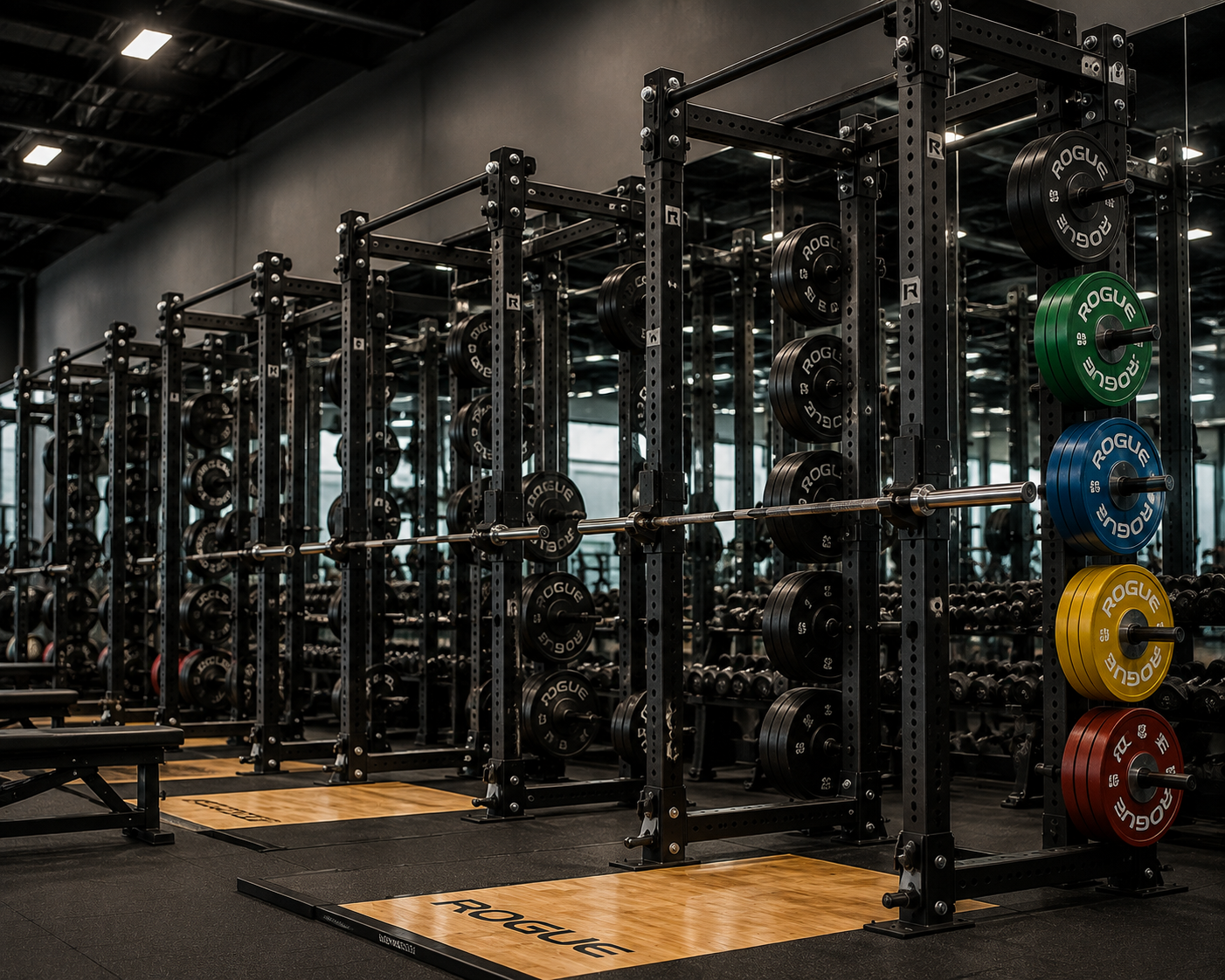
Used vs. New Gym Racks: Why Saving Money Can Be Costly
Purchasing a rack is one of the most important decisions when building a home gym or setting up a professional gym. Since this is the equipment that supports the heaviest loads during exercises like squats, bench presses, and military presses, the choice should not be based solely on price. It is precisely at this stage that many enthusiasts wonder whether it is better to opt for a used rack or invest directly in a new model.
The second-hand market often offers seemingly very attractive opportunities. Online listings, specialized flea markets, and fitness-dedicated groups offer structures at prices significantly lower than new ones. However, behind an initial saving, there can be risks that are difficult to identify during a simple visual inspection: fatigued welds, worn components, structural deformations, missing parts, or incompatibility with modern accessories.
In this guide, we objectively analyze the advantages and disadvantages of buying a used rack versus a new one, evaluating safety, durability, warranties, compatibility, and the total cost of the investment in the long term. The goal is not to demonize the second-hand market, but to help you understand when saving money is truly an opportunity and when, instead, it could turn into a much higher expense.
- Used and new: the main differences
- Why safety comes before price
- How to recognize structural wear
- Compatibility with accessories and upgrades
- The value of the manufacturer's warranty
- Evaluating the real cost of the investment
- The most common mistakes during purchase
- How to choose with greater awareness
Used and new: the main differences
The most obvious difference between a new rack and a used one naturally concerns the price. A second-hand model can cost even 30-50% less than the original list price, especially if the owner wants to quickly free up space in their home gym.
However, price is only one of the factors to consider. A new rack offers perfectly intact materials, complete components, certifications, manuals, available spare parts, and the certainty of knowing the entire history of the equipment. Conversely, in the second-hand market, it is often impossible to know how the rack was actually used in previous years.
Equipment that appears to be in excellent condition may have supported thousands of workouts with very heavy loads or may have been stored in humid environments that accelerated the aging of the materials. For this reason, the comparison should not be limited to the initial price.
When used can make sense
Buying a used rack can be an interesting choice when you personally know the seller, have the opportunity to carefully inspect the structure, and the product belongs to a reliable brand with spare parts still available.
The advantages of new
A new rack guarantees optimal conditions, complete components, design updates, and the peace of mind of starting to train with a structure free of previous wear.
Why safety comes before price
When it comes to racks, safety is not an optional extra. The structure must support the weight of the barbell, the athlete, and the dynamic stresses generated during every workout. Even small defects can influence the behavior of the equipment under load.
Welds represent one of the most delicate elements. Although they may appear intact on the outside, it is not always possible to assess micro-cracks, deformations, or metal fatigue phenomena resulting from years of intensive use by eye.
When purchasing new gym racks, every component is delivered in the conditions intended by the manufacturer, significantly reducing the uncertainties related to the origin and history of the structure.
Training with heavy loads
The more the loads used during squats and bench presses increase, the greater the importance of a structure that is perfectly intact and designed according to updated standards.
Checks that are not always enough
Even a thorough inspection cannot always identify internal material fatigue or stresses accumulated over the years.
How to recognize structural wear
Anyone evaluating a used power rack should carefully observe several elements: the state of the welds, any deformations of the uprights, the presence of corrosion, abnormal play in the bolts, and wear on the contact points with the barbell.
It is also important to check the holes intended for accessories. Prolonged use can cause slight deformations that compromise the correct insertion of pins and reduce the precision of the couplings.
The paintwork can provide further indications. Deep scratches, areas with oxidation, or signs of makeshift repairs always deserve further investigation before purchase.
Checking the welds
The welds must appear uniform and free of cracks, deformations, or repair work performed after production.
Checking bolts and components
Original hardware, intact threads, and the absence of play are fundamental elements to ensure stability during workouts.
Compatibility with accessories and upgrades
One of the often underestimated aspects concerns future compatibility. Many older racks use dimensional standards that are no longer widespread or proprietary systems that limit the installation of new components.
Those who wish to expand their gym might encounter difficulties in finding compatible power rack accessories or might have to incur high costs for components that are now out of production.
A new model designed according to current standards, on the other hand, offers greater possibilities for customization through lat machines, dip stations, integrated storage, spotter arms, jammer arms, and numerous other accessories.
Thinking about upgrades
Modularity represents one of the main advantages of modern structures. Evaluating this feature means protecting your investment in the long term.
Construction standards
Holes, uprights, and fastening systems that comply with the most common standards make it easier to purchase new accessories even in subsequent years.
The value of the manufacturer's warranty
One of the main advantages of new equipment consists of the presence of a fitness equipment warranty. The coverage offered by the manufacturer protects the buyer in case of manufacturing defects and guarantees access to original spare parts and technical assistance.
In the second-hand market, however, the warranty might be expired, non-transferable, or completely absent. Any repairs therefore remain the responsibility of the buyer.
The availability of an after-sales service also represents an added value when you want to expand the rack configuration or replace components subject to wear.
Support over time
A specialized manufacturer can provide technical guidance, compatible spare parts, and useful updates throughout the life of the equipment.
Original spare parts
The ability to easily find original components helps to increase the overall duration of the investment.
Evaluating the real cost of the investment
The purchase price represents only a part of the total cost. A particularly cheap used rack might require the replacement of hardware, repainting, new accessories, or maintenance work that quickly reduces the initial economic advantage.
Limited compatibility with upgrades can also have an impact over time. If you have to completely replace the rack to expand the gym, the initial savings will lose much of their meaning.
Before comparing gym rack offers, it is therefore useful to consider the expected lifespan, expansion possibilities, assistance, and residual value of the equipment over the years.
Don't just look at the price
A complete assessment considers construction quality, safety, modularity, and included services, not just the cost reported in the listing.
Investing with the future in mind
A quality product retains its value longer and continues to accompany the growth of the gym without requiring premature replacements.
The most common mistakes during purchase
The first mistake consists of letting yourself be convinced exclusively by a high discount without carefully verifying the actual conditions of the structure. A very low price should always prompt you to carry out even more in-depth checks.
Another imprudent choice is to buy a rack without knowing the manufacturer, the technical specifications, or the certified load capacity. The lack of information always represents an element of risk.
Finally, it is important to compare the power rack price of a used model with that of an equivalent new one. In some cases, the economic difference is smaller than you might imagine, especially considering the warranty, assistance, and durability over time.
Avoid impulsive decisions
Taking the necessary time to compare multiple solutions allows you to make a more rational and informed choice.
Always request complete information
Manuals, invoices, detailed photographs, and technical data help to evaluate the actual quality of the proposed equipment with greater precision.
How to choose with greater awareness
The choice between a used and a new rack depends on your budget, goals, and the level of risk you are willing to accept. Used equipment can represent an interesting opportunity in well-documented situations and with quality products, but it requires greater attention during the evaluation.
For those who want maximum safety, full compatibility with accessories, an official warranty, and the possibility of progressively expanding the gym, a new rack often represents the most convenient solution in the medium and long term. The higher initial cost is offset by greater reliability, less maintenance, and a longer lifespan.
To learn more about the features of professional structures and compare the different configurations available, you can consult the section dedicated to gym racks. Carefully evaluating construction quality, safety, and modularity allows you to turn the purchase of the rack into an investment destined to accompany many years of training.
Comments (0)