
Trolley
You have no items in your shopping cart

 Budgets
 Dumbers
 Discs
Discs
 Benches
 Racks and Rigs
 Weights Holders
 Isotonic machines
 Calisthenics
 Cardio
 Kettlebells
 Flooring
 Gym Set
 Accessories
 Combat
 ARTI MARZIALI
 CONTAINER GYM
 Tug-Of-War
 Used Gym Equipment
 PILATES MACCHINARI
 GINNASTICA ARTISTICA
 CAMPI DA PADEL
 Prodotti in Pronta Consegna
 Informazioni
 IRONMAN
 Gift Card
- Donatif
- General information
- 0 I like it
- 1 Views
- 0 comments
- gym flooring, safety flooring, gym safety, shock-absorbing materials
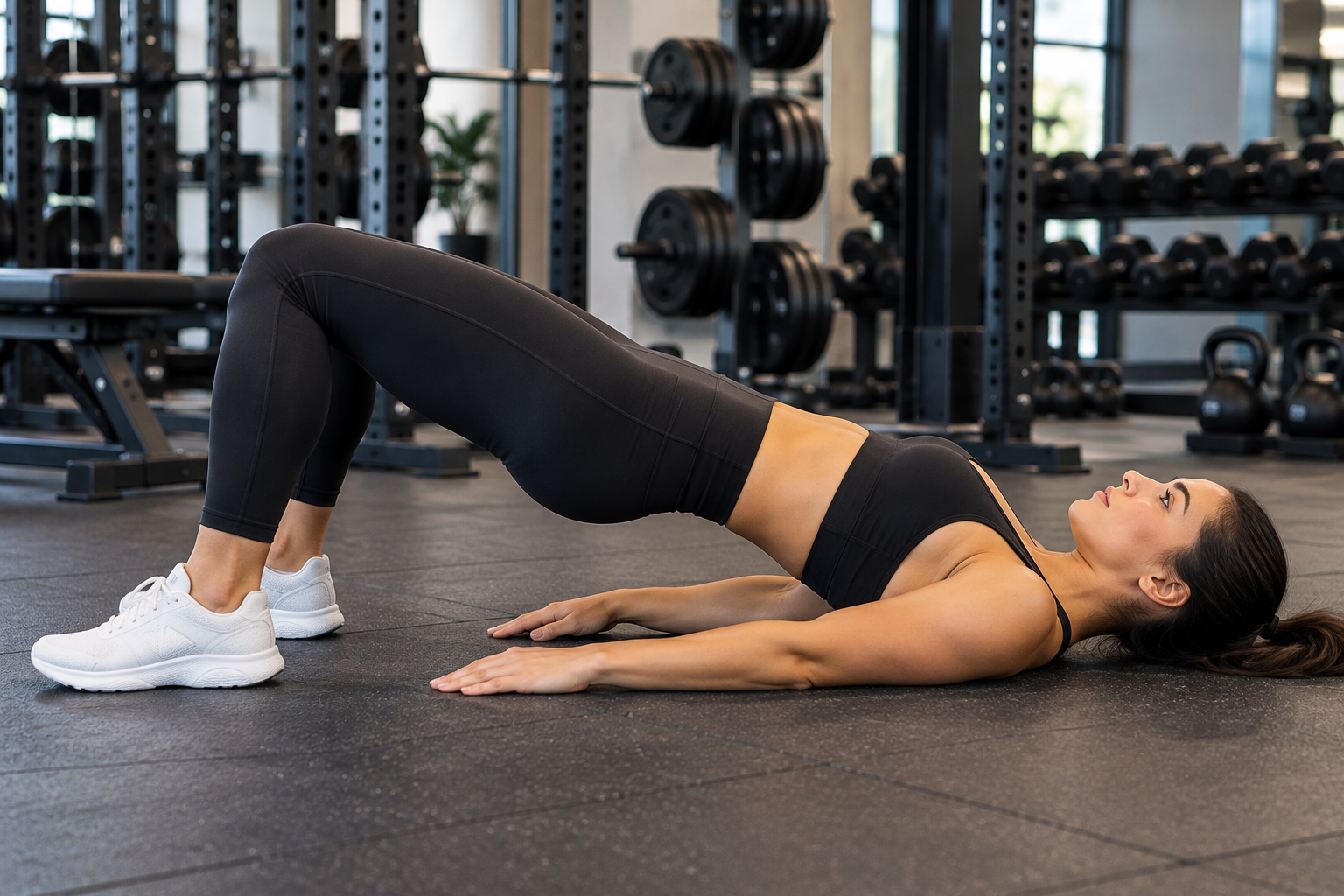
Hip thrust vs glute bridge: differences, usage and selection criteria
Hip thrust and glute bridge are two hip extension-based exercises that share the same general movement pattern but differ in body position, range of motion, execution method and setup organization. Understanding these differences makes it possible to choose the exercise most consistent with one's training program without necessarily considering them alternatives.
Both can be included in the same programming, but the context of use, available equipment and experience level influence the choice. Evaluating verifiable criteria such as setup configuration, load progression possibilities and ease of execution allows for a more rational training plan.
This guide compares hip thrust and glute bridge highlighting practical differences, usage criteria and errors to avoid without delving into the detailed technique of the hip thrust or its variants with different equipment.
- Quick answer
- What are the main differences?
- Comparison table
- How to choose between hip thrust and glute bridge
- When to use one or the other
- Errors to avoid
- FAQ
- Why integrate them strategically
Hip thrust or glute bridge: which to choose?
The choice between hip thrust and glute bridge depends on training goals, available equipment, experience level and how you want to organize your session. Both train hip extension but present differences in starting position, setup preparation and range of motion.
The decision should be made considering the overall training context and not a single parameter.
Both exercises can be used within the same program when consistent with the planned schedule.
What is the main criterion?
Evaluate which exercise allows you to maintain controlled technique and setup preparation compatible with the user's level.
Are they equivalent exercises?
No. While sharing the hip extension pattern, they differ in configuration, execution and usage method.
What are the main differences?
The two exercises are distinguished primarily by trunk position and setup organization.
Understanding these differences helps integrate them correctly into programming.
Each exercise presents specific operational characteristics.
Hip thrust characteristics
In the hip thrust, the upper back generally rests on a bench while the movement is performed through hip extension using body weight or equipment such as a barbell, dumbbells or dedicated machines.
Glute bridge characteristics
In the glute bridge, the trunk remains on the floor during execution and hip extension is performed without back support on a bench, thus modifying the setup configuration and range of motion.
Comparison table
A summary table facilitates comparison between the main operational characteristics.
| Criterion | Hip thrust | Glute bridge |
|---|---|---|
| Starting position | Back resting on a bench | Back resting on the floor |
| Equipment | Can use bench, barbell or machine | Can also be performed without equipment |
| Preparation | Requires setup preparation | Generally simpler |
| Range of motion | Variable according to configuration | Different compared to hip thrust |
| Space required | Requires area for bench and equipment | Primarily requires floor space |
How to interpret the comparison?
The table describes general differences. Practical execution may vary depending on the equipment used and training methods.
What elements to compare?
Setup preparation, equipment availability, ease of execution and session organization represent the most useful criteria.
How to choose between the two exercises?
The choice must be consistent with program goals and the training context.
Both can be included in the same planning with different purposes.
It is also useful to consider the time needed to prepare the setup.
Experience level
Familiarity with available equipment can influence the practicality of the exercise and the speed with which the setup is prepared.
Equipment availability
If choosing the hip thrust with external load, you can prepare the setup using an olympic barbell compatible with the weight room.
When to use the hip thrust and when the glute bridge?
The two exercises can be programmed at different times in the same routine.
The choice depends on the session structure and available equipment.
Variety can help organize more complete programs.
When to use the hip thrust
The hip thrust is indicated when an adequate setup is available and you want to use a configuration that includes a bench and, if necessary, additional equipment.
When to use the glute bridge
The glute bridge can represent a practical solution when you prefer to work directly on the floor or when you want simpler setup preparation.
What errors to avoid?
Exercise choice should always be consistent with the training program.
Many errors stem from considering the two exercises completely interchangeable.
Careful planning improves session organization.
Confusing the exercises
Despite sharing the same movement pattern, hip thrust and glute bridge are not identical and require different configurations.
Neglecting setup preparation
In the case of the hip thrust, it is important to check bench stability, equipment arrangement and available space before starting the exercise.
FAQ
Do hip thrust and glute bridge train the same movement?
Both are based on hip extension but differ in starting position, setup configuration and execution method.
Is it possible to include both in the same program?
Yes. They can be used in the same programming if consistent with training goals.
Is it necessary to always use a barbell in the hip thrust?
No. The hip thrust can also be performed with other equipment or bodyweight, depending on the planned program.
Why compare the two exercises objectively?
Comparing hip thrust and glute bridge through practical criteria makes it possible to choose the exercise best suited to the training context, avoiding evaluations based exclusively on personal habits.
Analyzing equipment availability, setup organization, simplicity of execution and session goals helps integrate both exercises into consistent programming.
A structured approach also makes it possible to adapt the choice to the evolution of training while maintaining continuity, organization and efficiency in session management.
Comments (0)