
Trolley
You have no items in your shopping cart

 Budgets
 Dumbers
 Discs
Discs
 Benches
 Racks and Rigs
 Weights Holders
 Isotonic machines
 Calisthenics
 Cardio
 Kettlebells
 Flooring
 Gym Set
 Accessories
 Combat
 ARTI MARZIALI
 CONTAINER GYM
 Tug-Of-War
 Used Gym Equipment
 PILATES MACCHINARI
 GINNASTICA ARTISTICA
 CAMPI DA PADEL
 Prodotti in Pronta Consegna
 Informazioni
 IRONMAN
 Gift Card
- Donatif
- General information
- 0 I like it
- 82 Views
- 0 comments
- gym flooring, safety flooring, gym safety, shock-absorbing materials
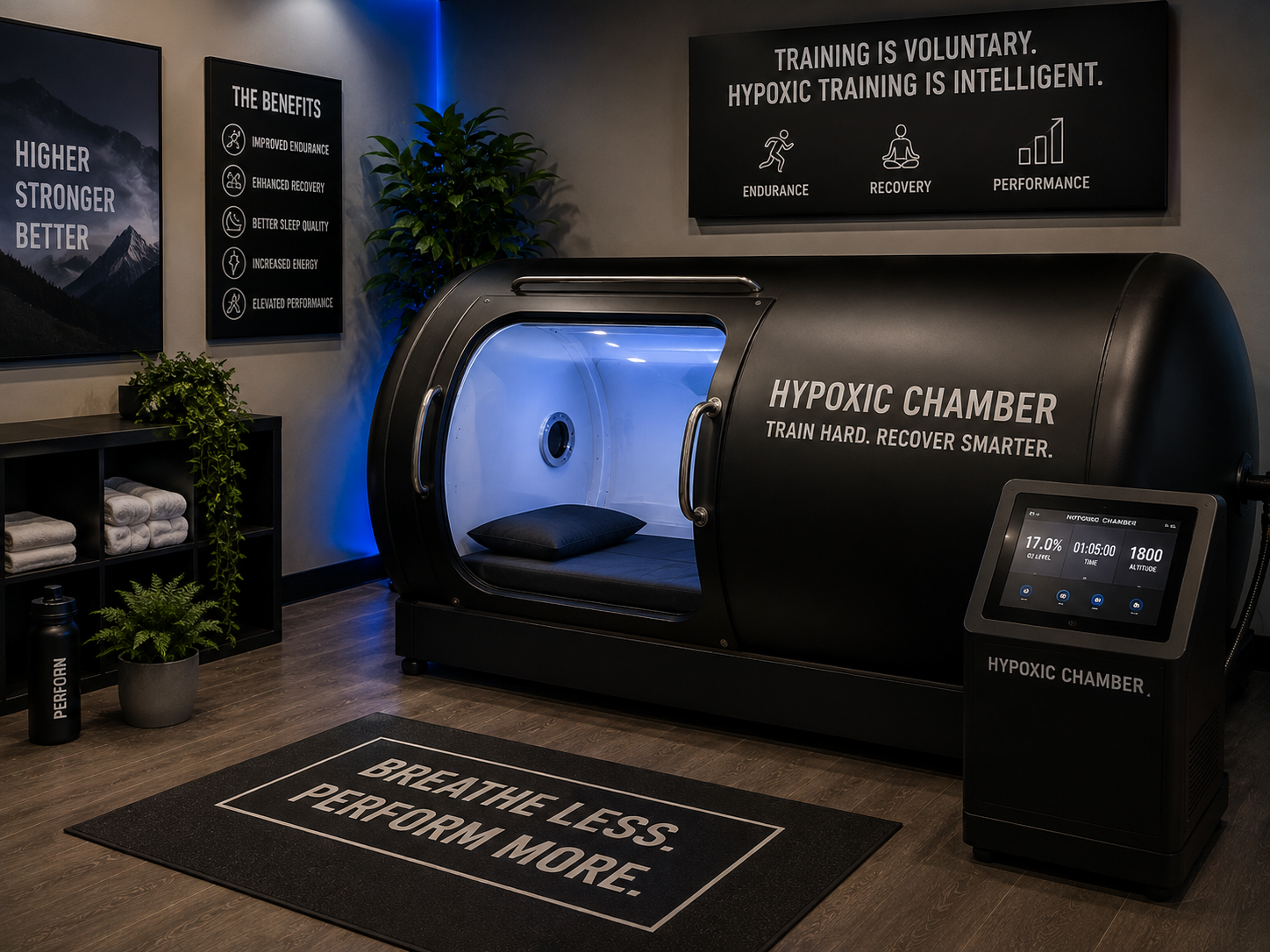
Hypoxic chamber meaning: beyond simple altitude simulation
In the professional fitness and athletic preparation sectors, the term hypoxic chamber is often generically associated with high-altitude simulation. However, truly understanding the technical meaning of this technology requires a precise distinction between different concepts: reduction of oxygen availability, physiological adaptation of the organism, and the creation of a controlled environment for training.
A hypoxic chamber is not simply a room where the air is "thinner," but a technological system designed to modify the composition of the breathed environment in a controlled manner. The difference between a professional solution and a simple imitation of altitude lies precisely in the ability to manage parameters, stability, and safety during every session.
Understanding the true hypoxic chamber meaning allows gym owners and fitness center operators to evaluate a technological investment with greater awareness. Knowing the correct terminology also means distinguishing between a real application of hypoxia in fitness and commercial communication based solely on the generic idea of training in the mountains.
- Technical definition of a hypoxic chamber
- What hypoxia actually means
- Normobaric hypoxia: the principle behind altitude simulation
- Hypoxic technology applied to professional fitness
- Difference between real altitude and hypoxic simulation
- Oxygen saturation and the organism's response
- Why understanding technical meaning helps the investment
- The evolution of the hypoxic chamber in modern fitness
Technical definition of a hypoxic chamber
A hypoxic chamber is a controlled environment in which the availability of oxygen present in the air breathed by the user is modified. Through dedicated technological systems, the composition of the air is regulated to create conditions similar to those encountered at higher altitudes compared to sea level.
The fundamental concept is that the chamber does not necessarily modify the atmospheric pressure of the environment, but intervenes on the percentage of oxygen available in the breathed mixture. This makes it possible to simulate certain characteristics of high altitude while maintaining the comfort and practicality of an indoor environment.
For a gym or a professional fitness center, the value of the hypoxic chamber lies in its ability to offer a repeatable, monitorable, and adaptable environment tailored to users' needs.
An environment designed for control
The hypoxic chamber integrates various technological components that work together to maintain stable conditions.
Generators, sensors, and air management systems allow for controlling the oxygen level and monitoring the correct operation of the system.
Beyond the concept of simple altitude
Altitude simulation does not merely represent a reduction in available oxygen.
A professional solution also considers safety, precision, and the ability to maintain the established protocol over time.
What hypoxia actually means
The term hypoxia indicates a condition in which the availability of oxygen available to the organism is lower than conditions considered normal. This concept can refer to various contexts and must not be interpreted exclusively as a negative condition.
In the field of sports training, hypoxia is used as a controlled stimulus to study and promote certain physiological adaptation processes. The objective is not to create an uncontrolled situation, but to use a programmed environmental variation within a structured path.
Hypoxia chamber technology makes it possible to transform hypoxia into a manageable variable, defining intensity, duration, and exposure modality.
Hypoxia in the fitness context
In professional fitness, hypoxia represents an additional tool compared to traditional training methods.
It can be integrated into protocols dedicated to performance, athletic preparation, or wellness-oriented paths.
A stimulus to be programmed
Hypoxia must be considered as an element of the program, not as a simple environmental effect.
The quality of the result depends on the ability to correctly manage the introduced stimulus.
Normobaric hypoxia: the principle behind altitude simulation
The normobaric hypoxia definition concerns a condition in which oxygen availability is reduced while keeping atmospheric pressure substantially unchanged. This is the principle used by most modern hypoxic chambers dedicated to fitness and sports preparation.
In real high altitude, however, the reduction in oxygen availability is mainly linked to the decrease in atmospheric pressure. The hypoxic chamber therefore reproduces a specific aspect of altitude through a controlled technological approach.
This distinction is important because it allows for a better understanding of what actually happens during the use of the technology.
Real altitude and simulated altitude
In the mountains, the organism simultaneously faces environmental variations linked to altitude.
In a hypoxic chamber, the focus is instead on managing oxygen availability in a controlled environment.
The advantage of technological control
The ability to program the stimulus represents one of the main advantages of hypoxic simulation.
Users can follow organized protocols without depending on external conditions.
Hypoxic technology applied to professional fitness
Hypoxic technology comprises the set of systems that make it possible to create, control, and maintain an environment with reduced oxygen availability. It is not a single component, but an ecosystem formed by generators, sensors, distribution systems, and control software.
Technological quality determines the precision with which the environment can be managed. In a professional facility, where different people may use the chamber throughout the day, the stability of parameters becomes a fundamental element.
Careful design allows for offering a service that is more reliable and consistent with user expectations.
The main elements of the system
A professional hypoxic system includes components dedicated to air production, parameter monitoring, and uniform distribution in the environment.
Each element contributes to the overall functioning of the solution.
Construction precision and reliability
Build quality directly influences safety and operational continuity.
A precise system allows for maintaining more predictable conditions during sessions.
Difference between real altitude and hypoxic simulation
Altitude simulation through a hypoxic chamber must not be confused with actually staying in the mountains. The two environments share certain elements linked to oxygen availability, but present different technical characteristics.
Real altitude involves a natural variation of the external environment, while the hypoxic chamber allows for isolating and controlling the stimulus linked to oxygen.
This difference makes the technology particularly interesting for those wishing to integrate specific protocols without completely changing their lifestyle.
Advantages of controlled simulation
The ability to define times and conditions allows for better organization of the path.
Users can incorporate hypoxia into their routine more practically.
Applications in fitness facilities
Gyms and fitness centers can use hypoxic technology to expand their offering.
The professional management of the tool represents a distinctive element of the service.
Oxygen saturation and the organism's response
One of the most important indicators for understanding the response to the hypoxic environment is blood oxygen saturation, often indicated as SpO2. This value allows for observing how the organism manages lower oxygen availability during exposure.
Oxygen saturation training represents one of the parameters that can be monitored to evaluate individual response and personalize protocols.
Correctly interpreting this data allows for using the technology with greater awareness.
The role of monitoring
Data collection helps to better understand the user's response.
This makes it possible to adapt the duration and intensity of sessions.
A data-driven approach
Modern technology allows for integrating measurement and programming.
Data becomes a tool to improve the management of the hypoxic experience.
Why understanding technical meaning helps the investment
When a gym evaluates the introduction of a hypoxic chamber, knowing the technical terminology allows for making a more informed choice. Understanding the difference between altitude simulation, normobaric hypoxia, and technological environmental management helps to better evaluate the characteristics of the system.
A technological investment should not be based solely on the general idea of training at altitude, but on the quality with which the system manages to create and maintain controlled conditions.
Precision of language thus becomes a tool to recognize the construction precision of the chosen solution.
Evaluating real characteristics
A correct evaluation considers technology, reliability, assistance, and integration possibilities within the facility.
These elements determine the overall value of the investment.
Reducing decision-making risk
Greater technical knowledge allows for comparing different solutions with more objective criteria.
Awareness reduces the risk of choosing systems that are inadequate for one's needs.
The evolution of the hypoxic chamber in modern fitness
The hypoxic chamber today represents a technology that is increasingly integrated into the world of professional fitness and sports preparation. Its meaning goes beyond simple altitude simulation because it involves design, environmental control, and data management.
Understanding the term hypoxia and how the technology works allows for evaluating this solution with greater precision, recognizing the value of an environment designed to offer controlled stimuli.
For fitness centers and gym owners, investing in a hypoxic chamber therefore means choosing a technology in which terminological precision and construction precision represent two aspects of the same professional approach.
Comments (0)