
Trolley
You have no items in your shopping cart

 Budgets
 Dumbers
 Discs
Discs
 Benches
 Racks and Rigs
 Weights Holders
 Isotonic machines
 Calisthenics
 Cardio
 Kettlebells
 Flooring
 Gym Set
 Accessories
 Combat
 ARTI MARZIALI
 CONTAINER GYM
 Tug-Of-War
 Used Gym Equipment
 PILATES MACCHINARI
 GINNASTICA ARTISTICA
 CAMPI DA PADEL
 Prodotti in Pronta Consegna
 Informazioni
 IRONMAN
 Gift Card
- Donatif
- General information
- 0 I like it
- 835 Views
- 0 comments
- gym flooring, safety flooring, gym safety, shock-absorbing materials
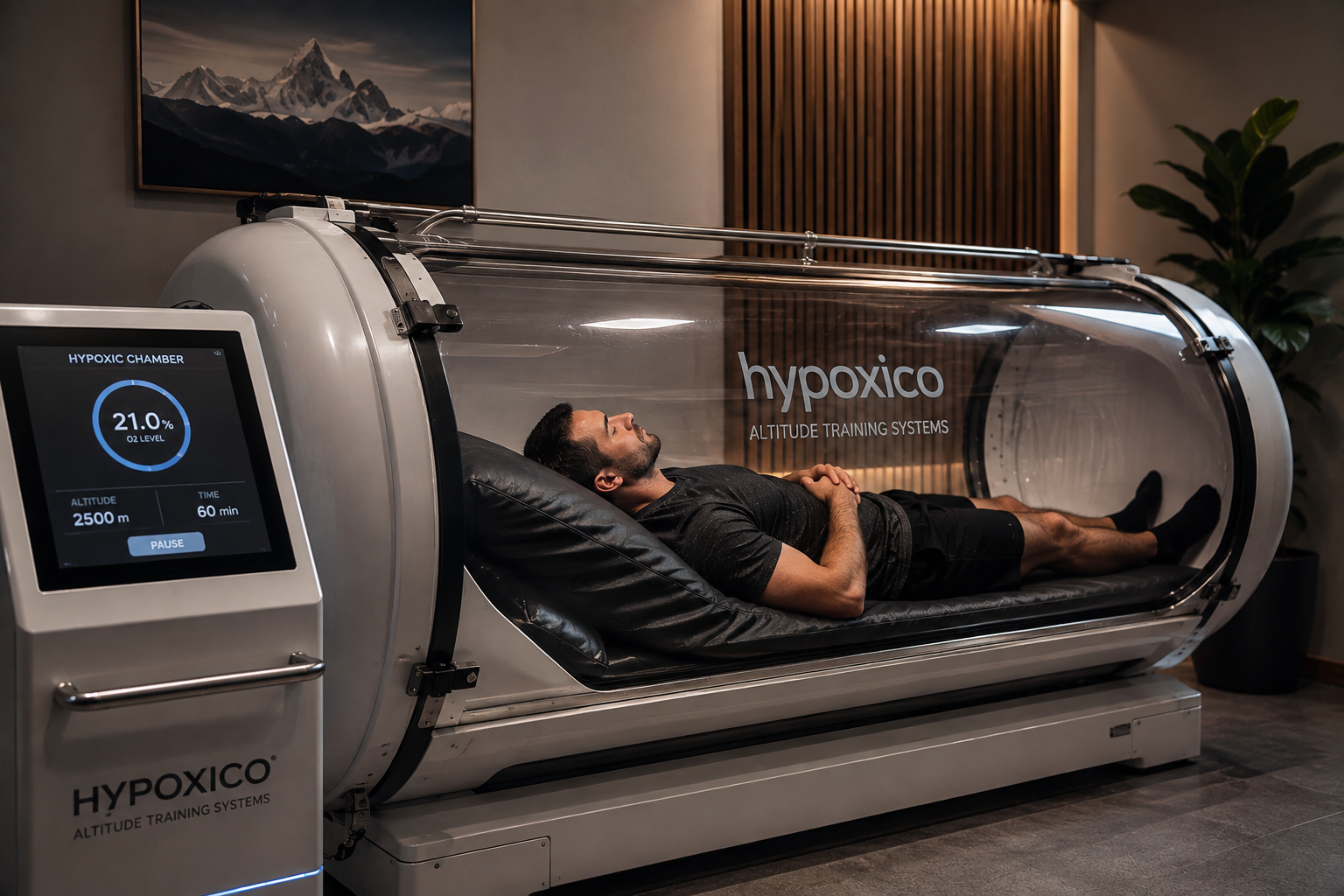
Hypoxic chamber: what you need to know about oxygen saturation (SpO2)
The hypoxic chamber is a technology increasingly used in the world of athletic performance, advanced fitness, and wellness-oriented programs because it allows conditions similar to high altitude to be recreated through a controlled environment. However, to truly understand how this methodology works, it is not enough to simply observe the amount of oxygen present in the environment: it is essential to understand how the body reacts to this variation.
One of the most important indicators for evaluating individual response to hypoxia is oxygen saturation, commonly referred to as SpO2. This parameter makes it possible to observe how the blood carries oxygen during exposure to simulated altitude and represents one of the primary tools for monitoring the body's adaptation.
Understanding the relationship between what a hypoxic chamber is used for and monitoring saturation allows you to approach hypoxic training with greater awareness. The chamber technology creates the stimulus, while the data collected during sessions helps interpret the body's response and build more personalized protocols.
- How a hypoxic chamber works and what it changes in the environment
- What oxygen saturation SpO2 is and why it is important
- How the body reacts to reduced oxygen availability
- SpO2 monitoring in athletes during training
- Physiological adaptation to hypoxia: what happens over time
- Managing hypoxic chamber sessions through data
- Safety and parameter control in hypoxic training
- The value of monitoring in modern performance
How a hypoxic chamber works and what it changes in the environment
A hypoxic chamber is an environment designed to modify in a controlled manner the availability of oxygen in the air breathed by the user. Through an air generation and management system, the technology makes it possible to simulate conditions similar to those found at high altitudes without having to change atmospheric pressure.
The underlying principle is the reduction of the relative oxygen concentration in the environment. When a person enters the chamber, their body perceives this variation and activates a series of physiological responses related to the management of available oxygen.
The quality of the experience depends on the system's ability to maintain stable and controlled conditions. For this reason, a professional hypoxic chamber integrates generators, sensors, and monitoring systems that allow the environment to be managed precisely.
Simulated altitude
Simulated altitude reproduces certain typical aspects of the mountain environment through a modification of air composition. The goal is to create a controlled stimulus that can be used within athletic or wellness protocols.
Unlike a trip to high altitude, the hypoxic environment makes it possible to define the duration and intensity of exposure according to specific needs.
The role of the hypoxia generator
The generator represents the technological heart of the chamber because it produces and manages air with hypoxic characteristics.
The precision of the system affects the stability of the environment and the possibility of using repeatable protocols over time.
What oxygen saturation SpO2 is and why it is important
Oxygen saturation, indicated as SpO2, represents the percentage of hemoglobin in the blood that is bound to oxygen. It is a parameter used to understand how effectively the blood is able to transport oxygen to the tissues.
During exposure to hypoxic conditions, the availability of oxygen in the air decreases, and this can influence the measured value. Monitoring SpO2 therefore allows us to observe the immediate response of the organism to the environmental stimulus.
Saturation should not be interpreted as an isolated value, but as part of a broader picture that includes training, recovery, preparation level, and individual characteristics.
How SpO2 is measured
Saturation measurement is generally performed using tools such as pulse oximeters, devices capable of detecting the blood oxygenation level quickly.
These tools can be used during sessions to gather information on the athlete's response.
Correctly interpreting the data
A single SpO2 value does not allow us to fully describe adaptation to hypoxia.
It is necessary to observe the trend over time and compare the data with the athlete's sensations and other available parameters.
How the body reacts to reduced oxygen availability
When the body is exposed to a hypoxic environment, it must adapt to a situation in which the available oxygen is lower than under normal conditions. This variation generates a series of physiological responses involving the cardiovascular, respiratory, and metabolic systems.
The first response concerns the need to maintain an adequate supply of oxygen to the tissues. The body modifies certain processes to compensate for the lower environmental availability and maintain internal balance.
Hypoxia training uses precisely this capacity for adaptation as an additional stimulus compared to traditional physical activity.
Immediate response of the organism
In the early stages of exposure, the body reacts quickly to the environmental variation.
Respiratory rate and other regulatory mechanisms may change to improve the management of available oxygen.
Adaptations over time
With repeated and properly programmed exposures, the body can develop more stable adaptive responses.
Monitoring makes it possible to understand how each individual reacts to the hypoxic program.
SpO2 monitoring in athletes during training
For athletes using a hypoxic chamber, controlling saturation represents a useful tool for evaluating the response to the stimulus. SpO2 monitoring in athletes makes it possible to gather objective data during sessions and integrate them into programming.
The ability to observe how saturation changes during different levels of exposure allows for greater personalization of the program. Indeed, each athlete may present a different response to the same hypoxic environment.
Using data also helps maintain a safer approach, avoiding reliance exclusively on subjective sensations.
Connecting SpO2 and performance
Saturation data can be analyzed alongside other indicators related to performance.
This combination provides a more complete view of the athlete's response.
The importance of continuous monitoring
Gathering data over time makes it possible to identify trends and changes in individual response.
Continuity makes the evaluation process more precise and useful.
Physiological adaptation to hypoxia: what happens over time
Physiological adaptation to hypoxia represents the process through which the body progressively modifies its response to reduced oxygen availability. This process does not happen in a single session, but requires coherent programming.
Controlled exposure makes it possible to introduce a stimulus that can be integrated into an athletic routine without replacing the fundamental principles of training.
Understanding these mechanisms helps to use the hypoxic chamber more effectively and consciously.
Cardiovascular response
The cardiovascular system plays a central role in oxygen management.
Monitoring physiological parameters helps understand how the body copes with the stimulus.
Metabolic response
Hypoxia also influences how the body uses energy resources during physical activity.
This makes it important to integrate exposure with comprehensive programming.
Managing hypoxic chamber sessions through data
Using the data collected during sessions transforms the hypoxic chamber into a more precise tool. It is not just a matter of entering an environment with less oxygen, but of understanding how the body responds and adapting the program accordingly.
Parameters such as SpO2, heart rate, and perceived exertion can provide useful information for modifying the duration and intensity of workouts.
Data-driven management allows for a more personalized approach both for individual athletes and for facilities offering professional services.
Personalizing protocols
Every person presents different characteristics and requires an adapted approach.
Data helps build protocols that are more consistent with specific goals.
Controlling progression
Monitoring the evolution of parameters makes it possible to evaluate the program over time.
Controlled progression represents an important element of training quality.
Safety and parameter control in hypoxic training
Safety is a fundamental element in the use of any technology that modifies the training environment. A properly designed hypoxic chamber must allow constant control of the main parameters.
SpO2 monitoring helps provide information on individual response and allows for better management of the program.
The data-driven approach reduces uncertainty and improves the overall quality of the experience.
Reducing risk through control
Gathering information allows for more informed decision-making.
Parameter control is one of the elements that makes modern hypoxia more accessible.
Technological reliability
Sensors and environmental management systems contribute to the stability of the chamber.
Build quality directly affects safety and operational continuity.
The value of monitoring in modern performance
The hypoxic chamber is not simply an environment with rarefied air, but a system in which technology and physiology work together. Understanding how the blood reacts through parameters such as SpO2 allows the tool to be used more intelligently.
Data monitoring makes it possible to transform hypoxia into a controlled, adaptable program based on concrete information. For advanced home gyms and professional fitness centers, this capability represents a distinctive element in performance management.
The quality of hypoxic training thus stems from the union of a designed environment, data collection, and the ability to interpret the individual response of the organism.
Comments (0)