
Trolley
You have no items in your shopping cart

 Budgets
 Dumbers
 Discs
Discs
 Benches
 Racks and Rigs
 Weights Holders
 Isotonic machines
 Calisthenics
 Cardio
 Kettlebells
 Flooring
 Gym Set
 Accessories
 Combat
 ARTI MARZIALI
 CONTAINER GYM
 Tug-Of-War
 Used Gym Equipment
 PILATES MACCHINARI
 GINNASTICA ARTISTICA
 CAMPI DA PADEL
 Prodotti in Pronta Consegna
 Informazioni
 IRONMAN
 Gift Card
- Donatif
- General information
- 0 I like it
- 10 Views
- 0 comments
- gym flooring, safety flooring, gym safety, shock-absorbing materials
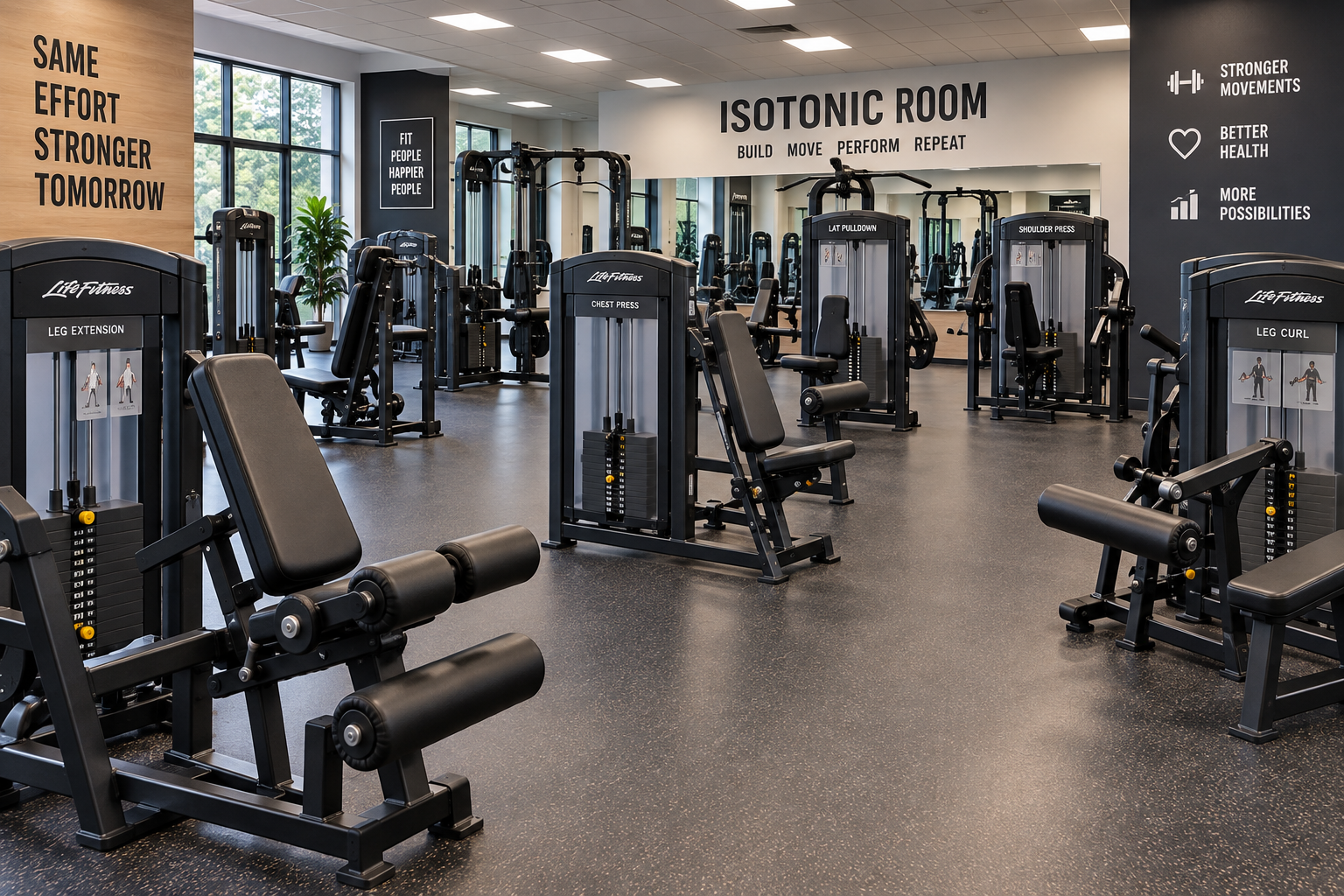
Isotonic room: meaning and features
An isotonic room is the area of a gym dedicated to guided-load machines, designed to allow exercises with controlled trajectories and simple load adjustments. This type of space allows for structured workouts aimed at users with different levels of experience, favoring an orderly use of equipment and efficient management of the facility.
The characteristics of an isotonic room do not depend exclusively on the installed machines, but also on the layout design, the organization of pathways, the availability of adequate operational spaces, and proper maintenance planning. Each element contributes to the overall functionality of the area.
In this guide, we analyze the meaning of the isotonic room, its main features, the functioning of guided machines, the most important design criteria, and mistakes to avoid in the creation of a space intended for training with isotonic equipment.
- What an isotonic room is
- What the main features are
- How an isotonic room works
- How to organize the space
- What advantages it offers
- Safety and correct use
- Mistakes to avoid
- How to evaluate the design of the area
What an isotonic room is
The isotonic room is an area of the gym dedicated primarily to machines that guide the user's movement through pre-established mechanical paths. The equipment allows for load adjustment and the performance of exercises aimed at specific muscle groups.
This configuration facilitates the repeatability of training and allows instructors to offer programs easily adaptable to the needs of users with different levels of preparation.
A well-designed isotonic room often represents a complementary area compared to the weight room and spaces dedicated to functional training or cardio fitness.
What isotonic means
In the context of gyms, the term commonly identifies guided-load machines used for controlled exercises, even though muscle behavior during execution varies depending on the exercise and the machine used.
Who it is intended for
The area can be used by beginners, intermediate users, people following guided programs, and athletes who wish to integrate free weight work.
What the main features are
An isotonic room is distinguished by the presence of machines dedicated to the main muscle groups, distributed according to a layout that favors order, accessibility, and training continuity.
Each station should have the necessary space for use, seat adjustment, and maintenance operations, avoiding interference between different machines.
The quality of the experience also depends on the arrangement of internal pathways, the clarity of signage, and the ease with which users can navigate within the room.
Guided-load machines
The equipment guides movement through mechanical systems designed to offer repeatable exercises and rapid load adjustments.
Organized layout
A logical distribution of stations facilitates the work of instructors and improves the overall usability of the environment.
How an isotonic room works
The user selects the machine best suited to the planned exercise, adjusts the seat and supports according to the manufacturer's instructions, and sets the desired load.
The movement is performed following the trajectory provided by the machine, while the weight adjustment allows the intensity of the exercise to be adapted to the training goals.
The ability to quickly transition from one station to another also makes the isotonic room suitable for organized circuits and programs with pre-established sequences.
Machine adjustments
Before starting any exercise, it is important to adapt the seat, backrest, and other adjustment points to the user's characteristics by following the manufacturer's instructions.
Guided training
The machines facilitate the construction of structured programs with exercises dedicated to different muscle districts.
How to organize the space
Effective design starts from the analysis of the available surface area, the expected number of users, and the characteristics of the equipment that will be installed.
The machines should be distributed while maintaining clear passageways and sufficient operational areas to allow use and maintenance without interference.
It is also useful to group stations according to functional criteria, for example based on the muscle groups involved or the training programs usually offered by the facility.
Internal pathways
Corridors must facilitate movement without crossing the operational areas of the machines during their use.
Dedicated spaces
Each machine requires a defined operational area based on the specifications reported in the manufacturer's manuals.
What advantages it offers
An isotonic room makes it possible to organize easily repeatable programs and manage a wide variety of users with different levels of experience.
The presence of guided trajectories facilitates the learning of exercises and allows rapid load adjustments during training.
From a management perspective, an orderly distribution of machines makes supervision of activities and the organization of usage flows simpler.
For users
Guided machines allow users to progressively learn exercises while maintaining high movement repeatability.
For the manager
A well-organized area favors better management of spaces, maintenance, and user assistance.
Safety and correct use
Safety depends on the correct installation of equipment, compliance with manufacturer instructions, and the availability of adequate space around each station.
Before use, it is appropriate to check the adjustment of the machine, the correct functioning of the locking systems, and the absence of obvious anomalies.
An anti-trauma flooring also helps improve comfort, equipment stability, and surface protection in the most heavily used areas.
Checks before training
Checking adjustments, load selection systems, and the general condition of the machine represents a good practice before each use.
Importance of maintenance
Following the maintenance schedules provided by the manufacturer helps maintain efficiency and operational continuity over time.
Mistakes to avoid
One of the most frequent mistakes consists in considering the isotonic room as a simple collection of machines without an overall layout design.
Another critical issue concerns the positioning of equipment without taking into account the operational areas necessary for their use and maintenance activities.
Even the choice of equipment lacking a functional logic relative to the gym's audience can reduce the effectiveness of the investment.
Dysfunctional layout
Disorderly pathways and stations placed too close together can compromise operational comfort and safety.
Lack of planning
Designing the room without considering possible future expansions makes area updates more complex.
How to evaluate the design of the area
The creation of an isotonic room should start from an analysis of the facility's needs, the expected number of users, and the actually available surface area.
It is useful to evaluate the construction quality of the equipment, ease of maintenance, availability of spare parts, and the possibility of modifying the layout over time based on the evolution of the gym.
To explore the different types of equipment dedicated to guided training, you can consult the category of isotonic machines. A design based on the technical specifications of manufacturers and a rational organization of spaces allows for the creation of an efficient, safe, and easily manageable isotonic room in the long term.
Comments (0)