
Trolley
You have no items in your shopping cart

 Budgets
 Dumbers
 Discs
Discs
 Benches
 Racks and Rigs
 Weights Holders
 Isotonic machines
 Calisthenics
 Cardio
 Kettlebells
 Flooring
 Gym Set
 Accessories
 Combat
 ARTI MARZIALI
 CONTAINER GYM
 Tug-Of-War
 Used Gym Equipment
 PILATES MACCHINARI
 GINNASTICA ARTISTICA
 CAMPI DA PADEL
 Prodotti in Pronta Consegna
 Informazioni
 IRONMAN
 Gift Card
- Donatif
- General information
- 0 I like it
- 1 Views
- 0 comments
- gym flooring, safety flooring, gym safety, shock-absorbing materials
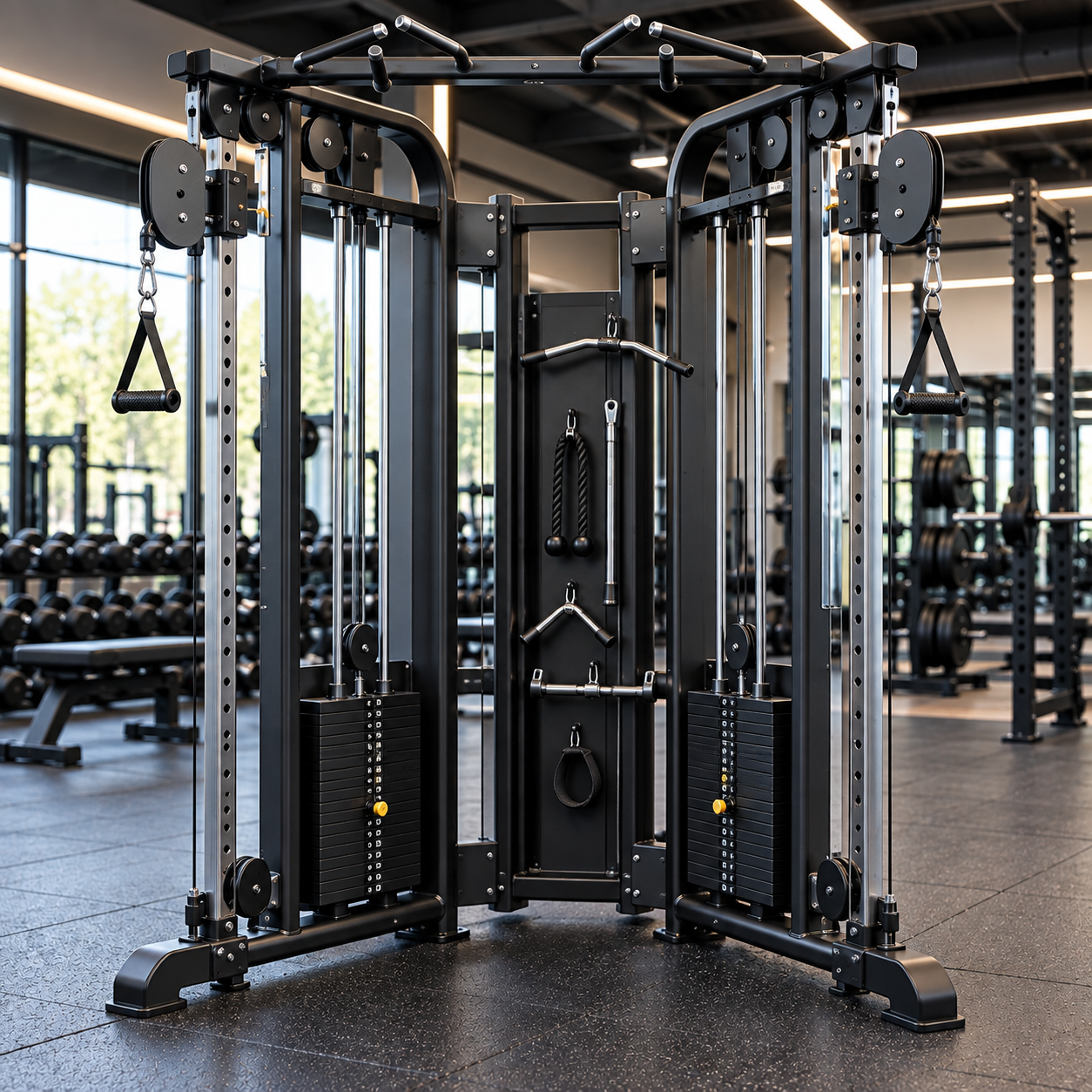
Cable machine vs functional trainer: differences and selection criteria
The comparison between a cable machine and a functional trainer is frequent when setting up a gym, a personal training studio, or an advanced home gym. Although both pieces of equipment share the use of cables, pulleys, and weight stacks, they are not always designed for the same goals and can offer different levels of versatility, adjustability, and space organization.
The choice should not be based solely on the number of exercises declared by the manufacturer, but on verifiable criteria such as pulley configuration, usage modes, footprint, user types, and compatibility with the rest of the workout area.
In this guide, we analyze the main operational differences between a cable machine and a functional trainer, providing practical criteria to identify the most suitable solution without delving into the internal workings of the machines or the pulley ratio, which are covered in dedicated articles.
- Quick answer
- What are the main differences?
- Comparison table
- How to choose between a cable machine and a functional trainer
- When to prefer one solution over the other
- Mistakes to avoid
- FAQ
- Which solution best enhances the investment?
Cable machine or functional trainer: which one to choose?
The choice depends on training goals, available space, and the type of users. A cable machine is often oriented toward specific exercises or dedicated setups, whereas a functional trainer normally prioritizes maximum versatility thanks to adjustable pulleys and the ability to perform numerous functional movements in the same space.
The evaluation should always start from the intended use and not just the commercial name of the machine.
Verifying the technical characteristics declared by the manufacturer allows you to compare different models with greater precision.
What is the most important criterion?
It is necessary to analyze which exercises will be performed most frequently and whether the priority is specialization or maximum operational flexibility.
Does the name always identify the machine?
No. Some manufacturers use different definitions for products with similar characteristics. It is therefore advisable to compare configuration, adjustments, and accessories rather than stopping at the commercial name.
What are the main differences?
Both machines use cable systems but can be designed with different purposes.
Understanding these differences helps make a choice consistent with the gym project.
Construction characteristics must always be compared using the manufacturer's technical documentation.
Cable machine characteristics
The cable machine may feature configurations dedicated to specific exercises or systems with adjustable pulleys intended for professional use. Characteristics change depending on the model and intended use.
Functional trainer characteristics
The functional trainer is generally designed to offer broad freedom of movement, numerous pulley height adjustments, and the ability to perform unilateral, bilateral, and functional exercises using various accessories.
Comparison table
The comparison should be made considering verifiable technical characteristics.
| Criterion | Cable machine | Functional trainer |
|---|---|---|
| Versatility | Variable based on configuration | Generally high |
| Pulley adjustment | Depends on the model | Normally wide |
| Functional exercises | Possible according to configuration | Designed for a wide variety of movements |
| Space organization | To be evaluated on the individual model | Optimized for multiple exercises at the same station |
| Accessories | Variable | Generally numerous and interchangeable |
How to read the comparison?
The characteristics shown represent general criteria. Each machine must be evaluated by consulting technical datasheets, manuals, and actually available configurations.
What data to compare?
Pulley adjustments, weight stack type, accessory compatibility, footprint, structure height, and operational space represent more reliable parameters than the commercial description alone.
How to choose between a cable machine and a functional trainer?
The choice should be made considering the overall weight room project.
The equipment must integrate with the rest of the available stations.
User experience also influences the ideal configuration.
Define training goals
If the program primarily involves functional exercises, multidirectional movements, and work with different pulley adjustments, a functional trainer may be more suitable. Conversely, if the activity requires a specific configuration, a dedicated cable machine may represent the most consistent solution.
Evaluate space and organization
The available space must allow complete movements and the use of accessories without interference with other equipment. To correctly integrate these stations, you can evaluate the range of isotonic machines intended for professional weight rooms.
In which situations should you choose one solution or the other?
Every context presents different needs.
The analysis of the operational scenario facilitates a more rational choice.
The same gym can provide both solutions in different areas.
Personal training studio
Versatility and quick adjustment are generally priority aspects when a single trainer supervises users with different characteristics.
Structured weight room
In a gym with numerous stations, it is possible to integrate dedicated machines and functional trainers based on the planned training paths.
What mistakes to avoid during selection?
Many unsatisfactory purchases stem from incomplete evaluations.
Comparing price or the number of accessories exclusively can lead to inconsistent decisions.
Preliminary verification reduces the risk of non-optimized investments.
Evaluate only the accessories
The quantity of available accessories does not replace the analysis of the machine's configuration, manufacturing quality, and space organization.
Neglect the layout
Installing a machine without considering usage pathways and movement areas can limit numerous exercises and reduce the overall efficiency of the room.
FAQ
Are a cable machine and a functional trainer the same thing?
Not always. Some models share similar characteristics, but construction configurations can be different. It is advisable to compare technical specifications rather than relying exclusively on the commercial name.
Which machine offers more exercises?
It depends on the configuration of the individual equipment and the available accessories. Versatility must be verified by consulting the manufacturer's technical documentation.
Is it possible to use both in the same gym?
Yes. In many professional facilities, the two types are integrated to meet different training needs and expand the room's usage possibilities.
How to choose the most suitable solution for your project?
The comparison between a cable machine and a functional trainer should be based on objective criteria such as configuration, available space, usage mode, and the characteristics of the users who will frequent the facility.
Carefully analyzing the layout, adjustments, accessories, and technical documentation allows you to select a machine that is truly consistent with the project, avoiding choices guided solely by commercial terminology or the declared number of exercises.
A preliminary evaluation allows you to obtain an efficient station that is easily integrated with the rest of the workout area and adequate for the future evolution of the gym.
Comments (0)