
Trolley
You have no items in your shopping cart

 Budgets
 Dumbers
 Discs
Discs
 Benches
 Racks and Rigs
 Weights Holders
 Isotonic machines
 Calisthenics
 Cardio
 Kettlebells
 Flooring
 Gym Set
 Accessories
 Combat
 ARTI MARZIALI
 CONTAINER GYM
 Tug-Of-War
 Used Gym Equipment
 PILATES MACCHINARI
 GINNASTICA ARTISTICA
 CAMPI DA PADEL
 Prodotti in Pronta Consegna
 Informazioni
 IRONMAN
 Gift Card
- Donatif
- General information
- 0 I like it
- 560 Views
- 0 comments
- gym flooring, safety flooring, gym safety, shock-absorbing materials
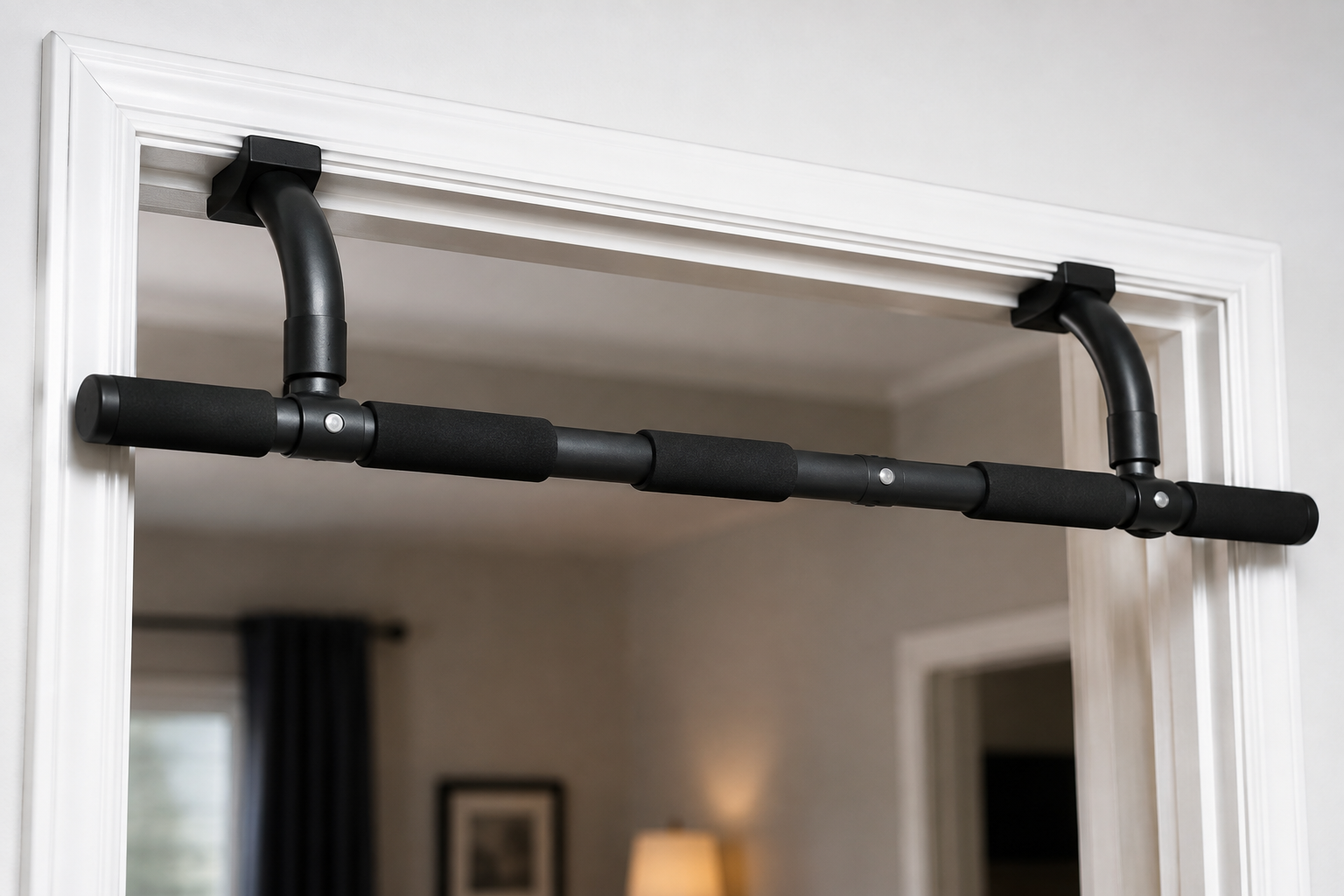
Doorway Pull-Up Bar: Limits, Risks, and the Best Alternatives for Your Home Gym
The doorway pull-up bar is one of the most sought-after solutions for those who want to train at home without dedicating an entire room to a home gym. The low cost, simplicity of installation, and the promise of being able to perform effective exercises like pull-ups, chin-ups, and various bodyweight variations make it particularly attractive for those with limited space. However, before purchasing one, it is fundamental to understand its structural limits, potential critical issues, and the real differences compared to a structure designed specifically to support a person's weight during intense workouts.
Many users choose a doorway bar without considering that door frames and home walls were not designed to withstand repeated dynamic loads. During a pull-up, body weight does not remain static but generates additional forces due to acceleration, oscillation, and explosive movements. This means that the load exerted on the door can be higher than the user's simple body weight.
In this guide, we analyze the advantages, disadvantages, risks, and available alternatives, helping you understand when a doorway bar can represent a temporary solution and when it is better to invest in a structure that is safer, more stable, and designed to support your athletic growth.
- How a doorway pull-up bar works
- The main structural limits
- Risks to safety and the home
- Impact on training
- The best alternatives
- How to choose the right solution
- Why invest in a dedicated structure
- Evaluating the best investment for your Home Gym
How a doorway pull-up bar works
Doorway bars can be pressure-mounted, lever-based, or hooked onto the door frame. Each system uses a different principle to distribute the user's weight without necessarily requiring permanent fixtures.
Telescopic versions are often advertised as easy to install because they expand by exerting pressure between the sides of the door frame. This feature allows for quick assembly but makes correct tightening essential to avoid unwanted movement.
Interlocking models instead use the geometry of the door frame to distribute the load. Although they generally offer greater stability than purely pressure-based systems, they still depend on the quality of the door and the sturdiness of the wall.
When to choose a screwless doorway pull-up bar
A screwless doorway pull-up bar can be attractive for those who rent or wish to avoid holes in the walls. However, this convenience inevitably entails some compromises in terms of stability and safety.
Before purchasing, it is advisable to check the dimensions of the door frame, the maximum weight declared by the manufacturer, and compatibility with the type of door in the home.
Features of the telescopic pull-up bar
The telescopic pull-up bar focuses primarily on simplicity of installation. However, the system requires correct tightening and periodic checks because repeated use can gradually change the locking force.
Even small movements can compromise the feeling of stability during demanding exercises like explosive pull-ups or preparatory muscle-ups.
The main structural limits
Most homes are not designed with bodyweight training in mind. Doors, door frames, and finishes have completely different functions than supporting high dynamic loads.
Doorway bars are also limited by the dimensions of the door frame, which often prevent the full execution of some exercises or limit the range of motion.
Even experienced users may perceive less psychological security compared to training on a rigid structure fixed to the floor or wall.
The problem of dynamic load
During every repetition, the body accelerates, decelerates, and oscillates. These variations increase the effective load transmitted to the structure compared to simple body weight.
Explosive movements, kipping, and oscillations further accentuate these stresses.
Limitations in exercises
Many advanced exercises are difficult or discouraged with a doorway bar. Dips, front levers, muscle-ups, and weighted work require significantly higher levels of stability.
Even the use of resistance bands, rings, or accessories can be less practical compared to a dedicated rack.
Risks to safety and the home
One of the most underestimated aspects concerns potential damage to the home. Not all doors have the same sturdiness, and different materials react differently to compression and repeated forces.
The possibility of the bar slipping increases when assembly is not carried out by strictly following the manufacturer's instructions or when surfaces are smooth or worn.
Training without periodic checks increases the risk of sudden failure and subsequent injury.
Possible damage to the door
Searches related to doorway pull-up bar damage are very frequent because numerous users report marks on the frame, paint deformation, or small structural failures of the door frame.
Even when damage is not immediately evident, repeated stress can progressively reduce the strength of the structure.
Safety comes first
Before every workout, it is advisable to check the tightening, stability, and integrity of the bar. A simple check takes a few seconds but can significantly reduce the risk of accidents.
Use must always respect the maximum weight and instructions indicated by the manufacturer.
Impact on training
An unstable structure also influences the quality of training. If the user perceives unwanted movement, they will subconsciously tend to limit force and intensity.
This can slow down technical progression and reduce the effectiveness of sessions dedicated to developing upper body strength.
Over time, many practitioners decide to switch to more robust solutions to increase the difficulty level of their exercises.
Limited progression
As the athletic level increases, so does the need to use weights, resistance bands, gymnastic rings, or more complex movements. A doorway bar is rarely the ideal solution at this stage.
The availability of a complete structure, on the other hand, allows for more varied programming.
User experience
A stable grip and a structure free of oscillations improve comfort, concentration, and the technical quality of the exercise.
These aspects directly affect the continuity of training in the long term.
The best alternatives
Those who have a dedicated space can look toward multifunctional stations, power racks, or freestanding structures designed specifically for bodyweight training.
These solutions allow for numerous exercises to be performed while maintaining higher levels of safety and greater freedom of movement.
Even if the initial investment is higher, the versatility and durability over time often compensate for the price difference.
Power racks and dedicated structures
A rack allows you to train not only pull-ups but also squats, bench presses, military presses, and many other fundamental exercises.
The greater rigidity promotes constant progression and professional use.
A solution designed to grow
For those who want to create a complete Home Gym, choosing a dedicated structure is often the most cost-effective choice in the long run. You can discover the solutions available in the Home Gym equipment range, designed to offer stability, modularity, and durability.
A professional structure also allows you to easily expand your training area by adding compatible accessories.
How to choose the right solution
The choice depends mainly on the available space, goals, and frequency of training. Those who perform a few occasional pull-ups may find a quality doorway bar installed correctly to be sufficient.
Those who plan regular workouts, progressions with weights, or advanced exercises should consider a more robust solution from the start.
Considering only the initial price risks leading to a purchase that will need to be replaced after a few months.
Evaluating available space
Even small environments can accommodate compact structures designed to offer greater stability than doorway bars.
Proper planning allows you to make the most of every square meter without sacrificing safety.
Looking at the long term
Investing once in a quality structure can be more cost-effective than the progressive purchase of limited accessories.
Durability, modularity, and the ability to evolve with your training represent concrete advantages.
Why invest in a dedicated structure
A structure designed to support high loads offers a stable base for any training program. The user can focus on technique without worrying about the equipment's hold.
The ability to integrate accessories greatly expands the available options, making the investment valid even in the long term.
For many enthusiasts, the transition from a doorway bar to a rack represents the moment when the Home Gym becomes truly complete.
Construction quality
Robust materials, accurate welds, and resistant finishes guarantee greater reliability and a significantly longer service life.
These elements become particularly important in case of frequent use.
Greater versatility
A complete structure allows you to train the entire body with a single investment.
This improves the efficiency of your home fitness area and promotes more complete programs.
Evaluating the best investment for your Home Gym
The doorway bar is a practical and accessible solution, but it is important to know its limits and potential risks before purchasing. Evaluating the quality of the door, your training level, and future goals allows you to make a more informed decision.
For those who want to build a Home Gym destined to last for years, a dedicated structure offers superior levels of safety, comfort, and growth potential, transforming daily training into a more effective and reliable experience.
Analyzing the initial cost together with the durability, stability, and versatility of the equipment allows you to make an investment truly oriented toward the long term and the continuous improvement of your performance.
Comments (0)