
Trolley
You have no items in your shopping cart

 Budgets
 Dumbers
 Discs
Discs
 Benches
 Racks and Rigs
 Weights Holders
 Isotonic machines
 Calisthenics
 Cardio
 Kettlebells
 Flooring
 Gym Set
 Accessories
 Combat
 ARTI MARZIALI
 CONTAINER GYM
 Tug-Of-War
 Used Gym Equipment
 PILATES MACCHINARI
 GINNASTICA ARTISTICA
 CAMPI DA PADEL
 Prodotti in Pronta Consegna
 Informazioni
 IRONMAN
 Gift Card
- Donatif
- General information
- 0 I like it
- 8 Views
- 0 comments
- gym flooring, safety flooring, gym safety, shock-absorbing materials
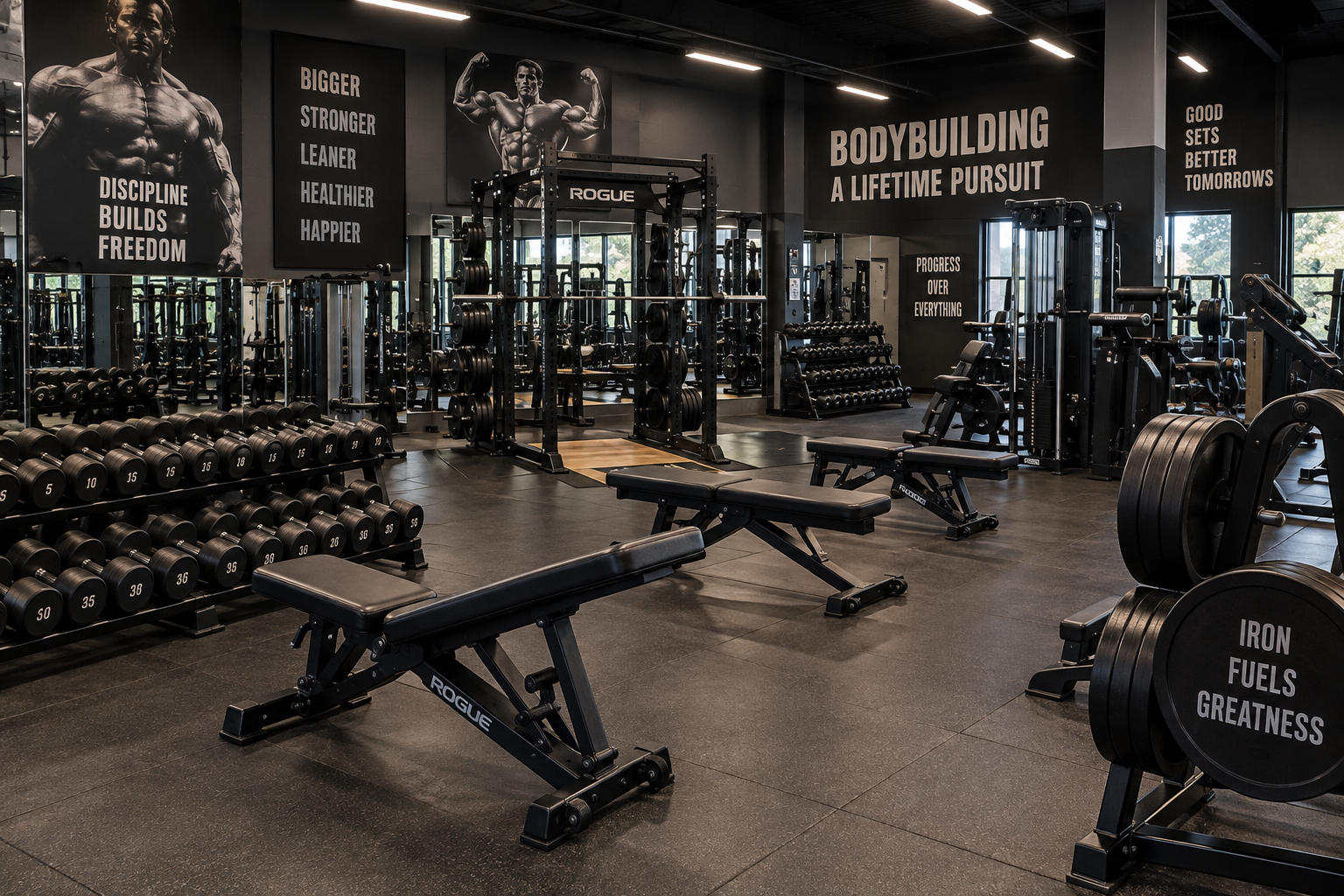
Weight room for bodybuilding: requirements and usage
A bodybuilding weight room must be designed to allow for progressive workouts, high workloads, and intensive use of equipment while maintaining high standards of safety and functionality. The ideal configuration combines free weights, isoinertial machines, and accessories, organized in a way that promotes a continuous training flow.
Unlike a generalist weight room, an area dedicated to bodybuilding must offer numerous possibilities for exercise variation, allow for load progression, and ensure the availability of equipment for all major muscle groups. The goal is to allow for complete workout programs without creating congestion during peak hours.
For a commercial gym manager, it is therefore essential to design spaces starting from the actual needs of users, evaluating the available surface area, area organization, equipment maintenance, and potential for future expansion.
- What requirements must a bodybuilding weight room have?
- What equipment is essential?
- How to organize the layout?
- How to correctly use the room?
- What safety aspects should be considered?
- Design errors to avoid
- Equipment maintenance
- Evaluating the investment
What requirements must a bodybuilding weight room have?
A room dedicated to bodybuilding must allow for complete workouts through a balanced combination of multi-joint and isolation exercises. The space must allow users to perform movements without interference and to move easily from one station to another.
The design must consider the distribution of equipment, internal pathways, the presence of areas dedicated to free weights, and flooring suitable for the loads normally handled during workouts.
The availability of numerous adjustments and progressive loads also makes it possible to satisfy users with different levels of experience.
Design objectives
The layout should promote continuous workouts, reduce waiting times, and allow for an effective progression of work programs.
Type of users
A bodybuilding-oriented gym generally welcomes users who frequently use free weights and seek a wide variety of exercises.
What equipment is essential?
A complete configuration includes racks, adjustable benches, barbells, dumbbells, weight plates, isoinertial machines, and accessories for complementary work. The goal is to allow the training of all major muscle groups without limiting the variety of exercises.
Free weights represent one of the central elements of the room because they allow for numerous training variants and high load progression.
Guided machines complete the offering by allowing isolation exercises and programs dedicated to different levels of preparation.
Barbells and racks
Olympic barbells, racks, and benches constitute the core of the area dedicated to fundamental exercises. You can learn more about the available solutions in the barbells category.
Isoinertial machines
Lat pulldowns, low rows, leg presses, chest presses, and other dedicated machines allow you to expand the number of available exercises and complete the workout program.
How to organize the room layout?
The layout should clearly separate the areas dedicated to free weights from the zones occupied by guided machines, maintaining easily navigable pathways even during peak hours.
A rational arrangement reduces crossing paths between users, facilitates instructor supervision, and improves the overall management of the room.
Dumbbell and plate racks should be placed close to their respective usage areas to limit movement with loads.
Functional subdivision
Organizing the space into dedicated areas helps make user circulation more orderly and simplifies the tidying up of equipment.
Operational pathways
Corridors should remain free of obstacles and allow passage even during the most intense workout sessions.
How to correctly use the weight room?
The correct use of equipment requires compliance with the instructions provided by the manufacturer and the adjustments intended for each machine.
Before starting any exercise, it is advisable to check the stability of the equipment, correctly select the load, and ensure that the surrounding area is clear.
At the end of the workout, plates, dumbbells, and accessories should be put back in their respective racks to keep the room tidy.
Initial adjustments
Seats, backrests, and locking systems must be adapted to the user before performing the exercise.
Tidying up equipment
Putting material away at the end of the workout improves safety, organization, and the lifespan of the equipment.
What safety aspects should be considered?
The safety distances in the weight room depend on the characteristics of the equipment and the operational spaces required during the execution of exercises. Each machine should be installed respecting the overall dimensions and instructions provided in the manufacturer's manuals.
It is also important to check the stability of the structures, keep passageways clear, and periodically check the condition of the flooring.
Staff training helps ensure the correct use of equipment and the rapid identification of any anomalies.
Technical manuals
Manufacturer manuals represent the main reference for the installation, use, and maintenance of equipment.
Periodic checks
Checking tightenings, adjustment systems, and components subject to wear helps maintain high safety standards.
What design errors should be avoided?
One of the most common errors consists of inserting an excessive number of machines, sacrificing the spaces necessary for free weights and user circulation.
Another critical issue concerns the choice of very similar equipment that limits the variety of the offering without providing real operational benefits.
Neglecting the organization of racks and areas dedicated to weight storage can also compromise order and safety.
Overcrowding of equipment
Maximizing the number of machines does not necessarily mean improving the quality of the workout or the efficiency of the gym.
Lack of planning
Each new piece of equipment should be included as part of an overall project and not as a simple occasional addition.
How to keep a bodybuilding room efficient?
Intensively used equipment requires scheduled checks, regular cleaning, and inspections of components most subject to wear. Cables, pulleys, adjustment systems, padding, and tightenings should be inspected following the manufacturer's instructions.
Flooring and weight storage systems also deserve periodic checks to ensure order, safety, and operational continuity. Documenting interventions facilitates maintenance planning and reduces the risk of sudden breakdowns.
Daily cleaning
Proper sanitization preserves materials and helps improve the user experience.
Scheduled inspections
Periodic checks allow for the timely identification of any anomalies before they turn into breakdowns.
How to evaluate the investment?
A weight room for bodybuilding represents an investment that must be planned by considering equipment quality, ease of maintenance, availability of spare parts, and the possibility of future expansion. A configuration designed with verifiable criteria allows for improved space utilization and offers a complete training experience without excessive purchases of underutilized equipment.
Before construction, it is advisable to develop a technical project that takes into account the available surface area, user flows, structural load capacities, and the operational needs of the gym. For installation, use, and maintenance, it is appropriate to refer to the equipment manufacturers' manuals, applicable standards, and checks carried out by qualified professionals, avoiding standard configurations that apply indiscriminately to every facility.
Comments (0)