
Trolley
You have no items in your shopping cart

 Budgets
 Dumbers
 Discs
Discs
 Benches
 Racks and Rigs
 Weights Holders
 Isotonic machines
 Calisthenics
 Cardio
 Kettlebells
 Flooring
 Gym Set
 Accessories
 Combat
 ARTI MARZIALI
 CONTAINER GYM
 Tug-Of-War
 Used Gym Equipment
 PILATES MACCHINARI
 GINNASTICA ARTISTICA
 CAMPI DA PADEL
 Prodotti in Pronta Consegna
 Informazioni
 IRONMAN
 Gift Card
- Donatif
- General information
- 0 I like it
- 10 Views
- 0 comments
- gym flooring, safety flooring, gym safety, shock-absorbing materials
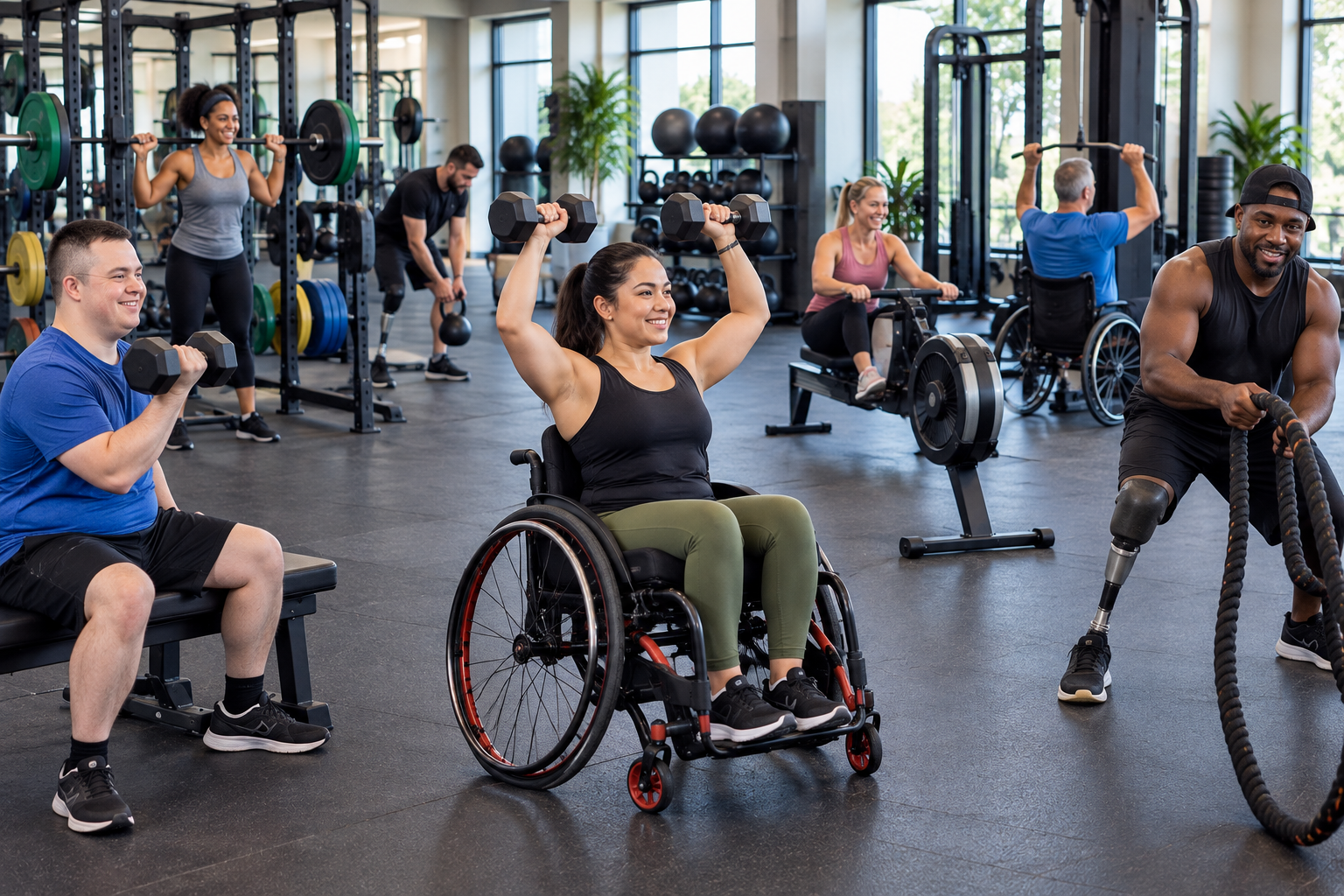
Criteria for Choosing Inclusive Sports Equipment: A Practical Guide for Gyms and Facilities
Paralympic sport and inclusive design mean selecting equipment that can be used by the greatest possible number of people, considering accessibility, safety, ease of use, adjustments, maintenance, and compatibility with available spaces. A choice based on verifiable criteria improves the quality of the sports experience and facilitates facility management over time.
Inclusive sports equipment does not represent a separate category compared to the traditional amenities of a gym. The goal is to design environments that allow users with different characteristics to train under the best possible conditions, reducing physical and organizational obstacles without compromising functionality and safety.
For fitness center managers, public bodies, sports associations, and designers, it is therefore important to evaluate every purchase as part of a broader system in which space, pathways, equipment, and operational organization work together to promote accessibility.
- Quick answer
- Which features really matter
- Selection criteria
- Compatibility with space and users
- Comparative criteria table
- Purchasing mistakes to avoid
- FAQ
- How to plan investments
How to choose inclusive sports equipment?
The choice should start from user needs, planned activities, and facility characteristics. It is advisable to prioritize equipment that is easily adjustable, simple to use, robust, accompanied by complete technical documentation, and compatible with the gym layout.
Each purchase should also be evaluated considering maintenance, availability of spare parts, and the possibility of integrating new stations without radically modifying the space organization.
Coherent design allows for an environment that is more accessible and easier to manage during all sports activities.
Goal of the choice
The goal is to create a space that can be used by the greatest possible number of users without introducing avoidable barriers during sports activity.
Design approach
Equipment should be selected as part of an overall project that includes pathways, flooring, area organization, and operational management.
Which features really matter?
The most important features concern not only technical performance but also simplicity of use, adjustability, and ease of access to the various stations.
Adjustments should be intuitive and reachable without complex procedures. This encourages smoother use and reduces the time needed to adapt equipment to individual needs.
Build quality also represents a fundamental element because frequent use requires robust components that are easily inspectable and simple to maintain.
Simple adjustments
Adjustments should be able to be made quickly following the instructions provided in the manufacturer's manuals.
Quality of materials
Resistant materials and easily replaceable components facilitate maintenance throughout the entire life cycle of the equipment.
What criteria to use in the choice?
The first criterion concerns the intended use. A municipal gym, a university sports center, or a facility dedicated to competitive training have different needs.
The second criterion concerns the expected number of users and the frequency of equipment use. The greater the intensity of use, the greater the importance of construction robustness and maintenance simplicity.
The third criterion concerns the possibility of progressively updating the gym configuration without completely replacing existing equipment.
User type
Analyzing the user profile allows for the selection of configurations that are genuinely consistent with the activities performed.
Project flexibility
A modular solution facilitates future expansions while maintaining operational continuity and streamlining investments.
How to verify compatibility with space and users?
Each equipment piece should be evaluated considering available spaces, internal pathways, and the maneuvering areas needed during use.
Stations should not obstruct passage between different areas of the gym nor create congestion points during workouts.
To learn more about solutions dedicated to sports facilities, you can consult professional gym equipment.
Layout compatibility
An orderly arrangement facilitates both movement and supervision by staff during sports activities.
Accessible pathways
Pathways should maintain continuity between the entrance, changing rooms, restrooms, and training areas while avoiding permanent or temporary obstacles.
Comparative selection criteria table
| Criterion | Why it matters | How to verify it |
|---|---|---|
| Adjustments | Facilitate adaptation to users | Practical test and technical manual |
| Accessibility | Improves usability | Layout and pathway check |
| Robustness | Reduces wear and interventions | Manufacturer documentation |
| Maintenance | Promotes operational continuity | Planned maintenance schedule |
| Modularity | Facilitates future expansions | Facility configuration |
| Compatibility | Avoids structural modifications | Analysis of available spaces |
What mistakes to avoid during purchase?
One of the most frequent mistakes consists of choosing equipment without previously analyzing the facility layout.
Another mistake concerns purchasing products that require complex adjustments or are difficult to perform during normal use.
It is also advisable to avoid configurations that reduce passageways or make routine gym maintenance more complex.
Ignoring the overall project
Each new piece of equipment should integrate with existing ones without compromising the general functionality of the facility.
Neglecting maintenance
The availability of technical documentation and maintenance procedures represents an element to be evaluated before purchase.
FAQ
Are there equipment options that work for all users?
There is no universal solution. The choice depends on the planned sports activities, user profiles, and facility characteristics.
Is it necessary to replace all existing equipment?
Not necessarily. In many cases, it is possible to improve accessibility by intervening on the layout and space configuration, and by progressively updating the equipment.
How much does equipment arrangement matter?
Arrangement is just as crucial as the quality of individual equipment because it affects the accessibility, safety, and organization of the entire facility.
How to plan investments in inclusive sports equipment?
Effective planning starts with the analysis of activities performed, the number of users, the characteristics of the environments, and the management needs of the facility. Only after this evaluation is it appropriate to define which equipment to purchase and how to distribute it in the available spaces.
When applicable, main references include national regulations on the elimination of architectural barriers, current building provisions, technical guidelines from the Italian Paralympic Committee for competent activities, manufacturer manuals regarding installation, use, and maintenance of equipment, and applicable standards for sports facilities. Compliance verification should be carried out in relation to the intended use of the facility.
A modular approach makes it possible to progressively update the gym, improving accessibility and functionality without intervening on all areas of the facility simultaneously. Planning purchases according to verifiable criteria allows for optimized investments and maintains a high quality of service over the long term.
Comments (0)