
Trolley
You have no items in your shopping cart

 Budgets
 Dumbers
 Discs
 Benches
 Racks and Rigs
 Weights Holders
 Isotonic machines
 Calisthenics
 Cardio
 Kettlebells
 Flooring
 Gym Set
 Accessories
 Combat
 ARTI MARZIALI
 CONTAINER GYM
 Tug-Of-War
 Used Gym Equipment
 PILATES MACCHINARI
 GINNASTICA ARTISTICA
 CAMPI DA PADEL
 Prodotti in Pronta Consegna
 Informazioni
 IRONMAN
 Gift Card
- Donatif
- General information
- 0 I like it
- 88 Views
- 0 comments
- gym flooring, safety flooring, gym safety, shock-absorbing materials
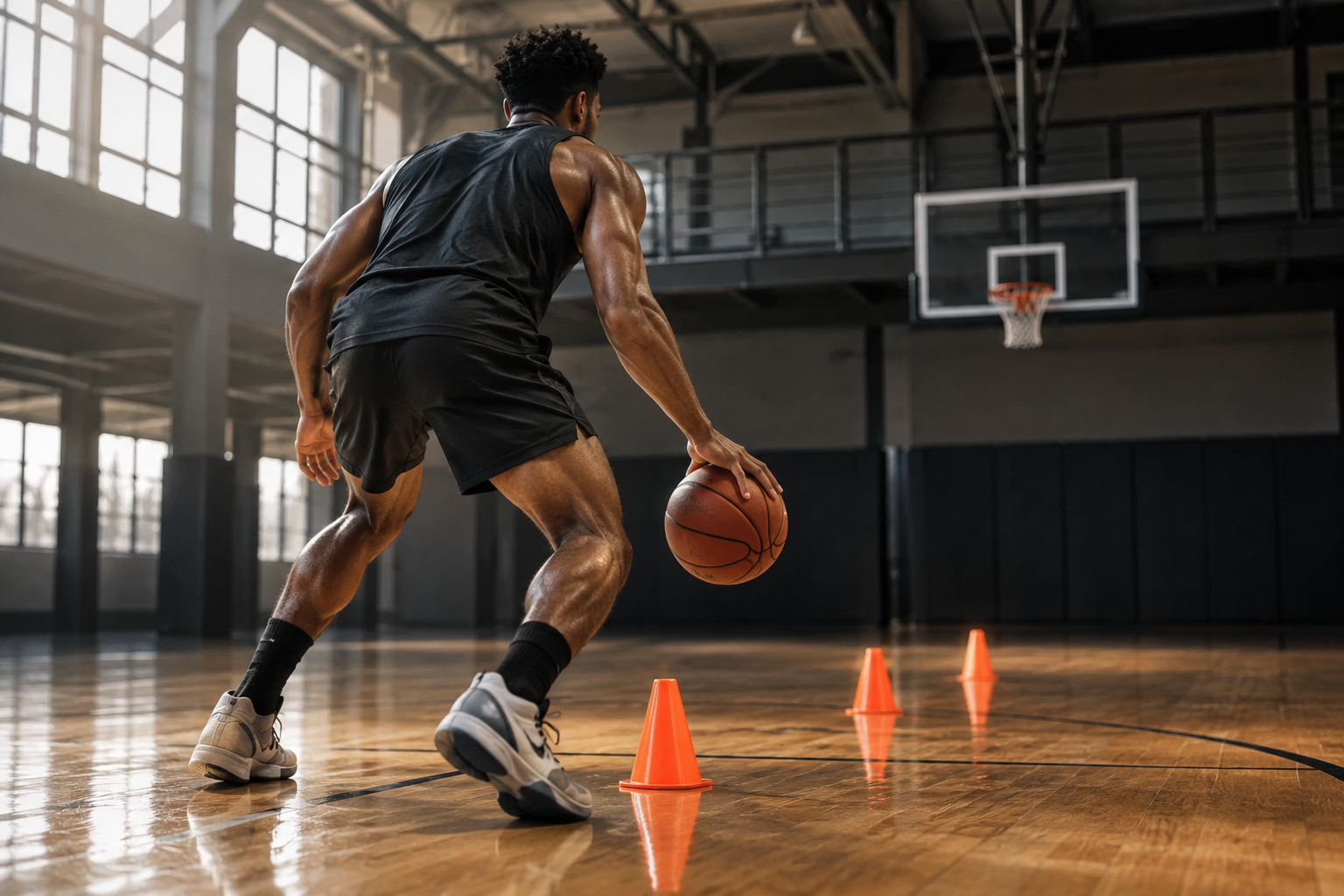
Athletic training for basketball players
Athletic preparation for basketball develops the physical qualities needed to accelerate, brake, change direction, jump, land and repeat demanding actions. It is more than a collection of leg exercises, and its value cannot be judged only by how exhausted a player feels afterwards.
A useful programme connects gym work with the competition calendar, training experience and on-court practice. A team facing several closely spaced games needs different decisions from a player preparing for a new season. Position, playing time and technical ability also affect workload distribution without requiring identical sessions for everybody.
This guide explains the main components of preparation and how to organise them. The examples describe general principles rather than an individual prescription. Resistance, volume and progression should be adapted by the people supporting the player, taking account of personal circumstances, recovery and team demands.
- Where should basketball preparation begin?
- How do you develop useful strength?
- How should acceleration and braking be trained?
- What role do jumping and landing play?
- How do direction changes differ from agility?
- How do players develop repeat-effort capacity?
- How should training and recovery fit into the week?
- How can you tell whether preparation is working?
Where should basketball preparation begin?
Begin by identifying the demands the player actually faces. Observe acceleration, stopping and footwork, alongside experience with resistance exercises. Establish the weekly schedule, technical sessions and other activity already being performed. A difficulty seen in a game does not necessarily come from one physical limitation: decision-making, technique and fatigue can interact. Avoid turning every problem into a request for more running or heavier weights. Define a few understandable priorities and decide how their development will be observed. This makes the programme easier to explain and prevents unrelated exercises accumulating without a clear purpose.
Assessments that inform decisions
Initial assessments should be repeatable and appropriate to age and experience. A test is useful when its result changes a practical decision, rather than merely filling a table. Keep conditions similar when repeating it and remember that familiarity and execution affect results. Compare the player primarily with their own development instead of ranking athletes in different circumstances. Pain or substantial limitations call for appropriate assessment before pursuing better performance. Recording the reason for a test helps distinguish a meaningful change from a different procedure.
How do you develop useful strength?
Strength supports propulsion, braking and body control, but preparation should include several movement patterns. Squatting, hip-dominant actions, pushing, pulling and single-leg work are exercise families to select according to competence and equipment. An exercise name does not guarantee usefulness: execution, resistance and its place in the week matter. Learn a controlled movement before increasing difficulty and keep contact points and movement paths recognisable as resistance rises. Constantly chasing the highest possible load is not required for a worthwhile session. Choose a challenge that serves the intended task instead of allowing the chosen weight to redefine the movement.
Single-leg work and the trunk
Court actions often involve producing or absorbing force through a predominant support leg. Unilateral work can help organise this task without making bilateral work unnecessary. The trunk contributes to transferring and controlling forces, so preparation is not simply a count of abdominal repetitions. Consider control during pushes, pulls and movement. If an exercise becomes mainly a struggle to balance, adjust it so the original goal remains clear. A less complicated version may allow better practice of the capacity being targeted.
How should acceleration and braking be trained?
Many basketball actions occur over short distances and begin from different positions. Acceleration training develops the ability to initiate movement purposefully with suitable foot contacts; it is not just longer-distance running. Use clear starting tasks and enough room to finish safely. High-quality fast actions need recovery. Accumulating progressively slower attempts changes the task, even if the player continues working hard. Distinguish a session intended to develop speed from one primarily intended to sustain effort. Keep the route understandable, and ensure players are not forced to negotiate unrelated obstacles while trying to execute a new starting action.
Learn to reduce speed
Braking deserves its own progression. Before adding complicated direction changes, establish the ability to slow down and control body position. Begin with predictable tasks, then gradually increase entry speed and decision-making demands. Insufficient stopping space can produce a different action from the one intended. Consider floor and footwear and keep the route clear. A slippery surface is not a useful shortcut for increasing difficulty because it changes contact conditions and makes the task less controllable. Progress should preserve an understandable stopping task.
What role do jumping and landing play?
Jumping matters, but complete preparation also considers the return to the floor. Observe how the player establishes contact, controls the body and prepares for the next action. Do not judge a landing only by its sound or by the appearance of one repetition. The context differs between a stationary jump, an approach jump and an action near other players. Use simple conditions for learning before increasing complexity or total contacts. Establish a task that the player can understand and repeat instead of assuming every jump variation trains the same quality equally.
Progress without unnecessary accumulation
Higher or more numerous jumps are not the only ways forward. Improvement can include a more coherent approach, smoother sequencing and repeated controlled contacts. Count the jumping already present in practices and games: additional work does not start from zero. If quality declines markedly, stop or modify the task. Avoid simultaneously raising jump demand, adding repetitions and cutting rest, because the response becomes harder to interpret. The purpose is useful preparation for play, not a separate contest to accumulate the largest number of demanding landings.
How do direction changes differ from agility?
A known route trains a predetermined sequence of contacts and movements. In a game, the player also reads information and chooses an action. Both settings can be useful, but they are not identical. Establish the movement you want to observe before adding signals and choices, while maintaining control of the space. An elaborate drill can become mainly a memory task if its rules absorb all attention. Complexity should serve basketball demands instead of merely making the exercise look impressive. Explain what the player is responding to and what counts as a useful response.
Equipment supports the task
Cones, floor markers and gym equipment can help organise practice. Do not attribute a quality to an accessory independently of how it is used. A coordination ladder can provide a reference for selected tasks, but moving through it quickly does not alone demonstrate game agility. Choose equipment that remains stable and visible, and place it away from areas where unexpected contact could interfere with movement. The available space and group organisation matter as much as the number of accessories used.
How do players develop repeat-effort capacity?
Basketball alternates intense actions, easier movement and pauses. Preparation should reflect that alternation without reducing everything to continuous sprints until exhaustion. Sustainable general work and more demanding intervals can serve different roles. Their place depends on the season and on the conditioning already supplied by court practice. If every additional session merely creates more fatigue, the player may become less available for the technical work preparation is supposed to support. Identify the missing demand first and choose a task that addresses it without duplicating everything already present in the week.
Specificity and workload control
Ball-based practice can contribute to physical demand, but duration alone does not establish its load. Player numbers, court space and rules change the pace. Agree with the coaching staff which objectives existing drills already cover. Add work for an identified need and retain criteria for adjusting it. A player with substantial game minutes and one who spent most of the game on the bench may need different distribution. This difference should reflect preparation needs rather than becoming punishment or an endurance competition between teammates.
How should training and recovery fit into the week?
Start with games and team commitments, then place athletic work around them. A demanding leg session can affect the next practice even when different exercises are used. Consider court and gym together instead of adding two independent programmes. During busy periods, less additional volume may help preserve quality and continuity; other periods may allow more development. There is no universal weekly arrangement that overrides the team's circumstances and player responses. Make the purpose of each session clear enough that staff can adapt it when travel, match timing or practice demands change.
Use communication and practical signals
Collect simple information about fatigue, sleep quality and perceived difficulty alongside movement observations. One value does not explain everything, but persistent changes deserve attention. Recovery includes food, rest and the organisation of commitments, not only extra activities performed after training. Pain that changes movement calls for stopping or adapting the task and seeking appropriate assessment. Completing a written plan at any cost is not a useful standard of success. Staff and players need a shared way to communicate when the intended task no longer matches the situation.
How can you tell whether preparation is working?
Look for the ability to complete intended work with more consistent execution and a sustainable weekly rhythm. Progress may appear in repeatable sprints, controlled braking and sustained movement quality as well as test scores. Do not automatically credit a good game to one exercise: technical performance, tactics and opponents affect the outcome. Seek plausible connections through repeated observations and comparisons under similar conditions. A useful review recognises both improvement and uncertainty rather than promising that a single physical measure explains an entire basketball performance.
Update a few priorities at a time
Keep a brief record of exercises, resistance, volume and reasons for changes. If a choice does not produce the intended response, review the goal, execution and placement in the week before adding more activity. Effective preparation remains understandable to player and staff. Its purpose is to improve the player's ability to face basketball demands while linking physical work to court skills and the recovery needed to practise them consistently. A clear programme is easier to adjust because each change has a reason rather than simply adding another demanding exercise to an already crowded schedule.
Comments (0)