
Trolley
You have no items in your shopping cart

 Budgets
 Dumbers
 Discs
 Benches
 Racks and Rigs
 Weights Holders
 Isotonic machines
 Calisthenics
 Cardio
 Kettlebells
 Flooring
 Gym Set
 Accessories
 Combat
 ARTI MARZIALI
 CONTAINER GYM
 Tug-Of-War
 Used Gym Equipment
 PILATES MACCHINARI
 GINNASTICA ARTISTICA
 CAMPI DA PADEL
 Prodotti in Pronta Consegna
 Informazioni
 IRONMAN
 Gift Card
- Donatif
- General information
- 0 I like it
- 62 Views
- 0 comments
- gym flooring, safety flooring, gym safety, shock-absorbing materials
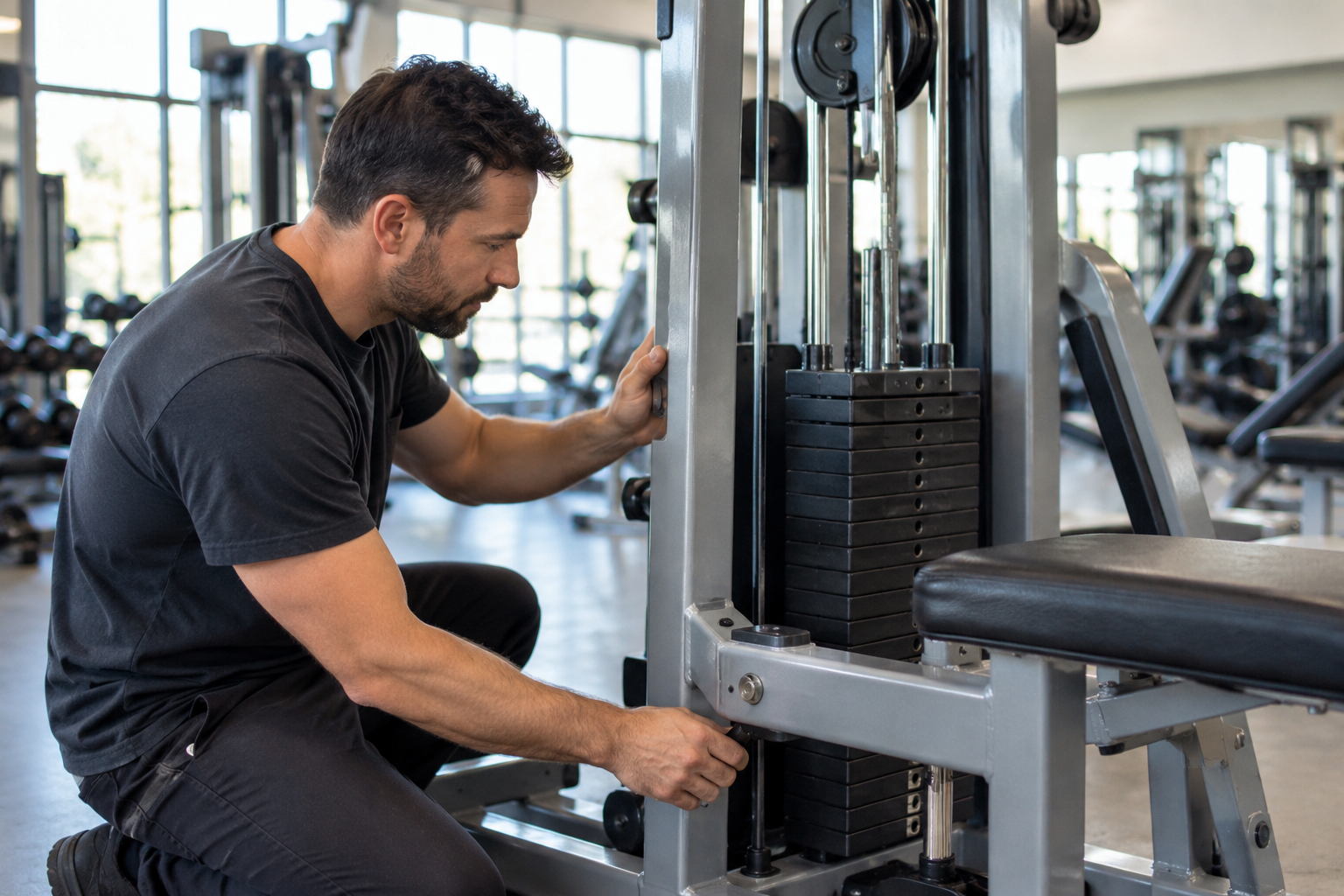
Used Gym Equipment: Risks and Checks Before Buying
Used gym equipment can be appropriate when its condition, intended application and total costs are clear. A price below new equipment does not establish value by itself. Hidden wear, missing parts, transport and restoration can change the outcome.
Distinguish visible observations from matters needing documentation or technical assessment. Fresh paint does not establish internal condition; cosmetic damage does not necessarily describe overall function. Evaluate the actual model for its intended use.
This guide covers identification, structure, movement, safety, documents, testing and costs. It is not a remote diagnosis or replacement for competent assessment. The aim is precise questions and comparable offers without assuming a uniform meaning for used or refurbished.
- How do you identify the model and intended use?
- What should be checked on the frame and supports?
- How should moving and wearing parts be examined?
- What matters for powered and cardio machines?
- Which documents and conditions should be requested?
- How should delivery, assembly and restoration be assessed?
- How do used, refurbished and new offers compare?
- When should you proceed or leave the decision open?
How do you identify the model and intended use?
Request brand, model and available machine identification. Clear photographs connect the offer to the real product. Confirm configuration, accessories and manufacturer-permitted use. Light previous use does not make a machine suitable for a different setting. Find the correct manual and compare dimensions, mass and installation requirements. Similar-model specifications may differ in version, parts and support. Identification is the basis for subsequent checks rather than a detail left until collection.
Available history
Ask about origin, duration and type of use, maintenance and repairs. History may be incomplete; acknowledge gaps instead of favourable assumptions. Read claimed light usage alongside observed condition. Retain confirmations and distinguish evidence from general statements. Like new does not explain what was checked. Transparency cannot remove every risk but shows unresolved questions before deciding.
What should be checked on the frame and supports?
Observe accessible structure, welds, joints and contact points without inappropriate dismantling. Corrosion, deformation, cracks and looseness need attention. Repainting can obscure signs and does not replace repair information. Confirm complete parts and correct assembly. No visible defect does not prove full integrity. Doubts about components supporting people or substantial loads require competent assessment. Do not improvise tests to discover structural limits.
Stability at the destination
Apparent stability in a seller's warehouse does not establish suitability for the new site. Consider floor, supports and required anchors. Do not disguise a deformed frame with random packing. Distinguish permitted adjustment from undocumented adaptation. Establish whether required fixing is possible and include its cost and feasibility. Discovering installation incompatibility after purchase complicates every solution.
How should moving and wearing parts be examined?
Guides, bearings, cables, pulleys, joints and surfaces differ by equipment. Observe regular movement, noises and play using permitted test methods. Do not touch moving parts or remove guards during operation. Ask which elements were replaced and with what. Partial repair is not whole-machine assessment. Recent maintenance needs detail explaining its scope rather than an assumption of complete restoration.
Seats, grips and adjustments
Coverings and handles affect comfort and contact, not just appearance. Test adjustments safely and confirm pins and locks work as intended. A slipping seat or insecure grip needs attention. Distinguish appropriate replacement parts from improvised modifications. Consider actual users too: a working adjustment can still lack the range they need. The machine must suit the task as well as be repairable.
What matters for powered and cardio machines?
Identify supply requirements, connections and accessible components from the manual. Avoid improvised electrical changes or unqualified internal checks. An intact cable covering does not describe the whole electrical system. Seek qualified support when needed. Observe starting, controls, transitions and stopping as specified. A lit display does not prove every function works. Connected features may require excluded services or accessories. Establish what remains available after transfer.
Testing actual use
Assessment should relate to the task, not a brief unloaded demonstration. Agree safe conditions. Maximum operation is not automatically necessary to establish suitability. Use checks relevant to intended work and technical observation where appropriate. Record faults and explanations. An untested feature remains unverified rather than assumed fully operational. Missing information affects the decision even when the rest looks good.
Which documents and conditions should be requested?
An offer should identify equipment, configuration, declared state and included parts. Clarify seller, supply and services. Manuals, recorded interventions and parts information support later management. Terms such as serviced, regenerated and refurbished do not always mean identical work. Ask what checks and replacements support the description. Documents need to concern the real product rather than generic category promotion.
Read warranty and support terms
Applicable conditions depend on contract and purchase context. Read them and clarify uncertainty instead of relying on a general verbal promise. Distinguish coverage, exclusions, reporting procedure and added services. Support availability does not automatically mean immediate or cost-free intervention. Check location, components and methods. Specific rights or obligations call for qualified advice rather than universal assumptions based on the used label. Clear agreements simplify later operation.
How should delivery, assembly and restoration be assessed?
Measure the route before buying: doors, stairs, lifts and handling space matter. Request transport dimensions and mass rather than only operating size. Dismantling must follow relevant instructions and expertise, with identifiable parts and an assembly plan. Not every machine can be separated without consequences. Clarify loading, transport, unloading and installation responsibility. The advertised price may exclude these and therefore not represent the cost of a usable station.
Parts and timing
Before accepting a repairable defect, verify compatible parts, availability, cost and work. Similar-looking components may not fit. Consider downtime, particularly for shared services. Do not base plans on unsupported optimistic estimates. Unquantified intervention is uncertainty to record and weigh. An inexpensive purchase may lose value when restoration is difficult or service cannot start on time. Include feasibility rather than assuming every fault has an easy fix.
How do used, refurbished and new offers compare?
Compare equivalent applications and inclusions beyond initial price. Assess gym equipment through setup, condition, installation, maintenance and support. New is not automatically more suitable, and used not automatically better value. Clear information determines comparison quality. Separate an offer including assembly and checks from collection-only supply. Adjustment range and permitted use must remain compatible with people and room.
Avoid superficial comparisons
More functions do not necessarily add value if unused. Another model can change space and management. Write essential requirements and preferences to resist an attractive but unsuitable offer. Price proves reliability in neither direction. High cost does not establish complete checks; low cost does not alone explain risk. Condition, evidence and required operations make evaluation possible. Alternatives should solve the actual need rather than merely fill available floor space.
When should you proceed or leave the decision open?
Summarise model, observed condition, documents, test, interventions and total cost. Separate confirmed and missing information. Do not replace unverifiable essentials with favourable assumptions through fear of missing an opportunity. Wait for relevant answers where necessary. Retain agreements for delivery and installation. The decision should be explainable through criteria rather than the feeling that the price was too attractive to wait.
Preparing ongoing use
After installation follow model procedures and organise maintenance and fault reporting. Pre-purchase checks do not eliminate future attention. In shared facilities, define intervention responsibility and withdrawal from use. A coherent purchase covers offer through daily management. The objective is not zero uncertainty, but understanding which conditions support a sustainable choice and which problems still require answers. This avoids both impulsive enthusiasm and automatic rejection of used equipment.
Comments (0)