
Trolley
You have no items in your shopping cart

 Budgets
 Dumbers
 Discs
 Benches
 Racks and Rigs
 Weights Holders
 Isotonic machines
 Calisthenics
 Cardio
 Kettlebells
 Flooring
 Gym Set
 Accessories
 Combat
 ARTI MARZIALI
 CONTAINER GYM
 Tug-Of-War
 Used Gym Equipment
 PILATES MACCHINARI
 GINNASTICA ARTISTICA
 CAMPI DA PADEL
 Prodotti in Pronta Consegna
 Informazioni
 IRONMAN
 Gift Card
- Donatif
- General information
- 0 I like it
- 55 Views
- 0 comments
- gym flooring, safety flooring, gym safety, shock-absorbing materials
Strength exercises to perform on a bench: practical techniques and criteria for the weight room
Strength exercises to perform on a bench represent a fundamental component of athletic preparation and resistance training. In a professional weight room, the bench is not just a support for barbell presses, but a versatile tool that allows for the development of strength, stability, and motor control through numerous exercise variations. The correct choice of movements and execution methods directly affects the quality of the training stimulus and the safety of the users.
For a weight room manager or a strength coach, effectively organizing bench exercises means evaluating several aspects: equipment characteristics, athlete position, load distribution, adjustment possibilities, and compatibility with racks, barbells, and dumbbells. A well-designed station must allow for repeatable executions and adapt to different levels of experience without introducing avoidable technical limitations.
In this guide, we analyze the main strength exercises achievable with a bench, the operating methods for performing them correctly, and the criteria to use in programming. The goal is to offer concrete indications to improve weight room organization, support the work of coaches, and enhance available equipment through usage consistent with athletes' needs.
- The role of the bench in strength training
- Barbell bench press
- Strength exercises on a bench with dumbbells
- Back training with bench support
- Lower body exercises with the bench
- Core stability and motor control
- Load programming and progression
- Safety and station organization
- Evaluating investment in the strength area
The role of the bench in strength training
The bench is one of the most used elements in areas dedicated to strength because it allows the body to be stabilized during numerous resistance movements. The support offered by the padded surface allows for better control of the torso position, reduces certain balance requirements, and concentrates work on the muscle groups involved in the exercise. These advantages become particularly important when using heavy loads or seeking measurable technical progressions.
However, not all benches offer the same operational possibilities. A fixed flat bench has different characteristics compared to an adjustable model, while a bench integrated into a powerlifting station may include specific supports for the barbell and dedicated dimensional requirements. The choice of configuration must therefore start from the exercises actually programmed and the level of the users.
In a weight room and powerlifting gym, the availability of stable surfaces, sturdy structures, and reliable adjustment systems contributes to making workouts more efficient. An adequate bench must maintain its position during repetitions, offer consistent support, and allow the athlete to correctly organize contact points with the floor.
Differences between flat and adjustable benches
The flat bench is mainly used for horizontal presses, supported pulling exercises, and accessory movements. Its simple geometry favors the repeatability of settings and allows one to focus on execution technique. In powerlifting-oriented contexts, the stability and dimensions of the surface take on particular importance.
An adjustable bench, instead, allows for changing the inclination of the backrest, expanding training possibilities. Adjustments must be easy to use and equipped with secure locking systems, especially when the station is shared by numerous users.
Stability and surface characteristics
The quality of support depends on the rigidity of the structure, the density of the padding, and the properties of the covering. An excessively soft surface can make the torso position less stable, while a too slippery covering can compromise maintaining alignment during presses.
For professional use, it is also appropriate to check the height of the bench, the width of the surface, and the load capacity declared by the manufacturer. Load capacity must be evaluated considering the intended use conditions and not just the athlete's body weight.
Barbell bench press
The barbell bench press is one of the fundamental exercises for developing upper body strength. It primarily involves the pectoralis major, triceps brachii, and anterior deltoid, with a significant contribution from the stabilizing musculature. The ability to progressively increase the load makes this movement particularly useful in maximal strength preparation.
Correct execution requires a stable position on the bench, conscious control of the shoulder blades, and a barbell path compatible with the athlete's anthropometric characteristics. Technique must be adapted to individual mobility and training goals, avoiding imposing an identical configuration on all users.
From an organizational point of view, the station should allow for controlled barbell removal and have adequate safety systems. When working with loads close to the maximum, the assistance of a competent spotter or the use of correctly adjusted protective devices represent particularly important measures.
Operational technique of the flat bench press
The athlete positions themselves with their head, upper back, and pelvis in contact with the bench, keeping feet in stable support according to the adopted technique. The shoulder blades are organized in a controlled position, while the grip must allow maintaining wrists and forearms in an effective alignment during the push.
After removal, the barbell is lowered in a controlled manner toward the chest and subsequently pushed up to the intended extension. The trajectory does not necessarily have to be perfectly vertical: in experienced lifters, it may present a diagonal component consistent with the biomechanics of the movement. Control of the eccentric phase remains essential even when the main goal is to develop high strength.
Variations with pause and different grip
The bench press with a chest pause is frequently used in powerlifting preparation because it develops control in the lower position and allows training the restart without exploiting a rebound. The duration of the pause must be defined according to the program and kept consistent between repetitions.
The press with a relatively narrow grip modifies the distribution of joint and muscle demands, generally increasing the contribution of the triceps. The width of the grip must, however, respect individual mobility and tolerance. To compare results over time, it is useful to keep grip, range of motion, and execution modes constant.
Strength exercises on a bench with dumbbells
Dumbbells expand training possibilities because they allow the upper limbs to move relatively independently. Compared to the barbell, they generally require greater control of the trajectory and allow for adapting hand orientation to the athlete's characteristics. This flexibility can be useful in general strength programs and complementary exercises.
The dumbbell press on a flat bench represents one of the most common applications. The movement involves the main pushing muscles of the upper body but requires particular attention to the preparation and conclusion phases of the set. Transferring the dumbbells from the seated to the supine position must be performed with a controlled procedure.
Variations on an inclined bench allow for changing the orientation of the push relative to the torso. The inclination influences the distribution of muscle work and joint demands, but there is no universally better angle for every athlete. The choice must consider goals, mobility, and the ability to maintain a stable position.
Dumbbell presses on a flat bench
To perform the movement, the athlete positions themselves on the bench keeping feet stable and dumbbells in a controlled position at the sides of the chest. During the push, the arms extend following a trajectory compatible with shoulder mobility, avoiding excessive oscillation or loss of control.
The descent phase must be slow enough to maintain muscle tension and joint stability. The range of motion is defined according to individual capacities, without seeking excessive stretching that provokes compensations or discomfort.
Inclined bench presses
Inclined presses are often used to vary the stimulus on the pectoral muscles and anterior deltoid. A moderate inclination allows for changing the direction of the push without completely transforming the exercise into a vertical press. By increasing the angle, the relative involvement of the shoulder musculature generally grows.
The adjustment of the backrest must be verified before starting the set. It is important that the athlete keeps the pelvis stable and does not compensate with excessive lumbar extension to artificially modify the effective inclination of the torso.
Back training with bench support
The bench can also be used for pulling exercises intended for the development of the dorsal musculature. In these movements, support allows for controlling the torso position and, in some variations, reducing the demand for stabilization of the lumbar region. This makes the bench a useful tool even in programs that include high volumes of upper body training.
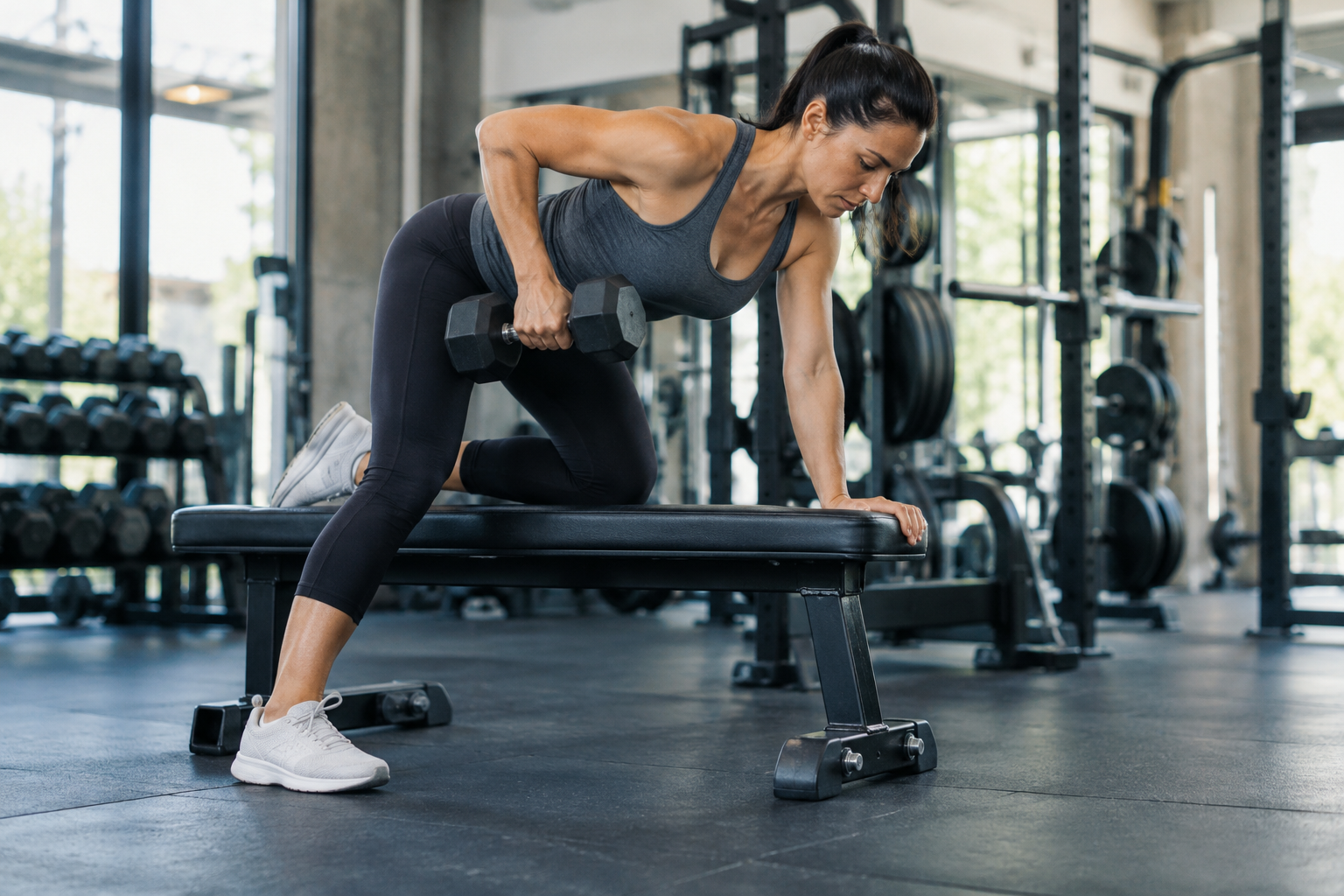
The one-arm dumbbell row with bench support is a particularly versatile exercise. It allows training one side at a time and observing any differences in control between the limbs. The body position must be organized in a way that avoids uncontrolled rotation of the torso and compensatory movements.
Another possibility is the row with the chest supported on an inclined bench. This configuration reduces the need to independently maintain the flexion of the torso, allowing for more focused attention on the pull. The choice between variations depends on technical needs and the distribution of fatigue in the program.
Unilateral row with dumbbell
The athlete uses the bench as a support point for one hand and, when appropriate, for a knee, keeping the torso in a stable position. The dumbbell is pulled toward the hip through a coordinated movement of the shoulder and elbow, without transforming the exercise into a torso rotation.
The trajectory must be compatible with body structure and muscle goals. To improve execution quality, it is useful to control the position of the pelvis, avoid jerking, and maintain a managed eccentric phase.
Chest-supported row
In the chest-supported row, the bench is inclined so as to offer stable support to the front of the torso. The athlete grabs the dumbbells and performs the pull while maintaining contact with the surface, avoiding lifting the torso to complete the repetitions.
This variation can be useful when one wishes to limit the contribution of momentum and make the execution more repeatable. However, it is necessary to check that the bench structure allows sufficient freedom of movement for the dumbbells and that the feet can maintain secure support.
Lower body exercises with the bench
Although it is primarily associated with chest training, the bench can also be used as a support for lower body strength exercises. In this context, it takes on a different function: it can provide a reference for the depth of movement, support a limb, or contribute to defining the initial position.
Among the most common applications are box squats with appropriate height, split squats with elevated rear foot, and some hip extension variations. Not all of these exercises are suitable for every bench. Stability, height, and resistance to lateral displacement must be evaluated before use.
For coaches, it is important to distinguish the goal of the exercise from the simple use of available equipment. A bench may be comfortable as a support, but it should not replace a specific structure when safety conditions or required geometry are not adequate.
Split squat with elevated rear foot
The split squat with an elevated rear foot is performed by keeping one foot on the floor and resting the other behind the body on a stable support. The athlete flexes the front limb controlling the descent and subsequently returns to the initial position through hip and knee extension.
The distance from the support must be adapted to body proportions and individual mobility. A support that is too high can make it difficult to maintain an effective position, especially in less experienced subjects. It is therefore appropriate to use an appropriate surface and verify that it cannot slip.
Hip thrust with bench support
In the hip thrust, the upper back is placed on a stable bench while the pelvis performs a hip extension movement. The load can be represented by an appropriately positioned and protected barbell, or by other resistances compatible with the athlete's level.
During execution, it is important to maintain adequate control of the torso and reach hip extension without unnecessarily accentuating lumbar hyperextension. The bench must be sufficiently stable and must not move under the athlete's push. In high-use contexts, a station specifically designed for this exercise may be preferable.
Core stability and motor control
The bench can be integrated into programs dedicated to core stability, provided it is used as a support consistent with the exercise's characteristics. Strength does not depend exclusively on the ability to produce tension in the main muscle groups, but also on the possibility of effectively transferring forces through the body.
In resistance movements, core control contributes to maintaining efficient positions and limiting unwanted compensations. For this reason, complementary exercises that require stabilization can be useful in general preparation, especially when selected according to individual needs.
However, it is important to avoid turning every exercise into a balancing act. To develop high strength, a stable base generally allows for using more significant loads and better controlling technique. Variations that introduce instability must have a precise goal and not automatically replace fundamental movements.
Inclined plank with hands on the bench
The inclined plank is performed by placing hands on a stable bench and keeping the body aligned. Compared to the floor variant, the inclined position can reduce the overall demand and be useful in initial core control progressions.
During execution, it is important to maintain regular breathing and control the position of the pelvis. The goal is not to prolong the duration indefinitely, but to maintain a consistent posture for the time specified by the program.
Support in unilateral exercises
A bench can offer a support point during some unilateral exercises, allowing the athlete to focus on force production without requiring excessive balance control. This mode is useful especially when the main goal concerns muscle work and not stabilization.
The coach must evaluate whether the support facilitates the movement or introduces unnatural positions. The chosen configuration should allow for measurable load progression and consistent repetition of execution conditions.
Load programming and progression
The selection of bench exercises must be inserted into a program consistent with the athletes' goals. A program oriented toward maximal strength has different characteristics compared to a path dedicated to hypertrophy or general physical preparation. Intensity, number of repetitions, recovery, and fatigue distribution change.
For fundamental barbell movements, progression can be organized using percentages of the maximum, perceived exertion ratings, or indicators of execution speed. None of these tools is universally superior: the choice depends on the coach's experience, the availability of reliable data, and the athlete's level.
Complementary dumbbell exercises can instead be managed through rep ranges and progressive load increments. The most important aspect consists of maintaining sufficiently constant execution conditions, avoiding interpreting an increase obtained exclusively by reducing the range of motion or modifying the technique as strength improvement.
Sets, repetitions, and intensity
In strength programs, the main movements are often performed with relatively high loads and a limited number of repetitions per set. Ranges like 3-6 repetitions can be used in many preparation phases, but they do not constitute a valid prescription for every subject or period.
Accessory exercises can include wider ranges, for example, 6-12 repetitions, when the goal includes muscle development and technical consolidation. Overall volume must be adapted to recovery capacity and other stimuli present in the week.
Technical progression and monitoring
Before increasing the load, it is appropriate to verify that the athlete maintains a controlled trajectory, a stable position, and a consistent range of motion. Progression can also occur through greater execution precision, better control of the pause, or a more efficient distribution of effort.
Recording loads, repetitions, and technical observations allows for evaluating results over time. In professional contexts, a log shared between coaches contributes to maintaining continuity in managing athletes and avoiding arbitrary changes in parameters.
Safety and station organization
The quality of a station for bench exercises also depends on the organization of the surrounding environment. Racks, barbells, weight plates, and dumbbells must be placed in such a way as to allow safe access and reduce interference between users. The layout of the equipment affects preparation times, supervision, and the management of sessions during peak hours.
For barbell presses, the presence of adjustable supports and safety devices represents a central element. Safety bars must be positioned in such a way as to be able to catch the load in case of failure, without interfering with correct execution. The adjustment must be verified in relation to the athlete's actual position on the bench.
Flooring also contributes to the functionality of the station. A stable, non-slip surface adequate for expected loads favors correct equipment placement. Lifting platforms must be integrated considering the needs of the practiced disciplines and the structural characteristics of the building.
Racks and safety systems
Integrating the bench into a rack allows for organizing a versatile station for different barbell exercises. It is necessary to verify compatibility between the dimensions of the bench, the width of the supports, and the space available for the athlete's movement.
Safety bars and barbell rests must be adjusted before the start of the sets. When using heavy loads, staff must know assistance procedures and how to manage a non-completed repetition.
Space and flow management
An efficient weight room must allow users to prepare the load without continuously crossing others' training areas. Proximity to racks and plate holders can reduce movement, but it must be balanced with the need to keep paths clear.
It is useful to define zones dedicated to barbell presses, dumbbell exercises, and complementary movements. This organization facilitates technical supervision and limits improper occupation of the most requested stations.
Evaluating investment in the strength area
Planning an area dedicated to bench exercises should start from the analysis of the activities performed and the number of expected users. For a powerlifting-oriented facility, the priority may be the availability of stable and repeatable stations for barbell presses. In a generalist gym, however, the versatility of adjustable benches may take on more weight in resource distribution.
Among the main practical criteria for evaluation are stability, declared load capacity, surface dimensions, quality of adjustments, and compatibility with other equipment. It is important to also consider ease of cleaning, durability of coverings, and availability of replaceable components. These aspects affect operational continuity and management costs in the medium term.
An operational how-to approach to design involves first identifying fundamental exercises, verifying necessary footprints, and subsequently defining the configuration of the stations. In this way, it is possible to avoid redundant purchases and concentrate investment on equipment that responds to the actual needs of the athletes.
Compatibility between benches, racks, barbells, and plates should be verified through measurements and technical specifications, not just on the basis of commercial descriptions. A bench that works correctly in an independent station could present limitations when placed in a rack with different geometry. Similarly, the position of the supports can influence the ease of barbell removal.
The number of benches to install must be proportionate to the frequency of use and the average duration of sessions. In weight rooms with high turnout, a balanced distribution of stations can reduce waiting times and improve program organization. It is useful to observe actual user flows before deciding on any expansions.
Technically correct investment must also consider scheduled maintenance. Periodic checks of fastenings, adjustment systems, coverings, and support surfaces contribute to keeping equipment in adequate condition. The availability of technical documentation and assistance represents an important criterion in selecting the supplier.
For a strength area manager, the value of a bench does not, therefore, coincide with the theoretical number of exercises it allows one to perform. What counts above all is the ability to offer stable, safe, and repeatable conditions for the movements actually planned by the programming. A selection based on operational needs allows for better use of available space, supports the work of coaches, and keeps the quality of the training experience high.
Comments (0)