
Trolley
You have no items in your shopping cart

 Budgets
 Dumbers
 Discs
 Benches
 Racks and Rigs
 Weights Holders
 Isotonic machines
 Calisthenics
 Cardio
 Kettlebells
 Flooring
 Gym Set
 Accessories
 Combat
 ARTI MARZIALI
 CONTAINER GYM
 Tug-Of-War
 Used Gym Equipment
 PILATES MACCHINARI
 GINNASTICA ARTISTICA
 CAMPI DA PADEL
 Prodotti in Pronta Consegna
 Informazioni
 IRONMAN
 Gift Card
- Donatif
- General information
- 0 I like it
- 243 Views
- 0 comments
- gym flooring, safety flooring, gym safety, shock-absorbing materials
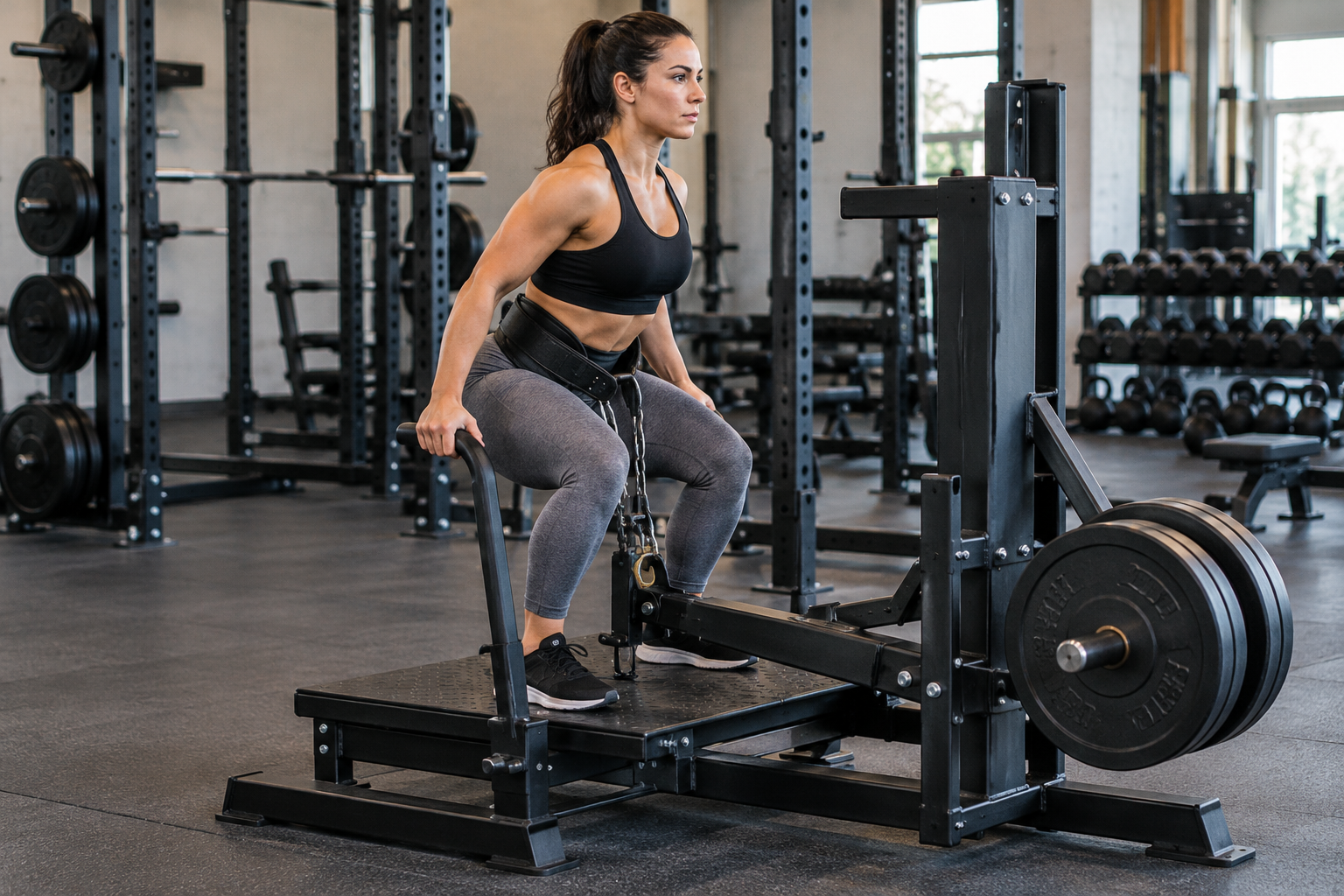
Belt squat: how it works and who it is suitable for in the weight room
The belt squat is a lower limb training solution that allows resistance to be applied through a belt positioned around the pelvis, rather than directly supporting a barbell on the shoulders. This feature makes it interesting for professional gyms, athletic preparation centers, and weight rooms that want to offer different training modes for squats and similar movements.
Understanding how the belt squat works means analyzing the resistance path, muscle involvement, machine adjustments, and differences compared to the traditional squat. Although it can reduce certain load support demands on the trunk, it does not eliminate stress on the spine and does not automatically represent a suitable solution for anyone experiencing pain or physical limitations.
For a weight room manager or strength area supervisor, the evaluation also includes organizational aspects. Dimensions, compatibility with users, ease of access, maintenance, and costs must be considered along with the potential benefits of the exercise. This guide delves into how the belt squat works and proposes practical criteria for understanding when to include it in a professional facility.
- How the belt squat works
- Which muscles the belt squat works
- Differences between belt squat and barbell squat
- Who the belt squat is suitable for
- Execution technique and adjustments
- Types of belt squat and resistance systems
- How to include the belt squat in programming
- Technical criteria for choosing a belt squat
- Investment and evaluation for a professional weight room
How the belt squat works
The principle of the belt squat consists of applying resistance to the pelvis through a belt connected to a load system. During the movement, the user performs flexion and subsequent extension of the lower limbs, following a dynamic similar to that of the squat. The load is transmitted primarily through the connection with the belt, modifying the support demands compared to a barbell resting on the upper body.
The actual operation depends on the machine configuration. Some models use articulated levers, others cable and pulley systems, or dedicated platforms with plate loading. These differences can modify the direction of resistance, the load trend during the movement, and the user's sensations.
An important feature is the ability to train the lower limbs without having to support a barbell on the shoulders. This does not mean the trunk is completely inactive. Posture control, balance, and stabilization remain necessary, with demands varying according to the model and technique used.
How the load is transmitted
The belt connects to a resistance system that may include cables, chains, or mechanical arms. During descent and ascent, the connection transfers force to the pelvis. The behavior of the system depends on the geometry of the machine and the characteristics of the mechanism.
It is important not to confuse the weight of the loaded plates with the actually perceived resistance. In lever or pulley systems, mechanical ratios and geometry can modify the force required in the different phases of the movement.
The role of the belt and connection points
The belt must distribute the load in a way that is compatible with the user's body and the manufacturer's instructions. Dimensions, padding, adjustments, and connection points influence comfort and stability during the exercise.
An unsuitable belt can create localized pressure or positioning difficulties. For this reason, in a gym frequented by people with different body types, it is useful to verify the ability to correctly adjust the system.
Which muscles the belt squat works
The belt squat primarily involves the muscles responsible for knee and hip extension. Quadriceps and gluteus maximus participate significantly in the movement, while other muscle groups contribute to stabilization and joint control. The distribution of work depends on depth, foot position, trunk inclination, and machine characteristics.
There is no configuration capable of completely isolating a single muscle group. Even when the primary goal is training the quadriceps, the movement requires the collaboration of multiple joints. For this reason, it is more correct to describe the belt squat as a multi-joint exercise for the lower limbs.
The subjective sensation of muscle work can vary among users. One athlete may perceive greater involvement of the quadriceps, while another may feel a more marked work on the glutes. These differences should not automatically be interpreted as precise measurements of muscle activation.
Quadriceps and glutes during movement
The quadriceps contribute to knee extension during the ascent phase. The gluteus maximus participates in hip extension, with a role influenced by the range of motion and the position assumed.
Greater knee flexion can modify the mechanical demands on the quadriceps, but the effect depends on the entire configuration. It is not correct to attribute fixed percentages of muscle involvement to all belt squats.
Stabilizer muscles and trunk control
The abdominals and other trunk muscles contribute to maintaining position during the exercise. Their demand may be different compared to the barbell squat, but it does not disappear completely.
Hip and ankle muscles also participate in movement control. Platform stability and the possible presence of handles can influence the work required to maintain balance.
Differences between belt squat and barbell squat
The main difference concerns the position and transmission of the load. In the traditional barbell squat, resistance is supported on the upper body and requires significant trunk stabilization activity. In the belt squat, the load is connected to the pelvis, modifying the distribution of stress.
This feature can make the belt squat useful as a complementary exercise to train the lower limbs without fully reproducing the demands of the barbell squat. However, it is not correct to consider it a perfectly equivalent substitute. Motor skills, balance conditions, and technical demands can be different.
For powerlifting athletes, the barbell squat remains a specific gesture of the discipline. The belt squat can contribute to accessory work, but it does not automatically replace the technical practice of the competitive movement. The choice depends on program goals and individual needs.
Differences in axial load management
The belt squat without a barbell on the shoulders modifies how resistance is applied to the body. This can reduce some demands associated with directly supporting a load on the upper trunk.
However, this does not mean the spine is completely free of stress. Forces generated by movement and muscle activity continue to affect the musculoskeletal system. Any clinical conditions require individual assessments by qualified healthcare professionals.
Powerlifting squat specificity
In powerlifting, the ability to manage the barbell, maintain position, and coordinate movement is an essential part of performance. The belt squat does not reproduce all these demands.
It can still be used to increase lower limb training volume when the coach deems it appropriate to differentiate stimuli. Its utility must be evaluated against overall programming.
Who the belt squat is suitable for
The belt squat can be proposed to people with different strength training experience, provided the machine is compatible with their characteristics and used correctly. It can interest athletes, weight room regulars, and individuals wishing to insert a squat variation into their program.
For a manager, versatility represents a possible advantage. A machine usable by people with different goals can contribute to the variety of the offering. However, this versatility depends on the availability of adjustments, ease of access, and quality of supervision.
It is not correct to present the belt squat as an exercise automatically indicated for those suffering from back pain, knee problems, or other medical conditions. Individual tolerance must be evaluated in the appropriate context and cannot be deduced solely from the position of the load.
Strength and powerlifting athletes
Strength athletes can use the belt squat as an accessory exercise for the lower limbs. The machine allows introducing a movement variation without necessarily using a barbell on the shoulders.
The choice of when to include it depends on overall volume, preparation phase, and individual goals. There is no usage frequency valid for all athletes.
Gym regulars and intermediate users
For those who frequent a weight room with general goals of strength or muscle development, the belt squat can represent an alternative to other multi-joint exercises. The ability to use handles and adjustments can facilitate certain execution methods.
It is still necessary to learn how to position the belt correctly and control the movement. A guided machine does not eliminate the need to understand technique, load, and exercise amplitude.
Execution technique and adjustments
Correct execution of the belt squat begins with machine adjustment. The user must verify belt position, connection to the resistance system, and foot stability on the platform. Precise methods depend on the model and must follow the manufacturer's instructions.
During descent, the movement involves coordinated flexion of hip and knee. Depth must be compatible with motor control and individual characteristics. During ascent, the user progressively extends the lower limbs while maintaining a stable position.
The presence of handles can contribute to balance, but their use must be consistent with the machine's design. It is not appropriate to modify connections, safety systems, or loading methods to obtain a greater range of motion.
Foot position and range of motion
Distance between feet and their orientation influence exercise mechanics. It is useful to identify a position that allows controlled movement compatible with the user's conformation.
There is no universal position capable of guaranteeing maximum involvement of a single muscle. Variations must be introduced gradually and evaluated in relation to technique.
Frequent errors during use
Possible errors include inadequate belt adjustment, use of excessive loads, and loss of control during descent. An unstable position on the platform can also compromise movement quality.
It is important to avoid increasing load before becoming familiar with the machine. Progression should be based on the ability to perform controlled repetitions consistent with training goals.
Types of belt squat and resistance systems
Belt squat machines do not all operate the same way. Some models use a lever loaded with plates, others a cable and pulley system. There are also configurations allowing specific accessories or dedicated platforms to be used.
Mechanical differences can influence the resistance trend during movement. Two machines loaded with the same nominal weight can produce different sensations. For this reason, comparison should not be limited to the number of usable plates.
For a professional gym, it is also important to evaluate simplicity of adjustment, station accessibility, and required maintenance. A highly versatile machine may prove less practical if it requires numerous operations between users.
Lever system belt squat
Lever configurations use a mechanical arm connected to the belt. Resistance depends on system geometry and load position relative to the fulcrum.
Before purchase, it is useful to verify dimensions, declared load capacity, and space needed to insert plates. Instructions regarding moving components and safety systems must also be checked.
Cable and pulley belt squat
Cable systems transmit resistance through a flexible connection. Behavior depends on pulley configuration and cable path.
These machines require attention to the state of wear-prone components. Cables, pulleys, and connections must be checked according to the manufacturer's directions, without using non-compatible replacement parts.
How to include the belt squat in programming
The belt squat can be included as a main or complementary exercise in a lower limb session. The choice depends on program goals and athlete characteristics. For some users, it can represent a useful squat variation, while for others, it can be employed primarily to increase work volume.
Programming must consider load, repetitions, sets, rest periods, and weekly frequency. These variables must be adapted to individual experience and work already done with other exercises. There is no universally optimal combination.
For the weight room technician, the belt squat can offer an additional possibility in session management. However, introducing a new machine does not automatically guarantee improvements in strength or muscle mass. Results depend on programming quality and training continuity.
Use for lower limb hypertrophy
The belt squat for quadriceps and glutes can be used in programs oriented toward muscle development. Load selection should allow technically controlled repetitions to be executed with effort consistent with the user's level.
It is useful to monitor progression over time, avoiding direct comparison of belt squat loads with traditional squat loads. Mechanical differences between exercises make a comparison based exclusively on kilograms less meaningful.
Complementary use in powerlifting
In powerlifting programming, the belt squat can be inserted to add lower limb work without fully replicating the technical demands of the competitive squat.
The coach must still evaluate total training load and recovery capacity. The presence of an additional machine does not automatically justify an indiscriminate increase in volume.
Technical criteria for choosing a belt squat
For a purchasing manager, selecting a belt squat requires a comparison between technical characteristics and operating conditions. Main criteria include dimensions, declared load capacity, resistance system, belt adjustments, and station access methods.
It is important to verify that the machine is intended for the intended use and that instructions are available. The presence of safety devices, blocking systems, and adjustments must be evaluated according to specific configuration. It is incorrect to assume all machines offer the same functions.
The choice must also consider the relationship with other existing equipment. In a weight room dedicated to strength, the belt squat can integrate racks, barbells, and other machines. Its utility depends on programming and actual space availability.
Dimensions, installation, and accessibility
Surface area occupied by the machine represents only part of the necessary space. Access, plate loading, adjustments, and user movement must be considered.
Before purchase, it is advisable to verify dimensions, equipment weight, and floor conditions. Any anchoring requirements must be met according to manufacturer directions.
Integration with strength room equipment
The belt squat can be evaluated alongside other lower limb stations. In a gym already equipped with squat racks and isotonic machines, it is useful to identify what additional functions it would offer.
To complete the strength area, the choice of professional isotonic machines can be compared with training needs and available spaces. The catalog constitutes a reference to identify pertinent categories, but final selection requires verifying specifications of individual models.
Investment and evaluation for a professional weight room
Inserting a belt squat must be evaluated as a functional investment, not merely as expanding machine count. The manager should consider user demand, expected usage frequency, and presence of equipment performing partially overlapping functions.
Total cost includes purchase price, transport, eventual installation, and maintenance. For models with moving components, it is useful to verify spare parts availability and assistance procedures. An economically convenient machine at purchase can involve different costs during its usage cycle.
Automatic forecasts of subscription increases or economic performance should be avoided. The belt squat can contribute to offering variety, but its commercial value depends on gym positioning, client needs, and service quality.
Pre-purchase checklist
Before selecting a model, it is useful to verify intended use, resistance system characteristics, load capacity, adjustments, dimensions, and maintenance methods. Machine compatibility with available space and intended users must also be checked.
Technical documentation should allow understanding operational limits and installation conditions. When information is incomplete, requesting clarification before placing an order is preferable.
Management and maintenance costs
Maintenance must follow manufacturer instructions and include checks on wear-prone components. In cable or lever systems, checks may concern connections, joints, and safety devices.
Recording any anomalies and interventions performed is useful. A machine presenting potentially dangerous problems must be excluded from use until appropriate evaluation.
Establishing priorities in the weight room
When budget is limited, the manager should compare the belt squat with other strength area needs. If the gym already has adequate lower limb stations, evaluating how frequently the new machine would actually be used may be appropriate.
Priority should be assigned to equipment responding to concrete and documentable needs. A specialist machine may be appropriate for a room dedicated to strength, but less relevant for a center with predominantly generalist programs.
From technical evaluation to final choice
The final decision should involve the manager, strength area technicians, and installation-responsible figures. This comparison ensures the machine is consistent with training goals and real room conditions.
A belt squat selected through clear technical criteria can broaden lower limb programming possibilities and offer a useful variant compared to barbell exercises. Investment value depends on its effective service integration, usage safety, and cost sustainability over time.
Comments (0)