
Trolley
You have no items in your shopping cart

 Budgets
 Dumbers
 Discs
 Benches
 Racks and Rigs
 Weights Holders
 Isotonic machines
 Calisthenics
 Cardio
 Kettlebells
 Flooring
 Gym Set
 Accessories
 Combat
 ARTI MARZIALI
 CONTAINER GYM
 Tug-Of-War
 Used Gym Equipment
 PILATES MACCHINARI
 GINNASTICA ARTISTICA
 CAMPI DA PADEL
 Prodotti in Pronta Consegna
 Informazioni
 IRONMAN
 Gift Card
- Donatif
- General information
- 0 I like it
- 175 Views
- 0 comments
- gym flooring, safety flooring, gym safety, shock-absorbing materials
How to use the press machine with correct technique
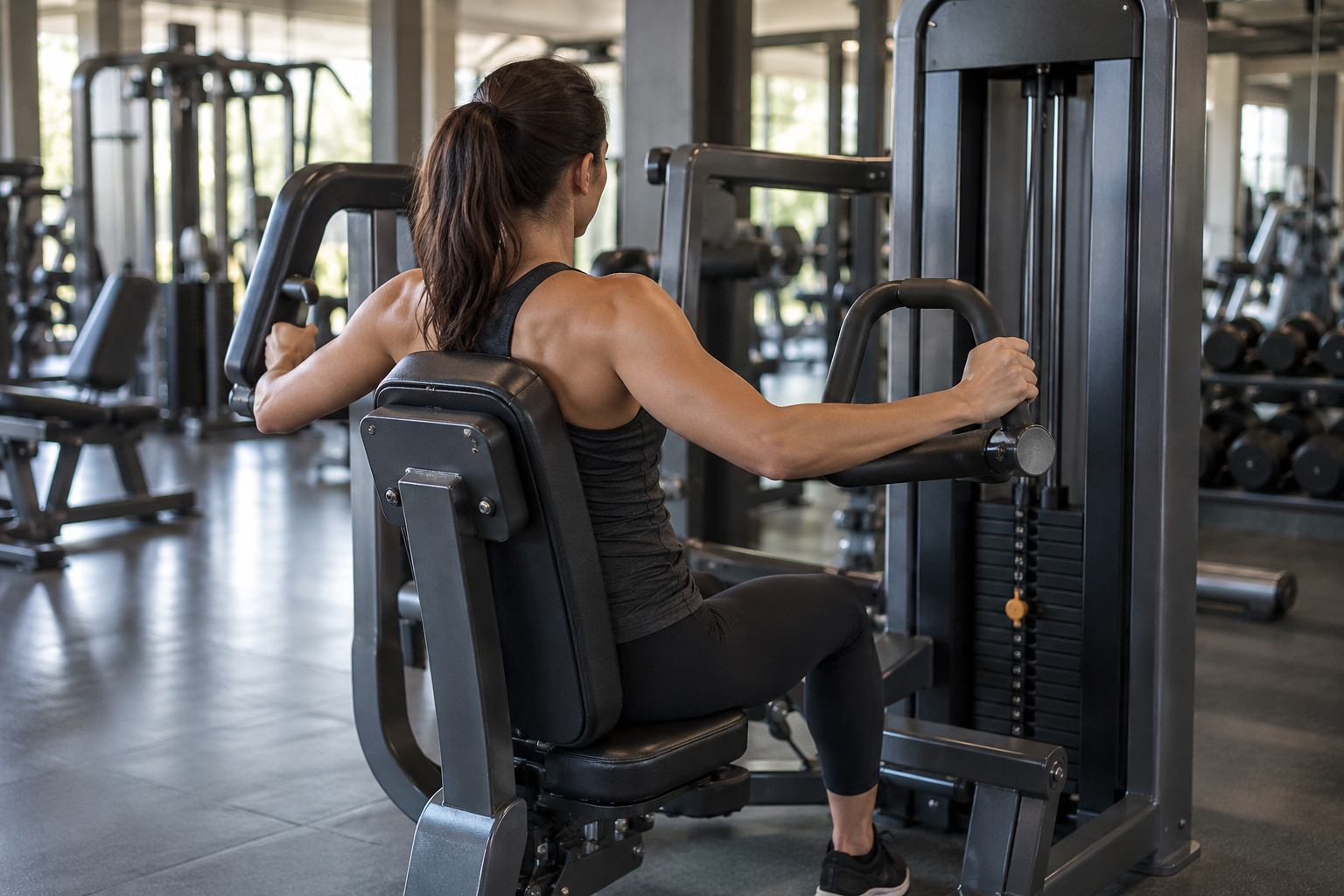
The word press appears on different machines: chest press, shoulder press, and leg press are not the same exercise and do not automatically share the same adjustments. Before starting, it is necessary to identify the workstation and read its instructions. This guide focuses on the seated chest press, which is the push exercise for the chest, without transferring the procedure to other machines that use the same word in their name.
Understanding how to use the press machine with correct technique requires connecting the starting position, adjustments, and the movement intended by the model. The guide offers general criteria to orient oneself and to communicate with the instructor; the instructions of the machine present remain the specific reference. Load and program must be adapted to the person, without deriving a universal prescription from the number indicated on the weight stack.
For the gym manager, a well-organized support procedure helps make instructions consistent among operators. The goal is not to memorize an identical posture for each model, but to understand which elements to check and when to ask for support. The machine guides some components of the movement, while preparation and control remain activities to be managed throughout the set.
- Recognizing the chest press and its adjustments
- Preparing the seat, supports, and starting position
- Selecting the load without using the movement as a maximal test
- Executing the push and managing the return
- Recognizing when to stop and ask for a verification
- Using instructor instructions and support during learning
- Including the chest press in the program and following progression
Recognizing the chest press and its adjustments
The first check concerns the function of the machine.
The illustrative card and instructions must match the model, including any adjustments for the starting point. A configuration seen on another workstation is not automatically transferable. If a control is not clear, it is best to have the staff explain it before preparing the load.
The seated chest press may feature different handles, levers, or resistance systems. These characteristics influence the preparation and the available movement. The user should know which parts are adjustable and how to check their position according to the relevant instructions, avoiding improvised interventions to obtain a trajectory that the machine does not provide.
Reading the model before the first set
Identification is important even when the gym has multiple chest machines. A workstation may require different adjustments than the usual one. The manager should make information available and keep references legible, so that the user can ask for support on the correct machine rather than describing the press near the wall generically.
Asking for a relevant demonstration
A useful demonstration includes access to the workstation, adjustments, and the start and end of the set. The staff should observe the person while applying the instructions, instead of simply showing the movement from a distance. This allows any doubts about operation to be clarified immediately, keeping the general explanation distinct from the choice of individual load and program.
Preparing the seat, supports, and starting position
The seat adjustment must allow assuming the position indicated for the model.
In the instructions of various manufacturers, height is described through the relationship between the chest and the handles. However, the concrete reference must be verified on the machine present, avoiding considering a scale number as a valid setting for all people.
The chest press adjustment must be completed before the set, following the intended system. The seat and other elements must not be modified in an improvised way during the movement. If the position is not understandable or usable, the instructor can help verify the configuration and evaluate an appropriate alternative for the person.
Verifying the relationship between body and handles
Life Fitness instructions for specific chest presses recall a consistent position relative to the backrest and handles. This example shows why adjustments must be read together with the model. It is not enough to bring the seat to a usual height: it is necessary to check how the person actually positions themselves in the workstation and how the planned push begins.
Maintaining supports during preparation
Supports must remain consistent with the machine's instructions and the position identified together with the staff. If reaching the handles requires unusual movements or unclear preparation, the issue must be resolved before the exercise. The ease with which another person uses the same workstation does not automatically confirm that the adjustment is appropriate.
Selecting the load without using the movement as a maximal test
The value displayed on the machine alone does not describe the difficulty for the person and does not allow automatic comparisons between models.
The choice must be linked to the exercise, experience, and individual program. The instructor can help prepare a resistance consistent with the task, preventing the first set from becoming an improvised test of the maximum possible.
The load control must be accompanied by the verification of the selection according to the product instructions. The system must be used as intended, without additions or non-relevant modifications. Before starting, the person should also know how to finish the set and restore the workstation through the sequence indicated for that machine.
Distinguishing the weight scale from individual capacity
Numerical settings can be recorded to follow the program, but they must remain linked to the model used. A usual value on a different machine is not an automatically equivalent starting point. The fact of having completed a set in the past also does not replace the verification of current conditions and the indications of one's own path.
Using the first execution to check control
The first executions allow the staff to observe whether position and resistance allow the intended movement without evident compensations or haste. If preparation is not manageable, conditions are reviewed together with the instructor. The criterion is to maintain an understandable and controlled procedure, without turning the selected number into an autonomous goal.
Executing the push and managing the return
The push must follow the trajectory and modalities relevant to the machine.
General references do not replace the model's instructions or the instructor's observation. The person should maintain a position consistent with the preparation and manage the movement, avoiding deriving range and speed from imitating another user.
The return is part of the exercise and requires control. The NASM guide dedicated to the chest press recalls a controlled management of both the push and the return phase. Concrete modalities must be adapted to the model and the person, without imposing a universal duration or an identical range in all conditions of use.
Following the movement intended by the workstation
During the push, it is useful to focus on the sequence explained by the staff and on maintaining the relevant supports. If movements appear that cannot be interpreted, the execution should be reviewed with the instructor. A guided trajectory does not eliminate the need to understand how the machine moves and how to end the action according to available indications.
Preventing the return from becoming a passive phase
The return should not be left solely to the action of resistance. The person must know the expected end position and the procedure for ending the set. If the load leads to losing control of the return, preparation must be reviewed with the staff, rather than trying to complete additional repetitions at any cost.
Recognizing when to stop and ask for a verification
A doubt about technique and a mechanical problem require different interlocutions.
The instructor can observe adjustment and movement, while equipment anomalies must follow the facility's planned reporting procedure. The user should not modify components or repeat tests to figure out on their own whether the symptom stems from the machine or their own execution.
The presence of pain or an unusual sensation requires interrupting the exercise and asking for appropriate support. A general guide does not allow evaluating the cause nor indicating a valid correction for every person. The program must be adapted to the case, without using the movement as a repeated attempt to check if the problem disappears.
Distinguishing technical doubt and machine anomaly
If the position appears different than usual, the first question concerns the model and actual adjustments. The staff can help reconstruct the preparation, without automatically attributing the doubt to inexperience. When noise or anomalous behaviors emerge instead, it is useful to report the machine and observed circumstances through the internal procedure, avoiding improvised diagnoses.
Reporting pain or unusual sensations without forcing
Forcing a range of motion because it is shown in an image is not a sufficient criterion for deciding the individual person's movement. The instructor must be able to observe the situation and indicate appropriate support. The choice to continue should not depend on comparison with other users or the need to complete the expected number of repetitions.
Using instructor instructions and support during learning
The machine instructions must help recognize the present controls, not just the name of the exercise.
Before the set, the user should know which adjustment modifies the seat and which controls any starting position. If the meaning is not clear, asking for an explanation avoids trying controls while the machine is already in motion.
The isotonic machines may feature different configurations even when training similar muscle groups. In practice, attention should be directed to the workstation used: reading its diagram, recognizing adjustments, and verifying preparation with the instructor allows connecting the general explanation to the movement actually available.
Connecting indications to workstation controls
To understand an adjustment, it is useful to apply it before the set and verify the position together with the staff. Copying the number used by another person does not clarify the relationship between body and machine. Even when the setting is recorded, it must remain linked to the model, because the same numbering can have a different meaning on another workstation.
Asking for feedback on a specific phase
A precise question helps feedback: difficulty reaching the handles, loss of a support, or doubt about the end of the return describe observable phases. The instructor can watch that part of the execution and review the preparation. Comparison should not be reduced to asking whether the weight is high enough, neglecting how the entire set is managed.
Including the chest press in the program and following progression
The chest press must be included in a program consistent with the person's goal and experience.
A general guide does not automatically establish sets, repetitions, and rests suitable for everyone. The instructor can connect these elements to the individual path, while the user maintains attention to adjustment, supports, and movement control during each set.
The chest press progression must consider what the person actually manages to execute in the intended configuration. The load is one piece of information, along with completed repetitions and observed movement quality. A higher value on the machine does not describe improvement if it coincides with a different preparation or loss of return control.
Recording execution and useful settings
Notes can include model, relevant settings, selected load, and received instructions. This allows resuming work without reconstructing the preparation every time. If a different machine is used, data should not be transferred automatically: the new configuration must be understood and verified before treating values as directly comparable.
Increasing the demand without losing the sequence
When the program's demand changes, the exercise sequence must remain recognizable. If new difficulties appear, the choice must be reviewed with the instructor rather than compensated with unintended movements. Monitoring serves to connect the work done to the individual goal, distinguishing a numerical increase in load from a progression managed with understandable criteria.
Comments (0)