
Trolley
You have no items in your shopping cart

 Budgets
 Dumbers
 Discs
 Benches
 Racks and Rigs
 Weights Holders
 Isotonic machines
 Calisthenics
 Cardio
 Kettlebells
 Flooring
 Gym Set
 Accessories
 Combat
 ARTI MARZIALI
 CONTAINER GYM
 Tug-Of-War
 Used Gym Equipment
 PILATES MACCHINARI
 GINNASTICA ARTISTICA
 CAMPI DA PADEL
 Prodotti in Pronta Consegna
 Informazioni
 IRONMAN
 Gift Card
- Donatif
- General information
- 0 I like it
- 185 Views
- 0 comments
- gym flooring, safety flooring, gym safety, shock-absorbing materials
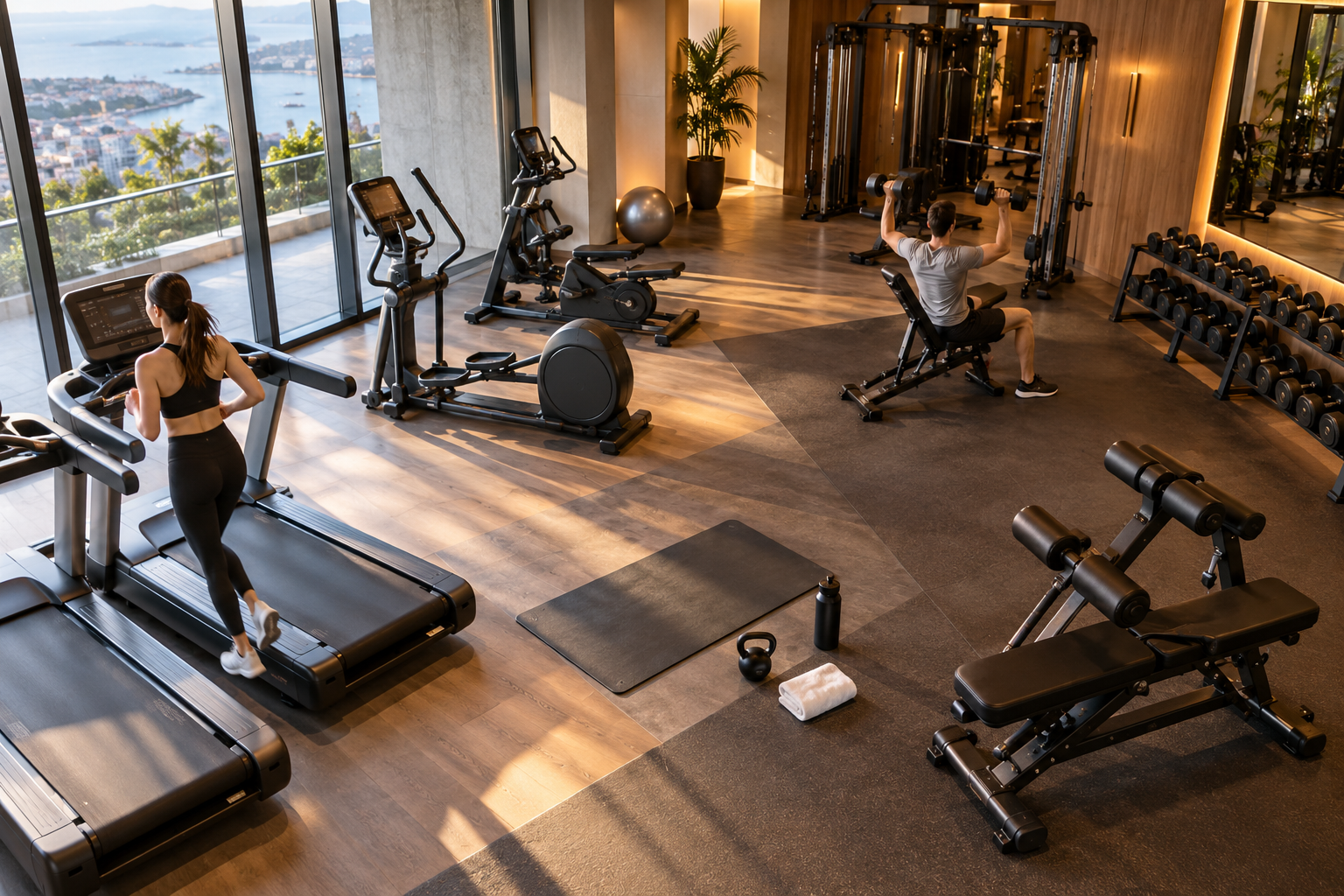
Hotel gym solution: defining an essential setup
A hotel has a room it would like to dedicate to fitness. Management asks for an essential solution, staff want to understand how to manage it, and the supplier needs more precise information to propose products. This hypothetical scenario helps read the project as a service to be organized, rather than as a simple filling of an available space.
A hotel gym solution must connect offered activities and the daily work of the facility. The guest must understand how to use the room, while departments must know how to clean, tidy it up, and collect reports. The final configuration depends on these relationships and the conditions of the room, which must be evaluated before confirming models and installation appointments.
In our example, results are not attributed to a real intervention. The choices describe an application path: clarifying the service, checking the space, and selecting a reasoned equipment set. The method allows management to prepare a useful brief, keeping visible the available data and the questions that still require comparison with relevant professionals and suppliers.
- Transforming the generic request into a defined service
- Reading the room through accesses and constraints
- Selecting an initial equipment set with few priorities
- Designing a room understandable upon first access
- Distributing tasks among hotel departments
- Coordinating delivery and start of the setup
- Evaluating the project through actual use and conditions
Transforming the generic request into a defined service
Management starts from two hypothetical functions: cardiovascular activity and general training.
The request does not yet indicate brands or models, because it first wants to understand which configuration responds to the space. This step allows evaluating different solutions without losing the initial function and without turning every commercial proposal into a project requirement.
The hotel fitness offering must be described in a way consistent with the real service. An essential room can offer a few well-organized activities, while too broad a promise can generate expectations not supported by the equipment. Management must therefore choose how to present the space, keeping communication and functions that will be actually available to guests connected.
Describing what the guest will be able to do
The brief can report the essential activities and those to be explored in depth, distinguishing customer data and initial hypotheses. If the hotel does not yet have observations on use, the limit must remain recognizable. The configuration can be designed for a consistent first phase, avoiding purchasing every category solely to make the service description longer.
Explicitly stating available support
Support must be explicitly stated: who accompanies a request, where instructions are available, and which channel receives reports. The presence of staff in other departments does not automatically confirm continuous assistance in the room. The project must use the actual organization as an initial condition, instead of introducing tasks that no one has been assigned to perform.
Reading the room through accesses and constraints
The room datasheet must describe dimensions, shape, openings, and relevant fixed elements.
A seemingly large room can offer limited positions when considering paths and activities. The supplier must receive sufficient data to develop a preliminary proposal, while unverified information must be flagged to avoid overly favorable interpretations of actual availability.
The feasibility of the fitness room includes evaluations pertinent to the property and the planned activities. Commercial comparison can provide product data, but it does not replace the skills necessary to examine systems, surfaces, and other conditions of the case. Choices must remain provisional when they depend on a not-yet-completed deep dive into the room.
Collecting a room datasheet
The datasheet can be accompanied by photographs and a list of known conditions. Management should indicate which environments are nearby and how to reach the room, without presuming that this information is already clear to operators. The document helps focus the discussion on real questions instead of reconstructing basic data in every communication.
Identifying decisions subordinate to verifications
Open verifications must be linked to decisions. If a placement depends on relevant in-depth study, the layout must show its preliminary character. This organization allows working on the defined parts, keeping visible what is missing before considering product, position, and economic conditions of the solution confirmed.
Selecting an initial equipment set with few priorities
The first configuration must make the essential service possible without occupying every space.
In the hypothetical case, management asks to justify each workstation through anticipated activities and users. This filter reduces the number of alternatives and makes it possible to understand which features are decisive, before comparing accessory equipment or elements that do not modify the requested function.
The cardio solutions for hotels can be explored through documentation of relevant models. Access, adjustments, and installation conditions must be read together with the real room. A commercial category does not automatically confirm suitability for any hotel, just as a compact machine must still be evaluated through its operational footprint.
Comparing cardio functions
Cardio functions can be compared through gathered needs and service organization, without assigning a universal preference to a type. The project must clarify why a given activity deserves space in the first phase. Initial hypotheses can be updated through use, while maintaining a complete configuration with respect to the functions actually promised.
Evaluating the general strength component
For general strength, the comparison must include adjustments, accessories, and tidy-up methods. A versatile solution may require explanations that need to be organized, while loose items require recognizable storage. The value of the equipment must be read through the whole service, avoiding using the mere number of declared exercises as the final criterion.
Designing a room understandable upon first access
The layout must show how the guest enters, reaches a workstation, and moves between functions.
The floor plan must consider access, adjustments, and movement, not just the perimeter of the machines. In our scenario, management asks to reread the design through ordinary situations, to verify that multiple activities can coexist without foreseeable interference.
The readability of the fitness room also depends on what remains free. An unoccupied space may be necessary for a function or a path, rather than representing missing equipment. The project must assign a role to areas, so that a new request is not solved by adding products in positions that seem available only on paper.
Separating passageway and activity
The passageway must remain understandable even when a person is adjusting the machine or retrieving an accessory. These sequences must be compared with the relevant conditions of the products. If interference recurs in simulations, the layout must be revised before entrusting guests with the task of adapting the arrangement every time.
Defining the place for accessories
Accessories must have recognizable positions for pickup and return. The staff in charge of cleaning can help identify a manageable arrangement. If the equipment finds no storage, the problem must be addressed in the project instead of accepting provisional supports in passageways or between workstations that continuously change the configuration.
Distributing tasks among hotel departments
The fitness room enters the work of departments and requires an explicit distribution of activities.
Management must know who follows cleaning, information, and request coordination. A list of tasks must not indiscriminately attribute every need to everyone: housekeeping, reception, and internal maintenance can have different roles to be connected through a simple and recognizable process.
The daily management of the gym must use indications relevant to the materials and installed products. Cleaning methods must not be automatically transferred from other hotel surfaces. Staff must be able to retrieve references and report what they observe, keeping an ordinary task and a technical intervention requiring appropriate skills distinct.
Preparing cleaning and tidying up
Cleaning and tidying up must be compatible with scheduled hours and accesses. Management can describe how the room is prepared and how any different availability conditions are communicated. The plan must be usable in actual shifts, avoiding procedures that depend on the presence of a single informed person during the setup phase.
Organizing the handover of reports
Reports must identify the machine and observation, even when they reach the reception through an inaccurate description by the guest. Readable codes and inventory help the handover. The contact person coordinates the request without turning it into an autonomous diagnosis, while the follow-up must remain recognizable until the outcome and the update of information available to departments.
Coordinating delivery and start of the setup
The calendar must distinguish product availability, delivery, and completion of agreed-upon services.
The room must be ready according to relevant conditions, with accesses and preparations assigned to contact persons. The date desired by management does not alone confirm these steps, which must be organized with operators and updated when project conditions change.
The operational delivery of the fitness room must have readable content. Equipment, assembly, and expected documents must be identified in the proposal, avoiding a generic formula being interpreted as the inclusion of every activity. If a service is excluded, the client must organize it before considering the path from supply to service opening consolidated.
Assigning preparations and services
Preparations can be summarized through activities, contact person, and status, keeping open points visible. Logistics must concern the complete path to the final position, not just the unloading place. This clarity makes it possible to coordinate appointments with hotel operations and any other work possibly present.
Gathering documents and instructions
Documents must be linked to actual models and accessible to those who will manage the room. Relevant instructions must be transferred to departments, without assigning technical activities outside their role to the staff. The configuration can thus enter the service through understandable references, instead of being considered ready just because the machines have been positioned.
Evaluating the project through actual use and conditions
After opening, management can observe accesses, requests, and recurring difficulties with a consistent method.
This data helps read the operation and must not be automatically turned into an economic return. The evaluation must return to the promised functions, to understand whether the initial solution responds to the service the hotel had decided to organize.
The investment must be read through products, services, and management necessary for the project. The cost must refer to a recognizable perimeter, distinguishing confirmed amounts and conditions yet to be defined. Any developments can be evaluated through new information, avoiding an occasional offer guiding the equipment before clarifying the need and compatibility with the room.
Comparing configuration and initial objectives
Comparison with initial objectives must consider the observed period and the availability of functions. A phase with provisional activities is not equivalent to the expected ordinary use. Management can update hypotheses while keeping recognizable what has been measured and what remains an interpretation, without attributing every variation solely to the setup.
Preparing any developments
Developments must maintain the coherence of the room and department work. If a function is added, layout, documents, and relevant tasks must be reviewed. The hotel gym solution thus remains a service managed over time, connected to people, space, and real organization, instead of becoming a succession of uncoordinated purchases.
Comments (0)