
Trolley
You have no items in your shopping cart

 Budgets
 Dumbers
 Discs
 Benches
 Racks and Rigs
 Weights Holders
 Isotonic machines
 Calisthenics
 Cardio
 Kettlebells
 Flooring
 Gym Set
 Accessories
 Combat
 ARTI MARZIALI
 CONTAINER GYM
 Tug-Of-War
 Used Gym Equipment
 PILATES MACCHINARI
 GINNASTICA ARTISTICA
 CAMPI DA PADEL
 Prodotti in Pronta Consegna
 Informazioni
 IRONMAN
 Gift Card
- Donatif
- General information
- 0 I like it
- 168 Views
- 0 comments
- gym flooring, safety flooring, gym safety, shock-absorbing materials
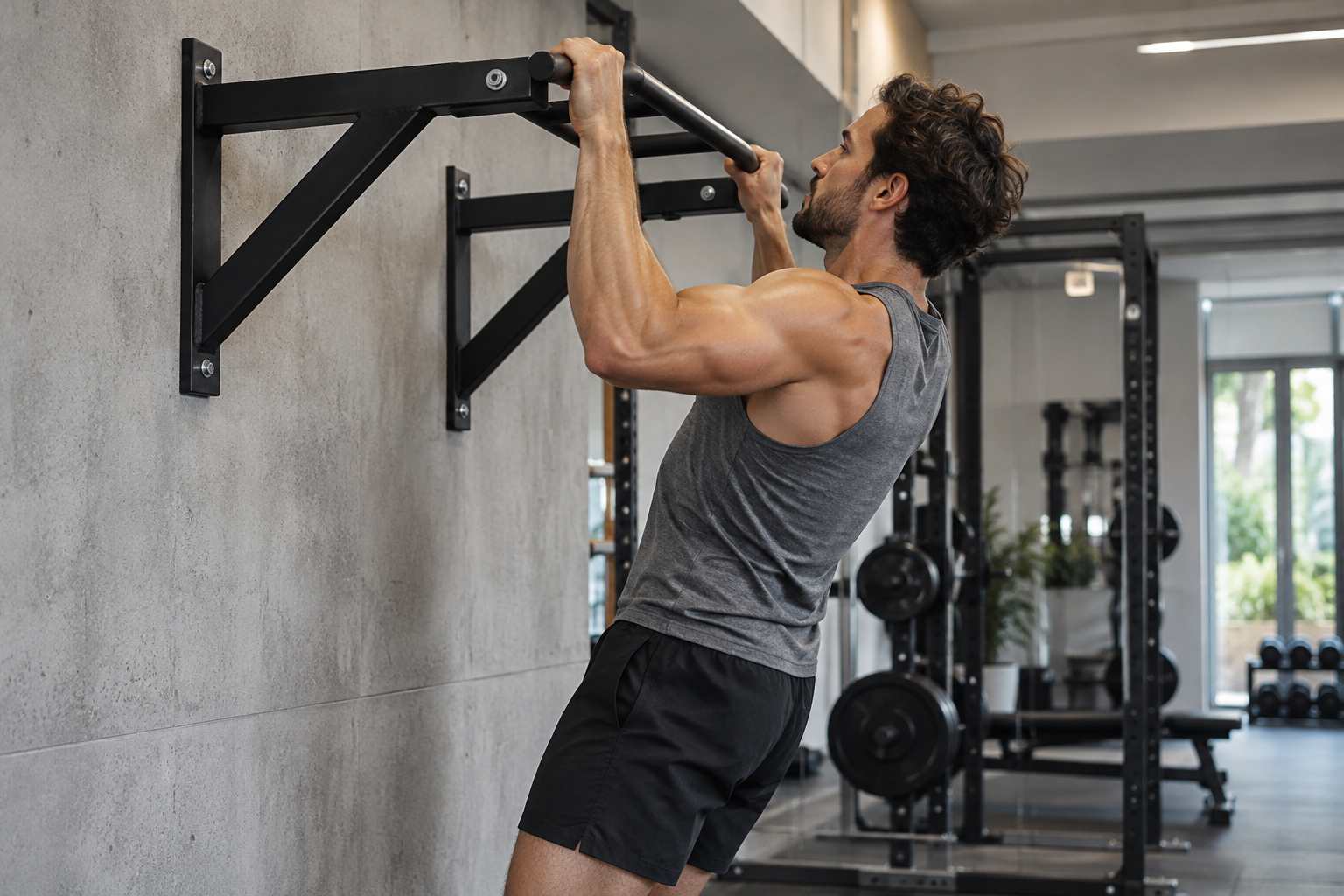
Risks of Wall-Mounted Pull-Up Bar Installation: A Safety Guide
The risks of wall-mounted pull-up bar installation represent a fundamental aspect in the design and management of professional fitness equipment. A wall-mounted pull-up bar must support not only the user's weight, but also the stresses generated during the execution of exercises. An incomplete assessment of the wall support, anchors, or structural geometry can compromise the stability of the installation and create dangerous situations for users.
For gym managers, purchasing managers, and designers, the main challenge consists of distinguishing the stated resistance of the equipment from the actual capacity of the installed system. A bar built with sturdy materials does not automatically guarantee a secure installation. Overall performance depends on the interaction between the metal structure, connecting plates, anchoring elements, and wall characteristics.
This guide explores the main risk factors, the technical checks to request, and the criteria useful for choosing a solution consistent with the gym's operating conditions. The objective is to provide practical guidance for recognizing critical issues, understanding when it is necessary to involve a qualified technician, and evaluating the investment without relying exclusively on price or commercial claims.
- Main structural risks of wall installation
- Wall types and compatibility with anchors
- Static and dynamic loads during pull-ups
- Anchoring systems and installation criteria
- Technical checks and safety controls
- Frequent errors in bar installation
- Alternatives to wall fastening in gyms
- How to evaluate costs, liability, and investment
Main structural risks of wall installation
A pull-up bar fixed to the wall transfers the forces generated by the user to the building structure through brackets and anchors. The system must be evaluated as a whole, because the resistance of a single component does not automatically establish the safety of the installation. Failure can affect the metal elements, connections, or the wall material.
Among the most significant critical issues are the pull-out of anchors, local support failure, bracket deformation, and progressive loosening of connections. These phenomena can have different causes and require specific checks. A fastening that appears stable during a simple manual test may not be adequate for the stresses expected during professional use.
To reduce risk, it is necessary to identify the wall material in advance, understand the characteristics of the bar, and define the conditions of use. In particular, the presence of dynamic exercises or users with different physical characteristics can significantly modify the actions transmitted to the structure.
Anchor pull-out and support failure
Anchors can be subject to tension, shear, and combinations of stresses. When the applied force exceeds the load-bearing capacity of the system, anchor pull-out, damage to the surrounding material, or other modes of failure may occur. Verification must consider the type of anchor, installation depth, edge distances, and support characteristics.
It is incorrect to consider a plug sufficient simply because it has a large diameter. Performance depends on the conditions for which it was designed and qualified, as well as correct installation.
Bracket and metal connection deformations
The geometry of the brackets influences the distribution of forces on the wall. A highly projecting bar generates a moment that must be transferred through the connections, increasing the importance of the plate configuration and the layout of the anchors.
Welds, bolts, and metal components must also be adequate for the expected actions. Any permanent deformations, cracking, or abnormal movement requires suspension of use and technical verification before returning to service.
Wall types and compatibility with anchors
The nature of the support represents one of the most important criteria for wall installation safety. Concrete, solid masonry, hollow bricks, and lightweight walls present different mechanical characteristics. It is therefore not possible to indiscriminately use the same anchoring system without verifying the specific conditions of the installation.
The assessment should include the material, thickness, state of conservation, and structural function of the wall. A plastered surface can conceal different materials or previous construction work. When the characteristics of the support are not documented, it may be necessary to perform appropriate investigations before defining the project.
For a professional gym, it is particularly important to avoid decisions based solely on the external appearance of the wall. The presence of cracks, detachments, moisture, or previous repairs may require further checks. The choice of anchor must derive from actually verified characteristics and applicable technical instructions.
Concrete and load-bearing masonry
Concrete can offer favorable conditions for certain anchoring systems, but the load-bearing capacity depends on numerous parameters. The material class, possible presence of cracks, edge distances, and conditions provided in the anchor documentation must be considered.
In masonry, the evaluation is further influenced by the type of elements and the quality of the joints. A system designed for concrete must not be automatically considered suitable for a brick wall.
Hollow bricks and lightweight walls
Hollow brick walls require particular attention because the distribution of stresses depends on the internal geometry of the elements. There are fastening systems intended for specific hollow supports, but their suitability must be verified with respect to loads and installation conditions.
Lightweight walls, such as certain drywall partitions, should not be considered adequate structural supports for a cantilevered bar without a designed and verified solution. The possible presence of reinforcements or connections to load-bearing structures must be evaluated by a competent professional.
Static and dynamic loads during pull-ups
One of the main sources of error consists in comparing the user's body weight with the nominal capacity declared for the bar, without considering actual operating conditions. During a controlled pull-up, the forces transmitted to the structure can vary during the movement. Accelerations, stops, and oscillations modify the stresses compared to a purely static condition.
Dynamic exercises can introduce particularly demanding actions for the anchoring system. Movements with momentum, rapid changes of direction, and body swings must be considered only when the equipment and installation are expressly suitable. It is incorrect to presume that a bar usable for controlled pull-ups is automatically suitable for any calisthenics exercise.
Sizing requires an evaluation of the expected actions, installation geometry, and available resistances. Safety factors and verification criteria must derive from relevant technical standards and component documentation, avoiding simplified formulas used without knowing the context.
Difference between body weight and design load
The user's weight constitutes an initial datum, but does not completely describe the forces acting on the bar. The designer must consider the intended mode of use and possible variations in actions during movement. The distance of the bar from the wall also influences the moment transmitted to the brackets.
A load capacity declaration must be interpreted by verifying the conditions to which it refers. It may concern only the metal component or a complete system installed according to specific configurations. This distinction is essential to correctly compare different products.
Swings, momentum, and intensive use
Pull-ups with momentum and other dynamic movements can produce stresses different from those of a slowly executed exercise. Furthermore, the frequency of repetitions and the number of users throughout the day affect the equipment's overall exposure to load cycles.
For facilities offering functional training, it is appropriate to clearly define which exercises are permitted. If the system does not have adequate technical instructions for the intended dynamic use, it is preferable to choose a configuration expressly designed for such use.
Anchoring systems and installation criteria
The choice of pull-up bar anchors must be made considering the support, stresses, and structure configuration. Mechanical and chemical anchors present different characteristics and conditions of use. Neither category can be considered universally superior without a technical evaluation of the specific case.
The manufacturer's documentation must indicate the permitted supports, installation conditions, performance characteristics, and any application limits. For anchors intended for structural uses, the presence of relevant technical assessments can provide useful data for sizing. It is necessary to verify that such documents refer to the product and configuration actually used.
Installation should be entrusted to competent personnel, following a project or technical instructions adequate to the complexity of the intervention. Operations such as drilling, hole cleaning, compliance with expected depths, and control of connections can significantly affect system performance.
Mechanical anchors and conditions of use
Mechanical anchors transfer actions to the support through specific operating mechanisms. Performance depends on the model, base material, and installation conditions. Compatibility with the actual support must be verified, and laying instructions must be followed.
Tightening must follow the manufacturer's instructions when provided. Applying an arbitrary torque or increasing it to obtain a feeling of greater stability can compromise the fastening instead of improving it.
Chemical anchors and installation checks
Chemical systems use specific products to create the connection between the metal element and the support. Their performance depends on material compatibility and compliance with installation conditions, including cleaning procedures, permitted temperatures, and hardening times.
It is not sufficient to generically identify a product as high-strength resin. It is necessary to verify the declared performance for the support in question and the conditions provided by the technical documentation. Any installation errors can reduce connection capacity.
Technical checks and safety controls
The verification of a wall-mounted bar must concern the entire installed system. A visual inspection can identify some obvious defects, but does not allow ascertaining all the load-bearing characteristics of the anchors or the wall. For this reason, in professional installations it is important to distinguish design verifications, checks during installation, and subsequent periodic inspections.
Before use, it is appropriate to have the equipment documentation, installation instructions, and any checks required for fastening. When the configuration is not provided by the manufacturer or the support presents uncertain characteristics, a qualified technician must be involved to evaluate the solution.
During the gym's operational life, checks must be organized according to the manufacturer's instructions and conditions of use. The intensity of sessions, presence of dynamic exercises, and installation environment can influence maintenance requirements. Documenting interventions allows for more orderly management.
Checks before commissioning
Before making the bar available to users, it is necessary to verify that the installed model corresponds to the expected configuration and that no missing components, deformations, or visibly abnormal connections are present. The manufacturer's instructions regarding usage spaces must also be respected.
Any load tests must not be improvised by applying arbitrary weights. If necessary, they must be defined by competent personnel through procedures consistent with the design and characteristics of the system.
Periodic inspections and signs of deterioration
Inspections can include checking brackets, accessible welds, connections, and surrounding wall surfaces. Unusual movements, new noises, cracks, or signs of deformation represent elements that require immediate attention.
In the presence of significant anomalies, the station must be excluded from use until verified and possibly restored. Simply tightening bolts does not constitute an adequate solution when the cause of the problem has not been identified.
Frequent errors in bar installation
Many critical issues stem from decisions made even before installation. Among the most frequent errors are the choice of an unverified wall, the use of undocumented anchors for the support, and the failure to consider dynamic stresses. These situations can be avoided through a preliminary assessment of real conditions.
Another error consists in modifying the configuration provided by the manufacturer without verifying the consequences. Changing the distance between brackets, using a different number of fasteners, or adding extensions can alter the distribution of forces. Structural modifications must be technically evaluated and not considered simple aesthetic adaptations.
The position of the bar also deserves attention. An installation too close to the ceiling or other equipment can limit execution and increase the risk of impacts. Safety therefore includes both the load-bearing capacity of the fastening and the availability of an adequate operating space.
Using plugs not compatible with the support
The choice of fasteners based exclusively on diameter or immediate availability represents a critical issue. An anchor can offer adequate performance in a given material and prove unsuitable in another. It is necessary to verify technical documentation and declared conditions of use.
When sufficient information on the wall is not available, proceeding by trial and error does not constitute a reliable method. Support identification and capacity assessment must precede the final choice of system.
Incorrect positioning and insufficient spaces
The position of the bar influences both safety and workout quality. User height, possible body oscillation, and the presence of building elements or nearby equipment must be considered. A too cramped station can make instructor intervention difficult.
Operating distances must be defined in relation to permitted exercises and the manufacturer's instructions. It is not appropriate to adopt generic measures without verifying the actual physical footprint during expected movements.
Alternatives to wall fastening in gyms
When the wall does not offer adequate conditions or checks prove complex, it is useful to consider alternative configurations. Free-standing structures, racks, and systems designed for functional training can represent interesting solutions, provided they are installed and used according to their respective technical specifications. The absence of wall fastening does not automatically mean the absence of structural risks.
A free-standing structure must be evaluated with respect to stability, load distribution, and any floor anchoring requirements. Some systems still require fasteners for certain conditions of use. It is therefore necessary to examine the model's documentation and verify that the expected configuration is compatible with the proposed exercises.
For a fitness center, the choice between a wall bar and an independent structure also depends on room organization. A wall bar can contain floor footprint, while a multi-function system can allow the execution of multiple exercises in the same area. Comparison must include safety, available space, frequency of use, and installation costs.
Racks and multi-function structures
Professional racks and rigs can integrate pull-up bars and other elements intended for strength training. Their configuration allows for organizing different stations, but requires attention to stability conditions and the manufacturer's instructions regarding fasteners.
To evaluate this type of equipment, you can consult the rack and rig structures for professional gyms, comparing dimensions, configurations, and installation requirements. The choice must be based on documented technical characteristics, not solely on the presence of a pull-up bar.
Free-standing structures can reduce dependence on wall characteristics, but must be designed to withstand expected actions without tipping over or dangerous movements. Stability depends on geometry, mass, load distribution, and conditions of use.
Free-standing structures and stability requirements
Before purchasing, it is necessary to verify whether the manufacturer requires floor anchors and which exercises are permitted. A structure declared free-standing for certain movements might not be suitable for particularly demanding dynamic exercises.
How to evaluate costs, liability, and investment
The choice of a wall-mounted pull-up bar must start from the technical feasibility of the installation. Before comparing prices, it is appropriate to verify the wall type, equipment characteristics, and exercises that will be permitted. This sequence reduces the risk of purchasing a product that subsequently requires unforeseen construction work or cannot be installed under available conditions.
The overall cost includes the equipment, any support assessments, design when necessary, anchors, installation, and scheduled checks. Periodic maintenance must also be included in the economic evaluation. A low initial price does not necessarily represent an advantage if the system requires complex adaptations or presents limitations incompatible with gym activity.
Responsibilities must be clarified before installation. The manufacturer provides characteristics and instructions relating to the equipment, while support evaluation and correct fastening execution require specific skills. The manager must organize use and maintenance according to applicable prescriptions, without assuming that purchasing professional equipment eliminates every verification obligation.
Comparing quotes and technical documentation
An effective comparison should verify which elements are included in the offer: metal structure, fasteners, possible design, installation, and assistance. It is important to request information on declared load capacity and the conditions to which that value refers, distinguishing equipment capacity from that of the system fixed to the wall.
The availability of instructions, technical specifications, and maintenance indications represents a concrete criterion to reduce uncertainty. When two offers present different prices, the comparison should concern documented performance and services actually included, avoiding automatically attributing greater safety to the more expensive solution.
Checklist before authorizing use
Before commissioning, it is useful to verify some essential aspects: has the wall material been identified? Has support capacity been evaluated? Are anchors compatible with expected conditions? Does installation comply with documented configuration? Are permitted exercises clearly defined? Are instructions for checks and maintenance available?
These questions do not replace professional checks, but help the manager identify any missing information. An uncertain answer on a structural element should be resolved before allowing use of the station.
Protecting the investment through a verifiable choice
A technically grounded decision simultaneously considers safety, building compatibility, user needs, and operational continuity. In a gym with structurally adequate walls, a correctly designed wall bar can represent a functional solution. Conversely, when the support presents limitations, evaluating an alternative system can avoid complex interventions and hard-to-predict costs.
The most important criterion is being able to justify the choice through verifiable data: support characteristics, equipment documentation, installation conditions, and usage methods. This approach allows managing risks more consciously, planning checks, and allocating economic resources to a solution consistent with the actual needs of the sports facility.
Comments (0)