
Trolley
You have no items in your shopping cart

 Budgets
 Dumbers
 Discs
 Benches
 Racks and Rigs
 Weights Holders
 Isotonic machines
 Calisthenics
 Cardio
 Kettlebells
 Flooring
 Gym Set
 Accessories
 Combat
 ARTI MARZIALI
 CONTAINER GYM
 Tug-Of-War
 Used Gym Equipment
 PILATES MACCHINARI
 GINNASTICA ARTISTICA
 CAMPI DA PADEL
 Prodotti in Pronta Consegna
 Informazioni
 IRONMAN
 Gift Card
- Donatif
- General information
- 0 I like it
- 146 Views
- 0 comments
- gym flooring, safety flooring, gym safety, shock-absorbing materials
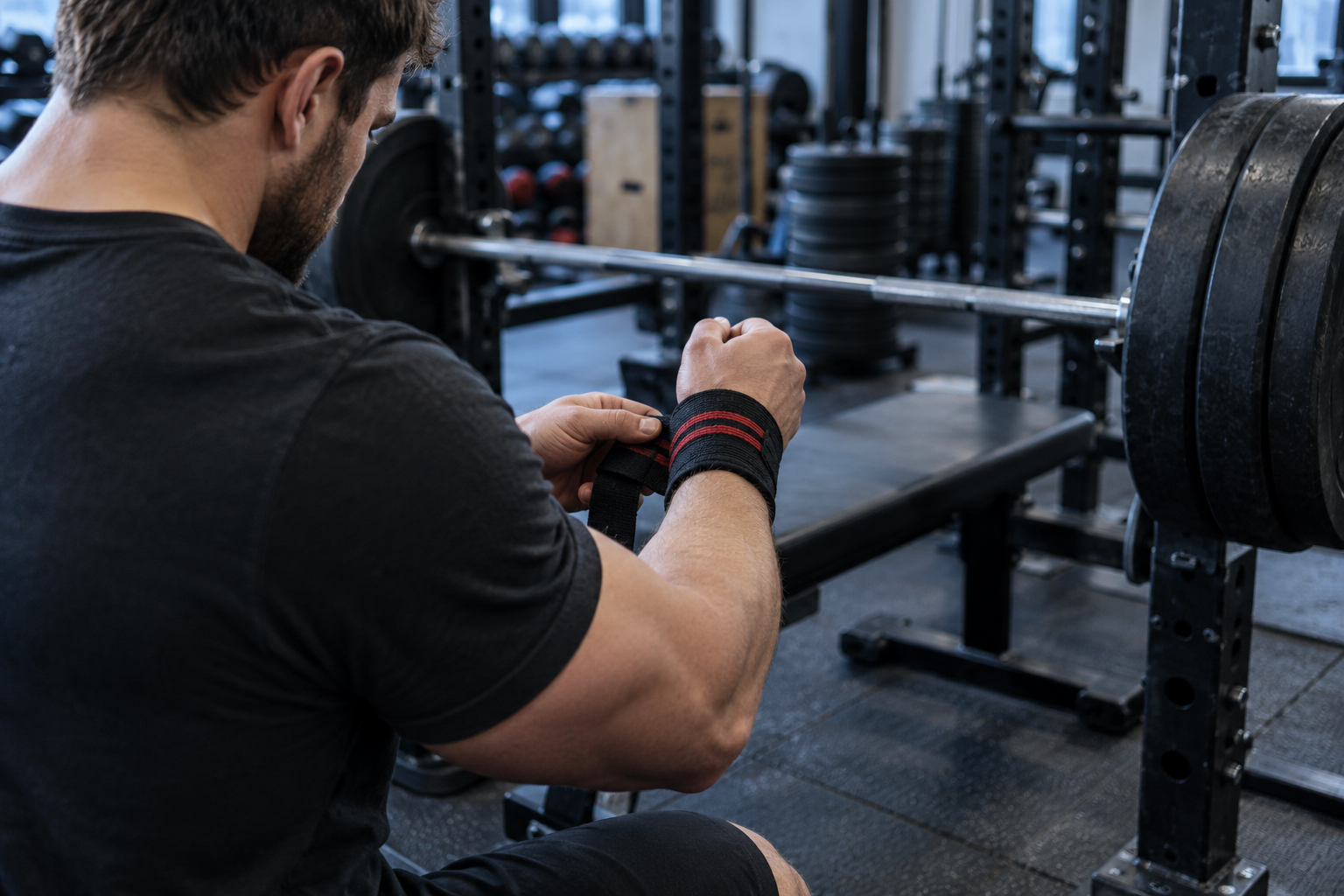
Lifting wrist cuffs or wrist wraps: how to choose for the weight room
The choice between lifting wrist cuffs or wrist wraps may seem like a secondary detail in the organization of a professional weight room. In reality, understanding the differences between these accessories makes it better to evaluate the support required during exercises, users' needs, and the consistency of the purchase with the activities practiced. For a gym manager, a strength coach, or a purchasing manager, the problem is not simply identifying the most resistant product, but understanding which solution meets a concrete need.
In commercial language, terms like wrist cuffs, wrist wraps, wrist supports, and wrist braces are sometimes used without a precise distinction. This overlap can generate confusion, especially when comparing products intended for powerlifting, resistance training, or general fitness. Two seemingly similar accessories can offer different levels of compression, movement restriction, and adjustability, with consequences for practicality during training.
To make an informed choice, it is therefore useful to start with functional characteristics, analyze the exercises performed, and consider the total cost of the equipment in the context of the gym. This guide proposes comparison criteria applicable to real situations, without automatically considering the most rigid or expensive product more effective. The objective is to reduce non-pertinent alternatives and identify a solution technically consistent with the needs of the facility and its users.
- Differences between lifting wrist cuffs and wrist wraps
- How wrist support works during lifting
- Technical criteria to compare products
- Practical applications in the weight room
- Choosing accessories in powerlifting
- Comfort, safety, and usage limits
- Costs, durability, and accessory management
- Practical method to compare alternatives
- How to direct investment for a professional gym
Differences between lifting wrist cuffs and wrist wraps
The first distinction concerns the meaning attributed to the terms. In the weightlifting accessories market, lifting wrist cuffs can generically indicate devices worn around the wrist, while wrist wraps often identify rollable and adjustable technical fabric strips. However, there is no universally applied commercial separation: some manufacturers use the two names to describe substantially equivalent products.
To avoid evaluation errors, it is preferable to observe the construction of the accessory rather than relying solely on the name. A closed-structure elastic cuff, an adjustable wrap with hook-and-loop closure, and a rigid support intended for powerlifting can present very different functional characteristics. The designation reported on the product sheet is not sufficient to establish which accessory is suitable for a given exercise.
For a fitness center, this distinction is particularly important when purchasing accessories intended for multiple users. A simple and easily wearable solution can be practical in a generalist context, while an adjustable wrap allows greater personalization of compression. Neither characteristic automatically determines overall superiority.
Cuffs with closed or semi-rigid structure
Closed-structure cuffs are generally worn by sliding them around the wrist. They can be made of elastic fabric, neoprene, or composite materials, with different characteristics in terms of thickness, compression, and breathability. Their main operational advantage is ease of use, especially when it is not necessary to frequently modify the adjustment.
The main limitation concerns fit. If the size does not correspond to the wrist circumference, the support may be too weak or excessively compressive. For this reason, in a gym with different users, it is necessary to carefully verify the availability of sizes.
Rollable and adjustable wrist wraps
Rollable wraps allow tension to be modified through the number of turns and the force applied during closure. They are frequently used in barbell pushing exercises and in some strength disciplines, where the athlete desires more structured support during demanding sets.
The possibility of adjustment represents an advantage, but also requires a correct application technique. A poorly wrapped band can shift, interfere with the grip, or create unnecessary compression. Ease of adjustment must therefore be evaluated together with closure stability.
How wrist support works during lifting
During resistance exercises, the wrist contributes to the transmission of forces between the hand and forearm. Its position changes in relation to the grip, the direction of the load, and the execution technique. In pushing movements, for example, the wrist can assume a position of extension that becomes more difficult to control when loads increase or fatigue appears.
External support can offer a feeling of greater containment and partially limit some movements, especially when it features a sufficiently rigid structure. This does not mean that the accessory eliminates joint stress or automatically corrects inadequate technique. Load distribution also depends on hand position, grip, and movement coordination.
The perceived level of support also varies among users. Two athletes can evaluate the same wrap differently based on individual mobility, wrist dimensions, and training habits. For a professional choice, it is therefore necessary to distinguish the declared properties of the product from the subjective sensations of those who use it.
Mechanical stabilization and movement control
Wrist support in weightlifting derives primarily from the resistance that the material opposes to deformation and from the compression exerted around the joint. A less elastic wrap, if applied correctly, can limit range of motion more than a soft cuff. The result still depends on the overall construction of the accessory and not just on its nominal rigidity.
It is important to remember that external stabilization does not replace muscular control. The athlete must continue to manage wrist alignment during movement and choose loads compatible with their technical capabilities.
Compression and perception of support
Compression can improve the perception of contact and wrist position, but a high level does not necessarily equate to better support. Excessive pressure can cause discomfort, tingling, or unwanted limitations during exercise.
Adjustment should allow a functional grip and not interfere with the circulation or sensitivity of the hand. If pain, numbness, or sensory alterations appear, the accessory must be loosened or removed and the situation evaluated adequately.
Technical criteria to compare products
A reliable comparison between cuffs and wrist wraps must consider verifiable characteristics. Material, length, width, elasticity, closure system, and stitching quality affect the mode of use and durability of the accessory. Evaluating these elements makes it possible to distinguish products that, while belonging to the same commercial category, respond to different needs.
Rigidity is one of the most relevant parameters, but it is often not expressed through a standardized measurement. Terms like soft, medium, or rigid can have different meanings among manufacturers. To correctly compare alternatives, it is appropriate to request information on material composition and, when possible, perform a practical test under the intended training conditions.
A purchasing manager should also verify the quality of available documentation. Detailed technical sheets, size indications, usage instructions, and maintenance information make the evaluation more transparent. Generic declarations regarding performance should not be considered sufficient proof of technical superiority.
Length, width, and rigidity of wraps
The rigidity of wrist wraps influences freedom of movement and the feeling of containment. More flexible models can be comfortable during varied workouts, while structured wraps may be preferred by athletes performing strength sets with specific support requirements.
Length determines how much surface can be wrapped and how many adjustments are possible. A long wrap is not automatically better: it takes more time to apply and can be bulky. Width must also be compatible with wrist anatomy and the required movement.
Materials, stitching, and closure systems
Elastic fabrics can offer progressive adjustment, while less deformable materials tend to provide a more structured response. The choice depends on the desired relationship between comfort and containment. Breathability and ease of cleaning also assume importance in professional environments.
Hook-and-loop closures must maintain adjustment during exercise and withstand repeated use. Irregular stitching, abrasive edges, or unreliable closures can compromise the user experience even before the main material shows signs of deterioration.
Practical applications in the weight room
In a traditional weight room, exercises, experience levels, and different goals coexist. An accessory used during a bench press does not necessarily respond to the same needs as one worn during dumbbell exercises, overhead movements, or general training circuits. Selection must therefore start from the activities actually practiced in the facility.
For a gym that primarily offers recreational training, the priority may be ease of use. In a strength area frequented by experienced athletes, however, it may be useful to offer accessories with more specific characteristics. The composition of users directly affects the number of alternatives that makes sense to make available.
It is also appropriate to consider the interaction between accessories and main equipment. The use of wrist wraps during barbell exercises must be evaluated together with grip technique, hand position, and movement characteristics. The accessory represents a complementary element and not an independent solution from the training context.
Bench press and pushing movements
During bench presses, some athletes use wrist wraps to obtain a feeling of greater stability when the load increases. The position of the barbell relative to the palm nonetheless remains fundamental for correct force transmission.
A gym wishing to organize a dedicated strength area should evaluate wrist support together with the quality of gym benches, the stability of structures, and the availability of adequate safety systems. The choice of accessories gains meaning within a correctly designed workstation.
Dumbbells and exercises with greater variability
In dumbbell exercises, the wrist position can change during movement. A very rigid support could prove impractical when execution requires greater joint freedom, while a flexible solution may be more compatible with diversified workouts.
The coach should verify whether the accessory actually facilitates the intended execution or introduces unnecessary limitations. The choice must be made considering the specific exercise, not simply the presence of a load.
Choosing accessories in powerlifting
In powerlifting, the use of wrist wraps is particularly associated with the bench press, even if some athletes employ them in other lifts. Needs are different compared to those of a generalist fitness room, because workouts can include high loads, specific preparations, and technical gestures repeated with great precision.
For this context, comparison should consider the athlete's level, training characteristics, and any rules of the reference federation. An accessory suitable for daily training is not necessarily allowed in competition. Dimensions, construction characteristics, and authorized brands may be subject to specific regulations.
It is important to avoid automatically associating a stiffer wrap with increased performance. The result depends on numerous factors, including technique, programming, experience, and individual characteristics. Support can be a functional preference of the athlete, but must not be presented as a guarantee of improved lifted load.
Wrist wraps for bench press in powerlifting
Powerlifting wrist wraps are often chosen based on the feeling of stability during the pushing phase. More experienced athletes may prefer less elastic materials and sustained adjustments, while others use more flexible wraps to maintain a balance between support and comfort.
A practical test should include warm-up sets and movements performed with controlled technique. It is not necessary to immediately start with maximal loads to verify fit, closure stability, and compatibility with the grip.
Competition regulations and compatibility
Competitions may foresee limits regarding the length, width, and position of wraps. Some federations also apply specific requirements to authorized products. These conditions must be verified on the updated regulations of the organization with which the athlete intends to compete.
For a gym hosting competitive athletes, distinguishing between accessories intended exclusively for training and accessories compatible with competitions helps avoid purchases that cannot be used in the expected scenario.
Comfort, safety, and usage limits
The quality of an accessory cannot be evaluated solely through the level of containment. Comfort affects the ability to use the product correctly during a complete session. A wrap that causes discomfort or requires continuous adjustments can prove poorly functional even when it features robust materials and careful construction.
External support should not be used to ignore persistent pain, joint instability, or technical difficulties. If an athlete experiences symptoms during training, it is appropriate to interrupt the activity causing them and evaluate the situation with a qualified healthcare professional when necessary. Lifting cuffs are not automatically medical devices and must not be considered treatments for clinical conditions.
For a professional facility, correct management also includes clear indications on use. Coaches should know the differences between available models and explain how to apply them without exerting excessive compression. A brief practical instruction can prevent many problems related to improper adjustments.
Fit and compression adjustment
The fit of lifting cuffs depends on wrist circumference, the shape of the accessory, and the material's ability to adapt. For closed-structure models, accurate measurement is particularly important. For adjustable wraps, instead, it is necessary to verify that the closure allows adequate tension without uncomfortable overlaps.
During the test, the user should be able to maintain a stable grip and normal hand sensitivity. The presence of tingling, color changes, or persistent discomfort indicates that the adjustment must be modified and that the accessory may not be suitable.
Hygiene and maintenance in a shared environment
Wearable accessories are subject to contact with sweat and skin. When made available to users, the gym must define cleaning procedures compatible with materials and manufacturer instructions. Not all fabrics tolerate the same detergents or the same washing methods.
In the presence of frequent use, it may be preferable to provide personal accessories or a shared supply managed through appropriate hygienic procedures. The decision depends on the facility's service model and the ability to guarantee cleaning and drying between uses.
Costs, durability, and accessory management
Purchase price represents only one component of economic evaluation. For a professional gym, frequency of use, expected durability, ease of maintenance, and the possible need to purchase multiple sizes or models must be considered. An inexpensive product may prove convenient in an occasional use context, but less interesting if it requires frequent replacements.
Similarly, an expensive accessory does not automatically guarantee greater durability. The quality of stitching, the resistance of closures, and the behavior of materials after repeated use are more significant elements than commercial positioning alone. When possible, it is useful to compare products with similar characteristics and request information on warranty conditions.
The choice must also distinguish between individual purchase and collective supply. An experienced athlete can invest in a specific model for their own preferences, while a gym must evaluate versatility, ease of management, and the number of potential users. The two decisions respond to different economic logics.
Initial price and cost per use
The cost of weight room accessories can be analyzed by relating total spending to the estimated number of actual uses. For example, a pair purchased for 25 euros and used 250 times presents a theoretical purchase cost equal to 0.10 euros per use. A 40-euro pair used 800 times drops to 0.05 euros per use.
These values are mathematical examples, not guaranteed durability estimates. They serve to show why the initial price is not enough to compare two alternatives. To obtain a realistic evaluation, any maintenance, replacement, and management expenses must be added.
Durability, wear, and replacement criteria
Points most subject to deterioration include closures, stitching, edges, and areas subjected to repeated tension. Loss of elasticity or reduction in closure hold can modify the accessory's behavior during exercise.
A gym should schedule periodic checks and replace products that show evident damage or no longer maintain reliable adjustment. The frequency of checks must be proportional to intensity of use and manufacturer instructions.
Practical method to compare alternatives
When the market offers numerous models, the most effective way to reduce uncertainty consists of defining essential requirements first. For a generalist weight room, comfort, ease of adjustment, and adaptability may be priorities. For a powerlifting area, containment, repeatability of application, and compatibility with relevant sports rules may assume greater importance.
A structured evaluation makes it possible to avoid comparisons based solely on photographs, generic reviews, or promotional descriptions. The purchasing manager can prepare a sheet reporting material, dimensions, closure type, intended use, price, and maintenance conditions for each alternative. Missing data must be flagged rather than replaced with assumptions.
Before proceeding with a substantial purchase, a limited test with representative users can provide useful indications. The test should focus on observable aspects, such as ease of application, closure stability, interference with grip, and comfort during pertinent exercises. Subjective impressions can integrate evaluation, but not replace technical requirements.
Checklist for a documentable evaluation
An effective checklist should verify declared intended use, availability of sizes, material composition, closure quality, maintenance instructions, and commercial conditions. For competitive athletes, verification of applicable regulations must be added.
It is useful to assign priority to each criterion before examining prices. In this way, a cheaper product unsuitable for the intended use is excluded without compromising the quality of the decision. The procedure also makes it easier to justify the purchase to facility management.
Three scenarios to guide the choice
In a gym with a predominantly generalist user base, a moderately elastic and easily adjustable wrap can represent a versatile solution to submit for testing. In a center dedicated to maximal strength, it may be appropriate to also compare more structured models, verifying athlete preferences and technical needs.
In a facility offering personal training and individualized coaching, instead, it might prove more effective to maintain a limited selection of alternatives and leave advanced users to choose specific personal accessories. These examples do not constitute absolute rules, but show how the operational context can modify the decision.
How to direct investment for a professional gym
The choice between lifting wrist cuffs and wrist wraps should be integrated into the overall planning of the strength area. For a manager, the priority does not consist in multiplying available variants, but in identifying an assortment proportioned to the exercises practiced, user characteristics, and the level of technical assistance offered. An essential, well-selected, and correctly maintained supply can prove more functional than a wide but underutilized range.
Before defining the budget, it is useful to distinguish fundamental needs from individual preferences. If most users perform general training, purchasing numerous highly specialized models might not be justified. If instead the gym hosts a consolidated community of powerlifters, the availability of accessories with different characteristics may have greater operational value, provided they are actually requested and used.
Economic evaluation should include the number of pairs needed, size availability, storage methods, and expected replacement frequency. Involving coaches in selection can also improve purchase consistency, because it allows commercial specifications to be linked to situations actually observed during training sessions.
A prudent approach consists of making an initial limited purchase, gathering structured observations, and expanding the supply only when documentable needs emerge. This method reduces the risk of immobilizing resources in underutilized products and allows progressive updating of the gym's offering without depending on temporary commercial trends.
The final decision should therefore be supported by verifiable criteria: compatibility with exercises, adequacy of support, construction quality, comfort, maintenance, and total cost. Considering these elements together allows the purchasing manager to select accessories consistent with the service offered, protecting the budget and maintaining an appropriate level of equipment for strength area needs.
Comments (0)