
Trolley
You have no items in your shopping cart

 Budgets
 Dumbers
 Discs
 Benches
 Racks and Rigs
 Weights Holders
 Isotonic machines
 Calisthenics
 Cardio
 Kettlebells
 Flooring
 Gym Set
 Accessories
 Combat
 ARTI MARZIALI
 CONTAINER GYM
 Tug-Of-War
 Used Gym Equipment
 PILATES MACCHINARI
 GINNASTICA ARTISTICA
 CAMPI DA PADEL
 Prodotti in Pronta Consegna
 Informazioni
 IRONMAN
 Gift Card
- Donatif
- General information
- 0 I like it
- 152 Views
- 0 comments
- gym flooring, safety flooring, gym safety, shock-absorbing materials
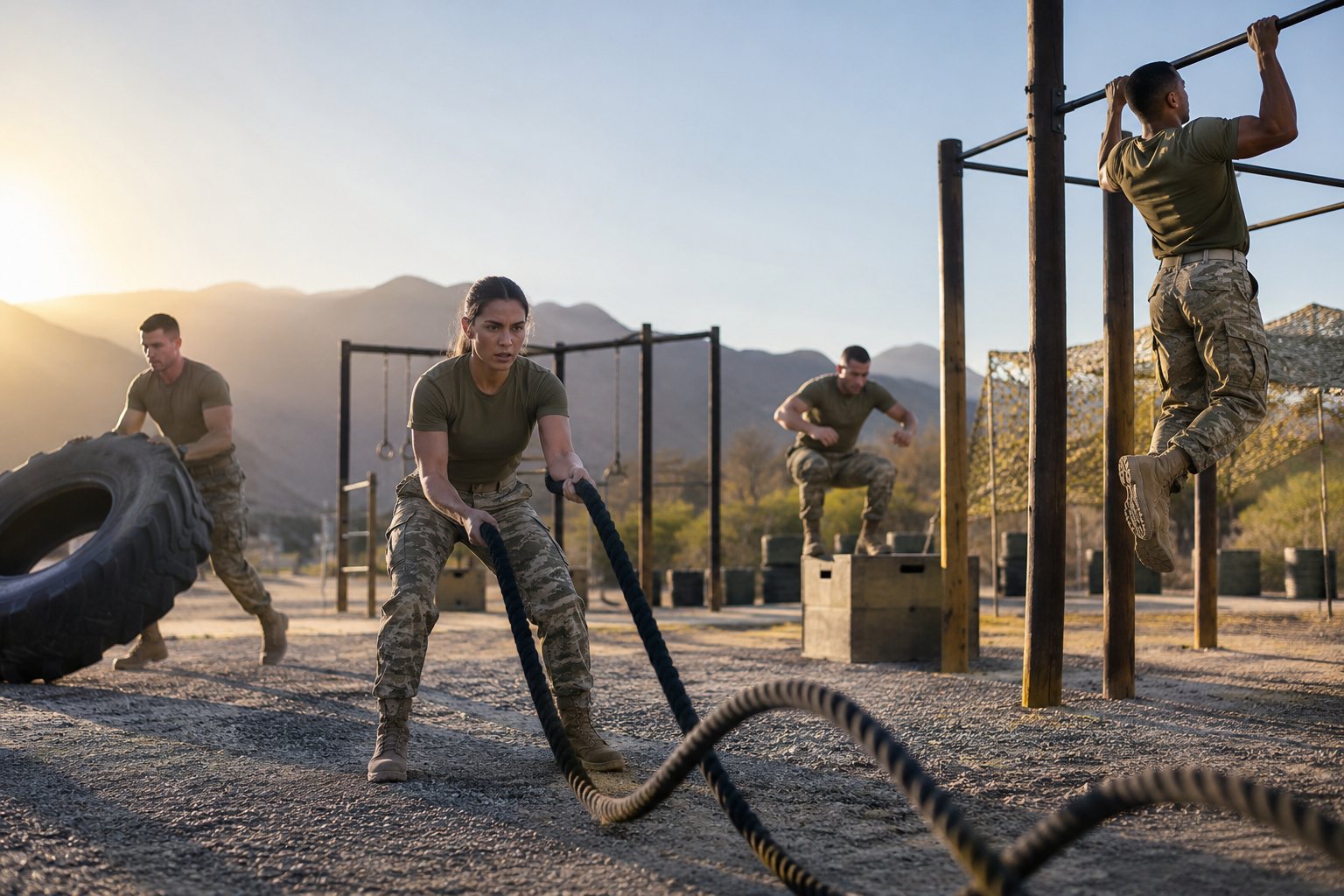
Military-Style Fitness Circuits: Planning and Progression
Military-style physical preparation circuits are often associated with exhausting tests, but their quality is not determined by leaving everybody depleted. A useful circuit connects exercises, space and recovery to defined abilities: moving, pushing, pulling, carrying and repeating demanding activity with control.
In a civilian gym, a workout inspired by that setting is not an official programme for a particular unit or complete preparation for every selection process. Tests, criteria and requirements differ. Preparation for a specific assessment must consider its relevant official information and the individual.
This guide describes a clear circuit for participants with different experience. Examples are illustrative scenarios, not universal protocols. It should be clear what is being trained, how demand changes and when a variation becomes unmanageable.
- Which capacity should the circuit develop?
- How should station exercises be selected?
- How should sequence and movement between stations work?
- How should work, rest and difficulty be adjusted?
- How should running and loaded carries be managed?
- How should sessions progress?
- Which equipment is needed and how should it be checked?
- How should results and recovery be assessed?
Which capacity should the circuit develop?
Begin with the task rather than an equipment list. Sustaining prolonged work, producing force and repeating short intense actions are not identical objectives. They can coexist in a programme, but each circuit needs an understandable priority. If strength is the aim, a sequence preventing controlled loading may be unsuitable. For sustained effort, frequent interruptions to explain complex movements change the task. Define the participants too: a session for experienced users does not automatically transfer to newcomers.
From inspiration to actual context
The military label does not replace a session description. State activities, expected duration and required level without promising readiness for every test. Clothing and scenery do not determine training content. Explain why exercises are included and which alternatives exist. A clear goal helps the instructor and group recognise whether the session follows its purpose. Fatigue is a response to manage, not sufficient proof of suitability or effectiveness.
How should station exercises be selected?
Choose familiar, observable actions before combining them. Squatting, stepping onto a suitable platform, pushing, pulling and carrying are useful movement families, but variations and resistance depend on users. A controlled push-up and an easier version can pursue similar objectives at different levels. Do not assign identical difficulty simply because everybody starts together. Practise stations separately to check support and understanding. An exercise requiring lengthy explanation each round may belong in a separate learning phase.
Simple movements with precise criteria
Simple does not mean undefined. Specify starting position, action, repetition ending and signs for stopping or adapting. This makes work assessable as effort rises. Complexity added only for novelty can create a memory test rather than a physical task. If jumps or fast actions are included, establish existing competence and suitable quantity and surface. They should not appear automatically because the circuit is marketed as intense. The movement still needs to serve the intended capacity.
How should sequence and movement between stations work?
Plan circulation first. Running, carrying and rope paths should not cross unpredictably. Every station needs room for the action and changeover. Decide where loads are placed and collected without obstructing others. An orderly layout helps the instructor observe and intervene. If some participants wait while others continue, the rhythm changes: assess station numbers, equipment availability and group organisation. Reaching the next station should not require negotiating unintended obstacles.
Alternating demands
Order affects difficulty. Several demanding stations for the same area or grip can undermine later ones. Alternating can help without removing all fatigue. Put a quality-dependent task where it can be performed under intended conditions. Trial the circuit including transition time, not just exercise time. Changeover includes storing an object, clearing space and arranging support. Skipping these steps to save seconds may reduce organisation without providing a useful training benefit.
How should work, rest and difficulty be adjusted?
Choose intervals or repetitions for the capacity and group. No universal work-to-rest ratio makes every circuit effective. A technical station may need different attention and recovery from simple locomotion. If execution deteriorates well before changeover, reduce demand, duration or complexity. With a repetition target, people finish at different times. Define what happens afterwards instead of allowing random waiting or requiring purposeless continuation until a signal. The format should explain the task rather than leave participants to improvise.
Adapt without losing the task
Change resistance, support height or variation while keeping the action recognisable. Avoid changing everything together, which prevents comparison. An easier version is not punishment: it trains the intended capacity with control. Explain alternatives before the start so nobody invents them while breathless. Individual needs may also require separate work. A group setting does not remove individual requirements or oblige everyone to continue under identical conditions.
How should running and loaded carries be managed?
Running and carrying are different tasks. Holding an object changes grip, balance and movement freedom. Define weight, handle, route and placement according to ability and equipment. Do not use improvised containers or handles without knowing their suitability. Participants must see their path and put loads down under control. If grip fails or position changes substantially, reduce demand instead of pursuing the endpoint at any cost. The return journey is part of the activity too.
Added weight and terrain
A vest or external load is not compulsory progression. Surface, pace and distance already change difficulty. Introduce variables separately. An uneven route differs from a flat one and should not be a random challenge for people unable to control it. Consider footwear, conditions and stopping opportunities. Outdoor organisation must fit location and weather. A hard-training label does not justify ignoring heat, footing or access to a return point. These conditions affect the actual task, even if the equipment stays unchanged.
How should sessions progress?
Establish constants before increasing work: stations, variations, route and quality criteria. Progress can mean more regular movement, fewer interruptions or better repeatability rather than only extra rounds. Adding weight, duration and speed together obscures the response. Learn a new circuit before treating it as a performance test. Record the rest of the week's work too. An identical session can feel different after other demanding activity. Interpret the context instead of calling every difficult day insufficient effort.
An illustrative example
Imagine a small group alternating step-ups, pushing, pulling and carries. Check each variation and assign manageable difficulty first. Initially keep the route stable to learn transitions and rhythm. Later change one selected variable while retaining the others. This is not an official protocol or a sequence suitable for everyone; it shows how decisions connect to observations. If carrying deteriorates while other stations remain consistent, analyse that section. Adding rounds everywhere would not automatically be the most relevant solution.
Which equipment is needed and how should it be checked?
A room need not be crowded with accessories. Select a few suitable tools in sufficient quantities. Compare gym equipment through stability, handles, adjustments and permitted use. Check visible condition, connections and supports beforehand. Follow manufacturer maintenance and do not improvise repairs to finish a round. Deal with visibly damaged components before use. Availability alone does not justify inclusion: an item should serve the intended capacity and fit the space.
Cleaning and shared organisation
Allow for resetting and cleaning between groups according to materials and instructions. Objects should not remain in running paths or landing zones. A previous user's setting may not suit the next one, so allow adjustment time. For managers, a simple layout supports continuity and fault recognition. A sustainable circuit accounts for preparation, exercise and restoration. Advertised exercise duration does not describe all work required to deliver an orderly session to the following group. These practical steps belong to planning rather than being left to chance.
How should results and recovery be assessed?
Assess controlled completion and repeatability in later sessions. Duration, rounds and repetitions help when conditions are comparable. Add observations about contact, rhythm and perceived difficulty. One test does not describe every capacity or demonstrate complete preparation. For selection assessments, use relevant official criteria and specific planning rather than assuming any intense circuit covers requirements. General work can contribute but must connect to recognisable goals and coherent checks.
When to change or stop
Ordinary fatigue, pain and technical difficulty are different. If an issue alters movement or persists, stop or adapt and seek appropriate assessment. Sleep, food and commitments affect recovery and should be considered before adding more work. Sustainable progression retains the ability to train consistently. The best circuit for its setting is not the most spectacular, but one whose exercises, dosage and changes can be explained. Clarity helps participants work purposefully and managers provide a service consistent with the group's abilities.
Comments (0)