
Trolley
You have no items in your shopping cart

 Budgets
 Dumbers
 Discs
 Benches
 Racks and Rigs
 Weights Holders
 Isotonic machines
 Calisthenics
 Cardio
 Kettlebells
 Flooring
 Gym Set
 Accessories
 Combat
 ARTI MARZIALI
 CONTAINER GYM
 Tug-Of-War
 Used Gym Equipment
 PILATES MACCHINARI
 GINNASTICA ARTISTICA
 CAMPI DA PADEL
 Prodotti in Pronta Consegna
 Informazioni
 IRONMAN
 Gift Card
- Donatif
- General information
- 0 I like it
- 184 Views
- 0 comments
- gym flooring, safety flooring, gym safety, shock-absorbing materials
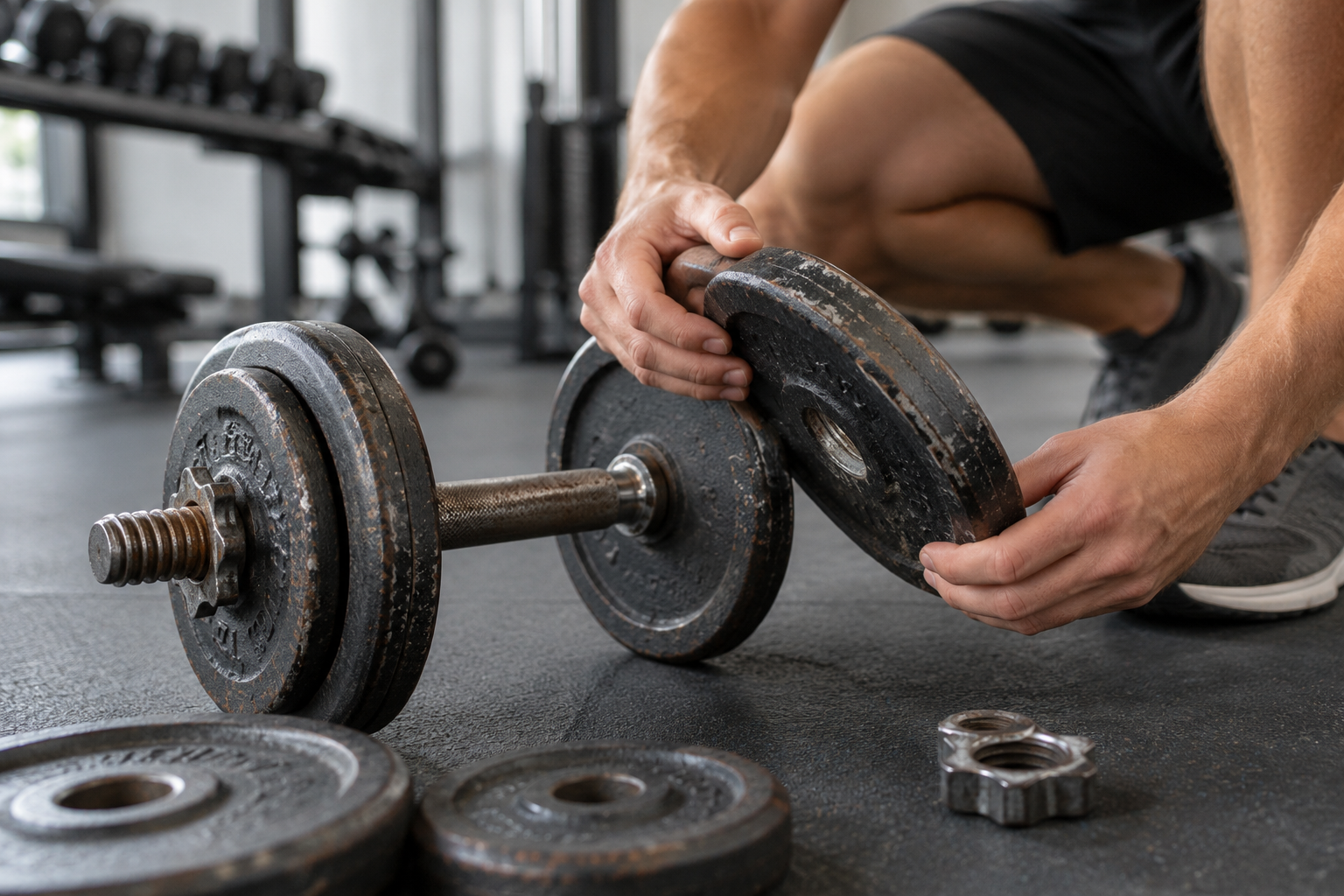
Risks of buying cheap gym weights: how to choose without compromising quality and safety
Choosing weights is one of the most important decisions when setting up or updating a professional gym. Dumbbells, plates, and barbells are used daily by people with different levels of experience and are subjected to repeated stress. For a purchasing manager, identifying cost-effective solutions is certainly important, but the initial price cannot be the only evaluation parameter.
The risks of buying cheap gym weights emerge especially when the savings come from inadequate materials, insufficient production controls, imprecise dimensional tolerances, or the absence of verifiable technical information. A low-priced product is not necessarily of poor quality, but a significant difference compared to professional alternatives requires an analysis of construction characteristics and the intended conditions of use.
For gyms and fitness centers, the goal should be to identify reliable equipment that is compatible with operational needs and sustainable in the long term. This guide analyzes the main risk factors and proposes concrete criteria for evaluating materials, safety, durability, suppliers, and the total cost of the investment, without limiting oneself to comparing commercial offers.
- Why price is not enough to evaluate gym weights
- Materials and construction quality: the risks to know
- Weight precision and dimensional tolerances
- Safety during professional use
- Durability, wear, and maintenance of equipment
- Compatibility with barbells, racks, and existing systems
- How to evaluate the supplier before purchasing
- Hidden costs and total cost of ownership
- How to plan a reliable investment
Why price is not enough to evaluate gym weights
The purchase price is an immediately comparable element, but it does not describe the quality of a piece of equipment on its own. Two seemingly similar plates may present differences in material composition, the precision of the center hole, surface finish, and wear resistance. Similarly, two dumbbells of the same nominal weight may have different assembly systems and ergonomic features.
In a professional context, these differences take on particular importance because the equipment is used frequently and by numerous users. A product suitable for occasional home use might not offer the same reliability in a high-traffic weight room. It is therefore necessary to verify the intended use declared by the manufacturer and the operating conditions for which the equipment was designed.
The economic evaluation should also consider the expected durability and any replacement costs. An initially affordable product can lose part of its advantage if it requires frequent intervention or shows early deterioration. Conversely, equipment with a low price but documented technical specifications can be an appropriate choice when it meets the facility's requirements.
The difference between cheap and poor quality
A cheap product can result from efficient production processes, essential configurations, or lower distribution costs. These elements do not necessarily compromise quality. The problem arises when price-cutting involves the use of unsuitable components, low-resistance finishes, or insufficient controls.
To distinguish between the two situations, it is useful to request verifiable information on materials, tolerances, intended use, and warranty conditions. The availability of clear technical documentation allows alternatives to be compared without relying solely on commercial descriptions.
Why professional use requires greater attention
In a commercial gym, the same weights can be moved numerous times throughout the day. Repeated settings, loading onto barbells, moving between stations, and contact with other equipment determine stresses that must be considered when choosing materials.
The purchasing manager should therefore evaluate the expected usage intensity, the number of members, and the type of training offered. A room dedicated to Olympic weightlifting has different needs than an area intended primarily for general resistance training.
Materials and construction quality: the risks to know
Material composition directly affects the strength, dimensional stability, and durability of weights. Plates can be made of cast iron, steel, rubber, or combinations of materials, while dumbbells can feature metal heads, protective coatings, and handles with different connection systems. Each solution has specific characteristics that must be evaluated against the intended use.
One of the main risks concerns the presence of construction defects that are not immediately visible. Irregular castings, unevenly applied coatings, or unreliable mechanical connections can compromise product durability. Aesthetic observation alone is not enough to identify all these issues.
For a professional facility, it is advisable to prioritize equipment accompanied by technical specifications and usage instructions. Quality must be evaluated by considering the entire product, not just the main material declared in the commercial sheet.
Cast iron and steel: features to verify
Cast iron plates are a widespread solution for resistance training. Their reliability depends on the quality of the casting, the precision of the machining, and surface protection. Possible defects can manifest through irregularities, chipping, or deterioration of the finishes during use.
In steel components, mechanical machining, corrosion protection, and the quality of couplings are of particular importance. It is not enough to verify that a product is made of metal: one must understand how it was built and what usage conditions it can support.
Rubber coatings and protective materials
Coatings can help protect surfaces and reduce some consequences of contact between equipment. However, their effectiveness depends on the composition, thickness, adhesion to the core, and quality of workmanship. Low-resistance coatings can deteriorate, deform, or separate from the support.
In the case of bumper plates, it is fundamental to verify that the product is actually designed for the intended usage modes. Not all rubber-coated plates are suitable for being dropped, and usage conditions must comply with the manufacturer's instructions.
Weight precision and dimensional tolerances
Nominal weight precision is a parameter often overlooked in the evaluation of economic offers. Two plates marked with the same value may present different deviations compared to the declared mass. The importance of this variable increases in programs that require controlled progressions and an balanced distribution of loads.
Tolerances do not only concern mass. Outside diameter, thickness, and center hole dimensions influence compatibility with other equipment and ease of use. A plate with imprecise dimensional machining can be difficult to insert on the barbell or have excessive play.
For a purchasing manager, the verification should be based on declared values and documented control procedures. The presence of specified tolerances allows for a more objective comparison than generic descriptions such as high precision or superior quality.
How to evaluate mass tolerances
The tolerance indicates the permitted deviation from the nominal weight. If a 20 kg plate has a declared tolerance of 1%, the maximum expected deviation corresponds to 200 grams more or less. This example helps to understand why it is important to know the value actually guaranteed by the manufacturer.
In a generalist gym, different tolerances might be acceptable compared to those required in particularly specialized training contexts. The choice must be consistent with the facility's goals and the level of precision required for the proposed programs.
Precision of holes and couplings
The center hole of the plates must be compatible with the diameter of the barbell sleeves. Imprecise machining can make loading difficult or cause unwanted movement during exercise. It is therefore important to verify the nominal dimensions and the expected tolerances.
The thickness of the plates also affects professional use because it determines the amount of load that can be installed on the sleeves. Two products with the same mass can occupy different spaces, modifying the station's operational capacity.
Safety during professional use
Safety is one of the central criteria in selecting weights for a gym. Damaged equipment, faulty connections, or incompatible components can increase the risk of accidents. For this reason, the purchasing manager must evaluate not only the price but also the technical information and the usage conditions intended by the manufacturer.
It is important to distinguish risks related to product quality from those arising from improper use. Even professional equipment can deteriorate quickly if used outside of permitted conditions. The choice of weights must therefore be accompanied by adequate usage, control, and maintenance procedures.
Proper safety management includes identifying damaged components, periodically checking the condition of the equipment, and promptly removing products that show significant anomalies from service.
Risks related to dumbbell connections
In fixed-weight dumbbells, the quality of the connection between the handle and the heads represents a fundamental element. Inadequate or deteriorated fastening systems can generate unwanted movement and compromise equipment reliability.
During selection, it is useful to verify the construction type, the manufacturer's instructions, and the presence of any usage limits. Subsequent inspections must pay attention to mechanical play, deformations, and signs of damage.
Drops, impacts, and use of plates
The stresses generated by impacts depend on the mass, drop height, surface, and material characteristics. Not all weights are designed to withstand repeated drops. Using traditional plates as if they were bumper plates can cause damage to equipment and surfaces.
The choice must also consider the available flooring. Surfaces designed to absorb certain impacts can contribute to protecting the area, but they do not automatically make a plate suitable for usage modes not foreseen by the manufacturer.
Durability, wear, and maintenance of equipment
The durability of weights depends on the quality of the materials, the intensity of use, and environmental conditions. A high-traffic gym subjects equipment to continuous movement, making the resistance of finishes and components subject to contact important.
Cheap products do not necessarily have a shorter lifespan, but the lack of information on construction characteristics makes it more difficult to predict their behavior. To reduce uncertainty, it is advisable to request maintenance instructions and verify the availability of support in case of defects.
Preventive management allows deterioration and anomalies to be identified early. Recording equipment conditions also helps to understand which types of products are best suited to the facility's actual use.
Corrosion and surface deterioration
Metal surfaces can be subject to corrosion, especially in the presence of high humidity or deteriorated surface protections. The quality of the finishes influences the resistance to these phenomena and the ease of cleaning.
Damaged coatings, chipping, and deformations must be evaluated in relation to their severity. Not every aesthetic imperfection compromises functionality, but some signs can indicate structural problems that require in-depth checking.
Organizing checks and replacements
A control program should include visual inspections of surfaces, handles, and connections. The frequency of inspections should be defined based on usage intensity and manufacturer instructions.
When a piece of equipment shows potentially significant damage, it is appropriate to suspend its use until technical verification. Improvised repairs or unauthorized modifications can alter the original characteristics and introduce further risks.
Compatibility with barbells, racks, and existing systems
Compatibility represents an essential criterion in selecting weights. Purchasing cost-effective plates that are not suitable for existing barbells can generate additional costs and limit the use of stations. It is therefore necessary to verify dimensions and technical characteristics before proceeding with the order.
The differences between standard and Olympic systems mainly concern the dimensions of the connections and sleeves. It is not enough to rely on the commercial name: one must compare the actual technical data and verify the compatibility declared by the manufacturers.
Another element concerns the organization of the weight room. Plates with different shapes, diameters, and thicknesses may require specific storage systems. The evaluation should include racks, supports, and available space.
Verifying the pairing of plates and barbells
Before purchasing, it is necessary to check the center hole diameter, sleeve diameter, and allowed load capacity. The locking systems must also be compatible with the planned configuration.
A preventive check reduces the risk of receiving products that are difficult to use. When possible, it is useful to request a sample or perform a practical test with the equipment already installed.
Storage and handling of weights
Weight management also includes storage methods. Racks and supports must be sized for the intended loads and placed in positions that allow for easy movement.
Dumbbells and plates with inconsistent dimensions can make space organization less efficient. A coordinated choice of equipment facilitates room order and reduces the need for additional storage solutions.
How to evaluate the supplier before purchasing
The supplier and purchase process must include checks that go beyond comparing price lists. A reliable supplier should provide clear technical information, transparent commercial conditions, and indications on support methods. These elements help the purchasing manager reduce investment uncertainty.
The presence of detailed descriptions, photographs, and dimensional specifications allows for an initial evaluation, but for large orders, it may be appropriate to request additional documentation. Materials, tolerances, intended use, and warranty conditions should be clarified before confirmation.
Another aspect concerns the continuity of supply. Gyms may need to later supplement new pairs of dumbbells or plates of the same type. The future availability of compatible products helps keep the weight room organization uniform.
Documentation and specifications to request
The documentation should at least include materials, dimensions, nominal weight, any declared tolerances, and usage instructions. Where applicable, it is useful to check for references to relevant technical standards and compliance documentation required for that specific product category.
Generic commercial statements do not replace verifiable data. A purchasing manager should prefer offers that allow concrete characteristics to be compared and the ordered product to be precisely identified.
Warranty, support, and anomaly management
Warranty conditions must be read carefully, distinguishing between production defects, ordinary wear, and damage resulting from unauthorized use. It is important to know the procedures for reporting anomalies and requesting any replacements.
The availability of a technical contact person and clarity of support conditions can reduce the time required to resolve problems. This aspect becomes particularly relevant when the purchase concerns numerous pieces of equipment intended for daily use.
Hidden costs and total cost of ownership
The price indicated in the quote represents only one component of the investment. Transport, handling, accessories, any replacements, and management costs can significantly change the overall convenience. A professional evaluation should therefore consider the total cost of ownership, often referred to as TCO.
This approach allows products with different initial prices to be compared based on their economic impact during the expected period of use. It does not mean the most expensive solution is always preferable, but that the comparison must include all relevant items.
For facilities with limited budgets, analyzing the total cost helps establish realistic priorities. Investing in equipment adapted to the most frequent usage modes can be more efficient than distributing the budget uniformly without considering the different stresses.
Transport, replacements, and accessory costs
Weights are products characterized by high mass and can entail significant logistics costs. It is important to verify if the price includes delivery, unloading, and movement to the installation area. Any special conditions must be clarified before ordering.
The replacement of deteriorated products generates additional costs, to which transport expenses and administrative management time can be added. Even when the warranty covers certain defects, one must know the expected operating conditions.
How to compare cost over time
A simple method consists of dividing the total expected cost by the estimated years of use. For example, a set purchased for 1,200 euros and used for six years has an average purchase cost of 200 euros per year, without considering maintenance and other expenses. A 900-euro set replaced after three years has an average cost of 300 euros per year, still limiting it to the initial price.
These values are purely illustrative and do not represent guaranteed durations for specific products. The example shows how a lower price may not coincide with the lowest annual cost. To obtain a reliable comparison, one must use motivated estimates and update calculations based on the facility's experience.
How to plan a reliable investment
An effective choice guide must transform technical information into a repeatable decision-making process. The first step consists of defining which weights are needed, what exercises they will be used for, and with what frequency. Subsequently, it is possible to identify minimum requirements regarding materials, precision, compatibility, and durability.
For a professional gym, it is useful to distinguish equipment intended for intensive use from that used occasionally. This classification allows the budget to be assigned proportionally to real needs, avoiding both excessive savings on high-stress stations and unnecessary investments in features of little relevance.
The purchasing manager should also consider the possibility of performing checks on samples before ordering large quantities. Checking dimensions, finishes, ergonomics, and compatibility allows for identifying any critical issues that might not emerge from commercial documentation alone.
Building an offer evaluation matrix
A practical method consists of assigning a weight to the main selection criteria. Construction quality, safety, precision, compatibility, support, and total cost can be evaluated through consistent scoring. The weighting should reflect the facility's priorities and not be identical for every type of equipment.
For example, in a center dedicated to Olympic weightlifting, the impact resistance of plates designed for such use may take on high importance. In a generalist gym, however, ergonomics, ease of movement, and availability of different sizes might have a greater impact on the decision.
Verifying the quote before confirmation
Before approving the order, it is appropriate to check quantities, sizes, technical characteristics, delivery times, and warranty conditions. The quote should clearly identify the products and any included accessories, avoiding ambiguities that might only emerge upon delivery.
When the purchase concerns plates and other weights intended for a professional room, it may be useful to delve into the characteristics of gym plate solutions, comparing materials, configurations, and compatibility with existing barbells. The goal remains to select products adapted to operational needs, not simply to identify the lowest unit price.
Monitoring quality after purchase
Evaluation does not end with delivery. During the first few months of use, it is useful to record any anomalies, observe the behavior of finishes, and collect feedback from trainers. This information allows for verifying the consistency between declared characteristics and actual performance.
In the medium term, data related to durability, replacements, and maintenance provide a concrete basis for subsequent purchases. Documented management helps the purchasing manager recognize the most reliable solutions, improve budget planning, and reduce the risk of repeating inefficient investments. The convenience of a gym weight must be measured through its ability to maintain functionality, safety, and operational value during the entire expected period of use.
Comments (0)