
Trolley
You have no items in your shopping cart

 Budgets
 Dumbers
 Discs
 Benches
 Racks and Rigs
 Weights Holders
 Isotonic machines
 Calisthenics
 Cardio
 Kettlebells
 Flooring
 Gym Set
 Accessories
 Combat
 ARTI MARZIALI
 CONTAINER GYM
 Tug-Of-War
 Used Gym Equipment
 PILATES MACCHINARI
 GINNASTICA ARTISTICA
 CAMPI DA PADEL
 Prodotti in Pronta Consegna
 Informazioni
 IRONMAN
 Gift Card
- Donatif
- General information
- 0 I like it
- 123 Views
- 0 comments
- gym flooring, safety flooring, gym safety, shock-absorbing materials
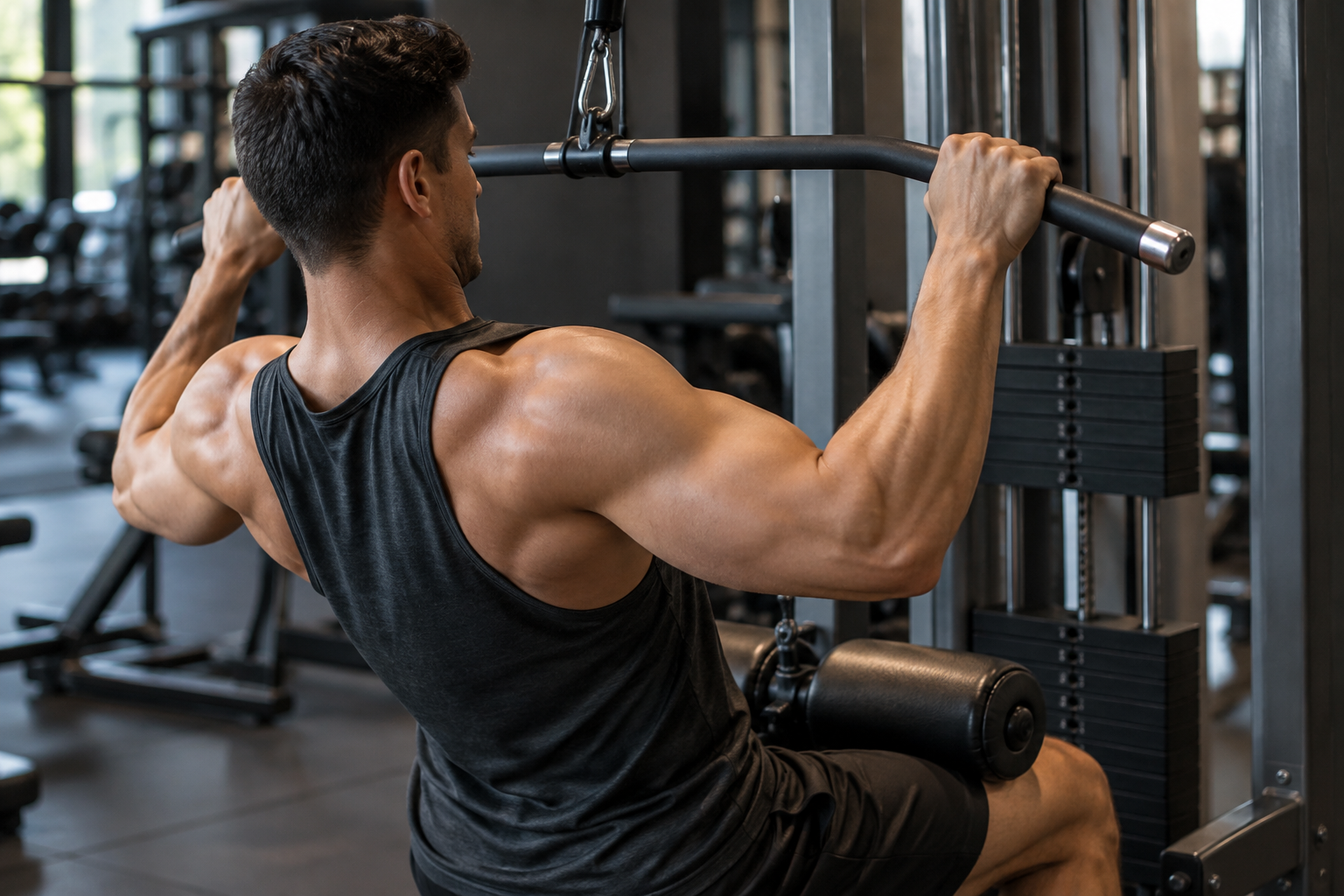
Back Machine: Exercises and Muscles Involved
The term back machine can refer to different stations. The lat pulldown offers a pull from above, while a guided row organizes a pull with a different relationship between the body and resistance. Before starting, it is necessary to recognize the machine and the planned movement: preparation, supports, and trajectory cannot be automatically transferred from one station to another.
Addressing the topic back machine: exercises and muscles involved means connecting anatomy and action. The back muscles participate in the movement together with those of the arms and the musculature that maintains the position. The contribution changes according to the exercise and configuration, without a single grip allowing a zone to be completely isolated or guaranteeing identical results for each person.
The guide offers general references to understand the main stations, prepare them with the instructor, and recognize frequent difficulties. It does not establish an individual program nor does it replace the model's instructions. The goal is to make the exercise sequence clear, from the starting position to the return, avoiding evaluating the work solely through the selected weight or the distance covered by the grip.
- Distinguish vertical pull and row
- Understand which muscles participate in the movement
- Prepare seat, supports, and grip
- Execute the pull on the lat pulldown
- Execute the row in the planned configuration
- Recognize errors and difficulties without forcing
- Insert pulls into the program and follow their progression
Distinguish vertical pull and row
In the vertical pull, resistance is addressed with a movement from above towards the body, according to the planned configuration.
In the row, the pull follows a different relationship with the torso and can be organized through a cable or levers. The generic designation back does not clarify these differences and is not enough to properly prepare the station.
The back machine must be identified through indications and model. An illustrative image can help recognize the movement, but adjustments must be understood on the actual machine present. If the function is not clear, a demonstration by the staff allows connecting commands, supports, and sequence before selecting the resistance for the set.
Recognize the function of the lat pulldown
The lat pulldown may feature a seat and support systems that must be prepared according to the relative instructions. The user must know how to reach the grip and how to finish the set without improvising steps. Familiarity with a similar station does not automatically confirm that height, supports, or access procedure are the same.
Identify supports and resistance of the row
In the row, it is necessary to recognize which supports are provided for feet, seat, or chest, according to the model. This preparation guides the position from which the pull will begin. A machine with torso support and a cable system may require different indications, which must be understood without automatically transferring the same setup to any equipment.
Understand which muscles participate in the movement
The latissimus dorsi participates in arm movements relative to the trunk, including shoulder adduction and extension.
Its action is part of the overall sequence of the exercise, together with other muscles. Describing a station as a back machine does not mean that the work is performed by a single structure or that the contribution remains identical in every variant.
The muscles involved in pulls must be read through the actual movement. When the elbow flexes, the elbow flexors, including the biceps, also participate. This collaboration does not automatically represent an error: the task is to organize the planned execution, avoiding reducing the evaluation to the sensation of a single muscle during the set.
The role of the latissimus dorsi and arms
Latissimus dorsi and arms work in a relationship that depends on trajectory and configuration. The choice of grip can modify the way a person executes the pull, but it does not eliminate the contribution of the other segments. The instructor can help connect the movement to the objective, without promising complete isolation through a simple hand position.
The contribution of the scapular girdle
Trapezius, rhomboids, and other muscles participate in managing the scapular girdle according to the gesture. Their contribution must be understood in the context of the exercise and the person. It is not useful to impose an identical shoulder blade command at every station: the explanation must refer to the planned movement and maintain a controllable sequence throughout the entire repetition.
Prepare seat, supports, and grip
The preparation must allow the person to assume the position foreseen by the model.
Seat, any supports, and the starting point must be adjusted following the pertinent instructions. A number on the scale can be noted to resume work, but it does not describe a setting valid for everyone nor can it be automatically transferred to a different machine with similar adjustments.
The lat pulldown adjustment and that of the row require attention to their respective configurations. Staff can observe how the person reaches the grip and begins the gesture. If the preparation requires unclear movements, the point must be resolved before the set, rather than trying to fix supports while the resistance is already in motion.
Adjust the machine before the set
Adjustments must be verified through the expected operation of the controls, without adding supports or improvised modifications. The position must be understandable to the person and consistent with the exercise. If a support cannot be used as indicated, consultation with the instructor is needed to review preparation or alternatives, without forcing the configuration simply to complete the program.
Choose a grip consistent with the exercise
The grip must correspond to the explained variant and the foreseen handles. There is no sufficient criterion based solely on the fact that a grip is wider or narrower. It is useful to understand where elbows and hands move in the sequence and ask for support when the gesture is difficult to interpret or keep controlled.
Execute the pull on the lat pulldown
In the frontal variant, the grip is brought towards the body through the sequence explained by the instructor and compatible with the model.
The movement must remain connected to the prepared position. Seeking an arrival point at any cost can lead to changing setup, so amplitude and trajectory must be addressed through indications pertinent to the person.
The lat pulldown pull must also be followed during the return phase. The user should not consider the upward movement as a pause in which to abandon control of the resistance. Preparation serves precisely to make the entire repetition manageable, without entrusting the movement to body oscillations or improvised changes of position during the set.
Manage the pull in front of the body
The frontal pull must remain consistent with the chosen variant, without introducing different paths because they are observed in another user. The instructor can verify trajectory and supports at the actual station. A doubt about the end of the movement must be addressed before increasing the demand, keeping technique distinct from the search for the highest possible load.
Control the return without letting yourself be dragged
During the return, the person must know how to manage the final position and prepare the next repetition. If the resistance leads to a loss of control, preparation must be reviewed with the staff. The number of completed repetitions alone does not describe the work done if the movement changes unexpectedly or becomes difficult to interpret.
Execute the row in the planned configuration
The row must be executed according to the variant and foreseen supports, maintaining a torso position consistent with the explanation received.
The pull does not consist merely of pulling the hands back: trajectory, elbows, and relationship with resistance must be understandable. If the gesture requires unexpected oscillations, technique and preparation must be reviewed with the instructor.
The back training machines may present different configurations. In practice, the user must use the indications of the present station and distinguish a row with chest support from other solutions. The category describes equipment possibilities, while the exercise must be prepared on the machine and person actually involved.
Coordinate pull and torso position
Coordination must make it readable how actions begin and proceed, without turning the torso into a means to move more resistance at any cost. A useful correction concerns an observable phase of the gesture. The user can signal where they lose supports or do not understand the trajectory, allowing staff to look at that concrete passage.
Recognize the end of the repetition
The end of the repetition must be referred to the variant and followed by a controlled return. It is not advisable to seek an extreme position just to increase the distance covered by the hands. The movement must remain manageable in the explained sequence, with preparation that allows starting and ending the set according to conditions pertinent to the model.
Recognize errors and difficulties without forcing
Resistance that leads to losing supports or modifying the sequence requires consultation with the staff.
The goal is not to prove the ability to move the weight stack anyway, but to perform the intended task. The instructor can help review preparation and demand, keeping the program connected to the person's actual execution.
Oscillations, sudden accelerations, or difficulties in the return must be described through the moment they appear. A generic command like feel your back more may not clarify the problem. It is more useful to observe position and trajectory, distinguishing what the person understands from what requires an explanation or a modification of the work.
Review the load when the movement changes
Load is one of the variables and not the only information in the program. Adjustments and familiarity with the model can also influence preparation. Before attributing every difficulty to strength, it is best to reconstruct the sequence with the instructor, avoiding automatically transferring settings or values from a different machine that uses a similar system.
Distinguish personal sensations and equipment anomalies
A noise or anomalous behavior of the station must follow the facility's reporting channel. Pain or unusual sensations require stopping the exercise and asking for appropriate support, without using further repetitions as proof. A general guide does not allow evaluating the cause or indicating a valid correction for every person and situation.
Insert pulls into the program and follow their progression
Lat pulldown and row must be inserted into the program through individual goals and experience.
A description of the muscles does not automatically prescribe sets, repetitions, and rests suitable for everyone. Staff can connect these elements to the person's journey, keeping the function of the exercise clear and the criterion with which the demand will be updated over time.
Progression must preserve a recognizable sequence. Increasing the selected value does not describe an improvement if it coincides with unexpected changes in amplitude, supports, or control. The program information must therefore be read together with execution, without turning the number on the weight stack into the only result to consider during back training.
Record variant and useful settings
Notes can report model, variant, adjustments, and load, along with the instructions received. This allows resuming work without rebuilding preparation every time. If the person uses another station, data must not be transferred automatically: the configuration must be understood and verified before treating values as directly comparable.
Compare work and execution quality
Comparison over time must concern what is actually executed in the foreseen variant. When a new difficulty emerges, conditions are reviewed with the instructor instead of compensating for it through improvised movements. Training thus maintains a concrete connection between exercise, muscles involved, and individual progression, with attention to the complete sequence and understanding of the station.
Comments (0)