
Trolley
You have no items in your shopping cart

 Budgets
 Dumbers
 Discs
 Benches
 Racks and Rigs
 Weights Holders
 Isotonic machines
 Calisthenics
 Cardio
 Kettlebells
 Flooring
 Gym Set
 Accessories
 Combat
 ARTI MARZIALI
 CONTAINER GYM
 Tug-Of-War
 Used Gym Equipment
 PILATES MACCHINARI
 GINNASTICA ARTISTICA
 CAMPI DA PADEL
 Prodotti in Pronta Consegna
 Informazioni
 IRONMAN
 Gift Card
- Donatif
- General information
- 0 I like it
- 194 Views
- 0 comments
- gym flooring, safety flooring, gym safety, shock-absorbing materials
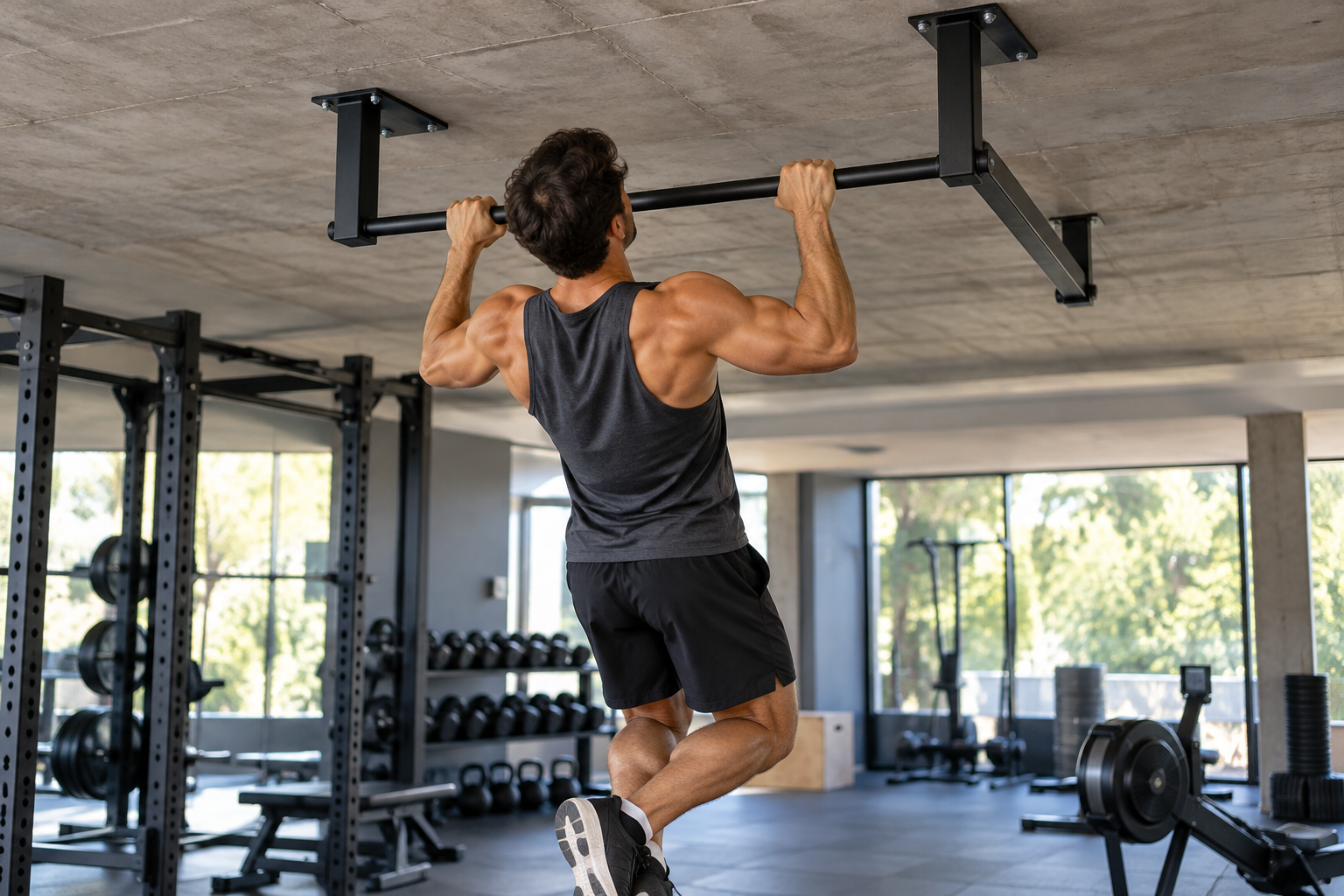
Safe installation of a ceiling pull-up bar: technical guide
The safe installation of a ceiling pull-up bar requires an evaluation that goes beyond the choice of the product and its relative fasteners. In a professional gym, a suspended bar is equipment subjected to stresses that depend on the users' weight, workout methods, and the characteristics of the structure to which it is connected. For this reason, before proceeding with assembly, it is necessary to verify the compatibility between the equipment, building support, and operating conditions.
A pull-up bar can be used for bodyweight exercises, athletic preparation, and functional activities. However, not all models are designed for the same usage methods. Controlled pull-ups, dynamic movements, and exercises that generate swings can produce different stresses. The load capacity declared by the manufacturer must therefore be interpreted in relation to the intended use and the conditions specified in the technical documentation.
For a gym manager or purchasing manager, the main problem consists in distinguishing what can be verified through a product datasheet from what requires an evaluation of the existing structure. The choice of wall plugs, anchors, and fixing points cannot be carried out reliably without knowing the characteristics of the support. This guide illustrates the preliminary checks, technical responsibilities, safety aspects, and economic criteria necessary to plan an appropriate intervention, without replacing a design or verification performed by qualified professionals.
- Preliminary evaluation of the installation
- Verification of the ceiling structure
- Static and dynamic loads and conditions of use
- Anchoring systems and compatibility of fasteners
- Bar positioning and space organization
- Assembly procedures and initial checks
- User safety and operational management
- Maintenance and periodic checks
- Alternatives to ceiling mounting
- How to evaluate the investment and decide
Preliminary evaluation of the installation
Before purchasing a ceiling pull-up bar, it is necessary to define where it will be installed, who will use it, and which exercises will be permitted. This information determines the characteristics required for the equipment and influences the evaluation of the load-bearing structure. A bar intended for controlled pull-ups must not be automatically considered suitable for dynamic movements or exercises involving significant swings.
The preliminary evaluation should include the identification of the room, the availability of building documentation, the usable height, the presence of systems, and access conditions for assembly. It is also necessary to verify that the chosen position does not interfere with other equipment or user pathways. A seemingly convenient location may prove unsuitable when considering the entire space necessary for the exercise.
For a professional gym, it is advisable to involve a competent technician in the structural evaluation from the very beginning. The equipment manufacturer can provide data relating to its product, but this information alone does not demonstrate that the existing ceiling is suitable to support it. The two verifications must be considered complementary.
Define the intended use
The first question concerns the planned activities. Traditional pull-ups, exercises with a different grip, and dynamic movements may require different characteristics of the bar and its connections. It is necessary to verify that each activity falls among those permitted by the manufacturer.
If the gym anticipates use by advanced athletes, the choice must take into account the most demanding operating conditions allowed. It is incorrect to presume that a structure suitable for a light user is automatically suitable for all members.
Gather necessary documentation
Before proceeding, it is useful to gather the technical datasheet of the bar, installation instructions, drawings of the fixing points, and information on the intended use. These documents allow the appointed professional to know the declared characteristics of the equipment.
When available, documents relating to the building structure must also be examined. If reliable information on the ceiling is missing, specific assessments may be necessary before establishing whether and how to carry out the fixing.
Verification of the ceiling structure
The visible ceiling does not necessarily coincide with the structural element to which a bar can be anchored. False ceilings, cladding, and finishes can conceal beams, floors, and systems. The presence of a seemingly solid surface does not constitute proof of its ability to support suspended loads.
The structural verification of the ceiling must identify the load-bearing material, its conditions, and the possibility of correctly transferring the stresses generated by the equipment. The evaluation depends on the building configuration and may require the intervention of an engineer or another authorized professional in accordance with applicable provisions.
Particular attention must be paid to existing buildings, especially when updated structural drawings are not available. Any previous interventions, deterioration, or modifications can influence the conditions of the support. It is not prudent to base the design on assumptions regarding the material or thickness of the floor slab.
Concrete, steel, and other supports
Concrete and metal structures may require different connection systems. Even within the same material category, there are configurations that influence the anchoring methods.
The system must be selected based on the actually verified characteristics. There is no universal fixing valid for any ceiling, and it is not possible to establish the suitability of the support through simple visual observation.
False ceilings and system interference
An ordinary false ceiling must not be automatically considered a load-bearing element for a pull-up bar. If the design involves connection to an upper structure, the solution must be defined and verified by a competent professional.
Before drilling, it is also necessary to locate any electrical systems, pipes, and other hidden elements. The absence of reliable information requires appropriate assessments, not exploratory drilling attempts carried out without risk assessment.
Static and dynamic loads and conditions of use
During a pull-up, body weight represents only a part of the stresses that can act on the bar. Accelerations, swings, and changes of direction can modify the forces transmitted to the connections. The evaluation must therefore consider the intended usage methods and not just the user's mass.
The pull-up bar capacity must be interpreted according to the manufacturer's instructions. A numerical value, devoid of the conditions to which it refers, does not allow establishing the suitability of the entire installation. It is necessary to distinguish the declared capacity of the equipment from the capacity of the anchoring system and the building structure.
Stresses can act in different directions and generate effects on individual fixing points. For this reason, simply dividing the user's weight by the number of anchors does not constitute a reliable sizing method. The distribution of forces depends on the geometry of the system and must be evaluated technically.
Static loads and user weight
The user's weight constitutes a useful initial datum, but does not exhaust the evaluation. Any worn-overloads and the limitations indicated by the manufacturer must also be considered.
A gym that allows weighted pull-ups must explicitly verify that such a mode is provided for. It is not correct to interpret a generic capacity as authorization to use any combination of body weight and additional load.
Dynamic movements and additional stresses
Pull-ups performed with momentum and other dynamic movements can produce different load conditions compared to a controlled exercise. The magnitude of the stresses depends on the movement and the characteristics of the system.
It is not possible to indicate a coefficient valid for all installations without a specific technical reference. If the manufacturer does not authorize certain exercise methods, these must not be introduced on the basis of empirical evaluations.
Anchoring systems and compatibility of fasteners
Anchors constitute the connection between the bar and the load-bearing structure. Their choice depends on the support material, expected stresses, geometry of the fixing points, and manufacturer's instructions. It is not sufficient to purchase wall plugs described generically as resistant or suitable for heavy loads.
The anchors for ceiling bar must be sized and installed according to an appropriate technical solution. Aspects to be verified include the characteristics of the support, distances from edges, center-to-center distance between fasteners, and conditions provided for installation. Prescriptions change according to the system used and cannot be replaced by generic rules.
A frequent error consists in considering the bar capacity and the nominal capacity of individual anchors separately, without verifying the behavior of the whole. Safety depends on the complete connection, the building structure, and the installation conditions. For this reason, the selection of fasteners must be entrusted to competent subjects.
Mechanical anchors and conditions of use
Mechanical anchors may be provided for certain materials and load conditions. Performance depends on the product characteristics and the correct execution of installation.
The choice must be based on applicable technical documentation and support verifications. It is not appropriate to select the diameter, depth, or number of fasteners without a design referring to the real situation.
Chemical anchoring systems
Some systems use resins and anchor bars, but their suitability depends on the support, environmental conditions, and specific prescriptions. Maturation times, hole preparation, and installation methods are relevant technical elements.
The presence of a chemical product does not automatically make the fixing safer compared to a mechanical system. The comparison must be carried out by a professional based on project characteristics and manufacturer documentation.
Bar positioning and space organization
The position of the bar affects the possibility of performing exercises without interference with walls, equipment, and other users. Proper design must consider ceiling height, body length during suspension, and potential leg movement. The necessary space depends on the planned activities.
In a professional gym, it is important to prevent the area underneath the bar from coinciding with a passageway. The user must be able to access the station, prepare for the exercise, and finish the movement without coming into contact with nearby people or objects. Operating distances must be defined through technical indications and risk assessment.
The location must also allow access for inspections and maintenance. A bar installed in a hard-to-reach position can make periodic checks of the connections complex. Ease of management must be considered as early as the design phase.
Installation height and accessibility
The height must be chosen according to users and planned exercises. A bar that is too low can limit movements, while an excessively high position can make access difficult.
It is not correct to identify a universal quota without knowing the context. Ascending and descending methods must also be considered, avoiding improvised solutions that introduce additional risks.
Free area and operational interference
The space around the bar must allow planned movements without collisions. Any permitted swings and the presence of other workout stations must also be considered.
A floor plan representation can help verify overall dimensions. Before final installation, it is useful to compare the design with the actual conditions of the room and user pathways.
Assembly procedures and initial checks
Assembly must be performed by competent personnel in accordance with the manufacturer's instructions and the verified anchoring solution. Operations include activities that may involve risks related to working at heights, the use of tools, and the presence of systems. It is therefore necessary to prepare appropriate working conditions and comply with applicable obligations.
The procedure cannot be reduced to a universal sequence of drilling and tightening. Different materials, different anchors, and specific structural conditions require special prescriptions. Parameters such as hole depth, cleaning methods, and tightening torques must come from the technical documentation of the selected system.
Before commissioning, it is necessary to verify that the installation corresponds to the design and instructions. Any checks or tests must be defined by those who possess the necessary skills. An empirical test performed by hanging from the bar does not demonstrate, by itself, the safety of the connection over time.
Skills required for assembly
The manager must identify subjects with skills adequate for the type of intervention. Structural evaluation and anchor installation may require different professional skills, which must operate on the basis of coherent information.
It is advisable to clarify before work begins who verifies the support, who defines the fixing system, and who checks the execution. An explicit distribution of responsibilities reduces the risk that important steps are considered someone else's responsibility.
Checks before commissioning
Before authorizing use, the correspondence of the installation to the expected indications, the integrity of the components, and the absence of evident anomalies must be checked. Specialized verifications must be performed when requested by the design.
It is useful to keep documentation of the intervention, instructions, and results of the required checks. These materials constitute a reference for maintenance and any future modifications to the workout area.
User safety and operational management
A correctly installed bar must be accompanied by usage procedures consistent with its intended use. The manager must establish which exercises are permitted, what limitations apply, and how personnel must intervene in the presence of inappropriate behavior. Safety also depends on the organization of the gym.
It is important to prevent users from introducing accessories or overloads not provided for by the manufacturer. The addition of straps, rings, or other elements can modify the application modes of forces and require specific verifications. Compatibility must be ascertained before use.
Operational indications must be understandable and accessible. In a facility frequented by people with different levels of preparation, staff should know the correct access methods to the bar and the conditions under which it is appropriate to provide supervision.
Define permitted exercises
Activities must fall within the declared intended use. If a bar is designed for controlled pull-ups, it must not be automatically used for acrobatic or dynamic movements.
The gym can prepare internal indications that clarify usage methods. These indications must be consistent with the technical documentation and the context risk assessment.
Supervision and user training
Instructors should be able to recognize potentially risky behaviors, such as unauthorized swings or improper use of accessories. Training must also include anomaly reporting procedures.
Initial supervision may be appropriate for less experienced users. Methods must be defined in relation to the activity and the characteristics of the structure, without presuming that seemingly simple equipment is devoid of risk.
Maintenance and periodic checks
After installation, the bar must be included in the gym's maintenance schedule. Connections may be subjected to repeated stresses, and component conditions must be monitored according to the manufacturer's instructions and the indications of the professional responsible for the intervention.
Verifications may concern the integrity of the bar, conditions of connection points, any deformations, presence of corrosion, and perceptible anomalies during use. Frequency must be established considering intended use, intensity of use, and environmental conditions. It is not appropriate to indicate a universal interval valid for all installations.
When a problem potentially relevant to safety is detected, the equipment must be removed from use until appropriate evaluation. Improvised interventions on fasteners or unauthorized modifications can compromise system characteristics. Documentation of checks facilitates management over time.
Visual inspections and anomaly reporting
Staff can be trained to recognize evident signs, such as abnormal movements of the structure, damaged components, or variations from initial conditions. These observations do not replace specialized checks.
An internal procedure should indicate how to report a problem and who is authorized to evaluate return to service. The availability of clear instructions prevents an anomaly from being overlooked during normal activities.
Intervention log and traceability
It is useful to keep a log with installation date, technical documentation, checks performed, and maintenance interventions. Information must be updated when components are replaced or usage conditions are modified.
Traceability allows reconstructing the history of the equipment and planning subsequent verifications. In case of transfer or room reorganization, documentation helps distinguish what can be reused from what requires a new evaluation.
Alternatives to ceiling mounting
Not all rooms are suitable to host a ceiling-mounted pull-up bar. In some cases, the building structure may present limitations, while in others, the cost of assessments or necessary interventions may make a different solution preferable. The choice should therefore also include comparison with freestanding equipment or dedicated structures.
Professional pull-up structures can include racks, rigs, and other configurations designed for bodyweight exercises. These solutions also require verifications of stability, operational space, and installation methods. The definition of freestanding structure does not automatically mean that anchors are not necessary.
To evaluate practical alternatives, it is possible to consult the category of racks and rigs for professional gyms, verifying the characteristics of individual models. Comparison must consider the entire room design, not just the possibility of performing pull-ups.
Wall-mounted bars
A wall-mounted bar can represent an alternative when a suitable vertical support exists. However, this configuration also requires an evaluation of structure characteristics and anchoring systems.
The presence of a masonry wall does not automatically demonstrate its ability to support expected stresses. The system must be verified based on material, support conditions, and usage methods.
Racks and independent structures
A rack equipped with a pull-up bar can integrate multiple functions into a single station. This solution can be interesting when the gym also plans barbell exercises or other strength activities.
It is still necessary to verify the manufacturer's indications regarding stability, any fixings, and permitted loads. A seemingly stable structure must not be used for dynamic exercises if such modes are not provided for.
How to evaluate the investment and decide
The choice to install a ceiling pull-up bar must start from a technical feasibility check. Before comparing product prices, it is necessary to establish whether the ceiling can host the equipment under expected usage conditions. Without this information, the quote relating to the bar alone does not represent a reliable estimate of the overall investment.
The total cost may include equipment purchase, structural evaluation, any assessments on the support, anchoring systems, assembly, and initial checks. In some cases, additional interventions may be necessary that significantly affect the budget. It is not possible to estimate such costs universally without knowing room characteristics.
A first scenario concerns a gym with a structurally documented ceiling and a position suitable for exercise. In this case, the decision-making path can be relatively straightforward, provided the competent professional confirms feasibility and defines the appropriate fixing solution. The presence of documentation does not eliminate the need to verify actual conditions.
A second scenario concerns a room with a false ceiling and load-bearing structure not immediately identifiable. Before choosing the bar, it is necessary to clarify the building configuration and evaluate necessary assessments. Purchasing the equipment without this verification can entail unexpected costs or make installation in the desired position impossible.
A third scenario involves a gym that already has professional racks or rigs. If such structures are compatible with planned activities, it might not be necessary to introduce an additional ceiling fixing point. However, the evaluation must consider turnout and availability of stations, because a shared solution can generate queues during peak hours.
To make the decision comparable, it is useful to prepare a matrix with five criteria: structural feasibility, permitted exercises, operational space, total cost, and maintenance. Each alternative should be evaluated based on verifiable data. When a requirement is not documented, it is preferable to record it as an element to be clarified rather than considering it implicitly satisfied.
The purchasing manager should also distinguish the cost of the equipment from the cost of its commissioning. A bar with a modest price can require a complex intervention, while a different structural solution can entail a higher initial expense but prove more consistent with room conditions. Comparison must be carried out on the entire system.
Before authorizing work, it is advisable to gather datasheets, manufacturer instructions, support evaluations, and quotes specifying included activities. Responsibilities regarding design, assembly, and verifications must be clarified. This documentation allows making a reasoned decision and planning subsequent management.
Protection of the investment also depends on the possibility of maintaining the equipment in expected conditions. Accessibility of connections, availability of spare parts, and control procedures must be considered from the beginning. A solution difficult to inspect or maintain can generate operational problems even when initial assembly was performed correctly.
The most appropriate choice is one that meets training needs through a technically verified solution, compatible with the structure and sustainable in daily management. For a professional gym, investing in correct preliminary evaluation means reducing the risk of subsequent interventions, avoiding unusable purchases, and providing users with a station consistent with expected safety conditions.
Comments (0)