
Trolley
You have no items in your shopping cart

 Budgets
 Dumbers
 Discs
 Benches
 Racks and Rigs
 Weights Holders
 Isotonic machines
 Calisthenics
 Cardio
 Kettlebells
 Flooring
 Gym Set
 Accessories
 Combat
 ARTI MARZIALI
 CONTAINER GYM
 Tug-Of-War
 Used Gym Equipment
 PILATES MACCHINARI
 GINNASTICA ARTISTICA
 CAMPI DA PADEL
 Prodotti in Pronta Consegna
 Informazioni
 IRONMAN
 Gift Card
- Donatif
- General information
- 0 I like it
- 157 Views
- 0 comments
- gym flooring, safety flooring, gym safety, shock-absorbing materials
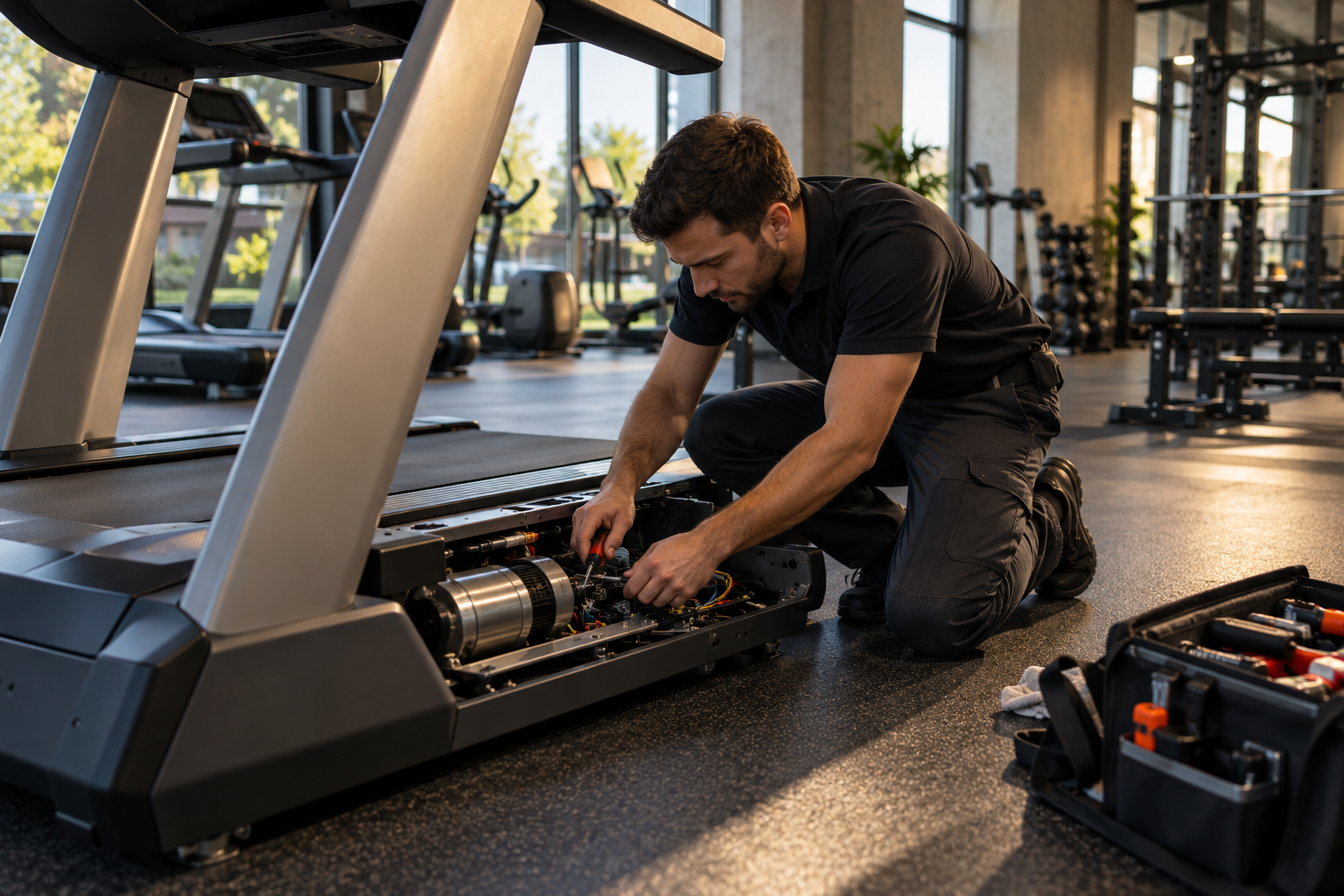
Technical support for fitness equipment: from report to outcome
During the evening shift, an instructor notices unusual behavior on a machine and notifies reception. The next morning, the staff changes, and the description gets lost among messages and conversations. The request reaches support without a model or context, while users continue to ask for information. This hypothetical example shows how an organizational problem can make even a well-handled technical intervention more difficult.
Technical support for fitness equipment requires a recognizable path between observation, intake, and outcome. Management must coordinate information and the availability of the gym floor, keeping this activity distinct from diagnosis and repair. A simple procedure can help each shift know what has been reported, who is following the case, and which step is expected.
The described method does not propose guaranteed turnaround times or a universal technical solution. It serves to build a usable internal process, connected to the products present and the communication channels of those in charge. The goal is to avoid duplicate requests, contradictory information, and cases left without follow-up, so that staff can organize the service based on the actual status of the stations.
- Opening a request that can be recognized
- Assigning a contact person and an understandable status
- Transmitting a targeted file to support
- Managing the availability of the station while waiting
- Preparing necessary appointments and materials
- Closing the request through a recognizable outcome
- Using the request summary to improve organization
Opening a request that can be recognized
The request should indicate the equipment, date, and initial observation.
A long text is not needed, but rather a concrete description that makes it possible to understand where the problem occurs. An internal code helps connect the report to the machine, avoiding references based solely on location that can become ambiguous after a relocation on the gym floor.
The fault report must distinguish what was observed from the interpretation of the cause. Staff can report symptoms and available messages without automatically ordering a component. The person in charge thus receives original information and can define the relevant follow-up actions, rather than starting from an informal diagnosis that could misdirect the request.
Collecting the essential data of the report
Essential data can be collected in a short form: identifier, symptom, time of appearance, and contact person. Readable photographs can supplement the observation when relevant, without requiring unexpected technical operations. The structure should not invite users or staff to reproduce the problem through additional tests just to make the description more convincing.
Connecting the machine to the inventory
The inventory completes the connection with the model and documentation. If the data is not available, the point must be recorded and retrieved through the appropriate channels. A request can be initiated by reporting the limitation, while avoiding completing uncertain references based on a similar machine or documents not clearly associated with the product.
Assigning a contact person and an understandable status
Each case must have a contact person to follow its progress, without automatically attributing the ability to perform repairs to them.
Their task is to coordinate relevant information, contacts, and internal steps. This distinction prevents personal availability from being interpreted as a technical assignment and allows activities to be distributed according to the actual roles within the facility.
The management of assistance requests must make the status legible: report received, awaiting response, scheduled appointment, or other condition relevant to the process. Categories must be used in the same way, so that an update is understandable even to someone who comes on duty without having participated in previous communications.
Separating coordination and technical intervention
The contact person must know what information they already possess and what they need to request, while maintaining a link to the case. If multiple people contact the same interlocutors without coordination, different descriptions and appointments may circulate. A single point of reference for the request helps avoid duplications, leaving evaluations regarding the equipment to the competent technical subjects.
Using consistent categories across shifts
Statuses must describe what actually happened and not what is hoped will happen. An ordered component is not equivalent to a completed intervention, while a requested visit is not a confirmed appointment. Clarity allows staff to communicate correct information to users and to organize the gym floor according to actual conditions.
Transmitting a targeted file to support
The file can be essential: machine identification, symptom description, and references useful to the history.
The goal is to make relevant information accessible without sending indiscriminate material. Manuals and reports must be associated with the correct product, avoiding the use of documents from a different version as if they automatically described the current configuration.
The request to the fitness technician should explain what actions have already been taken and what conditions remain open. Management must not expand the description with technical assumptions in order to appear more precise. A clear question allows the interlocutor to indicate the relevant path and to ask for additions that are truly necessary for the evaluation.
Combining the report and relevant documents
Documents must be orderly enough to be retrieved even after a change of contact person. Linking them to the case prevents a report from remaining in a separate folder without being considered. Collected information must maintain date and context, because an old description might not represent the condition that originated the current request.
Asking which data are missing
When data is missing, the contact person can ask how to retrieve it and who is competent to do so. They should not anticipate disassembly or other specialized operations to look for a reference if these do not fall within the activities pertinent to their role. The process must make the gap visible and assign the step, instead of replacing it with an improvised attempt.
Managing the availability of the station while waiting
The availability of the machine must reflect the indications and procedures pertinent to the situation, without depending on the pressure of user requests.
Staff must know how to manage the station and which information is confirmed. An organizational guide cannot determine on its own whether a specific anomaly permits use: the evaluation requires appropriate references.
The operational continuity of the gym also concerns the clarity of information. A user should not receive a different prediction at each shift. The contact person must update the statuses and distinguish indicative times from confirmed appointments, preventing the gym calendar from anticipating a return to use that still depends on activities or outcomes that are not yet complete.
Following the indications pertinent to the case
The indications must be accessible to the shifts managing the gym floor, with reference to the machine in question. This helps avoid contradictory interventions or informal tests based on the fact that the symptom seems to have disappeared. Actions must follow the established path, keeping communication to users separate from the technical evaluation of the case.
Communicating consistently with users
Communications can be brief and concrete: current status and confirmed updates are more useful than a generic promise of a quick solution. If there is no date yet, staff must be able to indicate this without inventing one. The process thus sustains trust through correct information, rather than through predictions that change without a documented reference.
Preparing necessary appointments and materials
The appointment must be prepared with access to the station and documentation available as agreed.
The contact person should know the required conditions and assign the pertinent preliminary activities. A team present without operational space or without essential information may fail to complete the work, even when the request was transmitted correctly and the calendar was confirmed.
Consulting professional fitness equipment can help retrieve commercial information and identify relevant products. Intervention on an existing machine still requires specific data and appropriate confirmations. The catalog category does not demonstrate component compatibility, immediate availability, or the inclusion of services that must be defined for the specific case.
Coordinating access to the machine
Access must be coordinated with the activity of the gym floor and with any other operators present. Staff should not anticipate unexpected technical activities to speed up the appointment. If a condition changes, the contact person must inform those in charge and update the plan, preventing operators from arriving based on data that is now outdated.
Tracking spare parts without anticipating outcomes
A spare part must remain linked to the proposal and the destination machine. Its arrival is a phase of the process and does not automatically confirm the completion of the intervention. The contact person must know which steps follow, keeping the order, appointment, and status of the station consistent, without communicating the delivery of the material as a certain return to normal availability.
Closing the request through a recognizable outcome
Closure must be supported by information that makes it possible to understand what was done and what indications were received.
A note like all good offers little support for future requests. The relevant report must be linked to the machine and the case, keeping any still-open activities or conditions for subsequent management visible.
The outcome should not be interpreted beyond its actual content. The contact person must ask for clarification when a phrasing does not allow the station to be properly organized. The return to use follows the conditions and procedures relevant to the case, without replacing the required steps with informal staff testing or the simple administrative conclusion of the appointment.
Collecting executed activities and indications
Activities and indications must remain retrievable, especially if the problem recurs. This makes it possible to transmit a useful history to support without having to reconstruct interventions through memory. Collection must not turn into an automatic diagnosis: a similar symptom may require a new evaluation, linked to the conditions of the specific machine.
Updating status and documentation
The status must be updated in the channels used by the gym floor, avoiding a situation where a completed request continues to appear pending or vice versa. Shifts must receive consistent information, and documents must enter the relevant file. The process thus ends with a legible outcome and the necessary references to handle any subsequent steps.
Using the request summary to improve organization
A periodic summary can show duplicate requests, missing data, or appointments rescheduled due to unprepared conditions.
This information helps improve the process without attributing every delay to a technical cause. Management can identify which steps to make clearer, keeping the functioning of the organization distinct from the evaluation of the individual pieces of equipment present.
Spending priorities must be discussed through proposals and relevant data, rather than deduced solely from the number of messages received. A heavily discussed case does not automatically represent a more serious problem or a more urgent investment. The file makes it possible to link each request to its own condition and to formulate motivated questions to the competent subjects.
Identifying steps that create ambiguity
Recurring ambiguities can be addressed by updating the form, identifiers, or task distribution. There is no need to add a new form with every episode: the system must remain usable by staff. A useful modification is one that makes the transfer of information more reliable without introducing work disconnected from the actual management of the gym floor.
Connecting priorities to data and real conditions
Decisions can thus start from documented cases and recognizable conditions. Support, any replacements, and staff organization must be compared through the real perimeter, keeping confirmed data and open points visible. The facility has a repeatable process to follow equipment from initial observation to the result and the necessary updates over time.
Comments (0)