
Trolley
You have no items in your shopping cart

 Budgets
 Dumbers
 Discs
 Benches
 Racks and Rigs
 Weights Holders
 Isotonic machines
 Calisthenics
 Cardio
 Kettlebells
 Flooring
 Gym Set
 Accessories
 Combat
 ARTI MARZIALI
 CONTAINER GYM
 Tug-Of-War
 Used Gym Equipment
 PILATES MACCHINARI
 GINNASTICA ARTISTICA
 CAMPI DA PADEL
 Prodotti in Pronta Consegna
 Informazioni
 IRONMAN
 Gift Card
- Donatif
- General information
- 0 I like it
- 206 Views
- 0 comments
- gym flooring, safety flooring, gym safety, shock-absorbing materials
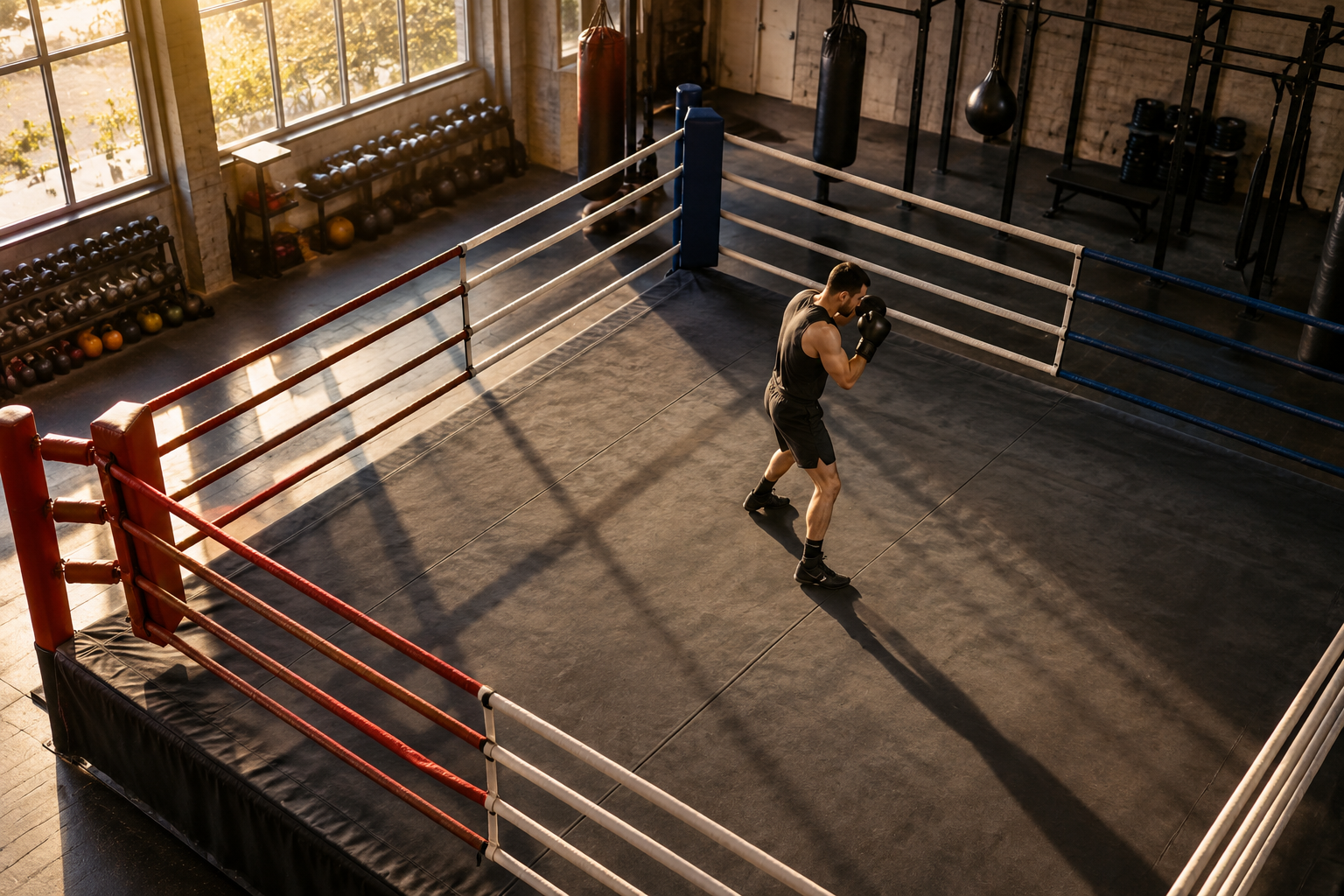
Equipment Needed for Training in Ring Sports: A Buying Guide
Identifying the equipment needed for training in ring sports is one of the fundamental steps in designing a functional, safe boxing gym that aligns with the needs of athletes. Boxing, kickboxing, Muay Thai, and other combat disciplines share some operational needs, but present significant differences in techniques, training methods, and protections used. For this reason, setting up a professional facility requires an evaluation that goes beyond simply purchasing a ring and a few training bags.
For a boxing gym manager, the primary goal is to build an environment capable of supporting technical training, athletic preparation, individual drills, and partner sessions. The choice of equipment must consider the number of users, available space, class frequency, and athlete skill level. Equipment designed for small amateur groups may prove insufficient for a facility hosting numerous daily sessions or competitive activities.
This guide analyzes the main equipment categories, technical criteria to verify, and economic aspects affecting long-term management. The objective is to help purchasing managers, instructors, and designers distinguish truly necessary elements from complementary equipment, avoiding investments that do not match the gym's operational model.
- How to organize a room for ring sports
- Boxing rings: features and selection criteria
- Punching bags and striking equipment
- Gloves and individual protections
- Flooring and safety of training areas
- Equipment for athletic preparation
- Maintenance, hygiene, and daily management
- How to plan the investment for a boxing gym
How to organize a room for ring sports
Designing a room dedicated to combat sports must start with an analysis of the activities that will actually be carried out. A facility oriented toward traditional boxing may require different organization compared to a center offering kickboxing, Muay Thai, and functional athletic conditioning. The presence of multiple disciplines entails the need to distribute spaces in a way that avoids interference between different exercises.
A professional room may include an area for bag work, a zone designated for technique with a partner, a space for physical conditioning, and, when necessary, a ring. These areas do not necessarily need to be separated by walls, but must allow for safe movement and effective supervision by instructors. The layout of the equipment must also take access points and walking paths into consideration.
Sizing should be based on the maximum number of participants in sessions rather than just the total available surface area. For example, a gym that organizes group classes with numerous athletes must provide sufficient space for simultaneous exercises, while a studio specialized in individual lessons can favor versatile and easily reconfigurable stations.
Subdivision of training areas
The functional separation between technical work, bag exercises, and physical preparation allows for better organization of sessions. Stations must be distributed considering the range of movement, the possibility of athlete displacement, and the presence of suspended or floor-standing equipment.
An orderly layout reduces interference between different activities and facilitates instructor oversight. It is also important to provide areas for storing gloves, protections, and accessories when not in use.
Number of athletes and frequency of use
The number of simultaneous users represents one of the main parameters for determining the quantity of necessary equipment. A facility with consecutive classes must also consider the time required to replace accessories, clean surfaces, and prepare stations.
Frequency of use also impacts the choice of materials. Equipment used daily by numerous users requires special attention to robustness, maintenance, and the availability of replacement components.
Boxing rings: features and selection criteria
The ring is one of the most recognizable pieces of equipment in combat sports, but its presence is not essential for every type of training. A room dedicated primarily to basic technical work can use suitably organized open areas, while a facility offering specific sparring and competitive preparation can benefit from a ring designed for such activities.
Choosing a professional boxing ring requires evaluating dimensions, supporting structure, flooring characteristics, rope tensioning systems, and corner pads. Configurations can vary depending on the intended use and any provisions from competent sports federations. A ring intended for training should not automatically be considered compliant with official competition requirements.
It is also necessary to check the spaces outside the structure. The overall footprint includes support elements, access points, and areas needed for staff movement. Before purchasing, the manager should compare the dimensions listed in the technical documentation with the actual characteristics of the environment and any building constraints.
Ring dimensions and configurations
Ring dimensions must be consistent with the planned activities and any applicable regulations. Structures can feature different platform and rope configurations, making it necessary to distinguish interior area measurements from the exterior footprint.
For a gym with limited space, it may be useful to evaluate compact solutions, provided they allow the scheduled drills to be carried out. If competitive activities are planned, the specifications requested by the reference sports organization must be verified beforehand.
Structure, platform, and protection systems
The ring structure must be designed to support the stresses resulting from intended use. The flooring requires adequate stability and impact behavior characteristics, while ropes and protections must be installed according to the manufacturer's instructions.
It is advisable to request information on the construction configuration, assembly methods, and maintenance procedures. The ability to replace covers, protections, and wear-prone components also represents a useful criterion in evaluating the investment.
Punching bags and striking equipment
Training punching bags constitute one of the primary provisions of a room dedicated to ring sports. They allow for the development of drills focused on precision, coordination, rhythm, and distance management, with varying methods depending on the discipline. The choice of bag must consider dimensions, mass, cover material, and installation system.
A heavy bag can be used for drills involving combinations of strikes and demanding physical work, while lighter or specific models can favor speed- and precision-oriented activities. In disciplines that include kicks, the length of the bag and the accessibility of different striking zones take on particular importance.
For a professional facility, evaluating the suspension system is fundamental. The nominal weight of the bag does not fully describe the stresses transmitted during use. Strikes generate oscillations and dynamic loads that must be considered when choosing supports and verifying the building structure.
Heavy bags and specific models
Heavy bags are frequently used for punch combinations, endurance exercises, and technical work. The choice of mass should be consistent with the characteristics of the athletes and the type of drill, avoiding the assumption that the heaviest model is automatically superior.
For kickboxing and Muay Thai, long bags that allow for working at different strike heights can be useful. The choice must still consider the manufacturer's instructions and intended use methods.
Focus mitts, Thai pads, and precision equipment
Hand mitts, Thai pads, and other accessories allow for organizing drills guided by an instructor or partner. These tools make it possible to work on combinations, reaction times, and precision, but require adequate skills from the person receiving the strikes.
Selection should consider dimensions, grip systems, forearm protection, and material resistance. In a gym with many users, it is useful to provide accessories of different sizes while maintaining clear procedures for checking and replacing deteriorated products.
Gloves and individual protections
Personal protections represent an essential component of training organization. Gloves, hand wraps, mouthguards, and other protections must be selected in relation to the discipline and planned activities. The choice cannot be based solely on aesthetic appearance or price, because construction characteristics and fit directly impact use.
It is important to distinguish accessories intended for bag work from those meant for sparring. Protection needs can vary, and federation or organizer rules may establish specific characteristics for certain activities. The manager should therefore define which gear is required for each class.
The availability of shared equipment can facilitate introductory lessons, but entails additional hygiene and maintenance needs. For accessories in direct contact with the body, it is appropriate to evaluate cleaning procedures compatible with the materials and determine when personal gear is preferable.
Gloves for bags, technique, and sparring
Gloves must be chosen considering discipline, activity, hand size, and instructor instructions. Weight expressed in ounces is one of the parameters used to distinguish models, but it does not independently describe all protection and fit characteristics.
For sparring, it is necessary to adhere to applicable rules and the technical instructions of qualified personnel. A glove suitable for individual work should not automatically be considered appropriate for drills involving contact between athletes.
Mouthguards, shin guards, and other protections
The mouthguard is commonly used in activities with a risk of facial contact. Proper fit is important for its use, and selection must consider the instructions of the manufacturer and any healthcare professional involved.
In disciplines that involve kicks, shin guards and additional protections may be necessary. Headgear, groin protectors, and other devices must be evaluated according to the specific activity. No protection completely eliminates the risk of injury, which is why supervision and training rules remain fundamental.
Flooring and safety of training areas
Flooring plays an important role in the functionality of a room dedicated to ring sports. During training, athletes perform footwork, direction changes, and movements that require stability. In some disciplines, falls or ground-contact exercises are also involved. The material must therefore be chosen considering the type of activity and not just the need to protect existing flooring.
Combat sports flooring should offer characteristics consistent with anticipated stresses, an easily manageable surface, and appropriate grip behavior. Materials that are too slippery can compromise stability, while surfaces with excessive friction may prove unsuitable for certain movements. It is necessary to evaluate technical specifications and, whenever possible, conduct practical tests.
The choice must also consider cleaning. Sports environments can be subject to sweat, skin contact, and frequent use by different groups. Compatibility with detergents, joint management, and the ability to replace damaged portions are important elements for maintaining adequate operating conditions.
Tatami mats and modular surfaces
Tatami mats and modular flooring can be used in different sports activities, but the required characteristics change depending on the discipline. A surface suitable for boxing footwork may not offer the desired behavior for exercises involving throws or falls.
Before choosing, it is advisable to check thickness, density, connection methods, and declared intended use. Impact absorption characteristics must be documented through relevant data without attributing unproven performance.
Cleaning and maintenance of surfaces
Flooring maintenance should be organized according to frequency of use and the manufacturer's instructions. It is important to regularly remove dirt and check that joints do not create unevenness or tripping hazards.
In the presence of modular surfaces, damaged elements must be evaluated and replaced when necessary. The use of incompatible detergents can alter material characteristics, making a documented cleaning procedure important.
Equipment for athletic preparation
Ring sports require different physical capacities, including strength, endurance, coordination, and speed. A professional room can therefore integrate equipment intended for athletic conditioning, provided its presence is consistent with the training program. It is not necessary to purchase every category available on the market to build an effective offering.
The choice should start with the drills planned by instructors. Jump ropes, free weights, and bodyweight exercise equipment can support different programs. The availability of versatile tools allows for adapting sessions without occupying excessive space.
For a manager, it is useful to distinguish fundamental gear from complementary equipment. If the facility has limited surface area, it may be preferable to favor easily storable tools and organize usage through group scheduling. A bulky machine used rarely might represent a less efficient investment compared to simpler equipment used daily.
Jump ropes and coordination
The jump rope is a frequently used tool in preparing ring sports athletes. It can be included in drills dedicated to rhythm, coordination, and cardiovascular conditioning, adapting duration and intensity to the individual level.
For a professional room, it is useful to have ropes with lengths suitable for different users. Sufficient space must also be provided to prevent interference between athletes during movement.
Free weights and conditioning tools
Dumbbells, kettlebells, and other tools can be integrated into physical preparation according to the goals defined by the trainer. The choice of loads must consider the level of users and the ability to properly perform exercises.
A zone dedicated to strength should be organized so as not to interfere with technical training. The presence of adequate storage systems also helps keep pathways clear and reduces the risk of tripping.
Maintenance, hygiene, and daily management
Managing a boxing gym does not end with purchasing equipment. Rings, bags, supports, protections, and flooring require periodic checks proportional to the frequency of use. Scheduled maintenance allows for identifying deterioration before it compromises workstation availability.
Suspended equipment deserves special attention. Chains, carabiners, connection systems, and supports must be checked according to the manufacturer's instructions. Abnormal noises, deformations, or signs of wear may indicate the need to stop use until the component is verified.
Hygiene management must be organized considering the presence of shared accessories and frequently touched surfaces. Clear cleaning and preservation procedures help maintain an orderly environment. It is important to use products compatible with the materials, avoiding treatments that could damage padding, covers, or closure systems.
Checks of rings, bags, and supports
A maintenance program should include checks of ring ropes, protections, covers, and accessible structural connections. For bags, it is appropriate to check the integrity of seams, suspension points, and connection elements.
Interventions must respect manufacturers' technical instructions. When anomalies that could compromise safety are identified, the equipment must be excluded from use until the required conditions are restored.
Hygiene management of shared protections
Gloves and protections used by different people require appropriate cleaning procedures. It is useful to define drying and storage methods that avoid the persistent accumulation of moisture while respecting material instructions.
The facility should establish which accessories can be shared and which must be personal. This distinction facilitates class organization and allows for accurately predicting quantities to purchase.
How to plan the investment for a boxing gym
Economic planning for a room dedicated to ring sports should start with the planned activity model. A facility oriented toward amateur classes, a school with competitive preparation, and a multidisciplinary center can require very different configurations. Defining priorities makes it possible to avoid purchases based solely on product availability or the aesthetic appearance of the setup.
The budget should include not only the main equipment, but also installation, any structural checks, flooring, accessories, maintenance, and periodic replacements. For suspended bags, for example, the cost of the product must be evaluated together with support characteristics and building structure compatibility. Similarly, the price of a ring must be compared considering configuration, assembly, and included gear.
An effective approach consists of dividing purchases into functional categories and prioritizing the equipment essential for already defined programs. Complementary gear can be evaluated later based on actual usage, avoiding compromising the quality of fundamental elements to finance unnecessary accessories.
Defining purchasing priorities
For a room primarily offering technical boxing lessons, priorities may include suitable flooring, bags, focus mitts, and personal gear consistent with the activities. The ring can be added when programming and available space justify its presence.
A facility also oriented toward competitive preparation might instead place greater importance on a ring compliant with the needs of the activity and specific stations for sparring. The choice must still respect the regulations of relevant sports organizations.
Comparing suppliers and technical specifications
A professional comparison should consider materials, dimensions, intended use, installation conditions, and spare parts availability. It is useful to request technical datasheets and maintenance procedure information, distinguishing documented characteristics from promotional claims.
To evaluate available equipment categories, you can consult combat sports equipment, using individual product information as a basis for a comparison consistent with the room project. The goal should not be to purchase as many items as possible, but to identify those truly compatible with planned activities.
Total cost of management and investment duration
The total cost of professional gear includes initial price, installation, maintenance, consumables, and replacement of wear-prone components. A seemingly cheap product may require frequent interventions, while a solution with a higher initial price may prove more convenient when it offers characteristics adequate for the intensity of use. This possibility must be verified through concrete data rather than assumed.
The availability of spare parts and simplicity of maintenance operations are important elements especially in facilities with daily classes. Unusable equipment for a prolonged period can impact class organization and workstation availability.
A choice consistent with facility needs
Before confirming purchases, the manager should verify that each piece of equipment has a precise function in the programming. It is useful to ask which disciplines will be practiced, how many athletes will simultaneously use stations, which activities require specific supervision, and what checks will be necessary during daily management.
A well-organized boxing gym stems from the integration of space, equipment, instructor skills, and operational procedures. Evaluating these elements through documentable criteria helps reduce decision-making uncertainty, plan investments, and build a training environment adequate to the real needs of users, without confusing the quantity of equipment with the overall quality of service.
Comments (0)