
Trolley
You have no items in your shopping cart

 Budgets
 Dumbers
 Discs
Discs
 Benches
 Racks and Rigs
 Weights Holders
 Isotonic machines
 Calisthenics
 Cardio
 Kettlebells
 Flooring
 Gym Set
 Accessories
 Combat
 ARTI MARZIALI
 CONTAINER GYM
 Tug-Of-War
 Used Gym Equipment
 PILATES MACCHINARI
 GINNASTICA ARTISTICA
 CAMPI DA PADEL
 Prodotti in Pronta Consegna
 Informazioni
 IRONMAN
 Gift Card
- Donatif
- General information
- 0 I like it
- 10 Views
- 0 comments
- gym flooring, safety flooring, gym safety, shock-absorbing materials
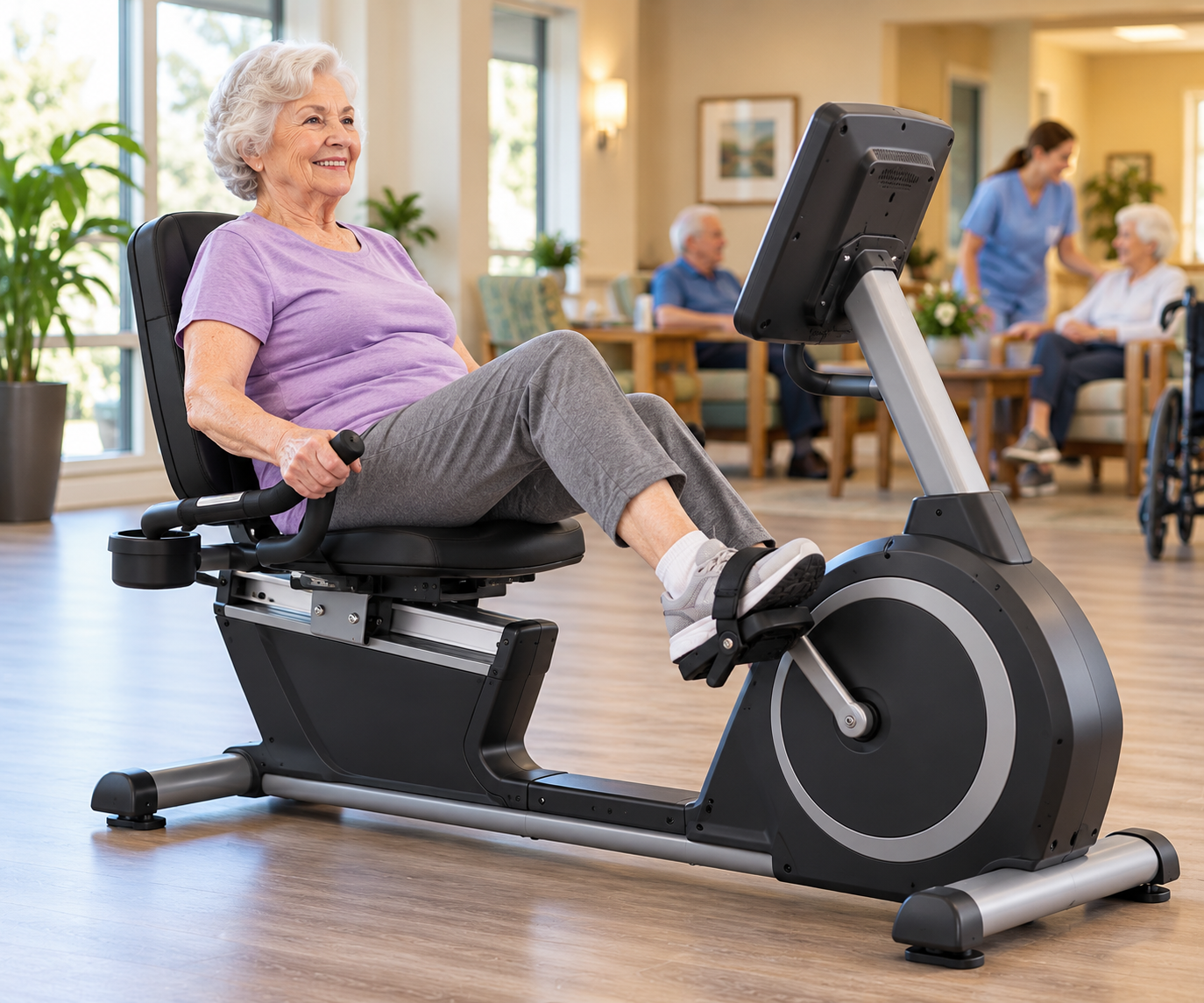
Recumbent Bike for Nursing Homes: Selection and Setup Criteria
The recumbent bike is one of the most suitable cardio pieces of equipment for Nursing Homes when physical activity is included within programs defined by competent professionals. Thanks to the seat with a backrest, easy access, and reposed position, it can help make exercise more accessible compared to a traditional exercise bike for many senior users. However, choosing the machine requires verifiable design criteria concerning space configuration, safety, maintenance, and operational management.
In a nursing home, equipment selection should not be driven exclusively by the commercial features of the product. Aspects such as ease of transfer to the seat, simplicity of adjustments, the possibility of assisting the guest during all phases of use, and proper integration into the facility's care pathway become priorities.
This guide provides operational guidelines for choosing a recumbent bike intended for a nursing home, analyzing space requirements, workstation configuration, safety criteria, maintenance, and design errors to avoid. When applicable, it is advisable to consult manuals, manufacturer instructions, and technical documentation, which constitute the primary sources for installation, adjustments, maintenance, and limits of use.
- What is a recumbent bike
- Why it is suitable in nursing homes
- How to design the space
- How to configure the workstation
- How to organize assisted flows
- Safety and maintenance
- Design errors to avoid
- How to evaluate the investment
What is a recumbent bike and who is it suitable for?
The recumbent bike is a reclined exercise bike characterized by a wide seat, a backrest, and pedaling with the legs extended forward. This configuration modifies the distribution of body weight and offers cardiovascular activity oriented toward low-impact cardio.
In nursing homes, it finds application when its use is planned within motor activity or rehabilitation programs defined by the professionals responsible for the care pathway.
The ease of getting on and off represents one of the elements that distinguishes it from the upright exercise bike in contexts intended for users with reduced motor autonomy.
How it works
The machine allows you to adjust the resistance level according to the methods provided by the manufacturer. The intensity of the activity is defined by the exercise program and not exclusively by the position of the seat.
Which users can use it
It can be suitable for people who need a stable seat and back support during exercise, always in compliance with the facility's clinical and organizational guidelines.
Why choose a recumbent bike in a nursing home?
In a Nursing Home, the priority is to guarantee an easily accessible environment that can be managed by the staff. The presence of the backrest, the wide seat, and lateral access can facilitate assistance operations compared to other types of exercise bikes.
The ability to make simple adjustments reduces the time needed to adapt the machine to guests with different physical characteristics.
The design objective consists of making the equipment easily usable without creating obstacles in the facility's internal pathways.
Accessibility
The configuration of the workstation should allow easy access even for users who use mobility aids, compatibly with the organization of the spaces.
Motor activity for senior users
The recumbent bike is frequently included in programs dedicated to senior fitness, in which comfort, stability, and simplicity of use play a central role.
How to design space and layout?
Space planning must consider both the footprint of the machine and the areas necessary for transferring the guest, assistance by operators, and routine maintenance.
Operational dimensions must always be verified in the manufacturer's manual, as each model has different characteristics.
A well-organized layout reduces crossings between operators, users, and other devices present in the gym or in the area dedicated to motor activity.
How much space does a recumbent bike occupy?
The footprint varies depending on the model. It is necessary to provide free space for seat adjustment, user access, and maintenance interventions, always following the manufacturer's technical documentation.
Flooring
The flooring must guarantee the stability of the machine and be compatible with the weight of the equipment and the intended methods of use by the facility.
How to correctly configure the workstation?
The initial adjustment of the seat is the first element to verify before starting the activity. The user must be able to reach the pedals while maintaining a stable and comfortable position.
Adjustments must be able to be made quickly even by care staff, limiting complex operations during the change between one user and the next.
Before use, it is advisable to check the correct locking of the adjustment systems and the absence of abnormal play.
Seat adjustment
The seat must be adapted according to the manufacturer's instructions so that the movement is fluid and free of forced positions.
Exercise setup
Resistance levels and activity duration must be defined by the program prepared by competent professionals and adapted to the user's characteristics.
How to organize assisted flows?
Nursing homes require simple, orderly, and easily controllable pathways for staff. The recumbent bike should be placed in an area that allows assistance during getting on, use, and getting off without interfering with other pathways.
The arrangement of the machines should facilitate visual supervision by operators and allow rapid interventions when necessary.
It is advisable to avoid isolated workstations or those difficult to reach with wheelchairs, walkers, or other aids.
Internal pathways
Corridors and access areas must remain free of permanent or temporary obstacles that could limit the passage of guests.
Staff operations
Operators must be able to assist the user from both sides of the machine when required by the care organization.
What safety and maintenance aspects to consider?
A machine installed in a nursing home requires scheduled checks, regular cleaning, and periodic checks of parts subject to wear.
Operations must be carried out according to what is reported in the manufacturer's manual, documenting the interventions provided for by the facility's maintenance plan.
Before daily use, it is advisable to check stability, adjustment systems, electronic components, and general conditions of the machine.
Routine checks
Checking fixings, seat, backrest, pedals, adjustments, and safety systems helps keep the machine efficient over time.
Cleaning and hygiene
Contact surfaces must be sanitized using products compatible with the materials indicated by the manufacturer.
What design errors to avoid?
One of the most common errors is underestimating the space needed to assist the guest during the transfer onto the machine.
Another critical issue concerns the positioning of the recumbent bike in areas difficult to reach or far from staff supervision.
It is also advisable to avoid configurations that prevent rapid seat adjustment between different users.
Recumbent bike vs upright exercise bike
The upright exercise bike requires a different getting-on method and a different posture. The choice between the two types should be made considering user characteristics, the organization of the nursing home, and project objectives.
Accessories and configuration
Any accessories must be compatible with the installed model and provided for by the manufacturer's technical documentation.
How to evaluate the investment in a recumbent bike for nursing homes?
The choice should consider accessibility, build quality, simplicity of adjustments, availability of spare parts, scheduled maintenance, and integration with the facility's spaces. For a nursing home, ease of assistance and the speed with which the machine can be adapted to guests with different needs are particularly important.
To learn more about solutions dedicated to cardiovascular training, you can consult the cardio machines category, which is useful for comparing the different types of equipment available.
Before installation, it is advisable to check technical datasheets, assembly manuals, instructions for use, and manufacturer documentation, which represent the primary sources for dimensions, power supply, adjustments, maintenance, and installation requirements. A design based on verifiable criteria allows the recumbent bike to be integrated into the nursing home context by improving accessibility, space organization, and operational continuity without basing the choice exclusively on commercial specifications.
FAQ: Does the recumbent bike replace all other cardio machines?
No. It constitutes one of the possible solutions for motor activity programs. The choice of equipment depends on the facility's objectives and the characteristics of the users.
FAQ: How to choose a recumbent bike for a nursing home?
It is advisable to evaluate accessibility, simplicity of adjustments, build quality, technical documentation, scheduled maintenance, and compatibility with the facility's layout.
Comments (0)