
Trolley
You have no items in your shopping cart

 Budgets
 Dumbers
 Discs
Discs
 Benches
 Racks and Rigs
 Weights Holders
 Isotonic machines
 Calisthenics
 Cardio
 Kettlebells
 Flooring
 Gym Set
 Accessories
 Combat
 ARTI MARZIALI
 CONTAINER GYM
 Tug-Of-War
 Used Gym Equipment
 PILATES MACCHINARI
 GINNASTICA ARTISTICA
 CAMPI DA PADEL
 Prodotti in Pronta Consegna
 Informazioni
 IRONMAN
 Gift Card
- Donatif
- General information
- 0 I like it
- 9 Views
- 0 comments
- gym flooring, safety flooring, gym safety, shock-absorbing materials
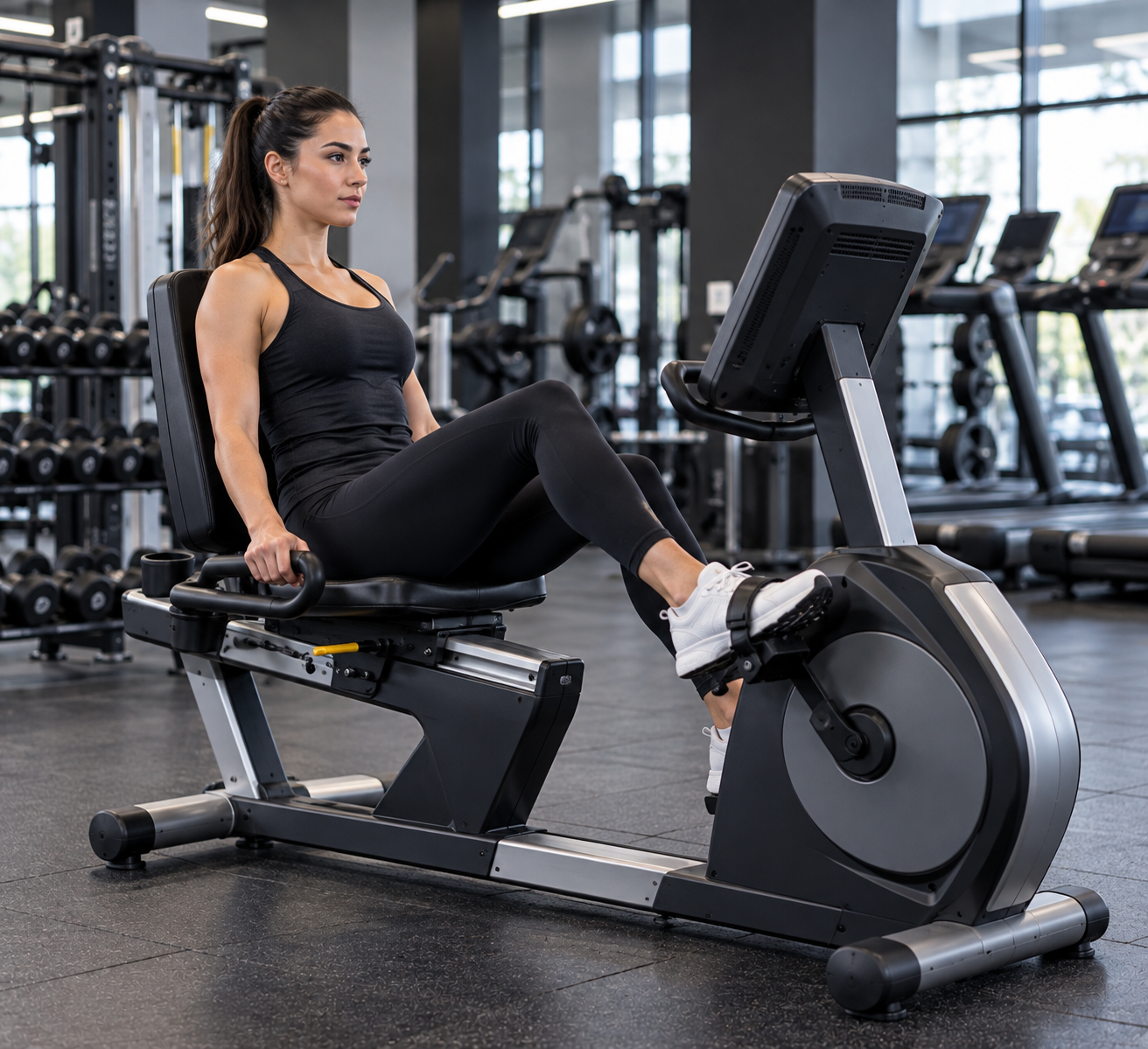
Recumbent bike in a professional gym: accessibility and assisted flows
The recumbent bike is a reclined exercise bike designed to offer low-impact cardiovascular activity, featuring a seat equipped with a backrest and an ergonomic leg position. In a professional gym, it represents a particularly suitable solution for senior users, people with reduced mobility, rehabilitation programs, and assisted training routines. Proper planning requires attention to accessibility, operational space, and flow management.
Machine selection should not be based solely on the technical characteristics stated by the manufacturer. In a professional context, ease of access, speed of adjustments, the possibility of assisting the user during mounting and dismounting, and the integration of the workstation within the cardio area layout become decisive factors.
This guide provides verifiable criteria for designing an area dedicated to recumbent bikes, comparing them with upright exercise bikes, and analyzing space requirements, configuration, maintenance, and safety aspects. When applicable, it is advisable to refer to the manufacturer's manuals, installation instructions, and current technical standards for fitness equipment, which constitute the primary sources for dimensions, adjustments, and usage limits.
- What is a recumbent bike
- Who is it suitable for
- How to design space and layout
- How to organize assisted flows
- How to properly configure the workstation
- Safety and maintenance
- Design errors to avoid
- How to evaluate the investment
What is a recumbent bike and who is it suitable for?
The recumbent bike is an exercise bike featuring a wide seat, a supporting backrest, and pedaling performed in a reclined position. This configuration distributes body weight differently compared to the traditional exercise bike and reduces load on the joints during cardiovascular activity.
It is used in commercial gyms, fitness centers, sports facilities, environments dedicated to senior fitness, and functional recovery programs where the responsible professional deems its use appropriate.
From a design perspective, it constitutes a machine that facilitates access even for users who encounter difficulties mounting an upright exercise bike.
How it works
Resistance is adjusted through the system provided by the manufacturer, while the seat allows the torso to remain supported during exercise. Workout intensity depends on the programmed schedule and not exclusively on the reclined position.
Why it is widespread in professional gyms
Ease of access and supported posture make it possible to broaden the user base, making the cardio area more inclusive and functional.
Which users benefit most from the recumbent bike?
The machine is frequently integrated into areas dedicated to low-impact cardio, paths intended for senior fitness, and supervised motor activity programs.
It may also prove appropriate for users who prefer a seat with a backrest or who seek greater stability during pedaling.
Suitability for use must always be assessed by qualified staff when specific clinical conditions or functional limitations exist.
Senior fitness
For senior users, the ability to sit down before starting to pedal facilitates access to the machine and reduces the need to maintain balance during mounting.
Rehabilitation contexts
When envisioned by the program defined by competent professionals, the recumbent bike can be included in controlled exercise pathways thanks to supported posture and progressive intensity adjustment.
How to design space and layout for the cardio area?
Professional design considers not only the footprint of the machine but also the space required to mount, dismount, assist the user, and perform maintenance operations.
Operational distances must always comply with what is reported in the manufacturer's installation manual. There is no one-size-fits-all measurement for all models, as dimensions and adjustment systems may vary.
The layout should allow for linear pathways, the absence of obstacles, and easy access even with mobility aids when required by the facility's intended use.
How much space does a recumbent bike occupy?
The overall footprint depends on the chosen model. In addition to the dimensions of the machine, it is necessary to provide functional space for access, adjustments, and maintenance following the manufacturer's instructions.
Flooring and stability
Correct installation requires a stable surface suitable for the weight of the equipment. The choice of flooring must be consistent with the design of the entire cardio area.
How to organize assisted flows and accessibility?
In professional centers, it is useful to design pathways that reduce crossing paths between users and allow instructors to easily assist individuals during access and exit phases from the machine.
Recumbent bikes should be placed in areas easily reachable from the entrance of the cardio area, avoiding narrow passageways or obstacles that limit mobility.
An orderly arrangement facilitates visual control by operators and improves the management of assisted sessions.
Access to the seat
Access must occur without interference from other machines. The seat must be easily adjustable before the start of exercise.
Assistance management
Staff must be able to quickly reach each workstation without crossing congested corridors or insufficient spaces.
How to properly adjust a recumbent bike?
Seat adjustment constitutes the first operational step. The objective is to allow smooth pedaling while maintaining a stable and comfortable position according to the indications reported in the manufacturer's manual.
Before use, it is appropriate to verify that all adjustment systems are locked correctly and that no abnormal play is present.
Resistance settings must be consistent with the user's level and the planned training program.
Seat adjustment
The distance between the seat and pedals must allow for natural pedaling, avoiding excessive extension or overly pronounced knee bending.
Workout setup
Available programs vary from model to model. It is advisable to use exclusively the modes provided by the manufacturer and adapted to the user's profile.
Which safety and maintenance aspects are priorities?
A machine used daily requires periodic checks of moving parts, stability, electronic systems, and seat adjustments.
Maintenance operations must be performed according to the frequency indicated by the manufacturer, documenting interventions in facilities that provide scheduled maintenance programs.
Before opening to the public, it is advisable to verify the correct functioning of the machine and the absence of worn components.
Routine checks
Visual inspection, verification of fasteners, cleaning of contact surfaces, and checking of adjustments represent fundamental activities to maintain machine efficiency.
Workstation cleaning
Surfaces used by users must be cleaned according to the procedures adopted by the facility and compatible with the materials indicated by the manufacturer.
Which design errors should be avoided?
One of the most frequent errors consists of positioning the recumbent bike in areas that are difficult to reach or devoid of the space necessary for user assistance.
Another critical issue concerns the failure to consider seat adjustments during space planning, resulting in a reduction of operational functionality.
It is also advisable to avoid layouts that force users to cross congested pathways to reach the machine.
Recumbent bike vs upright exercise bike
The upright exercise bike requires a different mounting method and posture. The choice between the two types should depend on the facility's objectives, the user profile, and the overall design of the cardio area.
Machine selection
Before purchase, it is useful to compare technical features, available adjustments, ease of maintenance, and documentation provided by the manufacturer.
How to evaluate the investment in a professional recumbent bike?
The evaluation should consider accessibility, build quality, spare parts availability, simplicity of adjustments, scheduled maintenance, and integration into the gym layout. For facilities with a diverse user base, the ability to quickly adapt the machine to different people constitutes an important element.
To explore solutions dedicated to the cardio area, you can consult the cardio machines category, which is useful for comparing different types of equipment based on the facility's project.
Before installation, it is advisable to check manuals, assembly instructions, technical datasheets, and manufacturer documentation, which represent the primary sources for dimensions, power supply, space requirements, maintenance, and conditions of use. Design based on verifiable criteria makes it possible to create an accessible, orderly, and easily manageable cardio area without turning the choice of equipment into a simple evaluation of price or commercial functions.
FAQ: is a recumbent bike suitable for all gyms?
Not necessarily. The choice depends on the user profile, the facility's objectives, available space, and the overall design of the cardio area.
FAQ: how to choose a reclined exercise bike?
It is appropriate to evaluate build quality, seat adjustments, ease of access, technical documentation, planned maintenance, and compatibility with the gym layout.
Comments (0)