
Trolley
You have no items in your shopping cart

 Budgets
 Dumbers
 Discs
Discs
 Benches
 Racks and Rigs
 Weights Holders
 Isotonic machines
 Calisthenics
 Cardio
 Kettlebells
 Flooring
 Gym Set
 Accessories
 Combat
 ARTI MARZIALI
 CONTAINER GYM
 Tug-Of-War
 Used Gym Equipment
 PILATES MACCHINARI
 GINNASTICA ARTISTICA
 CAMPI DA PADEL
 Prodotti in Pronta Consegna
 Informazioni
 IRONMAN
 Gift Card
- Donatif
- General information
- 0 I like it
- 10 Views
- 0 comments
- gym flooring, safety flooring, gym safety, shock-absorbing materials
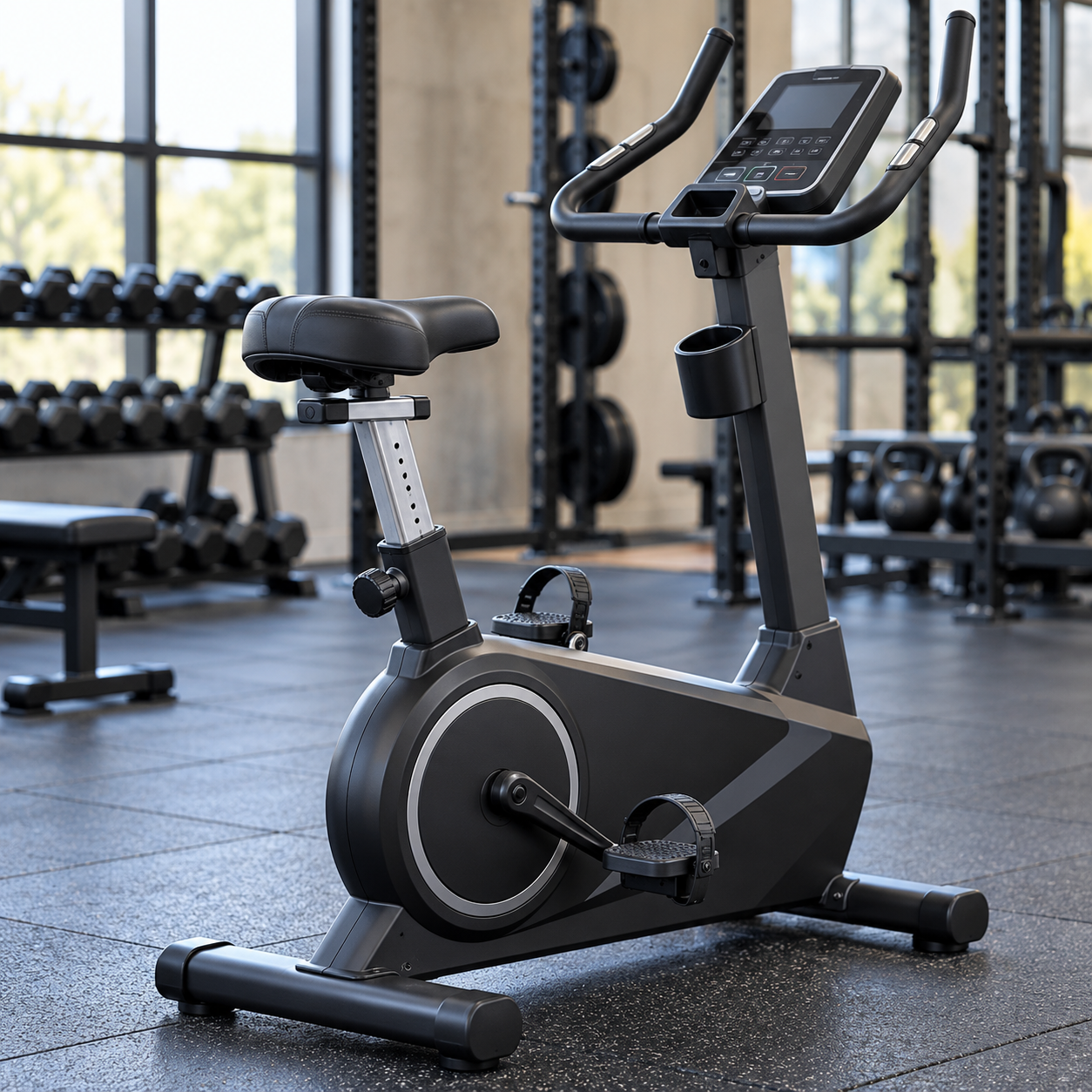
Recumbent bike vs upright exercise bike: which to choose and when
The recumbent bike and the upright exercise bike are both machines dedicated to cardiovascular training, but they differ in pedaling position, accessibility, ergonomics, and intended use. The choice should be based on verifiable criteria such as seat comfort, ease of access, available space, user profile, and mode of use, avoiding considering one solution universally better than the other.
Understanding the differences between these two types of equipment makes it possible to create a cardio area that is more consistent with the goals of the gym, fitness center, or private user. Posture during exercise indeed influences the user experience, getting on and off methods, and station management.
This guide compares recumbent bikes and upright exercise bikes by analyzing technical characteristics, operational advantages, selection criteria, errors to avoid, and safety aspects. When applicable, it is appropriate to refer to the manufacturer's manuals and official technical documentation, which represent the primary sources for adjustments, installation, maintenance, and limits of use.
- What are the main differences
- How they work
- Which to choose based on usage
- What space requirements to consider
- How to correctly adjust the machines
- Errors to avoid
- Safety and maintenance
- How to evaluate the investment
What are the main differences between recumbent bikes and upright exercise bikes?
The recumbent bike uses a wide seat with a backrest and a reclined pedaling position, whereas the upright exercise bike provides a posture closer to that of a traditional bicycle.
The most evident difference concerns access to the machine and the way body weight is distributed during exercise. The recumbent bike offers greater back support, while the upright exercise bike requires a seated position without a backrest.
Neither configuration is automatically superior. The choice depends on the context of use and user characteristics.
Posture differences
The reclined position modifies the way the user sits on the machine, while the upright exercise bike maintains a more traditional configuration.
Access differences
The recumbent bike generally facilitates getting on thanks to the low seat and backrest, whereas the upright exercise bike requires a different access method.
How do the two machines work?
Both allow you to perform cardiovascular workouts by adjusting the resistance level according to the methods provided by the manufacturer.
The difference does not concern the operating principle but the user's position and the machine's configuration.
Available programs, resistance management, and electronic functions depend on the chosen model and not exclusively on the type of equipment.
Resistance system
Each manufacturer may adopt different systems. It is advisable to always verify the specifications reported in the official technical documentation.
Modes of use
Both machines must be used after a correct initial adjustment of the pedaling position.
Which one to choose based on usage?
The choice should start from the facility's goals and the users' profile instead of sole commercial features.
A recumbent bike may be indicated when seat comfort, ease of access, and low-impact cardio represent design priorities.
The upright exercise bike may be preferred when a posture closer to the traditional bicycle is desired or when available space is limited.
When to choose the recumbent bike
It can represent an appropriate solution for programs dedicated to senior fitness, environments where it is important to facilitate access, or contexts requiring a seat with a backrest.
When to choose the upright exercise bike
It can be suitable in environments where you want to optimize spaces or reproduce a more traditional pedaling position.
How much space do they occupy?
The footprint varies depending on the model, and it is not possible to define a valid measure for all machines.
Beyond the dimensions of the structure, it is necessary to consider the operating space required for access, exit, adjustments, and maintenance.
Correct distances must always be verified in the manufacturer's installation instructions.
Cardio area layout
An orderly arrangement improves accessibility, user circulation, and staff intervention ease.
Role of flooring
The flooring must be stable and compatible with the equipment's weight as indicated by the manufacturer.
How to correctly adjust recumbent and upright exercise bikes?
Before use, it is necessary to adapt the machine to the user's characteristics by following the manufacturer's instructions.
Seat adjustments represent the first check to perform and must allow natural pedaling without forced positions.
After each modification, it is important to check the correct locking of the adjustment systems.
Recumbent bike adjustment
The distance between the seat and pedals must allow fluid pedaling while maintaining back support during exercise.
Upright exercise bike adjustment
The position of the saddle and any adjustable elements must be adapted by following the indications reported in the technical documentation.
What errors should be avoided?
A common mistake consists of choosing a machine exclusively based on price or the number of available electronic programs.
Another critical issue concerns failing to evaluate the operating space necessary for access, adjustments, and maintenance.
It is also appropriate to avoid improvised adjustments or modifications not foreseen by the manufacturer.
Ignoring the user profile
The choice should always consider age, motor skills, frequency of use, and training goals.
Underestimating the footprint
The available space must also include the areas necessary for user passage and maintenance interventions.
What safety and maintenance aspects to consider?
Both machines require periodic checks of the structure, adjustments, electronic systems, and parts subject to wear.
Maintenance operations must follow the schedule indicated by the manufacturer and use exclusively procedures compatible with the installed model.
Regular surface cleaning helps maintain comfort, hygiene, and the durability of the equipment.
Periodic checks
It is advisable to check stability, fastenings, seat adjustments, and correct functioning of the resistance systems.
Manuals and documentation
Official instructions constitute the primary reference for installation, correct use, and maintenance.
How to evaluate the investment between a recumbent bike and an upright exercise bike?
The choice should be based on intended use, accessibility, ergonomics, simplicity of adjustments, manufacturing quality, spare parts availability, and ease of maintenance. Evaluating solely the initial cost risks neglecting elements that affect daily use and equipment durability.
To explore the different solutions dedicated to cardiovascular training, you can consult the cardio machines category, useful for comparing the main types of available equipment.
Before purchase, it is advisable to compare technical data sheets, manuals, assembly instructions, and manufacturer documentation, which represent the primary sources for dimensions, adjustments, power supply, maintenance, and installation requirements. A comparison based on verifiable criteria allows you to identify the solution most consistent with the context of use, avoiding decisions based exclusively on commercial features.
FAQ: Does the recumbent bike replace an upright exercise bike?
No. The two machines respond to different needs and can coexist in the same cardio area when the facility's goals require it.
FAQ: Which machine takes up less space?
The footprint varies from model to model. For a correct evaluation, it is necessary to check the dimensions and operational space reported in the manufacturer's technical documentation.
Comments (0)