
Trolley
You have no items in your shopping cart

 Budgets
 Dumbers
 Discs
Discs
 Benches
 Racks and Rigs
 Weights Holders
 Isotonic machines
 Calisthenics
 Cardio
 Kettlebells
 Flooring
 Gym Set
 Accessories
 Combat
 ARTI MARZIALI
 CONTAINER GYM
 Tug-Of-War
 Used Gym Equipment
 PILATES MACCHINARI
 GINNASTICA ARTISTICA
 CAMPI DA PADEL
 Prodotti in Pronta Consegna
 Informazioni
 IRONMAN
 Gift Card
- Donatif
- General information
- 0 I like it
- 79 Views
- 0 comments
- gym flooring, safety flooring, gym safety, shock-absorbing materials
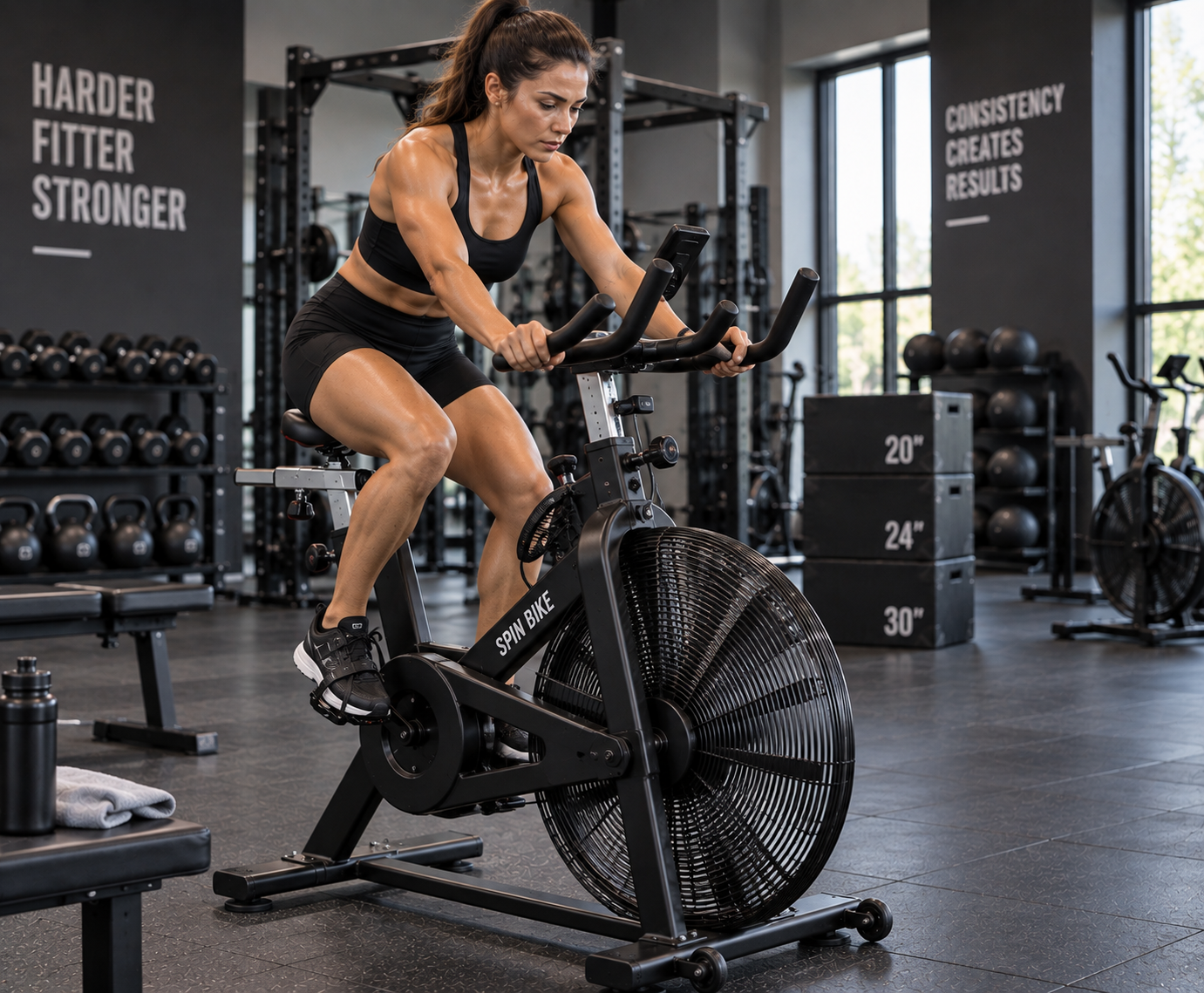
Magnetic vs Friction Spin Bike: Differences and Selection Criteria
Choosing a spin bike depends on numerous technical and operational factors. Among the most frequent comparisons is the one between models with magnetic resistance and those with a friction system, two solutions that use different operating principles to regulate pedaling intensity.
Neither magnetic nor friction technology represents a valid choice in every situation. The most suitable solution depends on the context of use, the frequency of sessions, the type of workout planned, and the maintenance requirements of the facility or the user.
This guide compares the two technologies through verifiable criteria, analyzing operational differences, maintenance aspects, usage scenarios, and elements to evaluate before purchasing a professional spin bike.
- Quick answer
- What are the main differences
- How to choose between magnetic and friction
- When to choose a magnetic spin bike
- When to choose a friction spin bike
- Mistakes to avoid
- Comparison table
- How to evaluate the investment
Magnetic or friction spin bike: which one to choose?
The answer depends on the usage environment and the facility's goals. A spin bike with magnetic resistance uses a system that modulates braking force without direct contact between the braking surfaces, while a friction version regulates resistance through an element that acts directly on the flywheel.
To make an informed choice, it is advisable to compare build quality, maintenance simplicity, spare parts availability, characteristics of the adjustment system, and the technical documentation provided by the manufacturer.
Evaluating the total cost of ownership allows you to compare the two technologies with more complete criteria than just the purchase price.
What is the first criterion?
The intended use of the spin bike represents the starting point for identifying the technology most consistent with operational needs.
Is there an absolute best solution?
No. Each system presents different characteristics that should be evaluated based on the context of use.
What are the differences between magnetic resistance and friction?
The main difference concerns how resistance is generated. In magnetic models, adjustment occurs via a magnetic system, while in friction versions, a braking element comes into contact with the flywheel.
This difference influences operating modes, maintenance characteristics, and the sensation perceived during pedaling.
Both technologies can be used in a professional setting as long as they are designed for continuous use and supported by adequate technical assistance.
What role does the flywheel play?
The flywheel contributes to the smoothness of pedaling and should be evaluated together with the resistance adjustment system.
Why also consider transmission?
The transmission system affects the overall behavior of the bicycle and is among the elements to check during maintenance.
How to choose between the two technologies?
A comprehensive evaluation should consider frequency of use, expected number of users, type of workouts, and maintenance organization.
It is useful to compare structural robustness, simplicity of adjustments, spare parts availability, technical assistance, and the quality of the documentation provided by the manufacturer.
For a gym or cycling studio, it is advisable to prepare a checklist that allows you to compare different models using the same criteria.
Why evaluate maintenance?
The simplicity of scheduled interventions affects operational continuity and equipment management in the long term.
How much do spare parts matter?
Good availability of components facilitates maintenance and helps reduce machine downtime.
When might a magnetic spin bike be indicated?
A magnetic solution can be considered when the facility is looking for a technology with characteristics consistent with its usage model and planned maintenance schedule.
The choice should still be based on the technical specifications declared by the manufacturer and not solely on the type of resistance system.
To complete an area dedicated to cardiovascular training, it is also possible to evaluate other professional cardio machines depending on the facility's goals.
For what workouts is it chosen?
The evaluation should be carried out considering the planned training program and the operational needs of the facility.
In what contexts is it used?
It can be considered for both individual and professional uses, provided the model is designed for the intended context.
When might a friction spin bike be indicated?
A friction spin bike can represent an appropriate solution when its characteristics are consistent with the goals of the gym or the user.
Here too, it is important to compare build quality, planned maintenance, spare parts availability, and technical assistance.
The choice should always be based on the set of technical characteristics and not exclusively on the type of resistance adopted.
Is it suitable for spinning classes?
Compatibility with a cycling studio depends on the overall characteristics of the bicycle and the intended use indicated by the manufacturer.
How to evaluate interval training?
It is advisable to verify that the resistance adjustment system is consistent with the planned training methods.
What mistakes are best avoided?
One of the most frequent mistakes is choosing exclusively based on resistance technology without considering build quality, maintenance, and intended use.
It is also advisable to avoid comparisons based solely on the initial price while neglecting the total cost of managing the machine.
Before purchasing, it is recommended to request technical data sheets, manuals, warranty conditions, and assistance information to compare different models with homogeneous criteria.
Why is the price not enough?
The total cost also includes maintenance, spare parts availability, and operational continuity throughout the machine's entire life cycle.
Why not choose based solely on technology?
Overall performance depends on the entire bicycle design and not just the resistance system.
Comparison between magnetic and friction spin bikes
| Criterion | Magnetic | Friction |
|---|---|---|
| Operating principle | Resistance via magnetic system | Contact between braking element and flywheel |
| Adjustment system | Based on magnetic mechanism | Based on friction |
| Maintenance | To be evaluated according to the manufacturer | To be evaluated according to the manufacturer |
| Spare parts | Verify availability | Verify availability |
| Intended use | Depends on the model | Depends on the model |
| Assistance | Element to compare | Element to compare |
How to compare multiple models?
A checklist that includes flywheel, transmission, adjustments, assistance, maintenance, and technical documentation allows for a more objective evaluation.
What documents to request?
Technical data sheets, user manuals, warranty conditions, and maintenance information represent the starting point for comparing different solutions.
How to evaluate the long-term investment?
The choice of a spin bike should be based on the analysis of the entire machine design, considering build quality, assistance, spare parts availability, maintenance, and intended use.
Comparing magnetic and friction resistance means evaluating two different technologies that can both be appropriate depending on the operational context and the facility's needs.
Requesting official technical documentation and comparing models using verifiable criteria represents the most reliable method for making an informed choice.
How to choose between two similar models?
It is advisable to compare technical characteristics, assistance, spare parts, maintenance, and documentation provided by the manufacturer instead of limiting oneself to the type of resistance.
What is the most important criterion?
The match between intended use, the facility's operational characteristics, and the specifications declared by the manufacturer represents the starting point for an informed choice.
Comments (0)