
Trolley
You have no items in your shopping cart

 Budgets
 Dumbers
 Discs
 Benches
 Racks and Rigs
 Weights Holders
 Isotonic machines
 Calisthenics
 Cardio
 Kettlebells
 Flooring
 Gym Set
 Accessories
 Combat
 ARTI MARZIALI
 CONTAINER GYM
 Tug-Of-War
 Used Gym Equipment
 PILATES MACCHINARI
 GINNASTICA ARTISTICA
 CAMPI DA PADEL
 Prodotti in Pronta Consegna
 Informazioni
 IRONMAN
 Gift Card
- Donatif
- General information
- 0 I like it
- 109 Views
- 0 comments
- gym flooring, safety flooring, gym safety, shock-absorbing materials
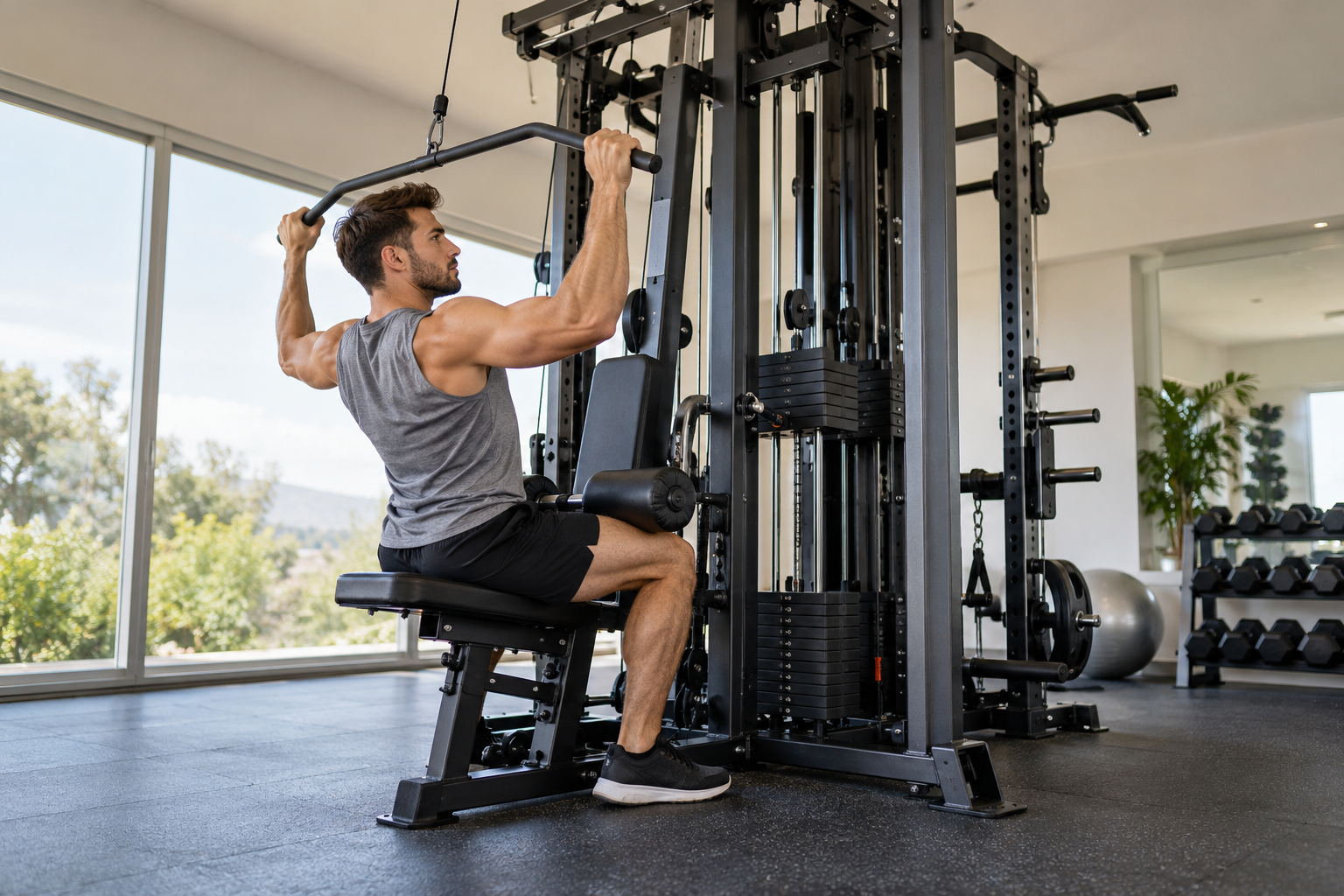
Multifunctional gym with assembly included: technical guide for an efficient machine room
Choosing a multifunctional gym with assembly included represents a strategic investment for machine room managers who wish to optimize space, expand training possibilities, and ensure operational continuity. A multifunctional structure allows for the integration of several exercise stations into a single system, but the quality of the investment depends on technical characteristics, component configuration, and correct installation. The assembly service constitutes an important element of the offer, provided that the included activities and the supplier's responsibilities are clearly defined.
In a professional context, a multifunctional machine must meet different needs compared to equipment intended for home use. The frequency of sessions, user rotation, repeated adjustments, and mechanical stress require reliable components and adequate maintenance procedures. The presence of multiple stations does not automatically guarantee greater room productivity, especially when exercises share the same weight stacks or create interference between users.
This technical guide delves into practical criteria for evaluating a multifunctional gym, with particular attention to isotonic machines, cable systems, installation requirements, and post-delivery management. The objective is to provide the machine room manager with a comparison method based on verifiable characteristics, avoiding turning the choice into a simple list of products or an exclusively economic evaluation.
- Define the operational needs of the machine room
- Evaluate station configuration and functionality
- Examine structure, materials, and stability
- Analyze cables, pulleys, and loading systems
- Verify ergonomics and adjustments
- Check what the included assembly covers
- Plan safety, checks, and maintenance
- Evaluate supplier, warranty, and purchase conditions
- Transform the purchase into a sustainable investment
Define the operational needs of the machine room
The first step consists of analyzing the activities the facility intends to offer. A multifunctional gym can be intended for general strength training, physical reconditioning paths, individual sessions with personal trainers, or organized programs for groups of users. Each application requires a specific configuration of stations and a different level of operational flexibility.
For a machine room manager, it is fundamental to evaluate the number of expected users during peak hours. A structure that integrates numerous exercises might seem advantageous on paper, but can become a bottleneck when several people must share the same weight stack or the same station. The actual number of users who can train simultaneously therefore represents a more significant parameter than the number of advertised exercises.
Planning should also include the type of prevailing training and the characteristics of the members. A room frequented by beginners requires intuitive adjustments and easily understandable movement paths, while a structure oriented toward athletic preparation may prioritize the range of adjustments and the versatility of cable systems. Defining these requirements before requesting quotes allows for the comparison of truly relevant solutions.
Analyze user flows
The distribution of users throughout the day influences the productivity of the stations. It is useful to observe which exercises are requested most frequently, how long sessions last on average, and which equipment generates wait times. A multifunctional machine can help improve organization when it integrates complementary movements, but might be less effective if it concentrates activities that users wish to perform simultaneously in a single point.
Identify training goals
The choice should consider the main muscle groups to be trained and the planned execution methods. Lat pulldowns, rows, presses, and cable movements can require different geometries. The manager must verify that the machine actually allows the necessary exercises, with adequate range of motion and resistance consistent with the users' level, without attributing value to functions that will likely not be used.
Evaluate station configuration and functionality
Multifunctional isotonic machines can integrate guided stations, cable towers, traction systems, and interchangeable accessories. The configuration determines the variety of exercises and the possibility of using multiple functions without complex modifications. Before purchasing, it is important to distinguish between theoretically executable exercises and movements that are actually practicable with correct posture.
A well-designed configuration must allow for rapid transitions between activities, especially in environments with high user rotation. Frequent accessory changes, adjustments that are difficult to reach, or the need to completely clear a station can slow down training. Operational simplicity therefore becomes an evaluation criterion that directly impacts the members' experience.
It is also necessary to verify the independence of the stations. Some systems use separate weight stacks, while others share transmission and loading elements. This difference influences the possibility of simultaneous training and circuit management. The room manager should request a functional diagram that clarifies which exercises can be performed simultaneously without interference.
Guided stations and movement trajectories
Guided stations offer trajectories defined by the machine's geometry. To evaluate them correctly, it is necessary to check the position of the grips, pivot points, and the possibility of adaptation for different users. A trajectory that is not compatible with the user's anthropometric characteristics can make the exercise uncomfortable or limit correct execution. Practical testing is a useful element when it is possible to access a demonstration machine.
Independent stations and simultaneous use
The presence of multiple stations does not necessarily equate to the possibility of using them all at the same time. It is appropriate to verify the independence of the loading systems, the space available for each exercise, and any interference between cables and users. A system with fewer functions but greater operational autonomy can be more productive than a complex structure that requires continuous waiting.
Examine structure, materials, and stability
The quality of the frame represents one of the fundamental elements in the evaluation of a professional multifunctional machine. The structure must support the stress generated during exercises and maintain stability even when different stations are used. Materials, geometry, connections, and quality of workmanship contribute to the overall resistance of the equipment.
The thickness of the metal profiles constitutes a useful piece of data, but it should not be interpreted in isolation. Structural capacity also depends on the section of the tubing, the arrangement of reinforcements, the quality of the welds, and the load distribution. An apparently massive machine is not automatically superior to a solution designed with different structural criteria.
For professional use, it is important to verify that the manufacturer clearly declares the intended use and the expected operating conditions. The presence of technical documentation, assembly instructions, and usage limits allows for the evaluation of compatibility with the room. The quality of the finishes also deserves attention, especially in points subject to frequent contact and in areas where humidity and residue can accumulate.
Frame, welds, and mechanical connections
The frame must have stable connections and a geometry consistent with the expected stress. During a practical check, it is useful to observe any abnormal movements, vibrations, and perceptible flexing under permitted usage conditions. Bolted connections must be installed according to the manufacturer's instructions, respecting the prescribed procedures and any specified tightening torques.
Surface finishes and wear protection
Paint, coatings, and component protection contribute to the preservation of the equipment. In a professional gym, frequent cleaning and contact with sweat can accelerate the deterioration of less protected surfaces. It is appropriate to verify the indications regarding compatible cleaning products and the possibility of replacing elements subject to wear, such as grips, padding, and guards.
Analyze cables, pulleys, and loading systems
The transmission system represents a central component in cable-based multifunctional machines. The quality of gym cables and pulleys affects the fluidity of the movement, the continuity of the resistance, and the frequency of maintenance interventions. For the machine room manager, these elements deserve a specific analysis because they are stressed during every repetition.
Cables must be compatible with the system's characteristics and the loads provided by the manufacturer. Diameter, construction, coating, and terminals affect the behavior of the transmission. It is not correct to evaluate a cable based solely on apparent thickness, as its suitability also depends on compatibility with pulleys, bending radii, and connections.
Pulleys must allow for smooth rotation and maintain the correct cable path. Bearings, groove geometry, and material quality contribute to smoothness. Excessive friction or misalignment can change the sensation of resistance and accelerate wear. A well-designed machine should allow accessible checks without requiring the disassembly of numerous components.
Characteristics of cables and terminals
The choice of cables must follow the machine manufacturer's specifications. Terminals and fixing systems must also be adequate for the expected stress. During the purchase phase, it is useful to verify if the supplier has identifiable spare parts and if the instructions clearly indicate the replacement criteria. The use of incompatible components can alter functionality and compromise safety.
Pulleys, weight stacks, and transmission ratios
The nominal weight of the plates does not necessarily coincide with the force perceived by the user. In cable systems, the transmission ratio can modify the resistance applied to the grip and the available range of motion. To compare different machines, it is therefore appropriate to verify the declared ratio and the effective characteristics of the system. Weight stack guides, selectors, and stops must also ensure smooth operation under the expected conditions.
Verify ergonomics and adjustments
A multifunctional machine intended for a professional room must adapt to users with different physical characteristics. Seat height, grip position, cable range, and station adjustments affect the quality of the exercise. The presence of numerous functions does not compensate for ergonomic limitations that prevent the machine from being used correctly.
The ease of adjustments takes on particular importance in fitness centers with high user rotation. Intuitive mechanisms, readable indicators, and reliable locking systems allow for a reduction in setup times. Conversely, complex adjustments can increase the need for instructor assistance and slow down sessions.
It is also appropriate to verify the accessibility of the stations and the space needed to enter and exit the machine. Some configurations can be impractical when installed near walls or other equipment. Ergonomic evaluation must therefore include both the product and its actual placement within the room.
Seats, backrests, and adjustment points
Adjustments must allow for an appropriate position relative to the exercise trajectory. Seats and backrests must maintain stability during use, while locking systems must be easily verifiable. For a room frequented by people of different heights, it is useful to check the effective range of the adjustments, without assuming that a machine is universally suitable just because it has an adjustable seat.
Grips and interchangeable accessories
Grips affect the hold and the possibility of performing different movements. Bars, handles, and accessories must be compatible with the connection system and the declared usage limits. The availability of additional accessories can expand operational possibilities, but it is important to verify that they are truly necessary and can be stored in an orderly manner without creating obstacles in the room.
Check what the included assembly covers
Professional fitness equipment assembly represents a service to be evaluated carefully. The term assembly included can refer to different activities, from the simple assembly of components to the placement of the machine and initial functional checks. Before confirming the order, it is therefore necessary to request a precise description of the included services.
The manager should verify if the service includes transport inside the premises, moving the packages, assembly, cable adjustment, and function checks. It is also necessary to clarify who is responsible for the disposal of packaging and what conditions must be prepared before the installers arrive. This information allows for the organization of delivery without unnecessarily interfering with the gym's activities.
A particularly important aspect concerns any fixing to the floor or other structures. Not all machines require the same installation methods, and the need for anchoring must be verified through the manufacturer's instructions. When interventions on the floor are planned, it is necessary to ensure compatibility with the building's characteristics and involve qualified personnel.
Preparation of premises before delivery
Before installation, it is appropriate to check the dimensions of entrances, the width of corridors, the presence of stairs or elevators, and the availability of the space needed to assemble the machine. The weight of the components and the handling methods must be compatible with the planned route. It is useful to agree on any logistical needs in advance, especially when the room is located in premises with limited accessibility.
Functional testing and equipment handover
At the end of assembly, the checks provided by the manufacturer should be performed, including the control of connections, the correct cable path, the operation of the adjustments, and the smoothness of moving parts. It is appropriate to document any anomalies before final acceptance. The handover should also include usage and maintenance instructions, along with the information necessary to request assistance.
Plan safety, checks, and maintenance
Operational safety depends on the quality of the machine, correct installation, and the procedures adopted by the gym. A professional multifunctional machine has numerous moving parts and adjustment points that must be used according to the manufacturer's indications. The presence of trained staff helps to reduce improper use and identify any anomalies promptly.
Preventive maintenance is particularly important in cable systems and sliding mechanisms. Periodic checks allow for verifying the status of components subject to wear and scheduling any replacements. The frequency of checks must follow the manufacturer's instructions and take into account the intensity of actual use.
For the machine room manager, it is useful to prepare an internal procedure that distinguishes ordinary visual checks, cleaning interventions, and activities reserved for technical personnel. Documenting the checks allows for maintaining a history of the equipment and facilitates assistance management. In the presence of anomalies that could compromise safety, the machine must be excluded from use until appropriate evaluation.
Periodic component checks
Verifications can include the inspection of cables, terminals, pulleys, selectors, and structural connections. It is important to observe any signs of abrasion, deformation, abnormal noise, or irregularities in sliding. The operations must be performed according to the manufacturer's procedures, avoiding improvised adjustments or replacements with components of unverified characteristics.
Spare parts management and operational continuity
The availability of spare parts represents an important element in the economic evaluation. Cables, pulleys, padding, grips, and weight stack components may require intervention during the machine's useful life. It is appropriate to verify the possibility of ordering compatible parts and to know the assistance methods. Prolonged downtime can reduce the availability of stations and compromise activity scheduling.
Evaluate supplier, warranty, and purchase conditions
Supplier selection must consider the completeness of the technical and commercial proposal. A quote for a multifunctional gym with assembly included should clearly identify the model, configuration, included accessories, and installation services. The presence of a total price is not sufficient when information on the activities actually included is missing.
To compare relevant alternatives, it is useful to consult a selection of professional isotonic machines and check the characteristics of the available multifunctional machines against the room's requirements. The comparison should focus on station configuration, quality of transmission systems, operational dimensions, and assistance conditions, avoiding attributing value to functions that will not be used.
Warranty conditions must be examined considering the professional intended use of the machine. It is important to verify the duration of the coverage, any exclusions for components subject to wear, and procedures for requesting interventions. The commercial warranty does not replace the obligations provided for by applicable law, but it can offer additional services that impact the overall management cost.
Compare quotes with the same scope
A reliable comparison requires distinguishing between the price of the machine, transport, assembly, any accessories, fixing interventions, and subsequent services. Two offers with similar amounts can include different services. It is therefore appropriate to prepare an internal table that lists the included items, those excluded, and any additional costs, using homogeneous criteria for all proposals.
Technical documentation and after-sales assistance
Before ordering, it is useful to request the data sheet, user manual, maintenance instructions, and applicable compliance documentation. The supplier should also clarify how to obtain spare parts and the assistance channels. The availability of complete information facilitates the manager's work and allows for the correct organization of maintenance from the very first weeks of use.
Transform the purchase into a sustainable investment
Choosing a multifunctional gym with assembly included should be part of an economic evaluation that considers the entire life cycle of the equipment. The initial price represents only one component of the investment, while maintenance, spare parts, any technical interventions, and operational availability can influence the overall cost. A cheaper machine does not necessarily constitute the most convenient solution when it requires frequent interruptions or presents functional limitations.
To evaluate alternatives, it is useful to prepare a matrix with mandatory requirements and preferential characteristics. The former can include professional intended use, adequate configuration, compatible dimensions, technical documentation, and defined installation conditions. The latter can include additional accessories, expansion possibilities, and aesthetic characteristics. Prioritizing the truly important parameters allows for making the decision more transparent.
A further indicator concerns the cost relative to usage sessions. For example, assuming a total investment of 6,000 euros distributed over six years and an average of 1,200 annual sessions, the initial share attributable to the machine would be equal to approximately 0.83 euros per session. This is an illustrative example that does not necessarily include maintenance, cost of space, and other operational charges. The method still allows for comparing different scenarios using consistent hypotheses.
Calculate total cost of ownership
The total cost should include purchase, transport, assembly, any adjustments to the premises, scheduled maintenance, and replacement of components subject to wear. It is also appropriate to consider the indirect cost of periods of unavailability. A multi-year evaluation allows for distinguishing immediate savings from effective economic sustainability, especially in structures that use the stations for many hours daily.
Define checks before approval
Before confirming the purchase, the manager should verify that the configuration meets training goals, that spaces are adequate, and that assembly conditions have been defined in writing. It is also important to establish who will perform the checks upon delivery and who will be responsible for subsequent controls. Involving instructors in the evaluation of the stations can help identify ergonomic or operational critical issues before installation.
Careful planning allows for integrating the multifunctional machine into the machine room without compromising access paths and the use of existing equipment. The quality of the investment depends on the combination of actual functionality, reliability of components, correct installation, and availability of assistance over time. For a professional structure, these elements constitute the basis for a purchase consistent with the users' needs and the gym's management objectives.
Comments (0)