
Trolley
You have no items in your shopping cart

 Budgets
 Dumbers
 Discs
 Benches
 Racks and Rigs
 Weights Holders
 Isotonic machines
 Calisthenics
 Cardio
 Kettlebells
 Flooring
 Gym Set
 Accessories
 Combat
 ARTI MARZIALI
 CONTAINER GYM
 Tug-Of-War
 Used Gym Equipment
 PILATES MACCHINARI
 GINNASTICA ARTISTICA
 CAMPI DA PADEL
 Prodotti in Pronta Consegna
 Informazioni
 IRONMAN
 Gift Card
- Donatif
- General information
- 0 I like it
- 107 Views
- 0 comments
- gym flooring, safety flooring, gym safety, shock-absorbing materials
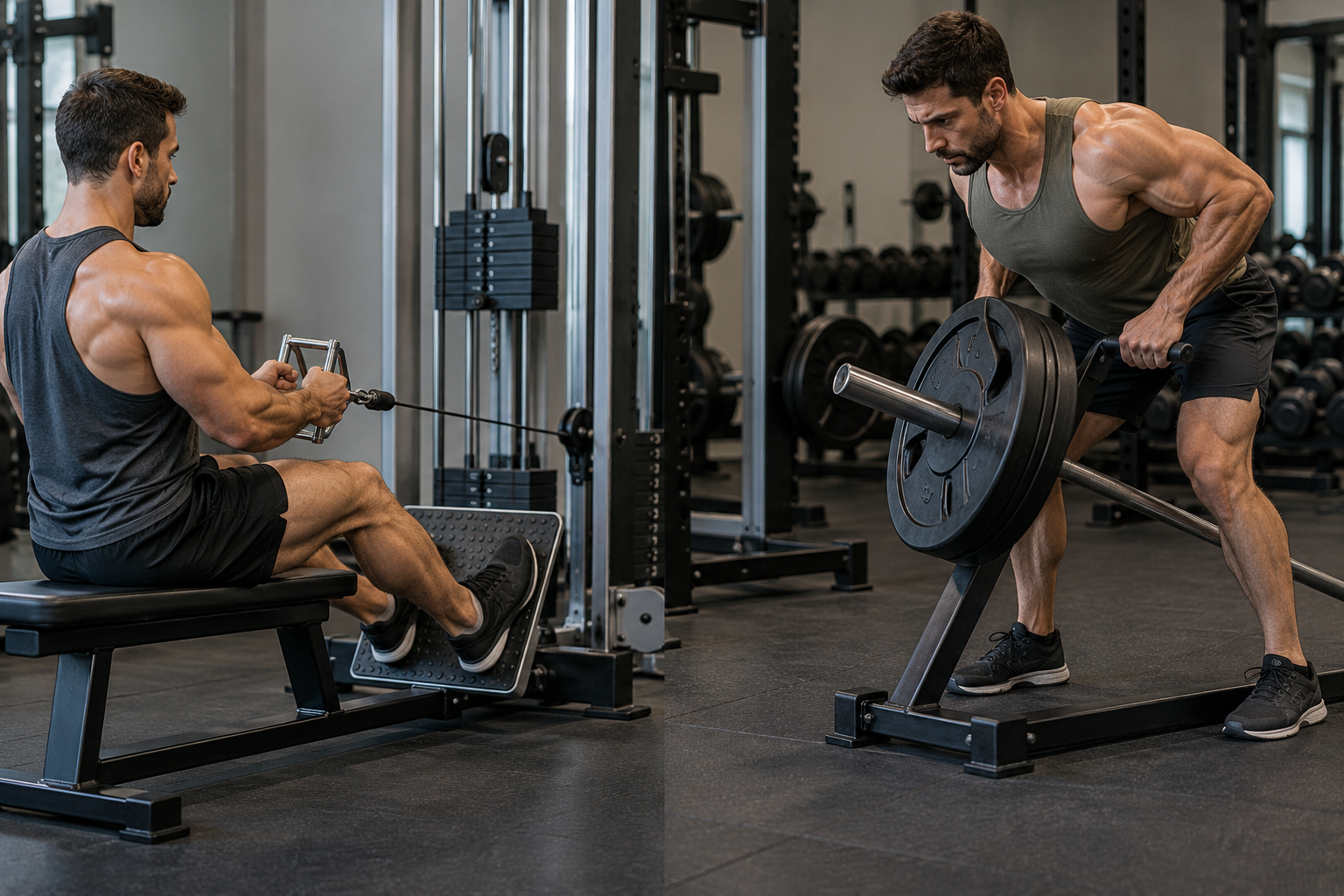
Pulley and T-bar: differences for back training and criteria for selection
Choosing equipment for back training is an important decision for any professional gym. Among the most used solutions for developing the dorsal muscles, pulley and T-bar play a significant role due to the possibility of performing pulling exercises with different biomechanical characteristics. Understanding these differences allows managers to better organize spaces, improve the variety of the offer, and select equipment consistent with the needs of members.
The comparison between pulley and T-bar should not be limited to the amount of load that can be used or the popularity of individual exercises. Both pieces of equipment allow you to train your back, but they differ in terms of resistance application, body position, adjustment possibilities, and technical requirements. These elements influence both the quality of the training experience and the operational efficiency of the facility.
For a gym manager or purchasing manager, evaluating pulley and t-bar: differences for back training therefore means considering biomechanical aspects, user profiles, dimensions, maintenance, and the sustainability of the investment. This guide proposes practical criteria for identifying the most suitable configurations, avoiding comparisons based solely on the commercial characteristics of the products.
- Biomechanical differences between pulley and T-bar
- Muscles involved and training goals
- Types of pulley and T-bar for professional gyms
- Choosing equipment based on users
- Dimensions and space organization
- Build quality, ergonomics, and safety
- Maintenance and operational continuity
- Practical criteria for comparing pulley and T-bar
- How to direct the investment for a professional gym
Biomechanical differences between pulley and T-bar
The pulley and the T-bar belong to the family of horizontal or predominantly horizontal pulling exercises, but they have important differences in the transmission of resistance. The pulley generally uses a system of cables and pulleys connected to a weight stack or a plate-loadable system. The traditional T-bar uses a bar constrained at one end, onto which loads are applied. There are also T-bar machines with chest support and guided trajectories.
This distinction changes the feel of the load during the exercise. In the pulley, the direction of the pull depends on the path of the cable and the position of the pulley, while in the T-bar, the movement follows a trajectory influenced by the rotation point of the bar. It does not mean that one system is universally superior to the other: the choice depends on the type of stimulus desired and the equipment's ability to adapt to the user.
From a programming point of view, both solutions can contribute to the development of back strength and hypertrophy. The most relevant difference concerns how the athlete stabilizes the body, controls the movement, and manages the resistance in the different phases of the repetition.
How the pulley movement works
In the traditional low pulley, the user sits, keeps their feet on the supports, and pulls a handle toward the torso. The cable system allows for the application of resistance along the direction of the pull, with characteristics that depend on the geometry of the pulleys and the transmission ratio. The seated position offers a stable reference, although it requires active control of the torso in configurations without chest support.
The possibility of using different handles allows you to change the width and orientation of the grip. This makes the pulley particularly interesting in facilities that offer diversified programs, provided that the variations are performed while respecting individual mobility and characteristics.
How the T-bar movement works
In the traditional T-bar, the user performs a row with the torso inclined, lifting the free part of the bar. The resistance comes from the loaded plates and varies according to the geometry of the movement. The stabilization of the torso and lower limbs plays an important role, especially when there is no chest support.
Versions with chest support, on the other hand, reduce the need to independently maintain the inclined position, allowing more focus on the pull. This difference must be considered when comparing models intended for users with different levels of experience.
Muscles involved and training goals
The pulley and the T-bar mainly involve the latissimus dorsi, trapezius, rhomboids, and other muscles that participate in the movements of the scapula and humerus. The posterior deltoid and elbow flexors also contribute to the execution. The extent of the involvement varies depending on the trajectory, grip, position of the torso, and individual characteristics.
It is not correct to automatically attribute exclusively back width work to the pulley and exclusively dorsal thickness stimulus to the T-bar. Both exercises can contribute to the overall development of the musculature, while the actual differences depend on the execution methods and the configuration of the equipment.
For a professional gym, it is therefore more useful to think in terms of complementarity. Having exercises with different stabilization conditions and adjustment possibilities allows trainers to adapt programs without relying on overly rigid muscular classifications.
Latissimus dorsi and scapular stabilizer muscles
During rows, the latissimus dorsi contributes to the movements of the humerus, while the trapezius and rhomboids participate in scapular control. The position of the elbows relative to the torso can change the distribution of muscle work without completely isolating a single anatomical region. For this reason, technical instruction should focus on the quality of movement and not just on the final position of the handle.
A pulley with different handles offers immediate possibilities for variation. A T-bar with multiple grips can provide similar flexibility, even if the trajectory remains conditioned by the structure of the machine.
Torso stabilization and lumbar involvement
In T-bars without chest support, the spinal extensors help maintain the torso position during the pull. This requirement can be useful in certain strength programs, but it also represents an additional element of fatigue to consider when managing total volume.
The seated pulley still requires postural control, especially when the user accompanies the movement with excessive swaying of the torso. For users who need to limit stabilization demands, a T-bar with chest support or a pulley with adequate supports may be preferable, subject to individual technical assessment.
Types of pulley and T-bar for professional gyms
The professional equipment market includes different configurations, which cannot be compared only through the name of the exercise. A pulley integrated into a multifunctional station has different operational characteristics compared to a dedicated machine. Similarly, a free T-bar with floor attachment does not necessarily offer the same experience as a guided machine with chest support.
The selection should start from the functions required by the facility. A gym oriented toward general training may prioritize versatility and ease of adjustment, while a center specialized in strength may place greater importance on the possibility of using high loads and the robustness of the components.
It is also important to distinguish the declared load capacity from the actual behavior of the machine. Pulley ratios, lever geometry, and plate positions can modify the perceived resistance, making direct comparison between nominal values of different pieces of equipment not very significant.
Weight stack pulley and loadable systems
The weight stack pulley generally allows for rapid load adjustment via a selector. This feature promotes alternation between users and can reduce the time needed to change intensity during circuits and individual sessions. Progression, however, depends on the available increments and the mechanical ratio of the system.
Plate-loadable versions allow for a different management of resistance and can be interesting for facilities that already have a large assortment of weights. However, one must consider the time needed to load and unload the machine, as well as the availability of plates during peak hours.
Free T-bar, landmine, and guided machines
Traditional T-bar configurations include systems with a constrained bar, dedicated handles, and machines designed specifically for rowing. A landmine solution with appropriate accessories can offer flexibility, but requires careful analysis of the stability of the anchor, operational space, and compatibility of components.
Guided T-bars with chest support, on the other hand, have a defined station and can facilitate the repeatability of the movement. Their operational advantage depends on the quality of the ergonomics and the possibility of adapting supports and handles to people of different heights.
Choosing equipment based on users
One of the most important variables in choosing professional fitness equipment is the composition of the clientele. A gym attended primarily by beginners has different needs compared to a center dedicated to bodybuilding or athletic preparation. The number of members, the distribution of time slots, and the presence of personal trainers directly influence the operational value of individual stations.
The weight stack pulley can be particularly practical when numerous users need to alternate on the same machine. The immediate adjustment of the resistance and the possibility of using different handles facilitate customization, while still requiring correct posture instructions.
The T-bar can be highly appreciated by experienced users who are looking for rowing exercises with specific characteristics. Supported versions expand the possibilities of use, while those without support require greater attention to managing the position of the torso.
Beginners and general fitness users
For those approaching resistance training, the ease of setting up the equipment is a relevant criterion. A well-designed pulley allows for quick load adjustment and offers an initial position that is relatively simple to understand. Adjusting distance, spinal control, and the correct execution of the pull remain fundamental.
A T-bar with chest support can be just as accessible when the height of the supports and the position of the handles are adequate. The presence of a guided trajectory, however, does not eliminate the need to verify that the movement is compatible with the characteristics of the user.
Bodybuilding and athletic preparation
In environments oriented toward hypertrophy, having multiple variations of rows allows for the distribution of work among exercises with different stabilization requirements. The pulley can be used for controlled sets and grip variations, while the T-bar can supplement programs that include rows with a constrained bar and progressive loads.
In athletic preparation, the choice depends on the goals of the program and the fatigue produced by other exercises. An athlete who already performs high volumes of demanding exercises for the torso might benefit from supported rows, avoiding the unnecessary addition of further stabilization demands.
Dimensions and space organization
The sizing of the weight room must not only consider the external dimensions of the machines. Each station requires space for access, movement execution, load adjustment, and the circulation of other users. This aspect is particularly important in gyms with limited surface area or high equipment density.
A dedicated pulley may occupy a relatively defined space, but one must verify leg extension, handle position, and the distances needed to sit down and get up. Configurations integrated into multifunctional stations can optimize some surfaces, provided they do not create interference between users performing different exercises.
A free T-bar requires attention to the movement of the bar and space for the plates. Guided machines may have more predictable footprints, but still require side areas for loading and sufficient passageways to access the station.
Positioning stations in the weight room
The layout should prevent movement trajectories from crossing paths frequently used by members. For T-bars, it is important to check the position of the bar in the different phases of the exercise, while for the pulley, one must evaluate the handle extension and any presence of exposed cables in accessible areas.
A functional layout can group equipment by training type, but must preserve access and supervision paths. Effective distances should be defined based on the manufacturer's instructions, room characteristics, and applicable regulations.
Managing flows during peak hours
During peak hours, the time needed to adjust a machine affects the availability of the station. A weight stack pulley normally allows for quick resistance changes, while a loadable T-bar requires moving plates. The difference becomes significant when many users share the same equipment.
To correctly assess operational efficiency, the manager can observe the average duration of sessions, the frequency of waiting times, and the number of people who actually use each station. These data are often more useful than an evaluation based solely on the declared footprint.
Build quality, ergonomics, and safety
Build quality influences equipment stability, movement precision, and component durability. In professional gyms, where machines are used repeatedly throughout the day, it is fundamental to verify the robustness of the frame, the quality of the welds, the reliability of the connections, and the protection of parts subject to wear.
For the pulley, cables, pulleys, weight stack guides, and selection systems are particularly important. Irregular smoothness can compromise the quality of the exercise and signal maintenance problems. In T-bars, it is necessary to assess above all the rotation system, the stability of the base, loading points, and any chest support structure.
Compliance with applicable technical standards, manufacturer instructions, and indications on usage limits must be examined before purchase. The aesthetic aspect alone does not determine whether a machine is suitable for intensive use in a professional environment.
Ergonomics and adjustment possibilities
Ergonomically valid equipment must allow users to assume positions compatible with their anthropometric characteristics. Seat height, distance from handles, position of supports, and range of motion are elements to be verified through practical tests, especially when the machine will be used by very different people.
In T-bars with chest support, it is important to check that the support does not excessively limit breathing or prevent a functional trajectory. In pulleys, instead, it is necessary to verify that the system allows for maintaining a stable position without requiring postural compensation to reach the handle.
Structural stability and user protection
Stability must be verified under expected usage conditions, considering the maximum allowed load and the stress generated during the exercise. Feet, fastening systems, and contact points with the floor must be compatible with the installation surface and the manufacturer's technical indications.
Protection of moving parts and correct management of pinch zones are equally important. A machine intended for public use must allow for periodic checks and offer clear instructions on how to use it and the conditions that require service suspension.
Maintenance and operational continuity
Maintenance is an essential component of the total cost of equipment. A machine that is cheap to purchase can be less cost-effective if it requires frequent interventions, has components that are difficult to replace, or remains unusable for long periods. The evaluation should therefore consider the entire lifecycle of the equipment.
In the pulley, periodic checks mainly concern the condition of the cables, the smoothness of the pulleys, the functioning of selection systems, and the integrity of the connections. Procedures must respect the manufacturer's instructions, avoiding improvised interventions on tensioned components.
In the T-bar, it is necessary to check the rotation system, attachment points, handles, and loading elements. Versions with adjustable supports require additional checks on locking mechanisms and padded parts subject to wear.
Scheduled checks and preventive maintenance
An effective maintenance program should include frequent visual inspections and technical checks according to the intervals indicated by the manufacturer. Recording anomalies, interventions, and replacements allows for identifying components subject to recurring deterioration and planning spare part purchases.
For facilities with numerous members, preventive maintenance reduces the risk of unexpected interruptions. It is useful to assign precise responsibilities to staff and define procedures for immediately reporting abnormal noises, mechanical play, or malfunctions.
Availability of spare parts and technical support
Before buying a machine, the manager should verify the availability of compatible spare parts and the support methods provided by the supplier. Cables, pulleys, bearings, handles, and adjustment components may require replacement over time, especially in high-traffic facilities.
The possibility of quickly obtaining technical support helps protect service continuity. Complete documentation, accompanied by maintenance instructions and component identification, also facilitates ordinary fleet management.
Practical criteria for comparing pulley and T-bar
An effective decisional comparison should start from the goals of the gym rather than the search for a machine considered best in absolute terms. The fundamental questions concern the type of clientele, the exercises already available, the expected frequency of use, and space limitations. This information allows you to evaluate which equipment adds the most value to the facility.
If the gym already has numerous cable rowing stations, a T-bar can expand the variety of training conditions. Conversely, a facility equipped mainly with barbells and loadable machines might find a weight stack pulley to be a practical solution to increase adjustment possibilities and make user alternation smoother.
It is important to distinguish the features that are truly necessary from those that have a marginal impact on daily use. The choice should prioritize compatibility with goals, reliability, and quality of experience, avoiding assigning excessive value to isolated technical specifications.
Five practical criteria to verify
The main practical criteria include versatility, ergonomics, operational footprint, ease of maintenance, and total cost of ownership. Versatility indicates how many usage modes are actually useful to the clientele. Ergonomics concerns the machine's ability to adapt to different people. Footprint must include the space needed during execution, not just the dimensions of the frame.
Maintenance should be evaluated through the accessibility of components, availability of spare parts, and simplicity of inspections. The total cost of ownership includes purchase, installation, accessories, maintenance, and possible downtime. Assigning a weight to each criterion allows you to compare alternatives in a consistent manner.
Example of choice for a medium-sized gym
Consider a gym with a heterogeneous clientele, frequent individual training sessions, and limited space for new machines. If there is no cable rowing station, a compact pulley with rapid load adjustment can meet various operational needs. The choice remains subject to verifying the footprint, ergonomic characteristics, and compatibility with the existing layout.
In a facility already equipped with cable stations, but with a limited offer of supported rows, a T-bar with chest support can be a more interesting addition. The evaluation should include a practical test with users of different builds and a realistic estimate of the frequency of use.
How to direct the investment for a professional gym
The decision between pulley and T-bar must be part of a broader development strategy for the weight room. The goal is not simply to increase the number of machines, but to improve the coverage of available exercises, the quality of the stations, and the facility's ability to satisfy different training needs. A well-planned investment avoids useless overlaps and allows resources to be allocated to equipment that provides concrete benefits.
Before proceeding with the purchase, it is advisable to analyze the use of existing equipment, collect observations from trainers, and check for recurring requests from members. This information helps to understand whether the priority is to increase the availability of stations, introduce a different way of rowing, or replace machines that have ergonomic and operational limitations.
Economic evaluation should consider the initial price together with the expected duration, maintenance, and the possibility of using components already present in the facility. For loadable machines, for example, it is useful to verify the availability of compatible plates and the organization of storage spaces. For cable systems, the quality of transmission and spare parts management take on greater importance.
Compatibility with equipment already present
A loadable T-bar can be effectively integrated into a weight room equipped with Olympic plates and adequate organization systems. Before choosing, you must check diameters, load capacity, sleeve dimensions, and manufacturer indications. Using incompatible components can compromise the operation and safety of the station.
For pulleys, instead, it is important to evaluate the compatibility of handles and accessories, as well as the availability of specific spare parts. A system that uses standard connections compatible with the manufacturer's indications can simplify accessory management, but every configuration must be verified before use.
Evaluation of the supplier and technical documentation
The selection of the supplier should be based on the clarity of specifications, the availability of technical documentation, and the quality of assistance. It is useful to request information on operational dimensions, load limits, adjustments, maintenance, and warranty conditions. A complete technical sheet facilitates comparison between models and reduces the risk of buying a machine not suitable for available spaces.
To learn more about solutions dedicated to weight room preparation, you can consult professional isotonic machines, evaluating the characteristics of individual configurations in relation to the goals of the facility. The comparison must always start from operational needs and not from the simple availability of a specific model.
Defining purchase priorities and measuring results
When the budget does not allow for purchasing both pieces of equipment, it may be useful to build an evaluation matrix by assigning scores to the most important criteria. A generalist gym might place more weight on ease of adjustment and frequency of use, while a specialized center might prioritize trajectory characteristics, robustness, and load progression possibilities. Assigned weights must reflect the real needs of the facility.
After installation, the manager can verify the effectiveness of the choice by observing the number of uses, waiting times, user feedback, and maintenance needs. These indicators allow you to evaluate if the equipment has concretely improved the service and offer useful data for planning subsequent purchases. The quality of the investment emerges, in fact, from the ability of the machine to maintain operational value over time, not just from its characteristics at the time of purchase.
Comments (0)