
Trolley
You have no items in your shopping cart

 Budgets
 Dumbers
 Discs
Discs
 Benches
 Racks and Rigs
 Weights Holders
 Isotonic machines
 Calisthenics
 Cardio
 Kettlebells
 Flooring
 Gym Set
 Accessories
 Combat
 ARTI MARZIALI
 CONTAINER GYM
 Tug-Of-War
 Used Gym Equipment
 PILATES MACCHINARI
 GINNASTICA ARTISTICA
 CAMPI DA PADEL
 Prodotti in Pronta Consegna
 Informazioni
 IRONMAN
 Gift Card
- Donatif
- General information
- 0 I like it
- 572 Views
- 0 comments
- gym flooring, safety flooring, gym safety, shock-absorbing materials
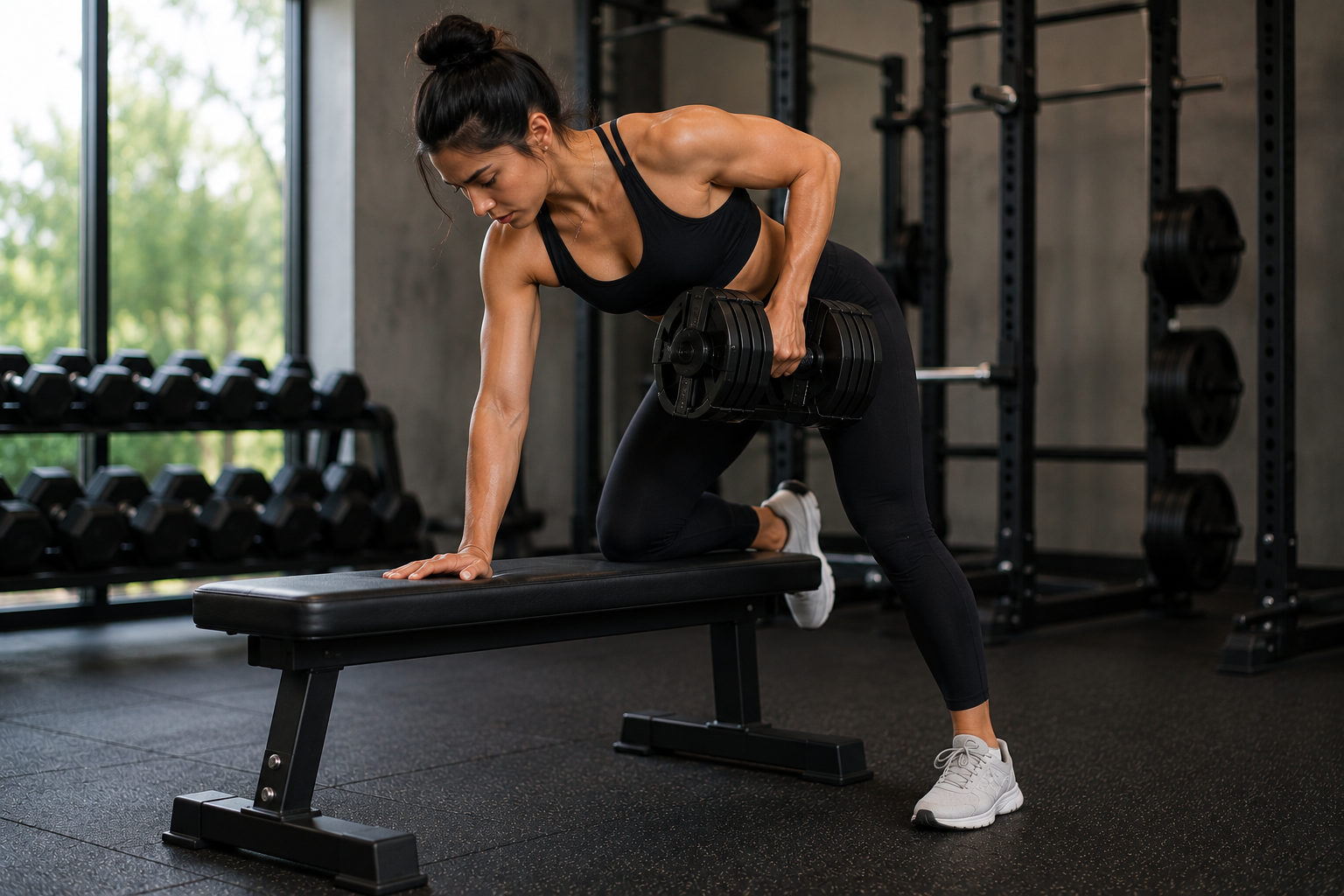
Dumbbell row: perfect technique to build a V-shaped back
The dumbbell row is one of the most effective exercises for developing a strong, wide, and defined back. Despite its apparent simplicity, the quality of the result depends above all on technical precision, the ability to control the movement, and the correct activation of the back muscles. Many athletes manage to lift heavy loads during this exercise, but they do not always manage to transfer the stimulus to the desired muscle group.
Correct execution of the dumbbell row allows you to primarily engage the latissimus dorsi, rhomboids, and trapezius, improving back thickness and contributing to the construction of the classic V-shape. The central point is not simply to bring the weight toward the body, but to create a controlled trajectory where the back is the true protagonist of the movement.
For those who want to improve their technique, avoid compensations, and achieve more consistent results, understanding biomechanics, elbow position, scapular control, and load management represents a fundamental step. A small error in execution can, in fact, drastically reduce the effectiveness of the exercise.
- Why the dumbbell row is fundamental
- Anatomy and muscles involved in the row
- Correct technique for the dumbbell row
- The high-elbow error in the row
- Single-arm row and scapular control
- Load progression and back development
- Integrating the row into dumbbell back exercises
- Building a V-shaped back with the correct technique
Why the dumbbell row is fundamental
The back is composed of numerous muscles that work together to ensure strength, stability, and movement. The dumbbell row is considered a fundamental exercise because it allows you to train the horizontal pull, an essential motor pattern for developing complete back musculature.
Unlike many machine-based exercises, the dumbbell requires a greater capacity for stabilization. The body must simultaneously control the position of the torso, the trajectory of the weight, and the movement of the scapula. This makes the exercise very useful not only for increasing muscle mass but also for improving coordination.
For those who train in a home gym, it represents an extremely efficient solution because it allows you to obtain a great stimulus with simple and versatile equipment.
Developing back thickness and density
Many athletes seek a wider back by focusing exclusively on the width of the lats, but a complete structure also requires thickness. The row works in a particular way on the muscles that contribute to back density.
Greater muscle depth creates a fuller and more athletic appearance, improving the ratio between width and overall volume.
Advantages of unilateral work
The row with a single dumbbell allows you to work each side separately. This feature helps to identify any strength differences and prevents a dominant side from compensating for the work of the other.
Unilateral work also promotes greater concentration on the target muscle and better perception of the contraction.
Anatomy and muscles involved in the row
To correctly perform an exercise, it is important to understand which muscles must work. In the dumbbell row, the main movement is a pull of the arm toward the torso, but several muscle groups collaborate to complete the action.
The final result depends on the ability to coordinate arm movement, torso stabilization, and scapular control.
Knowing the role of each muscle makes it easier to correct technical errors.
Latissimus dorsi and elbow trajectory
The latissimus dorsi is one of the main protagonists of the movement. Its function is to bring the arm toward the body through an action of adduction and extension of the shoulder.
The position of the elbow influences how the muscle is engaged. A controlled trajectory allows you to maintain greater tension on the back.
Rhomboids and trapezius in scapular control
The rhomboids and trapezius contribute to the management of the scapula during the pull. A stable scapula allows the arm to move more efficiently.
Neglecting this aspect can lead to compensations and reduce the effective work on the lats.
Correct technique for the dumbbell row
The technique of the dumbbell row requires attention to every phase of the movement. The starting position, the trajectory of the weight, and the negative phase determine the quality of the stimulus received by the muscles.
Correct execution does not just mean completing the repetition, but maintaining control from start to finish.
Seeking maximum load without a solid technical base is one of the most common mistakes in this exercise.
Starting position for the row
The starting position generally involves a stable support, with the torso inclined and the spine kept in a neutral position. The body must create a solid base from which to produce the movement.
Correct posture allows for better force transfer and reduces the risk of using momentum.
Pulling phase and contraction
During the concentric phase, the dumbbell must approach the body through a controlled movement of the elbow. The goal is to bring the arm back without losing the position of the torso.
The final contraction must be felt in the back area, not just in the arm.
The high-elbow error in the row
One of the most frequent errors in the dumbbell row concerns the so-called high elbow. Many athletes try to bring the elbow very far outward, thinking they are increasing the work on the back, but this strategy can change the distribution of the stimulus.
An elbow that is too high can shift part of the work toward the upper trapezius and rear deltoids, reducing the engagement of the latissimus dorsi.
The correct trajectory must be chosen based on the goal of the exercise and the ability to maintain control.
Why the high elbow reduces effectiveness
When the movement is guided exclusively by the elbow outward, the body may lose the ability to create an effective contraction of the lat.
The goal is not to lift the dumbbell to the highest position possible, but to correctly stimulate the muscle.
Correcting the movement trajectory
An effective correction consists of focusing on the movement of the elbow toward the hip, keeping the shoulder stable and the torso still.
This helps to create a line of pull more consistent with the function of the latissimus dorsi.
Single-arm row and scapular control
The single-arm row technique represents a widely used variant because it allows you to focus more on the work of each side of the back. The separation of movements offers greater control and facilitates the correction of errors.
Scapular control is one of the most important elements to make this variant effective. A scapula that moves correctly allows for a better relationship between the shoulder joint and the back muscles.
To achieve better results, it is necessary to avoid passive movements and learn to actively manage the position of the shoulder.
Importance of scapular retraction
Scapular retraction consists of the controlled movement of the scapulae toward the spine. This helps to create a stable base for the pull.
It does not mean locking the scapula completely, but coordinating its movement with that of the arm.
Mind-muscle connection in the row
The ability to perceive the work of the back is fundamental. Many athletes feel their biceps more because they use the arm as the main engine of the movement.
Focusing on the contraction of the lat improves the quality of the exercise.
Load progression and back development
Like every strength exercise, the row also requires progression over time. Gradually increasing the stimulus allows the muscles to adapt and continue to develop.
However, the load should not become the only parameter for improvement. A repetition performed with more control can be more effective than a heavier but technically imprecise repetition.
The best progression combines increased strength and improved movement quality.
Increasing weight without losing technique
When the load increases, the risk of using momentum and compensations grows. For this reason, every increase must be accompanied by the ability to maintain a correct position.
Technique must remain the main point of reference.
Training volume and frequency
The number of sets and the weekly frequency must be adapted to the athlete's level and the rest of the program.
A well-managed volume allows you to stimulate growth without compromising recovery.
Integrating the row into dumbbell back exercises
The row represents one of the main exercises within dumbbell back exercises, but a complete back requires a combination of different movements. Working at multiple angles allows you to stimulate all the functions of the back musculature.
Combining rows, extension movements, and work for the posterior chain allows you to build a balanced program.
The variety of stimuli must be accompanied by a consistent progression.
Combining different pulling movements
A complete routine can include exercises with different trajectories to engage different portions of the back.
This allows you to develop both width and thickness.
Choosing suitable equipment
The quality of the dumbbell influences safety and the feeling during training. Stable equipment allows you to focus more on technique.
The choice of reliable tools contributes to the continuity of the training journey.
Building a V-shaped back with the correct technique
The dumbbell row demonstrates how an apparently simple exercise can require great technical precision. Back growth does not depend only on the weight used, but on the ability to correctly stimulate the muscles involved.
Scapular control, elbow trajectory, mind-muscle connection, and load progression are elements that transform a simple pull into a truly effective movement.
Choosing quality tools like adjustable dumbbells allows you to build a versatile home gym suitable for developing a strong, balanced, and progressively growing back over time.
Comments (0)