
Trolley
You have no items in your shopping cart

 Budgets
 Dumbers
 Discs
Discs
 Benches
 Racks and Rigs
 Weights Holders
 Isotonic machines
 Calisthenics
 Cardio
 Kettlebells
 Flooring
 Gym Set
 Accessories
 Combat
 ARTI MARZIALI
 CONTAINER GYM
 Tug-Of-War
 Used Gym Equipment
 PILATES MACCHINARI
 GINNASTICA ARTISTICA
 CAMPI DA PADEL
 Prodotti in Pronta Consegna
 Informazioni
 IRONMAN
 Gift Card
- Donatif
- General information
- 0 I like it
- 9 Views
- 0 comments
- gym flooring, safety flooring, gym safety, shock-absorbing materials
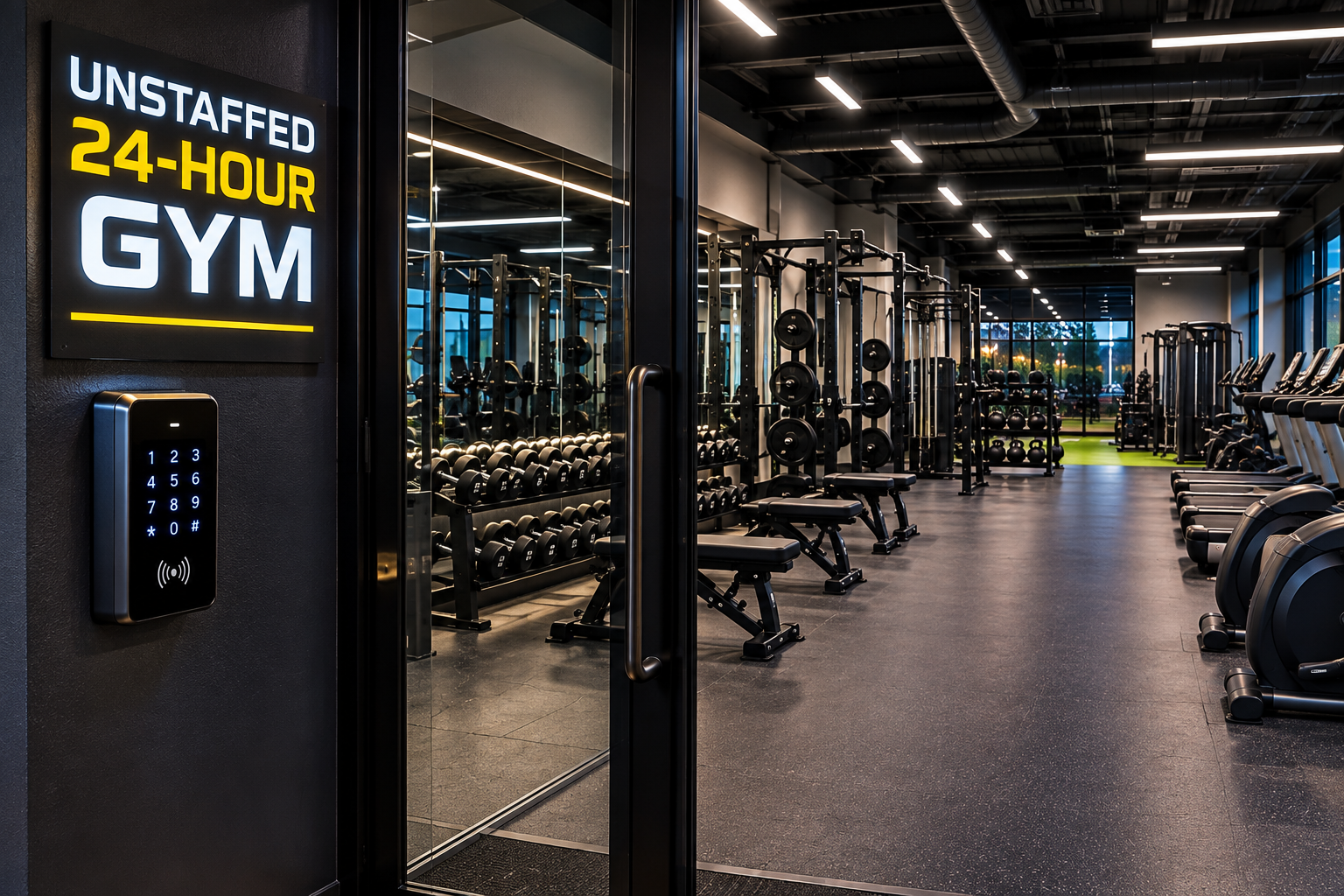
Staffed vs Unstaffed 24-Hour Gym: Differences, Selection Criteria, and Configuration
24-hour gyms, both staffed and unstaffed, represent two different organizational models. The former involves the presence of staff during all or most opening hours, while the latter relies on automated access and management systems during unstaffed hours. The choice depends on the business model, the services offered, the level of automation, and the organization of the facility.
In recent years, the 24-hour format has evolved thanks to the spread of access control technologies, monitoring systems, member management platforms, and automated procedures. However, there is no single solution that works for every gym. Each manager must carefully evaluate their target audience, operating costs, the type of assistance they wish to offer, and the necessary investments.
Comparing staffed and unstaffed 24-hour gyms therefore means analyzing concrete operational differences rather than identifying a universally superior model. Space design, equipment selection, and procedure organization directly impact facility efficiency and user experience.
- Quick Answer
- Main Differences
- What Criteria to Use in Selection
- Comparison Table
- When to Choose One Model Over the Other
- Mistakes to Avoid
- FAQ
- How to Plan the Project
What is the difference between a staffed and unstaffed 24-hour gym?
A staffed 24-hour gym ensures the presence of operators during all or almost all opening hours. An unstaffed gym instead uses automated systems to allow members access during unstaffed hours. Both models require careful planning of layout, equipment, safety, and operating procedures.
The choice depends primarily on the type of service the manager wishes to offer and the planned organization for the facility.
Before deciding, it is useful to analyze operating costs, assistance methods, user characteristics, and the desired level of automation.
Staffed 24-Hour Gym
The presence of staff facilitates user assistance, equipment monitoring, and immediate management of daily activities.
Unstaffed 24-Hour Gym
Activities are managed through automated procedures during unstaffed hours, with dedicated systems for access, monitoring, and member management.
What are the main differences?
The differences primarily concern operational organization, staff presence, assistance methods, and daily activity management.
In a staffed gym, staff can support users during equipment use, directly check any critical issues, and perform commercial or administrative activities.
In the unstaffed model, automated procedures, the clarity of instructions, and the reliability of installed technological systems take on greater importance.
Operational Organization
The organizational structure should be defined as early as the design phase to avoid subsequent modifications that could impact operating costs.
Supporting Technology
The systems used should be consistent with the adopted management model and integrate with the gym's procedures.
What criteria to use in selection?
The first criterion concerns the type of clientele. A facility oriented mainly toward independent workouts presents different needs compared to a gym based on assisted services.
The second criterion concerns the available budget for staff, technologies, and maintenance. Each model entails different organizational and operational needs.
The third criterion concerns the level of automation that the manager wishes to implement during different time slots.
Services Offered
Individual workouts, classes, personal training, and consultations require different organizational approaches.
Management Model
The choice should be consistent with the economic, organizational, and operational goals of the facility.
Comparison Table
| Element | Staffed | Unstaffed |
|---|---|---|
| Staff Present | Yes | Only during scheduled hours |
| User Access | Direct or automated management | Automated |
| Immediate Assistance | Available during staff presence | Limited to scheduled hours |
| Automation | Medium or high | High |
| Operational Management | Supported by staff | Based on automated procedures |
| Daily Checks | Direct | Programmable and periodic |
When to choose one solution over the other?
A staffed gym may be suitable when the business model involves high interaction with users, numerous classes, or services that require direct assistance.
An unstaffed gym can be considered when the project is oriented toward high automation of procedures and independent use of spaces by members.
In many cases, it is possible to adopt a mixed solution, with staff presence during certain hours and automated management during the remainder.
Model with Staff
Can facilitate consulting, reception, and operational support activities during peak hours.
Automated Model
Requires careful planning of access systems, informational procedures, and technical facility management.
What mistakes to avoid?
One of the most common mistakes is choosing the organizational model without analyzing the user profile and the type of services the gym intends to offer.
Another mistake concerns underestimating the maintenance of equipment and technological systems that support the facility's operation.
It is also advisable to avoid introducing automated systems without establishing clear operating procedures for users and staff.
Inconsistent Layout
The arrangement of areas should be designed based on the chosen management model.
Insufficient Procedures
Simple, documented procedures facilitate daily management in both staffed and automated facilities.
FAQ
Must a 24-hour gym necessarily be unstaffed?
No. A 24-hour gym can be fully staffed, partially staffed, or automated during certain time slots.
Does the equipment change between the two models?
Not necessarily. However, it is advisable to choose robust, easy-to-use equipment accompanied by complete technical instructions and documentation.
Which model requires more planning?
Both require careful planning. In the unstaffed model, automation, operating procedures, and control systems take on particular significance.
How to plan the 24-hour gym project?
Planning should begin with the analysis of the target audience, available surface area, desired level of automation, and the services the facility intends to offer. Subsequently, it is possible to define layout, equipment, technological systems, and operational methods in a coordinated manner.
To explore solutions dedicated to professional facilities, you can consult professional gym equipment. When applicable, it is also appropriate to refer to current building regulations, provisions regarding plant safety, any fire prevention standards, regulations applicable to access control and video surveillance systems, and manufacturer manuals for equipment installation, use, and maintenance.
Modular planning allows the gym to progressively adapt to the evolution of the business without radical interventions. Basing decisions on verifiable criteria makes it possible to organize an efficient facility that is easily manageable and consistent with the chosen operating model.
Comments (0)