
Trolley
You have no items in your shopping cart

 Budgets
 Dumbers
 Discs
Discs
 Benches
 Racks and Rigs
 Weights Holders
 Isotonic machines
 Calisthenics
 Cardio
 Kettlebells
 Flooring
 Gym Set
 Accessories
 Combat
 ARTI MARZIALI
 CONTAINER GYM
 Tug-Of-War
 Used Gym Equipment
 PILATES MACCHINARI
 GINNASTICA ARTISTICA
 CAMPI DA PADEL
 Prodotti in Pronta Consegna
 Informazioni
 IRONMAN
 Gift Card
- Donatif
- General information
- 0 I like it
- 491 Views
- 0 comments
- gym flooring, safety flooring, gym safety, shock-absorbing materials
Hex vs. round dumbbells: which to choose for functional training
In the world of functional training, the choice of equipment directly influences the quality of exercises, the safety of movements, and the ability to develop increasingly complete training programs. Among the most used tools are dumbbells, but not all shapes offer the same advantages when used in dynamic exercises, floor movements, or high-intensity protocols.
The comparison between hex vs. round dumbbells is not just about an aesthetic difference. The geometry of the dumbbell changes the way the tool interacts with the floor, the athlete's body, and the different phases of the exercise. Stability, control, and versatility therefore become fundamental elements in choosing the most suitable model.
For those setting up a home gym, a garage gym, or a space dedicated to cross-training, understanding the characteristics of the two solutions allows for a more informed investment. A dumbbell designed for a specific use can improve the training experience and reduce limitations during functional exercises.
- Differences between hex and round dumbbells
- Why the shape of the dumbbell is important
- Stability in floor exercises
- Hex dumbbells for functional training
- Advantages and limitations of round dumbbells
- Materials, construction, and durability
- How to choose dumbbells for your gym
- Evaluating the role of shape in fitness investment
Differences between hex and round dumbbells
Hex dumbbells and round dumbbells represent two different approaches to equipment design. Both can be used for numerous exercises, but they have specific characteristics that make them more suitable for certain training contexts.
Round dumbbells follow a traditional configuration, with circular ends that allow for great freedom during dynamic movements. They are very common in classic weight rooms and are mainly used for exercises where the dumbbell remains lifted for the entire duration of the set.
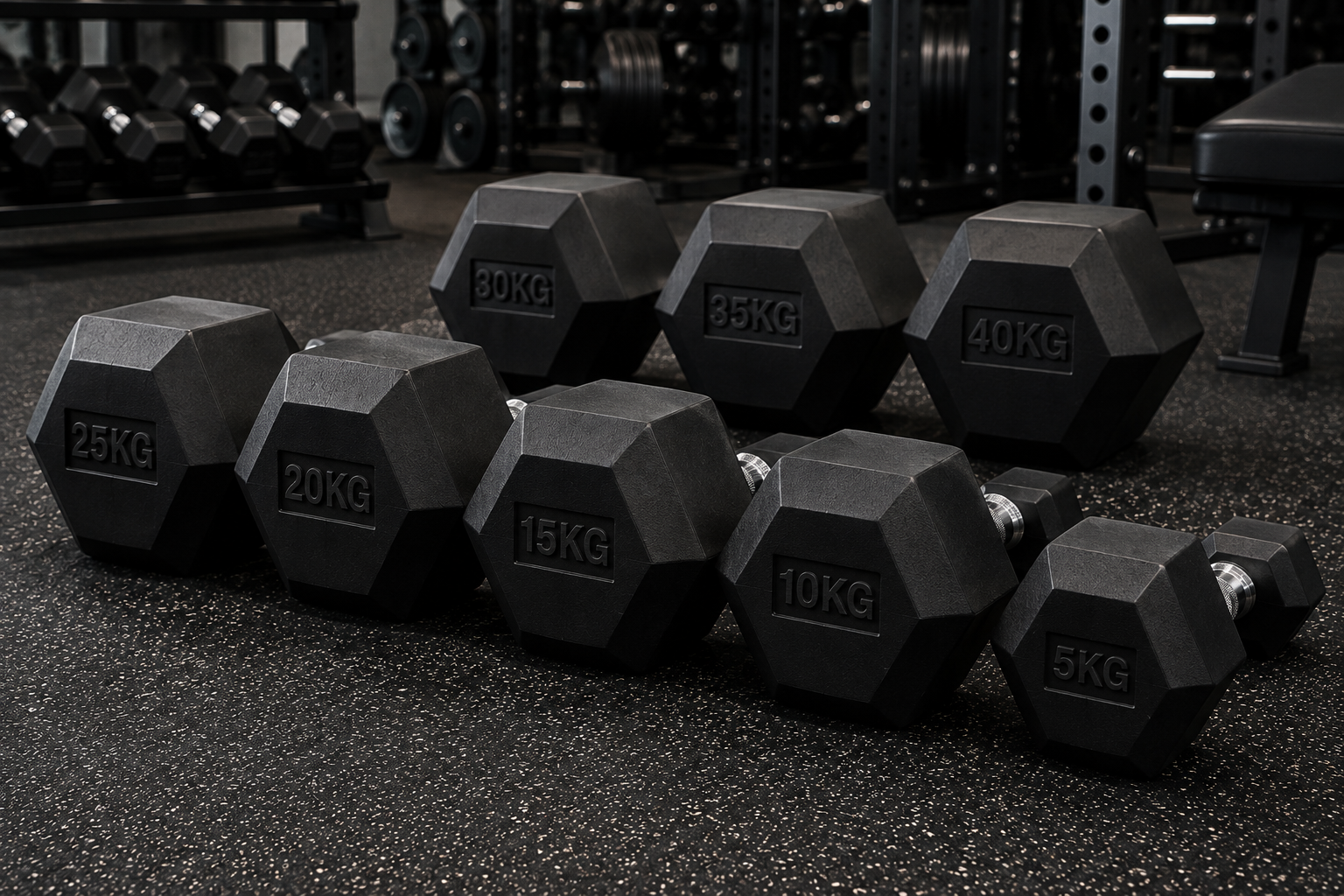
Hexagonal models, on the other hand, feature a flat base composed of multiple sides that prevents rolling when they are placed on the floor. This feature completely changes their use in functional exercises and movements that involve frequent contact with the ground.
Structure and design of hex dumbbells
Hex dumbbells are designed with polygonal-shaped heads, often coated in rubber to improve protection and durability. The flat geometry creates stable support points and allows the athlete to use the dumbbell also as a support element.
This feature is particularly useful in workouts where the dumbbell is placed on the floor between one phase of the movement and the next.
Characteristics of traditional round dumbbells
Round dumbbells have a more classic shape and are often associated with traditional weight training. Their circular surface allows for natural rotations during certain exercises and can be comfortable in various situations.
However, the round shape presents an obvious limitation when the tool is placed on the floor, because it naturally tends to move.
Why the shape of the dumbbell is important
In functional training, every detail of the equipment can influence the execution of the exercise. Unlike traditional bodybuilding, where many movements are performed in a controlled and stable position, functional workouts often include rapid transitions, multi-joint exercises, and frequent changes of position.
The shape of the dumbbell determines how the tool behaves when it comes into contact with the ground. This aspect becomes fundamental in exercises that involve pushing, supporting, changing direction, or explosive movements.
Proper design allows one to focus more on the quality of the athletic gesture, reducing unnecessary distractions and instability.
Impact on the biomechanics of movement
Biomechanics considers the relationship between the human body, applied force, and the tools used. A stable dumbbell allows the athlete to create a more predictable base during certain exercises, improving position control.
This aspect is particularly important when the load is used as a support as well as a simple resistance.
Control and safety during training
The stability of the equipment contributes to the overall safety of the session. A tool that remains still when placed down allows for better management of transitions between one movement and another.
For those who practice high-intensity training, reducing unpredictable elements can improve the quality of the work performed.
Stability in floor exercises
One of the main advantages of hex dumbbells emerges in exercises that involve contact with the floor. Movements such as dumbbell push-ups, renegade rows, dumbbell burpees, and functional variations require a stable base to be performed correctly.
The stability of dumbbells for floor exercises represents an important technical element because it allows the athlete to maintain a safer position during the support phases.
In functional training contexts, where speed and control must coexist, this feature can make a significant difference.
Advantages in pushing exercises
During exercises such as floor presses, a hex dumbbell offers a more stable base compared to a circular model. The athlete can position their hands with greater confidence and focus on force production.
The reduction of involuntary movement of the tool improves the perception of control.
Use in cross-training
Cross-training often combines strength, endurance, and complex movements. In this environment, tools must adapt quickly to different situations.
Dumbbells with a flat base are particularly appreciated because they can be used both as a load and as a support during dynamic exercises.
Hex dumbbells for functional training
Dumbbells for functional training must meet different needs compared to simple weight room tools. They must be resistant, versatile, and suitable for movements that involve the whole body.
The hexagonal shape integrates well into this approach because it allows the dumbbell to be used in multiple ways, increasing the number of available exercises.
For those building a functional gym, choosing equipment consistent with the type of training practiced represents a strategic element.
Support in multi-joint exercises
Multi-joint exercises require coordination between different muscle groups. Stable equipment helps the athlete focus on the correct execution of the movement.
This is particularly useful in programs that combine strength, balance, and motor control.
Adaptability to different protocols
A good functional dumbbell must be able to be used in circuits, metabolic workouts, and strength sessions. The ability to quickly switch from one exercise to another increases the efficiency of the session.
Hex models offer this versatility thanks to their ability to adapt to multiple situations.
Advantages and limitations of round dumbbells
Round dumbbells remain a valid solution used in many contexts. Their traditional shape offers specific advantages, especially in exercises where the dumbbell is kept completely lifted.
The choice should therefore not be based on the idea that one shape is always superior, but on compatibility with the type of training practiced.
Understanding the limitations allows for an informed choice.
Advantages of the circular shape
The round shape allows for fluid and natural movements in many classic exercises. It may be suitable for those who mainly perform isolation exercises or controlled movements.
In environments where equipment is used mainly while standing, this feature may be sufficient.
Limitations in functional exercises
The main limitation of round dumbbells emerges when they are placed on the floor. The possibility of rolling can make some transitions less practical and require more attention.
In high-intensity workouts, this detail can influence rhythm and safety.
Materials, construction, and durability
Beyond the shape, the quality of the material represents a fundamental element in choosing a dumbbell. Tools used in functional training must withstand drops, frequent placement, and intensive use.
Rubber-coated models are very common because they protect both the tool and the training surfaces.
The overall construction determines durability, comfort, and reliability over time.
Hex rubber dumbbells and equipment protection
Hex rubber dumbbells use rubber coatings that improve resistance and reduce impact during placement. This feature is particularly useful in environments where tools are used frequently.
The rubber also contributes to a better acoustic experience and protection of the floor.
Resistance for intensive use
A functional gym requires equipment capable of supporting numerous usage cycles. Sturdy materials and careful construction reduce the need for frequent replacements.
Durability therefore becomes an integral part of the value of the investment.
How to choose dumbbells for your gym
The choice of the ideal dumbbell must start from the analysis of the main type of training. Those who practice exclusively traditional exercises might have different needs compared to those who do cross-training or athletic preparation.
Evaluating space, frequency of use, and goals allows you to identify the most suitable solution.
A correct investment considers both current needs and the possibility of future growth.
Dumbbells for home gym and garage
The best dumbbells for home must combine practicality, durability, and the ability to adapt to different exercises. In a home gym, space is often limited, so every tool must offer the maximum possible value.
The hexagonal shape can be particularly useful when the environment is used for functional training.
Evaluating goals and type of training
Before purchasing, it is important to consider which exercises will be performed most frequently. The choice between hex and round dumbbells must be consistent with the training program.
A preliminary assessment avoids purchasing equipment that is not well-suited to your needs.
Evaluating the role of shape in fitness investment
The shape of a dumbbell is not a simple aesthetic element, but a characteristic that influences use, safety, and versatility. In functional training, where contact with the floor and the speed of transitions are frequent, the geometry of the tool plays an important role.
Hex dumbbells offer specific advantages thanks to their stability and ability to adapt to numerous functional exercises. Round models remain a valid choice in contexts where the priority is the simplicity of traditional movements.
Choosing the most suitable solution means evaluating your training method and investing in equipment capable of supporting goals, safety, and progression over time.
Comments (0)