
Trolley
You have no items in your shopping cart

 Budgets
 Dumbers
 Discs
Discs
 Benches
 Racks and Rigs
 Weights Holders
 Isotonic machines
 Calisthenics
 Cardio
 Kettlebells
 Flooring
 Gym Set
 Accessories
 Combat
 ARTI MARZIALI
 CONTAINER GYM
 Tug-Of-War
 Used Gym Equipment
 PILATES MACCHINARI
 GINNASTICA ARTISTICA
 CAMPI DA PADEL
 Prodotti in Pronta Consegna
 Informazioni
 IRONMAN
 Gift Card
- Donatif
- General information
- 0 I like it
- 0 Views
- 0 comments
- gym flooring, safety flooring, gym safety, shock-absorbing materials
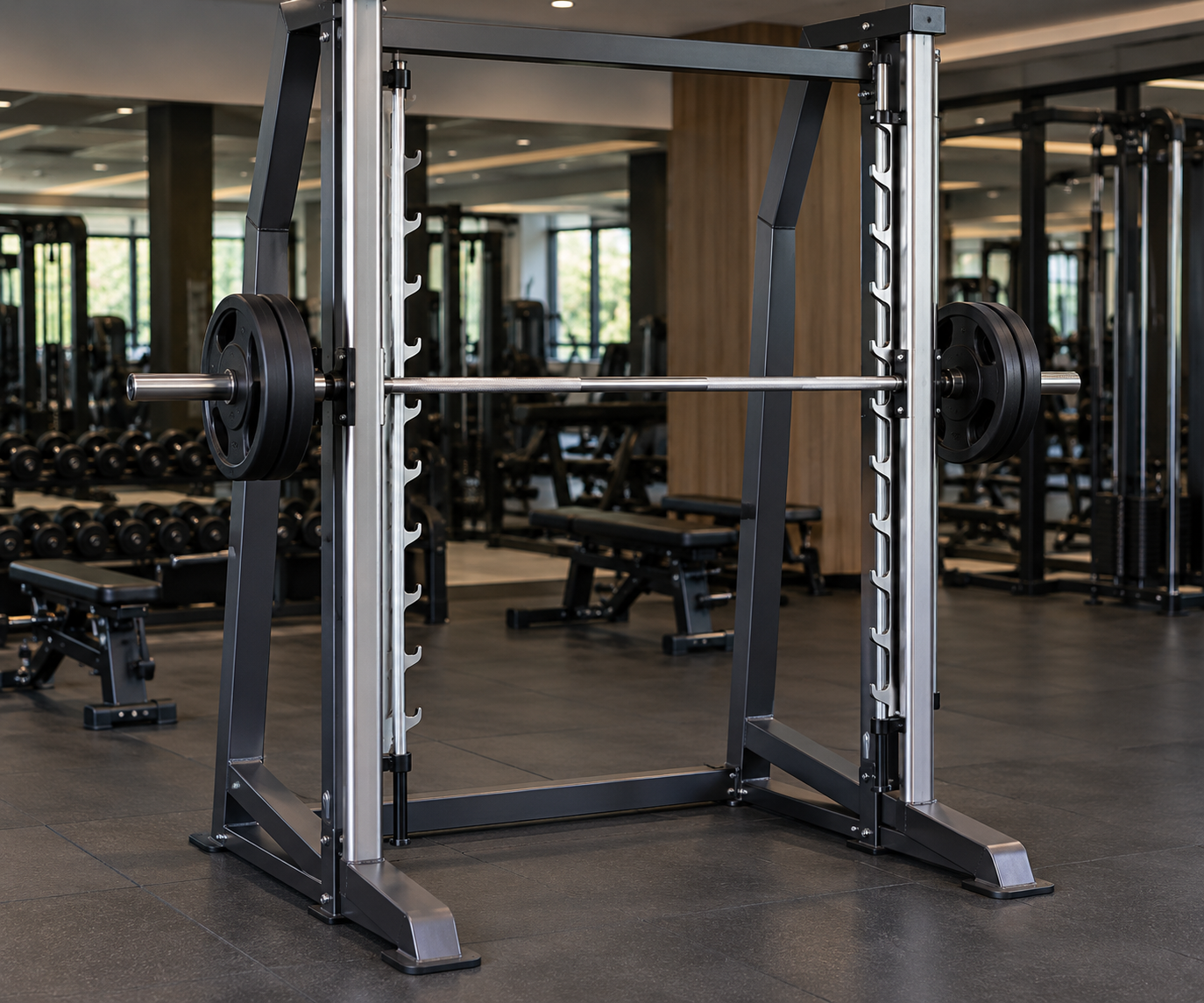
Smith machine safety: how to avoid improper alignment with the guide and incorrect stops
Safety during the use of the smith machine depends primarily on the correct configuration of the equipment before training. An alignment inconsistent with the trajectory of the guides or improper use of the safety stops can compromise the execution of the exercise, increase joint stress, and reduce the margin of protection in case of failure.
Before starting any exercise, it is therefore essential to verify that the guided barbell moves smoothly, that the stopping devices are properly adjusted, and that the body position is compatible with the trajectory imposed by the machine. The operational response consists of performing a systematic check of the equipment and adapting the exercise to the characteristics of the machine, avoiding forcing movements incompatible with the path of the guides.
This guide provides verifiable criteria, practical checks, and operational instructions dedicated to gym owners, personal trainers, and users who want to improve smith machine safety without overlapping with topics dedicated to general operation or equipment choice.
- Quick answer
- What are the main risks
- Safety requirements
- Pre-use checks
- Errors to avoid
- Checks and maintenance
- Evaluating a safe machine
- FAQ
How to quickly check smith machine safety?
Verification must begin with the observation of the entire structure. The frame must be stable, the barbell must move without catching, and the guides must allow uniform sliding along the entire stroke.
The safety stops must be easily adjustable and lock without noticeable play. During a dry run, the barbell must stop exactly at the set point.
If friction, abnormal noise, lateral oscillation, or differences between one guide and the other are perceived during movement, the machine should be checked before use.
What criteria to use?
Check the position of the stops, verify smoothness, ensure that accessories are properly secured, and that the surrounding area is free of obstacles.
Why must alignment be consistent?
Since the trajectory is imposed by the machine, the body must adapt to the path of the guides. Trying to automatically replicate free barbell technique can produce unnatural movements.
What risks do incorrectly adjusted guides and stops entail?
Incorrect alignment can increase stress on the knees, hips, shoulders, and spine during squats, lunges, military press, and bench press.
Stops that are too low can prevent recovering the barbell in case of failure, while stops that are too high can unnecessarily limit the range of motion.
Worn or misaligned guides can compromise sliding fluidity and alter the perception of the load.
During the squat
Incorrect foot positioning relative to the machine's trajectory can force the body into undesirable compensations.
During the bench press
The stops must allow the barbell to be stopped before the load can compress the chest if the athlete fails to complete the repetition.
What safety requirements must be verified?
The machine must comply with the manufacturer's instructions regarding installation, load capacity, maintenance, and intended use.
It is always advisable to consult the user manual and check any references to technical standards applicable to commercial fitness equipment when declared by the manufacturer.
Elements to check include frame stability, proper bolting tightness, the condition of the guides, locking systems, and any counterweights.
Why check load capacity?
The declared maximum capacity must not be exceeded, considering both the weight of the barbell and that of the loaded plates.
Compatible accessories
Exclusively use accessories provided by the manufacturer or compatible with the machine's technical specifications.
What checks to perform before every workout?
A brief checklist reduces the risk of avoidable errors.
Verify that the barbell rotates correctly at the attachment points, that the hooks function without friction, and that the stops are positioned at the appropriate height for the exercise.
Also check that the floor is stable, clean, and adequate for the weight of the machine and the loads used.
Practical checklist
1. Check the guides. 2. Verify the stops. 3. Check the tightness of the structure. 4. Test the travel without load. 5. Adjust the safety devices.
Environmental control
The space around the machine must allow easy access and execution of exercises without interference with other equipment.
What are the most frequently committed errors?
The most widespread error consists of adjusting the stops only after loading the barbell.
Another frequent error is assuming a position identical to that used with the free barbell without considering the machine's different trajectory.
It is also discouraged to use a machine that exhibits irregular sliding without having identified the cause.
Body position
Posture must be adapted to the guided trajectory while always maintaining control of the movement.
Adjustment of stops
The stopping devices must be set before the start of the set and verified with a practical test.
How to keep a smith machine efficient?
Scheduled maintenance helps maintain consistent sliding quality and operational safety.
The guides must be kept clean following the manufacturer's instructions, and fastening systems must be checked periodically.
In a professional gym, it is advisable to document maintenance interventions and record any anomalies detected by operators.
Guide inspection
Check for wear, corrosion, dirt accumulation, and sliding regularity along the entire stroke.
Maintenance log
Documentation of checks facilitates the scheduling of interventions and contributes to equipment management.
How to evaluate a smith machine before purchase?
Gym managers should consider not only price but also build quality, guide fluidity, spare parts availability, and technical assistance.
A machine designed for intensive use generally offers greater reliability over time and helps reduce operational interruptions. To learn more about the category of plate loaded and pin loaded machines, it is useful to compare the technical characteristics of the various available models.
The presence of complete manuals, maintenance instructions, and information on load capacity constitutes an important element in the overall evaluation of the investment.
Quality indicators
Structural rigidity, machining precision, simplicity of stop adjustment, and availability of assistance represent concrete evaluation criteria.
Technical documentation
Before purchase, it is advisable to verify the availability of the manual, maintenance instructions, and technical specifications declared by the manufacturer.
FAQ
Must the stops be adjusted for every exercise?
Yes. The ideal position changes depending on the exercise, the range of motion, and the characteristics of the user.
Is a slightly noisy guide normal?
Unusual noises can indicate dirt, wear, or the need for maintenance. It is advisable to check the cause before continuing with the workout.
Does the smith machine completely replace the free barbell?
No. The two pieces of equipment have different characteristics and require specific usage techniques.
What sources to consult for safety?
The main indications must come from the manufacturer's manual, the technical documentation of the machine, and any references to applicable standards declared by the manufacturer. Maintenance procedures must follow what is provided in the official documentation. The setup of this content follows an answer-first technical structure with verifiable criteria, consistent with the brief provided. :contentReference[oaicite:0]{index=0}
Comments (0)