
Trolley
You have no items in your shopping cart

 Budgets
 Dumbers
 Discs
Discs
 Benches
 Racks and Rigs
 Weights Holders
 Isotonic machines
 Calisthenics
 Cardio
 Kettlebells
 Flooring
 Gym Set
 Accessories
 Combat
 ARTI MARZIALI
 CONTAINER GYM
 Tug-Of-War
 Used Gym Equipment
 PILATES MACCHINARI
 GINNASTICA ARTISTICA
 CAMPI DA PADEL
 Prodotti in Pronta Consegna
 Informazioni
 IRONMAN
 Gift Card
- Donatif
- General information
- 0 I like it
- 63 Views
- 0 comments
- gym flooring, safety flooring, gym safety, shock-absorbing materials
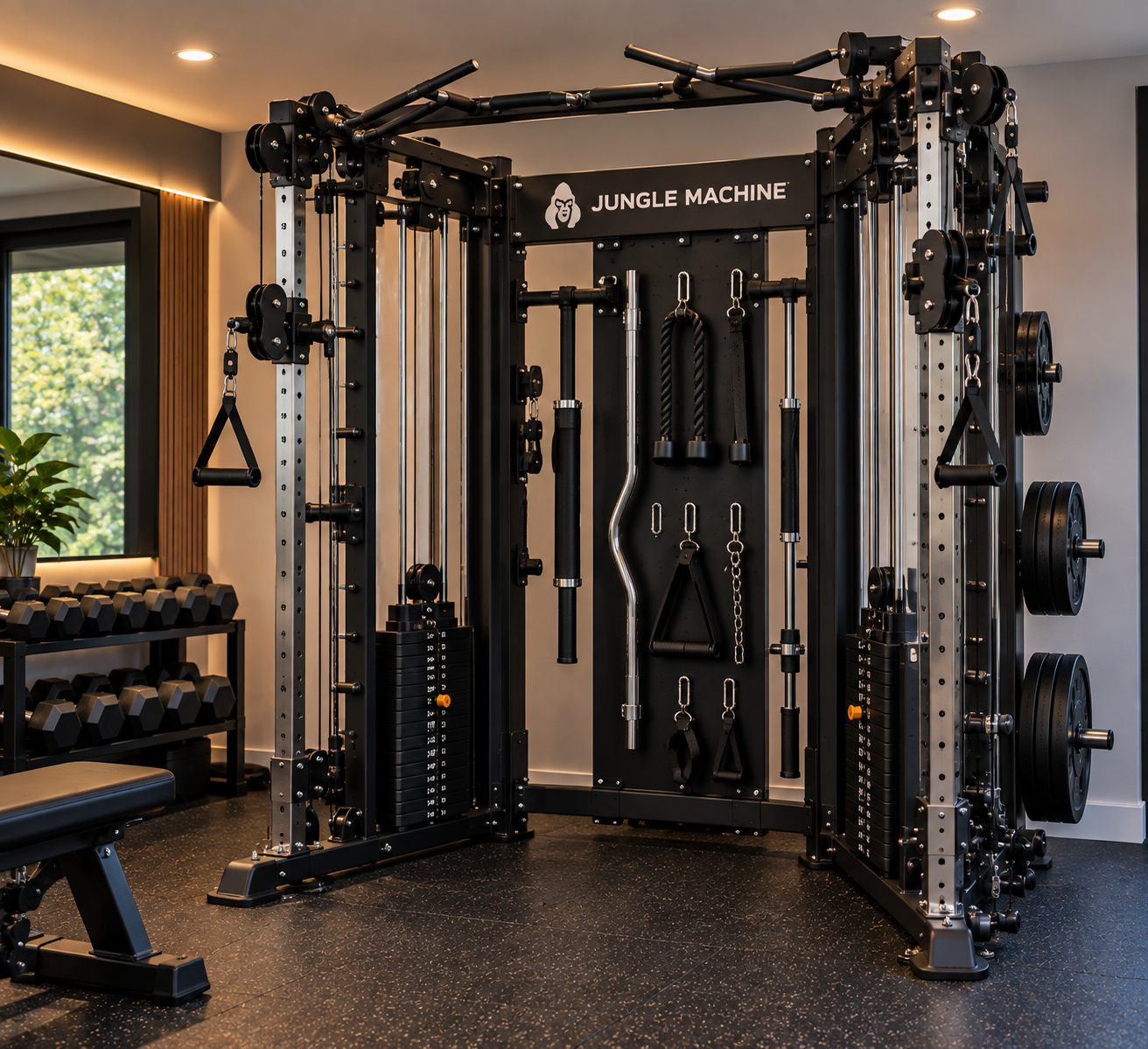
Jungle machine safety: how to prevent user interference and cable issues
The safety of a jungle machine depends on proper space organization, compliance with the manufacturer's instructions, and periodic checks on cables, pulleys, and adjustment systems. Adequate design of the training area helps reduce user interference and keeps the machine efficient over time.
Since a jungle machine is designed to be used simultaneously by multiple people, the main risk involves not only the machine itself but also the interaction between different stations. Unorganized pathways, insufficient space, and a failure to check components can make the equipment less convenient to use.
This guide compiles practical and verifiable criteria for organizing a jungle machine safely, checking the condition of the cables, and planning periodic inspections according to the manufacturer's technical documentation.
- What are the main risks?
- How to avoid user interference
- How to check cables and pulleys
- Pre-use checklist
- Maintenance and periodic inspections
- Errors to avoid
- Inspection table
- How to maintain high safety standards
What are the main risks?
The main critical issues concern interference between users, crossing operating areas, cable wear, incorrect adjustments, and a lack of maintenance for moving components.
A jungle machine is frequently used simultaneously by multiple people and therefore requires spatial organization that allows exercises to be performed without obstructing other stations.
The presence of accessories left in the operating area can also affect the fluidity of movements and the management of the machine.
Why does user interference occur?
Interference can stem from an inadequate layout, transit routes crossing work areas, or the simultaneous use of accessories requiring more space.
Why analyze training flows?
The distribution of users across different stations helps identify potential critical points and better organize the weight room.
How to properly organize space?
The layout should allow access to all stations while keeping pathways clear and easily identifiable.
It is advisable to verify that each station has the operating space specified by the manufacturer and that main walkways do not cross work areas.
Proper distribution of equipment also promotes the management of simultaneous training during peak hours.
How to organize pathways?
Pathways should be linear and allow users to reach different stations without interfering with anyone performing an exercise.
How much does the footprint matter?
The machine's footprint must be evaluated considering both the dimensions of the equipment and the space required during users' movements.
How to check cables and pulleys?
Cables represent components subject to wear and should be checked regularly according to the manufacturer's instructions.
Visual inspection should check for any signs of deterioration, abrasions, deformations, damaged strands, or anomalies at connection points.
Pulleys and sliding systems should also be checked by verifying movement fluidity and the absence of unusual noise.
What signs should be observed?
Evident wear, damaged coatings, deformations, or irregular sliding are elements that require technical verification according to the machine's manual.
Why check pulleys?
A pulley that is not working properly can affect the fluidity of the cable system and requires an inspection compliant with the manufacturer's instructions.
What checks should be performed before use?
Before opening the gym or starting the session, it is useful to perform a visual check of the machine.
Checking the integrity of the cables, the correct positioning of the weight stack selectors, the stability of the structure, and the absence of loose components helps keep the equipment efficient.
Accessories used with the machine should also be checked before use.
Why perform a visual check?
A quick inspection makes it possible to promptly identify obvious anomalies before using the machine.
Which components should be verified?
Cables, pulleys, load selectors, attachment points, accessories, and adjustment systems represent the main elements to check.
How to plan maintenance?
Routine maintenance includes cleaning, periodic checks, checking moving components, and recording performed interventions.
The frequency of inspections depends on the intensity of machine usage and the indications provided in the manufacturer's manual.
To learn more about the different types of dedicated equipment, you can consult the isotonic machines category.
Why maintain a logbook?
Recording checks and maintenance facilitates the planning of subsequent interventions and the monitoring of the machine's condition.
Why check replacement parts?
The availability of replacement components can reduce downtime and facilitate scheduled maintenance.
What errors should be avoided?
Common errors include placing the machine in transit areas, failing to check cables, and using worn components.
It is also advisable to avoid modifications not foreseen by the manufacturer and to neglect scheduled checks.
The presence of mobile equipment or accessories left in the operating area can also hinder the correct use of the machine.
Why avoid congested areas?
An orderly distribution of equipment promotes user movement and reduces the potential for interference between different stations.
How much does the manual matter?
The manufacturer's instructions represent the primary reference for installation, use, checks, and maintenance of the machine.
Compact inspection table
| Element | Recommended check |
|---|---|
| Cables | Wear, abrasions, and integrity |
| Pulleys | Sliding and noise |
| Weight stacks | Selectors and correct insertion |
| Structure | Stability and fasteners |
| Layout | Operating space and pathways |
| Accessories | Integrity and correct positioning |
This table represents an operational checklist useful for periodic checks and does not replace the procedures established by the manufacturer.
All checks must be performed by referring to the official technical documentation of the machine.
What documents should be consulted?
Installation, use, and maintenance manuals provided by the manufacturer constitute the primary source for learning control methods, maintenance schedules, and component replacement.
What aspects should be evaluated during design?
Number of stations, operating space, user pathways, component accessibility, and ease of maintenance represent fundamental criteria for organizing a jungle machine efficiently.
How to maintain high safety standards?
The safety of a jungle machine depends on the combination of careful design, periodic checks, and use compliant with the manufacturer's instructions. Planning regular checks on cables, keeping the training area tidy, and monitoring the condition of components helps improve the daily management of the equipment.
Before purchasing, it is also useful to evaluate maintenance simplicity, component accessibility, spare parts availability, and the completeness of technical documentation. These elements affect the management of the machine throughout its entire lifecycle.
FAQ
Do cables need to be checked every day? It is advisable to perform frequent visual checks and follow the maintenance schedule provided by the manufacturer.
How to reduce user interference? Through a correct layout, orderly pathways, and adequate operating space around the stations.
When should machine use be stopped? In the presence of damaged cables, worn components, or obvious anomalies, use should be suspended until technical verification.
What is the main source for safety checks? The manufacturer's installation, use, and maintenance manual represents the main reference for verifications, checks, and component replacement.
Comments (0)