
Trolley
You have no items in your shopping cart

 Budgets
 Dumbers
 Discs
Discs
 Benches
 Racks and Rigs
 Weights Holders
 Isotonic machines
 Calisthenics
 Cardio
 Kettlebells
 Flooring
 Gym Set
 Accessories
 Combat
 ARTI MARZIALI
 CONTAINER GYM
 Tug-Of-War
 Used Gym Equipment
 PILATES MACCHINARI
 GINNASTICA ARTISTICA
 CAMPI DA PADEL
 Prodotti in Pronta Consegna
 Informazioni
 IRONMAN
 Gift Card
- Donatif
- General information
- 0 I like it
- 10 Views
- 0 comments
- gym flooring, safety flooring, gym safety, shock-absorbing materials
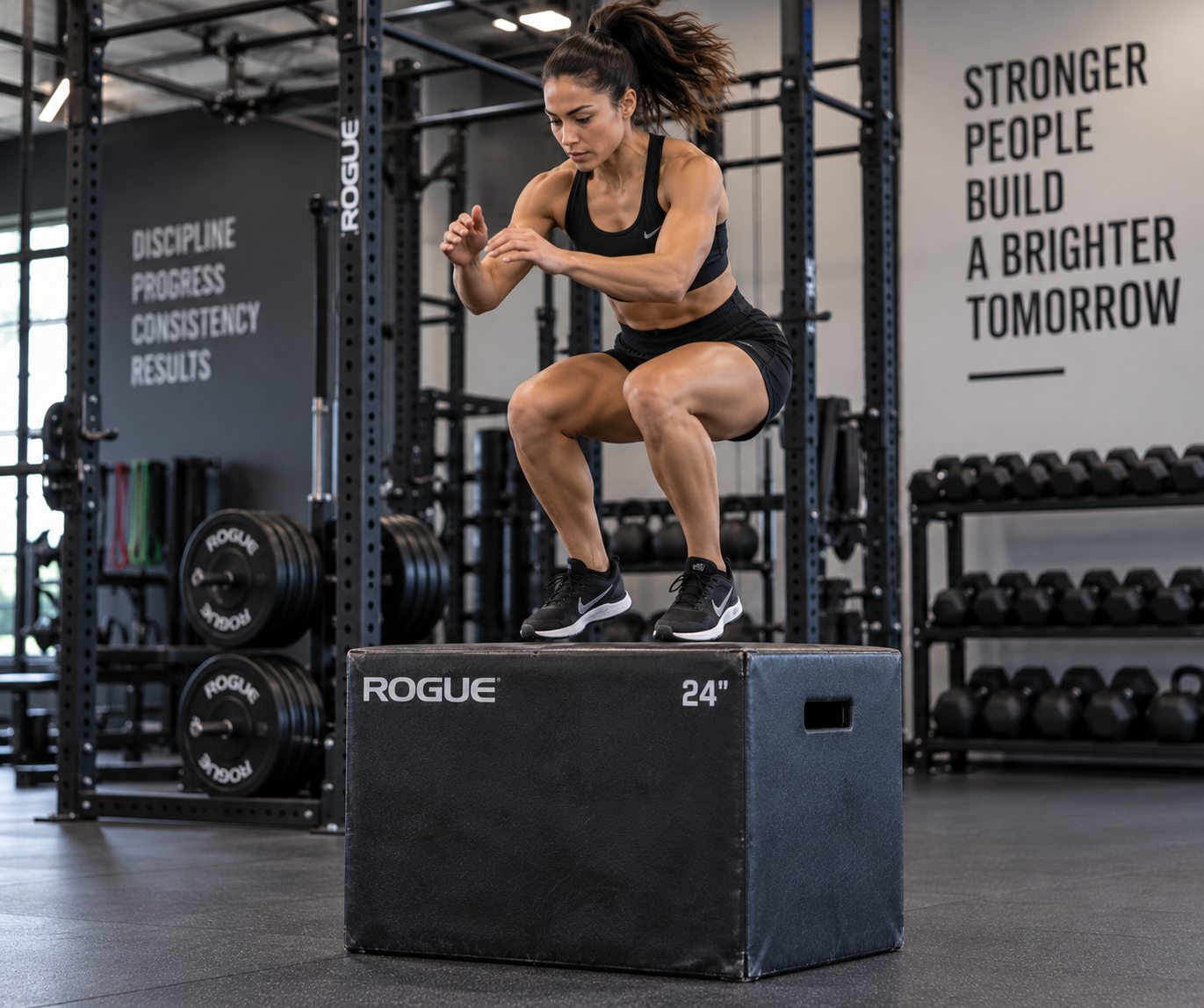
How to use the plyo box safely: a practical guide for every level
Correctly using a plyo box means combining proper technique, equipment in good condition, and a suitable training environment. Safety does not depend exclusively on the box but also on the user's preparation, the choice of height, and movement control during every repetition.
Plyometric exercises generate high forces during the push-off and landing phases. For this reason, it is important to follow a coherent progression, avoid improvisation, and always check the equipment's stability before starting the session.
This guide explains how to use the plyo box safely, what checks to perform, how to correctly execute the most common exercises, and which mistakes to avoid to reduce the risk of accidents during training.
- Quick answer
- What using the plyo box safely means
- How to correctly use the plyo box
- Practical criteria before starting
- Guidelines for the most common exercises
- Mistakes to avoid
- Safety checks during training
- How to evaluate the most suitable plyo box
Quick answer
To use the plyo box safely, it is necessary to check the stability of the equipment, choose a height compatible with one's technical level, perform controlled movements, and use the box exclusively according to the manufacturer's instructions. Each exercise must be performed maintaining balance and control in both the jump phase and the landing.
A gradual progression allows you to improve technique and efficiency without unnecessarily increasing the risk of errors.
The manufacturer's specific instructions always represent the primary reference for assembly, use, and maintenance.
Proceed in stages
Increasing height and difficulty only after acquiring a stable technique allows you to maintain greater control of the movement.
Prioritize control
The goal is to perform each repetition with precision rather than immediately seeking maximal performance.
What using the plyo box safely means
Safe use of the plyo box consists of employing the equipment while respecting its structural characteristics and maintaining conditions that allow for controlled execution of the exercises.
This includes preventive checking of the structure, choosing the most suitable height, and organizing the training space.
Physical preparation and knowledge of the technical movement also decisively contribute to overall safety.
Equipment in good condition
The box must be stable, free of evident damage, and positioned on an even surface.
Suitable environment
The surrounding area must be free of obstacles that could interfere with jumping, landing, or descending.
How to correctly use the plyo box
Before starting, it is advisable to assume a stable position with feet firmly planted on the ground and gaze directed toward the landing surface.
During the jump, the movement must be fluid and controlled, avoiding unexpected rotations or changes in direction.
After landing, it is important to regain balance before stepping down from the box or starting a new repetition.
Jump phase
The push-off must be coordinated while maintaining body control to reach the upper platform without sudden movements.
Landing phase
The landing must take place with stable and complete contact on the box's surface, avoiding arriving too close to the edges.
What checks to perform before starting
A quick check of the equipment takes only a few minutes but allows you to identify any anomalies before training.
It is useful to check the cleanliness of the surface, the stability of the box, and the absence of damaged or loose components.
For those wishing to complete their training area, it is possible to consult the section dedicated to gym accessories by choosing products compatible with their workspace.
Equipment verification
Make sure that the box does not wobble and that the top surface is clean and dry before starting any exercise.
Area verification
The surrounding space must allow for complete movement without interference with other equipment or people.
Guidelines for the most common exercises
The plyo box can be used for box jumps, step-ups, controlled climbs, and other athletic preparation drills.
Each exercise requires a height appropriate to the user's capabilities and a technique consistent with the training goals.
Difficulty should increase progressively without simultaneously modifying multiple variables such as height, speed, and volume of work.
Box jump
During the box jump, it is important to focus on landing quality while maintaining control of the final position.
Step up
The step-up is also a useful exercise for developing coordination and strength with a generally lower level of complexity compared to explosive jumps.
Which mistakes are best avoided
One of the most common mistakes is immediately choosing a height superior to one's technical capabilities.
Even performing repetitions with excessive haste can compromise landing precision and movement control.
Training with a worn box or one placed on an unsuitable surface unnecessarily increases operational risk.
Choosing an appropriate height
The plyo box heights must be selected based on experience, technique, and the type of exercise planned.
Ignoring fatigue
When execution quality decreases, it is advisable to stop or modify the session rather than continuing with poorly controlled movements.
What checks to maintain during training
Safety does not end with initial preparation but requires continuous attention throughout the entire session.
Any anomalous movements of the box, loss of grip, or changes in the environment must be evaluated before proceeding.
The conditions of the anti-shock flooring also affect the stability of the equipment and the user.
Monitor the box
If the box moves or shows wobbling, it is advisable to stop the exercise and check its conditions.
Maintain concentration
Adequate pauses between sets help preserve technical precision and movement control during plyometric exercises.
How to evaluate the most suitable plyo box
Equipment selection should consider intended use, manufacturing quality, stability, materials, and ease of maintenance, in addition to the characteristics of the planned exercises.
Before purchasing, it is useful to compare dimensions, available configurations, possibilities for progressive use, and compatibility with the training space, avoiding basing the decision solely on price.
When applicable, it is advisable to consult the manufacturer's manual and any references to relevant technical standards for sports equipment, always verifying the instructions regarding assembly, use, maintenance, and limits of use.
Elements to compare
Materials, stability, quality of finishes, ease of inspection, and intended use represent useful criteria in evaluating a new plyo box.
Use in sports facilities
In gyms and fitness centers, it is advisable to integrate periodic equipment checks and documented inspection procedures to maintain constant safety standards during intensive use.
Comments (0)