
Trolley
You have no items in your shopping cart

 Budgets
 Dumbers
 Discs
Discs
 Benches
 Racks and Rigs
 Weights Holders
 Isotonic machines
 Calisthenics
 Cardio
 Kettlebells
 Flooring
 Gym Set
 Accessories
 Combat
 ARTI MARZIALI
 CONTAINER GYM
 Tug-Of-War
 Used Gym Equipment
 PILATES MACCHINARI
 GINNASTICA ARTISTICA
 CAMPI DA PADEL
 Prodotti in Pronta Consegna
 Informazioni
 IRONMAN
 Gift Card
- Donatif
- General information
- 0 I like it
- 77 Views
- 0 comments
- gym flooring, safety flooring, gym safety, shock-absorbing materials
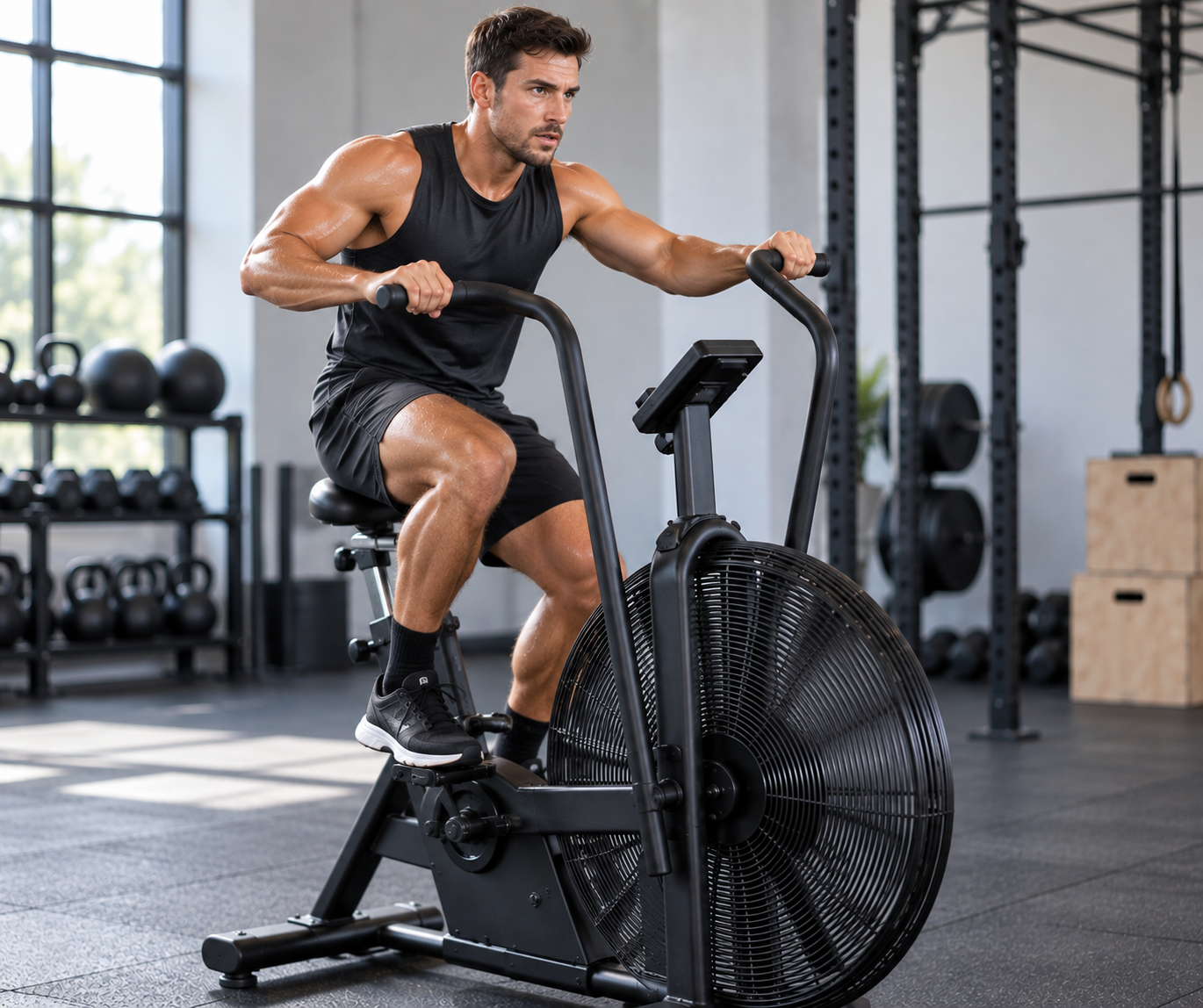
How to choose an air bike: a guide to the truly important criteria
How to choose an air bike means evaluating technical characteristics, build quality, and compatibility with your intended use. The best choice does not depend on a single parameter, but rather on the balance between robustness, adjustments, ease of maintenance, available space, and expected workout intensity.
An air bike can be used in home gyms, commercial gyms, and facilities dedicated to functional training. Each context presents different needs and requires a specific evaluation of the machine's features, avoiding comparisons based solely on price or declared performance.
Before purchasing, it is therefore advisable to define training objectives, the number of users, frequency of use, and the space actually available. These elements make it easier to select a solution consistent with your needs and simpler to manage over the long term.
- Which specifications really matter?
- How to choose based on usage?
- Why are adjustments important?
- How much space is needed?
- How to evaluate maintenance?
- Compatibility with gyms and home gyms
- Purchase mistakes to avoid
- How to evaluate the investment
Which specifications really matter?
The choice should start with an analysis of the machine's structure, the quality of the materials, and the reliability of the mechanical components. Frequent use requires a construction designed to support repeated sessions while maintaining stability and operating fluidity.
Elements to check include the quality of the transmission, the saddle and handlebar adjustment system, the robustness of the frame, and ease of access to components subject to maintenance.
The display, adjustment possibilities, and ease of use can also affect the overall experience, especially when the machine is shared among different users.
Frame robustness
A stable structure helps maintain comfort and control during high-intensity workouts, limiting vibrations and unwanted movement.
Fan system
The fan represents one of the characteristic elements of the air bike and must be designed to guarantee continuous operation even under intensive use.
How to choose based on usage?
The needs of a commercial gym are different from those of a home gym. A facility open to the public will prioritize robustness, simplicity of adjustment, and scheduled maintenance, whereas home use may place greater importance on footprint and frequency of use.
It is also useful to define whether the machine will be used primarily for warm-ups, metabolic circuits, interval training, or continuous cardiovascular workouts.
A correct analysis of the intended use prevents over-dimensioned purchases or solutions poorly suited to actual needs.
Home use
For a home gym, it is important to check available space, simplicity of adjustment, and practicality of routine maintenance operations.
Professional use
In a gym or a functional box, it is advisable to focus on machines designed to support numerous hours of daily use.
Why are adjustments important?
An air bike intended for multiple users should allow for quick and intuitive adjustments of the saddle and handlebars. This makes it easy to adapt the position to the athlete's physical characteristics without interrupting the workout rhythm.
Before purchasing, it is useful to verify the simplicity of the adjustment systems and the presence of mechanisms that allow for stable locking of the selected settings.
Adjustment procedures must always be carried out following the instructions in the manufacturer's manual.
Saddle adjustment
Correct adjustment helps maintain a comfortable position during the workout and facilitates the repeatability of sessions.
Handlebar adjustment
The system should allow simple and quick adjustments when the machine is shared among multiple users.
How much space is needed?
To evaluate installation, you must consider not only the footprint of the machine but also the operating space needed to get on, get off, and correctly use the moving grips.
The layout should guarantee clear pathways and allow for any maintenance operations without having to continuously move the equipment.
Before installation, it is advisable to check the dimensions and clearances indicated by the manufacturer of the specific air bike.
Space organization
An orderly layout improves user flow and facilitates the management of the cardio area.
Flooring
A stable and suitable surface helps preserve the subfloor and increases the machine's stability. To explore dedicated solutions, you can consult the cardio machines category.
How to evaluate maintenance?
A machine that is simple to inspect and clean reduces downtime and facilitates routine management, especially in professional facilities.
Before purchasing, it is appropriate to check the availability of spare parts, the clarity of the maintenance schedule, and the accessibility of components most subject to wear.
Maintenance operations must be performed according to the instructions provided in the manufacturer's technical documentation.
Routine cleaning
Periodic cleaning helps keep mechanical parts and contact surfaces efficient.
Scheduled checks
Periodic inspections allow for the prompt identification of any anomalies before they compromise the machine's operation.
How to check compatibility with your space?
The choice of the air bike should be consistent with the overall design of the gym or home gym. It is useful to evaluate the number of users, the arrangement of other equipment, and the expected frequency of use.
A machine well-integrated into the layout improves the fluidity of workouts and makes daily management of the cardio area easier.
Compatibility also concerns the possibility of expanding the facility's equipment in the future without having to completely redesign the spaces.
Possibility of expansion
Leaving margins for possible future integrations makes the project more flexible over time.
Flow management
The layout should avoid interference with other equipment present in the workout area.
What mistakes should be avoided?
One of the most frequent mistakes is choosing a machine based solely on price without evaluating build quality, maintenance, and the real intended use.
Another critical issue involves underestimating the necessary operating space or purchasing a machine inconsistent with the expected level of use.
It is also advisable to avoid comparisons based solely on commercial features without analyzing the technical documentation and the manufacturer's instructions.
Evaluating only the price
The initial cost represents only one of the elements to consider when choosing an air bike.
Neglecting technical documentation
Manuals and technical data sheets constitute the main reference for verifying characteristics, adjustments, and maintenance.
How to evaluate the investment?
Choosing an air bike means evaluating overall robustness, build quality, simplicity of adjustment, maintenance, and compatibility with your training project. A machine consistent with the context of use offers greater operational continuity and helps reduce extraordinary interventions over time.
Before purchasing, it is advisable to compare technical specifications, verify overall dimensions, analyze the maintenance schedule, and consult the manufacturer's documentation. For adjustments, installation, and maintenance, it is appropriate to refer to the technical manuals of the specific machine, avoiding basing decisions exclusively on commercial features or uncontextualized data.
Comments (0)