
Trolley
You have no items in your shopping cart

 Budgets
 Dumbers
 Discs
Discs
 Benches
 Racks and Rigs
 Weights Holders
 Isotonic machines
 Calisthenics
 Cardio
 Kettlebells
 Flooring
 Gym Set
 Accessories
 Combat
 ARTI MARZIALI
 CONTAINER GYM
 Tug-Of-War
 Used Gym Equipment
 PILATES MACCHINARI
 GINNASTICA ARTISTICA
 CAMPI DA PADEL
 Prodotti in Pronta Consegna
 Informazioni
 IRONMAN
 Gift Card
- Donatif
- General information
- 0 I like it
- 510 Views
- 0 comments
- gym flooring, safety flooring, gym safety, shock-absorbing materials
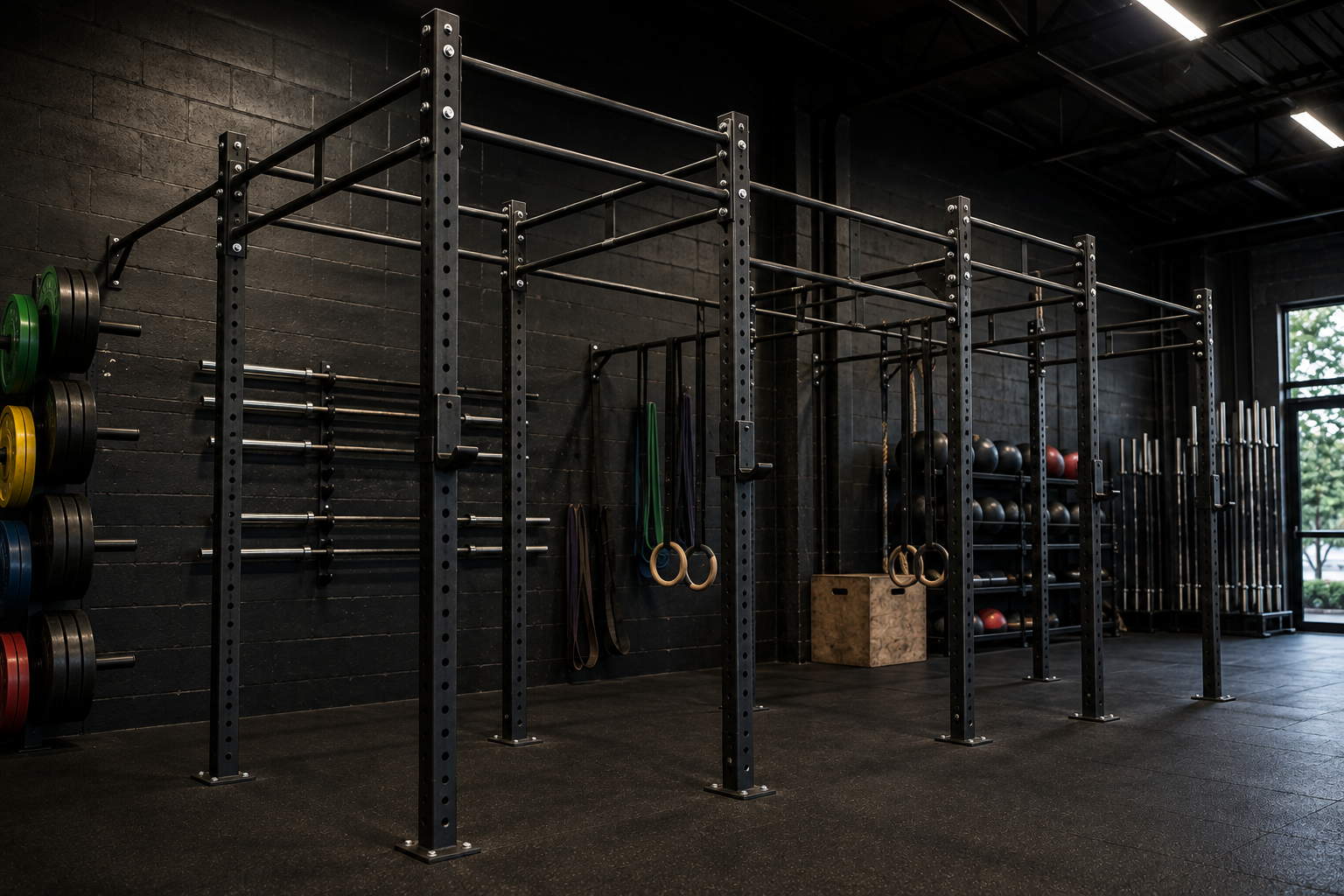
How to Choose a Pull-Up Rack for Low Ceilings or Attics
Creating a home gym in an attic or an environment with limited height is absolutely possible, provided you choose the right equipment. A low-ceiling pull-up rack designed correctly allows you to train safely even when vertical space is limited, without compromising on training quality. Many enthusiasts give up on the idea of installing a professional station because they believe a low ceiling makes it impossible to perform pull-ups and other fundamental exercises, but in most cases, the problem is not the available space, but the choice of an unsuitable structure.
Modern homes have very different configurations: attics with sloped ceilings, taverns, basements, garages, and rooms built into the loft require different design solutions. In these contexts, a standard rack might be too tall or prevent the correct execution of exercises. Fortunately, there are modular structures, customizable configurations, and bespoke solutions that allow you to make the most of every available centimeter.
In this guide, we will see how to choose the most suitable rack for low ceilings, which measurements to evaluate before purchasing, how to design your home gym layout, and which features to prioritize to get the most out of it even when the height is not that of a professional gym.
- Measuring the space correctly
- What is the minimum height required
- Training in an attic
- When to choose a bespoke solution
- Organizing an efficient gym
- The advantages of modularity
- Errors to avoid
- Why invest in a rack designed for your space
Measuring the available space correctly
Before choosing any structure, it is essential to take precise measurements of the environment. The clear height is not the only parameter to consider: you must also evaluate the presence of beams, skylights, roof slopes, systems, and any element that could limit movement during exercises.
An accurate measurement allows you to identify the best point to install the rack, taking advantage of the areas with the greatest useful height and leaving enough space to move safely.
It is advisable to also check the available lateral and frontal space, so you can perform exercises with a barbell, resistance bands, rings, or other accessories without limitations.
The truly important measurements
In addition to the ceiling height, it is useful to measure the width, depth, and distance from obstacles in the room to correctly design the station.
Leaving a safety margin
A structure should never be installed right up against the ceiling. A small margin facilitates assembly, improves ventilation, and makes using accessories easier.
What is the minimum height required
One of the most frequent questions concerns the minimum pull-up height. There is no value that applies to everyone, because it depends on the user's height, arm length, the type of exercises performed, and the rack configuration.
For traditional pull-ups, it is important to be able to hang completely without your feet touching the floor. In particularly low environments, it is still possible to use variations with bent legs or set up platforms that allow for better space management.
Exercises such as muscle-ups, hanging leg raises, or ring work also require more height than simple pull-ups, which is why it is appropriate to plan your choice based on your training program.
Only pull-ups or also skills?
Those who wish to train exclusively for pull-ups have different needs than those who intend to practice advanced calisthenics or ring gymnastics.
Adapting exercises to the space
In some environments, it is possible to slightly modify the technique or choose alternative variations without compromising the effectiveness of the training.
Training in an attic
An attic gym often features sloped ceilings that can be exploited intelligently. Identifying the highest point of the room allows you to place the rack in the most favorable position, leaving areas with less height for other exercises or equipment storage.
Attics also offer the advantage of being generally dedicated environments, where you can create a permanent gym without interfering with other areas of the house.
With proper organization, it is possible to integrate a rack, bench, barbell, and accessories even in seemingly complex rooms, obtaining an extremely functional home gym.
Exploiting the roof slope
Correctly positioning the rack relative to the ceiling slope allows you to recover precious centimeters of useful height.
Dividing training areas
The lower areas can host floor exercises, stretching, mobility, or dedicated storage for accessories.
When to choose a bespoke solution
In some cases, a standard structure cannot make the most of the environment's characteristics. A bespoke pull-up bar allows you to adapt dimensions and configuration to the user's real needs.
Customized solutions are particularly useful when the room has sloped ceilings, niches, beams, or architectural constraints that make a product with fixed measurements ineffective.
A bespoke project also allows for future gym expansions, integrating accessories and modules without compromising space optimization.
Designing around the house
Customizing the height, depth, and configuration of the structure allows you to make the most of any environment, even when it has particular characteristics.
The value of design
Analyzing the available space beforehand helps avoid unsuitable purchases and improves the final result of the home gym.
Organizing an efficient gym
A good home gym does not depend solely on the rack. The arrangement of the equipment directly affects the quality of training and freedom of movement.
It is advisable to keep the front area of the structure clear, provide a space dedicated to floor exercises, and place accessories and weights in an orderly manner to reduce movement during sessions.
Lighting, ventilation, and the presence of non-slip surfaces also contribute to creating a safer and more pleasant environment.
Every centimeter counts
Designing the layout before purchasing allows you to obtain a more efficient gym without increasing the overall footprint.
An orderly gym
Correctly organizing accessories and equipment improves daily practicality and encourages training consistency.
The advantages of modularity
One of the main advantages of a modular system is the ability to adapt to evolving needs without completely replacing the structure.
New accessories, barbell supports, rings, pulleys, or other components can be added over time while keeping the main structure unchanged.
This flexibility is particularly valuable when space is limited, because it allows you to maximize functionality without significantly increasing the footprint.
A structure that grows
Modularity allows you to gradually transform a simple pull-up station into a complete home gym.
More exercises in the same space
Interchangeable accessories greatly expand training possibilities while keeping the structure compact.
Errors to avoid
One of the most common mistakes is purchasing a rack based solely on the dimensions reported in the technical sheet without considering the height actually needed to perform the desired exercises.
Another error concerns underestimating modularity. Choosing a rigid, non-expandable structure can limit the future growth of the home gym.
Finally, neglecting the layout design often leads to poor use of the available space, reducing comfort and safety during workouts.
Measuring only once
Checking the room dimensions multiple times reduces the risk of incompatibility between the structure and the room.
Thinking about the future
A solution designed to evolve allows you to expand the gym without having to start from scratch.
Why invest in a rack designed for your space
Having a low ceiling or an attic does not mean giving up on a professional home gym. With proper design and the choice of an adequate structure, it is possible to effectively exploit even non-standard environments, maintaining high levels of safety and training quality.
Preventive space assessment, the ability to customize dimensions, and the use of modular systems allow you to transform any room into an efficient station that is ready to grow over time along with your goals.
For those who wish to create a home gym perfectly integrated with their home, choosing a professional Donatif pull-up rack designed to adapt to the characteristics of the space represents an investment that combines functionality, build quality, and maximum training freedom.
Comments (0)