
Trolley
You have no items in your shopping cart

 Budgets
 Dumbers
 Discs
Discs
 Benches
 Racks and Rigs
 Weights Holders
 Isotonic machines
 Calisthenics
 Cardio
 Kettlebells
 Flooring
 Gym Set
 Accessories
 Combat
 ARTI MARZIALI
 CONTAINER GYM
 Tug-Of-War
 Used Gym Equipment
 PILATES MACCHINARI
 GINNASTICA ARTISTICA
 CAMPI DA PADEL
 Prodotti in Pronta Consegna
 Informazioni
 IRONMAN
 Gift Card
- Donatif
- General information
- 0 I like it
- 518 Views
- 0 comments
- gym flooring, safety flooring, gym safety, shock-absorbing materials
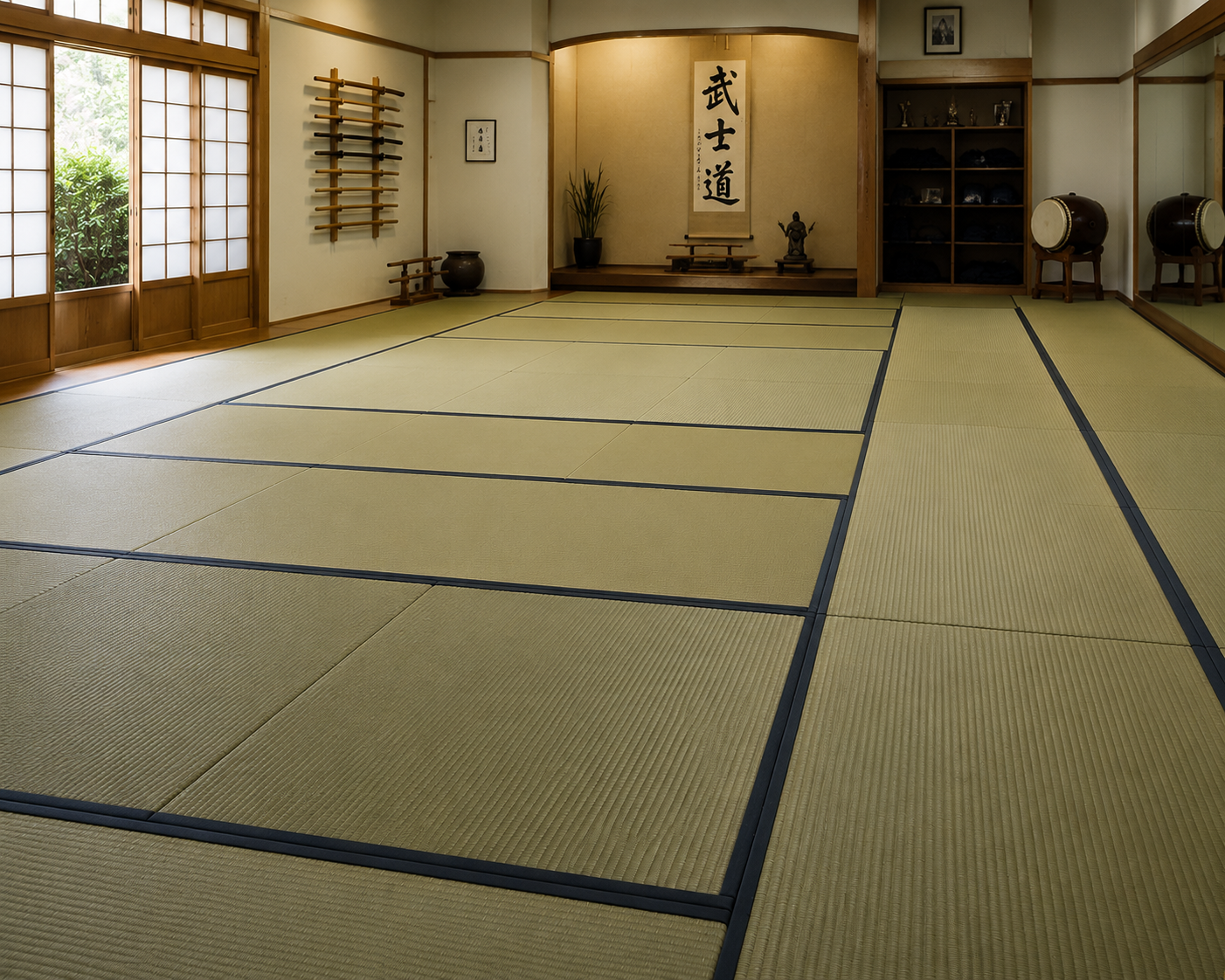
Interlocking vs. Traditional Tatami: A Guide for Martial Arts Schools
Choosing martial arts gym tatami is one of the most important decisions for those planning a new dojo or looking to renovate an existing facility. The flooring does not only influence the aesthetics of the room, but it directly impacts the safety of the athletes, the quality of training, the durability of the facility, and the overall experience of practitioners and instructors.
Many masters focus their attention exclusively on the thickness of the tatami, considering it the main indicator of quality. In reality, there are numerous other factors to consider: foam density, impact absorption capacity, stability during movement, installation system, surface finish, maintenance, and long-term durability. An apparently similar product can offer very different performance depending on the discipline practiced.
In this guide, we analyze the main differences between interlocking (puzzle) tatami and traditional tatami, comparing their advantages, limitations, and applications for Judo, Karate, MMA, Brazilian Jiu Jitsu, Taekwondo, and other martial arts, helping school managers choose the most suitable solution for their project.
- The main types of tatami
- Interlocking tatami: features and advantages
- Traditional tatami: when to choose it
- Choosing based on the discipline
- Technical criteria to evaluate
- The most common mistakes in choosing
- Durability and maintenance
- How to evaluate the investment
The main types of tatami
In the professional market, there are two large families of products: traditional tatami and modern interlocking tatami. Although both are designed to ensure a safe surface for training, the construction technologies and methods of use are profoundly different.
Traditional tatami mats derive from Japanese culture and are now made with modern materials, while maintaining a different installation system compared to modular models. Puzzle tatami mats, on the other hand, are designed to offer practicality, modularity, and rapid installation.
The choice does not depend exclusively on the available budget but above all on the type of intended use, the frequency of training, and the need to modify or expand spaces over time.
The evolution of modern tatami
In recent years, technical materials have progressively replaced traditional solutions, offering greater durability, better mechanical performance, and significantly simpler maintenance.
What goals the flooring must meet
A good tatami must protect athletes during falls, offer stability in movements, ensure adequate grip, and maintain its characteristics even after years of intensive use.
Interlocking tatami: features and advantages
Puzzle tatami mats represent one of the most widespread solutions in martial arts schools today thanks to their extreme versatility. Each element connects to the others via an interlocking system that allows for rapid installation without the use of permanent glues.
This modularity makes it easy to replace any damaged elements, modify the available surface, or transport the flooring for events and competitions.
The quality of the materials used significantly influences the durability of the system, which is why it is important to choose professional products designed for intensive use.
Advantages of the 4cm puzzle tatami
The 4 cm thickness represents one of the most common configurations for disciplines that involve frequent throws and falls, offering a good compromise between protection, stability, and comfort.
Rapid installation
One of the main qualities of interlocking tatami is the speed of assembly. A dojo can be set up in a short time and, if necessary, easily modified without invasive interventions on the existing structure.
Traditional tatami: when to choose it
Traditional tatami mats continue to be a popular choice, especially in some disciplines that wish to maintain a strong bond with Japanese cultural tradition.
Modern versions use advanced synthetic materials that reproduce the classic look but guarantee superior performance compared to ancient rice straw solutions.
This type generally requires more careful planning of the installation and may be less flexible in the event of future changes to the environment.
Aesthetic value
For many dojos, the traditional look helps to strengthen the school's identity and convey an image consistent with the discipline taught.
Continuous surface
The absence of visible interlocking joints creates a uniform surface that some instructors prefer for specific techniques or educational needs.
Choosing based on the discipline
Every martial art has different needs in terms of impact absorption, grip, and surface rigidity.
In Judo and Brazilian Jiu Jitsu, the ability to absorb falls is of fundamental importance, while in Karate and Taekwondo, stability and control of movement become priorities.
Even hybrid disciplines like MMA require specific characteristics to ensure safety both during standing combat and on the ground.
The best flooring for MMA
Areas dedicated to Mixed Martial Arts must combine high mechanical resistance, good grip, and the ability to absorb repeated impacts during very intense training.
Judo requirements
Frequent throws make a system capable of effectively dissipating impact energy while maintaining a stable surface for movement essential.
Technical criteria to evaluate
Thickness is only one of the many parameters to consider. Even more important is the density of the material, which determines the elastic response and the ability to maintain performance over time.
The surface finish also significantly influences safety, offering the correct balance between grip and the possibility of foot rotation during techniques.
A professional product must also guarantee dimensional uniformity, precision of the interlocking joints, and resistance to wear caused by thousands of hours of training.
Foam density
An adequate density allows for the avoidance of permanent deformation and ensures consistent behavior even after years of use.
Certifications and quality
The presence of certified materials is an important indicator of the product's reliability and its suitability for professional use.
The most common mistakes in choosing
One of the most frequent mistakes is comparing only the price without analyzing the quality of the materials and the expected durability of the flooring.
Another incorrect assessment concerns choosing the same tatami for very different disciplines, without considering the specific technical needs of each practice.
Finally, neglecting the quality of the installation can compromise even the best product available on the market.
Looking only at the cost
Judo tatami prices can vary significantly depending on construction quality, density, and expected durability. Focusing exclusively on the initial price risks increasing costs in the medium term.
Neglecting planning
Every dojo has different characteristics and requires a specific technical assessment before the final choice of flooring.
Durability and maintenance
Proper maintenance contributes significantly to the longevity of the tatami. Regular cleaning, the use of suitable detergents, and periodic checks of the interlocking joints allow for high performance to be maintained over time.
Professional products are designed to withstand intensive use, but proper management allows for extending their useful life even further.
Also, the timely replacement of any damaged modules prevents small problems from compromising the safety of the entire surface.
Daily cleaning
Proper sanitization protects athletes and preserves the quality of the materials, keeping the dojo always ready for use.
Modularity and spare parts
Interlocking systems allow for replacing only the worn elements without having to completely redo the floor.
How to evaluate the investment
The choice of tatami should be considered a long-term investment and not a simple initial expense. Safety, athlete comfort, the school's image, and maintenance costs directly impact the profitability of the project.
Relying on specialized suppliers and choosing products designed specifically for the martial arts sector allows for reducing the risk of premature replacements and ensuring a professional training experience from the very first day.
For this reason, it is advisable to carefully evaluate the technical characteristics of the products and compare different solutions before the final decision. Choosing a professional system like martial arts gym tatami means creating a safe, durable dojo that is ready to support the school's growth over the years.
Comments (0)