
Trolley
You have no items in your shopping cart

 Budgets
 Dumbers
 Discs
Discs
 Benches
 Racks and Rigs
 Weights Holders
 Isotonic machines
 Calisthenics
 Cardio
 Kettlebells
 Flooring
 Gym Set
 Accessories
 Combat
 ARTI MARZIALI
 CONTAINER GYM
 Tug-Of-War
 Used Gym Equipment
 PILATES MACCHINARI
 GINNASTICA ARTISTICA
 CAMPI DA PADEL
 Prodotti in Pronta Consegna
 Informazioni
 IRONMAN
 Gift Card
- Donatif
- General information
- 0 I like it
- 9 Views
- 0 comments
- gym flooring, safety flooring, gym safety, shock-absorbing materials
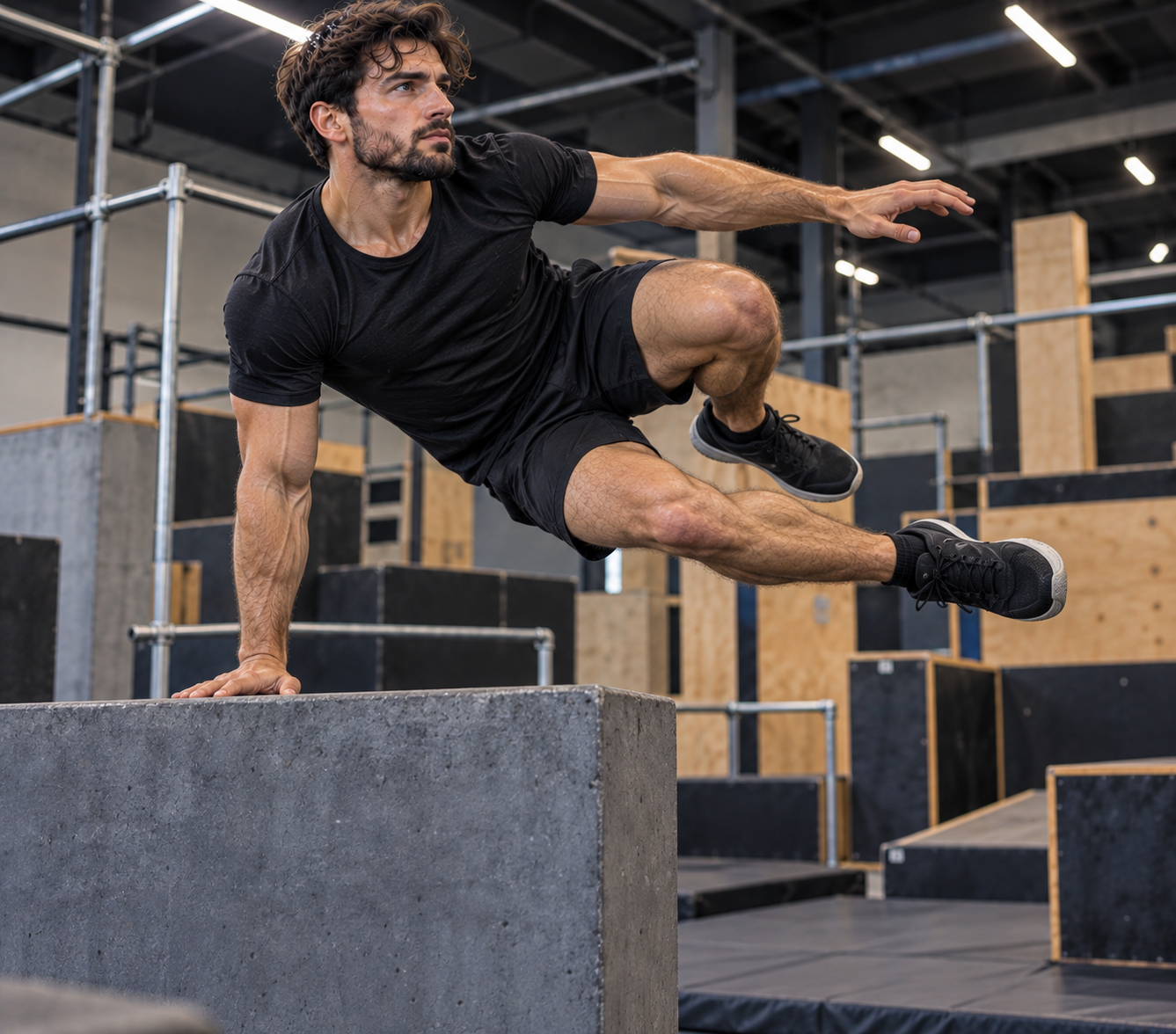
What equipment is needed for indoor parkour: a practical guide to selection and use
Parkour gym means designing a space dedicated to training the art of movement through modules, obstacles, landing surfaces, and technical areas organized consistently with the users' level and the facility's goals. The choice of equipment must consider safety, flexibility, maintenance, and the possibility of evolving the layout over time.
An indoor parkour gym is not limited to gathering obstacles of different shapes. The effectiveness of the facility depends on the ability to create progressive routes that allow the development of technique, coordination, strength, and motor control without interference between the various training areas. For this reason, design should be approached as an integrated system that includes equipment, flooring, fall surfaces, and space organization.
Sports associations, fitness centers, schools, and public facilities have different needs but share the same goal: to create a versatile environment that is easy to manage and compliant with manufacturers' technical guidelines. A thoughtful choice of equipment allows you to optimize the initial investment and progressively expand the structure based on the evolution of activities.
- Quick answer
- What equipment is necessary
- How to choose equipment
- How to use equipment correctly
- Safety and checks
- Errors to avoid
- FAQ
- How to plan the setup
What equipment is needed for indoor parkour?
A parkour gym should include modules for creating routes, obstacles of different sizes, support surfaces, anti-trauma flooring, fall areas, anchoring systems when provided, and complementary equipment for managing workouts. Each element must be chosen considering the intended use, available space, and manufacturer's instructions.
The ideal configuration depends on the technical level of the users, the number of practitioners present simultaneously, and the possibility of periodically modifying the layout.
A modular design allows the gym to be expanded without completely rethinking the existing structure.
Objective of the choice
To create a functional, safe gym easily adaptable to different sports activities.
General criteria
Each piece of equipment should be selected as part of an overall project that includes layout, maintenance, and operational management.
What equipment should be included in the project?
Equipment must be identified based on the activities actually carried out inside the gym and the technical progression planned for users.
| Category | Function | Aspects to verify |
|---|---|---|
| Parkour modules | Creation of routes | Installation and stability |
| Technical obstacles | Jumping and overcoming exercises | Compatibility with the layout |
| Fall surfaces | Landing protection | Positioning and integrity |
| Flooring | Training surface | Continuity and maintenance |
| Accessories | Support for activities | Compatibility with the project |
The final configuration should be defined by evaluating the facility's sports program and daily usage methods.
Main modules
Modules represent the basis for building routes and should allow different training configurations.
Complementary equipment
Accessory equipment completes the facility and facilitates the management of technical and educational activities.
How to choose the equipment?
The choice should start from the analysis of available space, planned activities, and the number of users who will use the gym simultaneously.
It is also advisable to check reconfiguration possibilities, ease of maintenance, availability of technical documentation, and compatibility with the building structure.
A modular design allows the layout to be progressively updated while maintaining operational continuity and optimizing investments.
Space evaluation
Each element should be placed while maintaining fluid paths and areas dedicated to landings.
Project flexibility
The ability to modify the layout represents an advantage in facilities hosting different activities.
How to use the equipment correctly?
Equipment should be used respecting the manufacturer's instructions and the operational procedures defined by the facility.
Before each workout, it is advisable to check the stability of the modules, the condition of the surfaces, and the correct arrangement of the fall areas.
To explore dedicated solutions, you can consult gym equipment.
Initial checks
A visual check before use allows any anomalies to be identified.
Workout management
The orderly arrangement of equipment facilitates the work of instructors and improves group management.
Which safety aspects to verify?
Checks should concern modules, support surfaces, fall spaces, anchoring systems when present, and conditions of the sports flooring.
Equipment should be maintained according to the maintenance schedule defined by the manufacturer and facility manager.
Manuals, installation instructions, and maintenance logs should always be available to facilitate checks and interventions.
Maintenance
Scheduled checks help maintain the gym's reliability and operational continuity.
Technical documentation
Documentation constitutes the main reference for installation, use, and maintenance of equipment.
What mistakes to avoid?
One of the most common mistakes is purchasing equipment without having previously defined the overall layout of the gym.
It is also advisable to avoid configurations that reduce movement spaces or available landings, as well as modifications to anchoring systems not foreseen by the manufacturer.
Neglecting scheduled maintenance and recording checks can compromise facility management in the long term.
Improvised layout
The arrangement of equipment should be planned before installation.
Insufficient checks
Regular maintenance facilitates the technical management of the entire structure.
FAQ
Is it possible to start with little equipment?
Yes. A modular project allows the gym to be progressively expanded according to operational needs.
What is the role of flooring?
Flooring represents a fundamental element of the facility and should be consistent with the intended use and designed routes.
What documents to keep?
Manufacturer manuals, installation instructions, maintenance logs, and technical documentation of the installed equipment.
How to plan the setup of the parkour gym?
Design should begin with the analysis of planned sports activities, available surface area, and number of users. Subsequently, it is possible to define the layout, modules, fall surfaces, routes, and maintenance plan, maintaining the possibility of progressively developing the structure.
When applicable, the main references include current building regulations, technical standards relating to sports equipment, guidelines from competent sports organizations, and manufacturer manuals regarding installation, use, and maintenance. Each configuration should be verified against the facility's intended use and applicable regulatory requirements.
Modular planning allows investments to be optimized, the gym to be adapted to the evolution of activities, and high standards of safety, functionality, and operational continuity to be maintained throughout the entire life cycle of the equipment.
Comments (0)