
Trolley
You have no items in your shopping cart

 Budgets
 Dumbers
 Discs
Discs
 Benches
 Racks and Rigs
 Weights Holders
 Isotonic machines
 Calisthenics
 Cardio
 Kettlebells
 Flooring
 Gym Set
 Accessories
 Combat
 ARTI MARZIALI
 CONTAINER GYM
 Tug-Of-War
 Used Gym Equipment
 PILATES MACCHINARI
 GINNASTICA ARTISTICA
 CAMPI DA PADEL
 Prodotti in Pronta Consegna
 Informazioni
 IRONMAN
 Gift Card
- Donatif
- General information
- 0 I like it
- 2 Views
- 0 comments
- gym flooring, safety flooring, gym safety, shock-absorbing materials
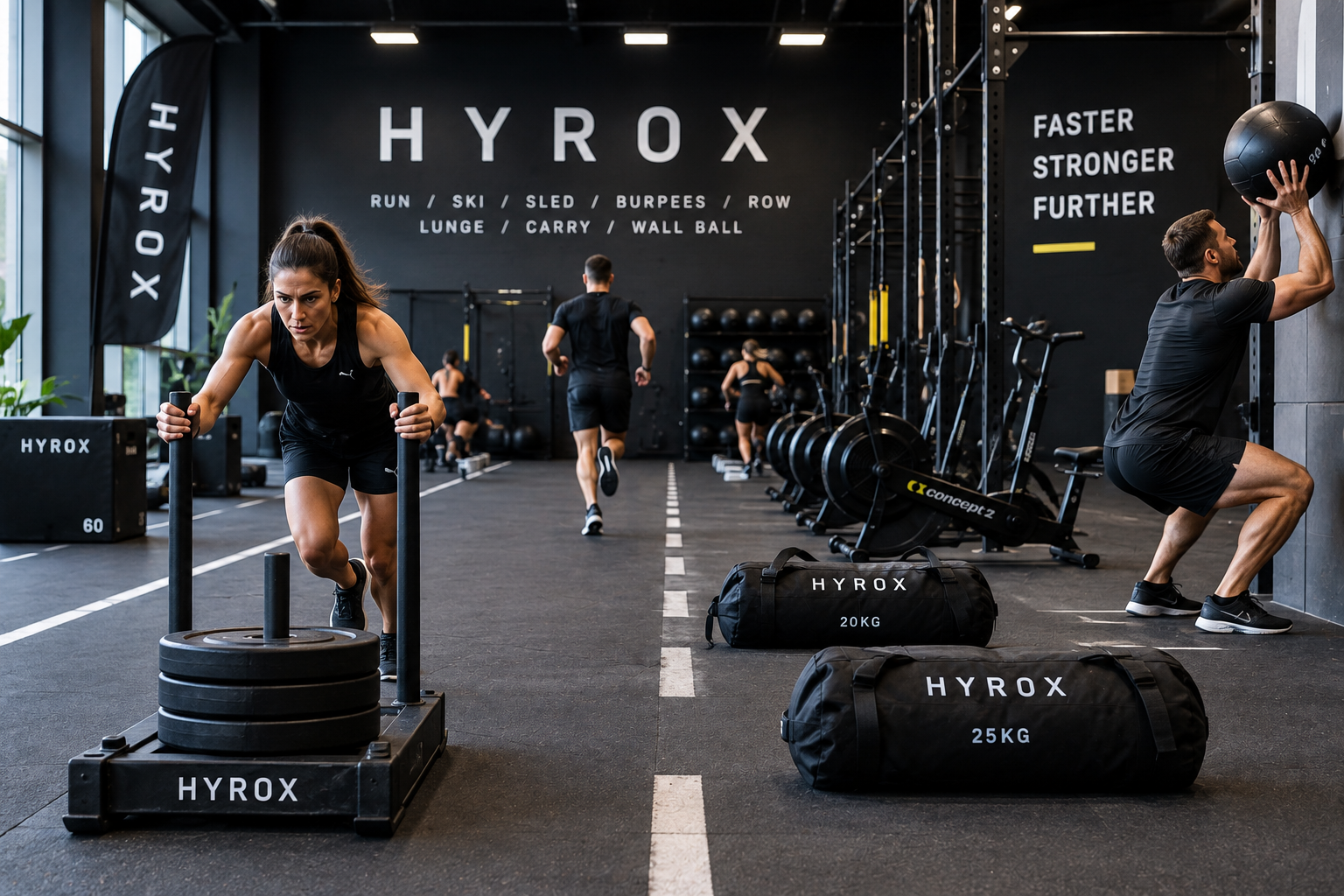
What equipment is needed to train for Hyrox
Training for Hyrox requires a combination of equipment dedicated to cardiovascular preparation and tools used in functional training. It is not essential to immediately have the entire set used in competitions, but it is important to select the tools that allow for the progressive development of strength, endurance, coordination, and the ability to manage transitions between running and exercises.
The choice of equipment should be based on the athlete's goals, available space, and frequency of use. An effective program prioritizes the quality of training over the quantity of tools present, making it possible to build a complete preparation without purchasing superfluous accessories.
For fitness centers and gyms, it is useful to organize the training area in a modular way, so as to accommodate both individual sessions and group workouts while maintaining high standards of safety and functionality.
- Quick answer
- What equipment is needed
- How to choose the equipment
- How to properly use the equipment
- How to organize the training space
- Errors to avoid and safety
- How to plan the investment
What equipment is needed to train for Hyrox
To prepare for Hyrox, tools dedicated to running, push and pull sleds, ski ergs, rowers, wall balls, kettlebells, and other functional training accessories are generally used. The choice depends on the athlete's level, preparation goals, and space availability, always prioritizing reliable equipment suited for the intended use.
It is not necessary to purchase all the equipment at once. Gradual planning allows for building a complete area over time while maintaining efficient use of the available budget.
Each piece of equipment should be integrated into a coherent program that progressively develops aerobic capacity, strength, and muscular endurance.
Decision-making criteria
The main criteria concern training goals, the construction quality of the equipment, ease of maintenance, available space, modularity, and the possibility of use in different preparation programs.
Technical references
For the correct use of the equipment, it is advisable to follow the manufacturer's instructions and refer to applicable technical standards, such as the EN ISO 20957 series relating to fitness equipment, in addition to official guidelines available for the Hyrox format when relevant.
What equipment is most used
The preparation includes tools dedicated to both cardiovascular work and functional exercises. Each piece of equipment contributes to the development of different physical qualities and is included in the programming according to the athlete's goals.
Commonly used tools include treadmills or dedicated running tracks, sled push and sled pull, ski ergs, rowers, wall balls, kettlebells, carry bags, and other functional accessories.
Having all of this equipment is not essential to begin. A targeted selection still allows for building effective and progressive workouts.
Cardio equipment
Running, ski ergs, and rowers allow for developing aerobic endurance and the ability to sustain prolonged efforts throughout the entire session.
Functional equipment
Sleds, kettlebells, wall balls, and tools for carrying loads allow for training strength endurance, coordination, and movement control.
How to choose the equipment
The choice should start from the user's preparation level and the type of workouts planned. A beginner can focus on essential equipment, while a gym dedicated to specific preparation can progressively expand its equipment.
It is important to evaluate robustness, simplicity of maintenance, availability of spare parts, and compatibility with available space.
Multifunctional equipment often allows for performing different exercises while reducing the overall footprint of the area.
Build quality
Resistant materials and reliable components help maintain consistent performance over time and reduce maintenance interventions.
Modularity
Modular equipment allows for progressively expanding the area without replacing the equipment already present.
How to properly use the equipment
Each tool should be used respecting the manufacturer's instructions and integrated into a program that alternates technical work, strength development, and cardiovascular training.
Movement quality remains a priority compared to increasing load or execution speed. Gradual progression favors technical learning and reduces errors during phases of greater fatigue.
Transitions between different stations also deserve specific training as they represent a characteristic component of the discipline.
Work progression
Gradually increasing volume and intensity allows for more effective adaptation compared to sudden increases in load.
Execution technique
Correct technique improves the efficiency of the movement and makes training more sustainable in the long term.
How to organize the training space
A dedicated area should allow for fluid movements between different stations while avoiding obstacles and interference with other gym activities.
The arrangement of the equipment must favor a logical sequence of exercises and leave sufficient space for the execution of dynamic movements.
Adequate anti-trauma flooring helps improve the stability and durability of surfaces during intensive workouts. To learn more about available solutions, you can consult anti-trauma flooring for gyms.
Area layout
An orderly arrangement of equipment facilitates instructor supervision and improves the user experience.
Maintenance
Periodic checks on the condition of the equipment help maintain high safety standards and operational continuity.
Errors to avoid
One of the most frequent errors consists of purchasing numerous pieces of equipment without real planning for use. A targeted selection is often more effective than a very broad but underutilized equipment setup.
It is also advisable to avoid using tools unsuitable for the intensity of workouts or neglecting routine maintenance of the equipment.
Even an irrational arrangement of space can limit the fluidity of sessions and increase the risk of interference between users.
Unplanned purchases
Evaluating the structure's goals before the investment allows for choosing truly useful equipment.
Neglected maintenance
Periodically checking wear, stability, and correct functioning helps keep equipment efficient over time.
How to plan the investment in equipment
Investment planning should consider the expected number of users, frequency of use, the possibility of expanding the equipment in the future, and the versatility of individual pieces of equipment.
For a gym, it is often advantageous to start with the tools most used during preparation and progressively integrate new equipment based on the growth of supply and demand.
A choice based on technical criteria, build quality, and space organization allows for creating a functional area, easily manageable and suitable both for beginner athletes and those wishing to develop more advanced preparation.
Comments (0)