
Trolley
You have no items in your shopping cart

 Budgets
 Dumbers
 Discs
Discs
 Benches
 Racks and Rigs
 Weights Holders
 Isotonic machines
 Calisthenics
 Cardio
 Kettlebells
 Flooring
 Gym Set
 Accessories
 Combat
 ARTI MARZIALI
 CONTAINER GYM
 Tug-Of-War
 Used Gym Equipment
 PILATES MACCHINARI
 GINNASTICA ARTISTICA
 CAMPI DA PADEL
 Prodotti in Pronta Consegna
 Informazioni
 IRONMAN
 Gift Card
- Donatif
- General information
- 0 I like it
- 2 Views
- 0 comments
- gym flooring, safety flooring, gym safety, shock-absorbing materials
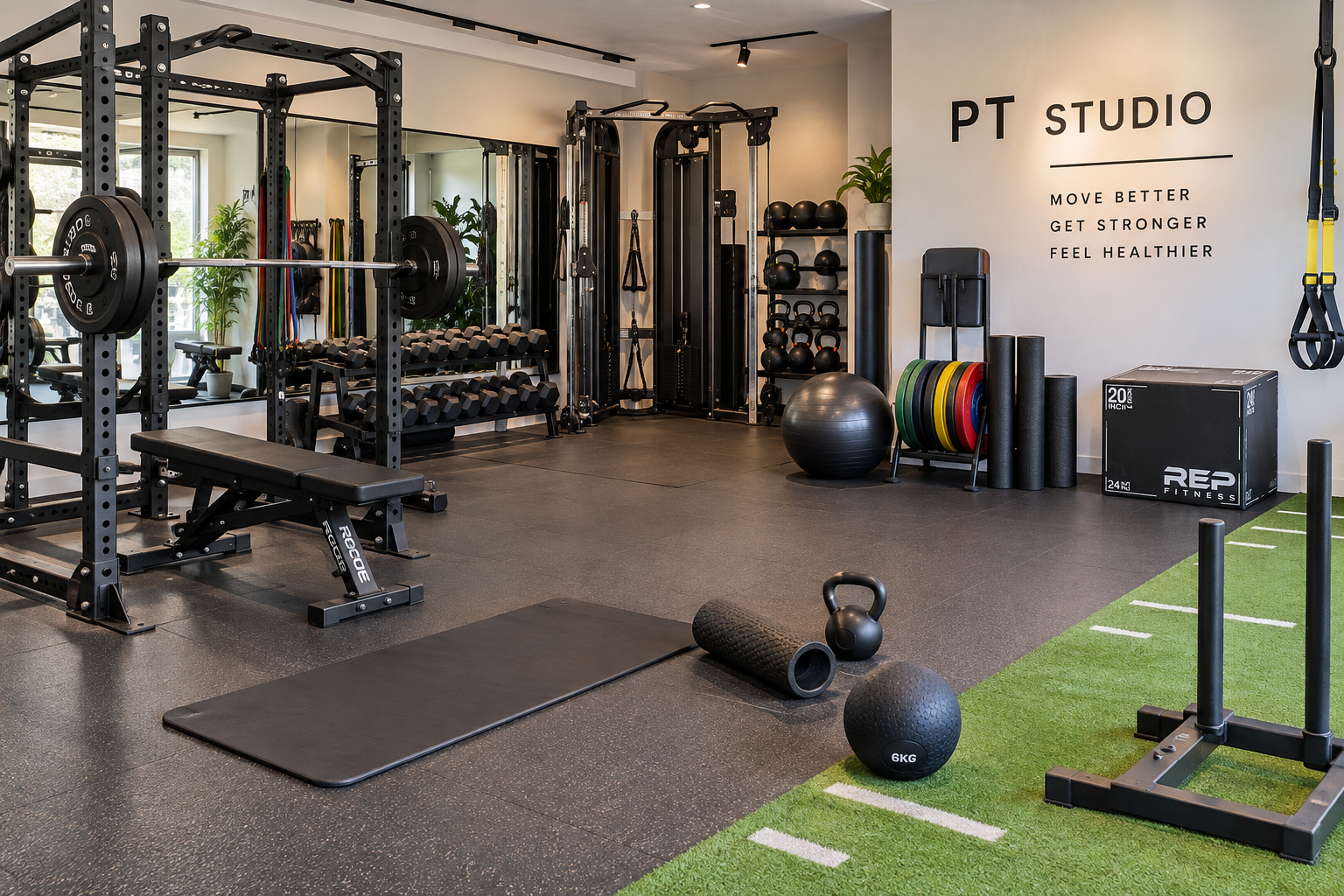
What equipment is needed in a personal trainer studio: guide to choosing professional equipment
A personal trainer studio requires a setup designed according to the professional's working method rather than the number of pieces of equipment installed. The goal is to create a versatile, orderly, and easily manageable space where each tool contributes to the execution of personalized training programs. A coherent selection allows you to optimize investments, improve organization, and quickly adapt the environment to clients' needs.
The quick answer is that a PT studio should prioritize multi-function equipment, efficient storage systems, and accessories that expand training possibilities without taking up unnecessary space. Before purchasing, it is advisable to analyze the number of clients that can be managed simultaneously, the methodologies used, and the surface area actually available.
Careful planning facilitates daily work, simplifies maintenance, and allows the facility to be gradually developed while maintaining coherence between layout, services, and technical equipment.
- How to choose equipment
- What tools are essential
- How to organize the space
- Recommended equipment table
- How to use equipment correctly
- Maintenance and checks
- Mistakes to avoid
- How to plan investments
How to choose the equipment?
The choice should start from the studio's goals and the types of training actually offered. Each piece of equipment should have a precise function, avoiding duplications and rarely used tools.
It is advisable to check dimensions, installation methods, component compatibility, and instructions reported in the manufacturers' technical data sheets. The possibility of expanding the equipment over time is also an important criterion.
A modular configuration allows you to easily update the studio without completely modifying the layout.
Why start from the working method?
The activities actually carried out determine which tools are truly necessary and which can be avoided.
Why check compatibility?
Compatible equipment facilitates organization, maintenance, and future expansions.
What tools are essential?
A professional setup generally includes multi-function racks, barbells, adjustable benches, kettlebells, resistance bands, functional training accessories, and a complete range of dumbbells. These tools allow you to develop very different programs while keeping the overall footprint contained.
Dedicated storage systems are also essential to maintain order during sessions and reduce workout preparation times.
The quantitative choice should be proportional to the available space and the maximum number of clients present simultaneously.
Why prioritize multi-function tools?
They allow you to perform numerous exercises using the same station and improve space efficiency.
How much do accessories matter?
A balanced selection expands training possibilities without requiring new dedicated areas.
How to organize the space?
The main equipment should be placed along the perimeter, leaving the central area free for dynamic exercises. Accessories should be easily accessible through orderly storage systems.
Simple and well-defined paths facilitate the movements of the trainer and the client during all phases of the session.
A rational distribution also allows you to quickly modify the room configuration when necessary.
Why leave the central area free?
A large operational space improves the quality of workouts and facilitates the personal trainer's supervision.
Why organize accessories?
Proper storage maintains order and speeds up session preparation.
Recommended equipment table
| Category | Function | Selection criterion |
|---|---|---|
| Rack | Multi-joint exercises | Modular configuration |
| Barbells | Strength training | Compatibility |
| Dumbbells | Complete exercises | Load progression |
| Benches | Exercise support | Stability |
| Accessories | Workout variety | Storage ease |
| flooring | Surface protection | Compatibility with activities |
The final configuration should be adapted to the characteristics of the studio and the activities actually offered.
For technical data, weight capacities, and installation requirements, it is advisable to consult the manufacturers' technical data sheets and manuals.
Why consult technical documentation?
Manuals provide fundamental instructions for the installation, use, and maintenance of equipment.
Why choose a modular solution?
It allows you to progressively expand the studio while maintaining organizational coherence.
How to use the setup correctly?
Equipment should be used exclusively according to the manufacturer's instructions and put away correctly at the end of each session. Constant organization makes preparing subsequent workouts simpler.
Scheduling the exercise sequence also based on the arrangement of the tools improves the studio's operational efficiency.
An orderly environment also helps convey professionalism to clients.
Why maintain order?
An organized room facilitates the professional's work and improves the client's experience.
Why plan the exercise sequence?
It reduces unnecessary movement and optimizes space utilization.
How to manage maintenance and checks?
Maintenance includes periodic equipment checks, scheduled cleaning, and surface inspection according to the manufacturers' instructions.
Storage systems and technical flooring should also be inspected regularly to keep the studio efficient.
Recording interventions facilitates planning for future maintenance.
What checks to perform?
Visual checks, functional tests, and cleaning represent the main routine maintenance activities.
Why schedule interventions?
Regular maintenance helps preserve the functionality of the facility.
What mistakes to avoid?
One of the most common mistakes is purchasing numerous pieces of equipment without prior layout design. This approach limits available space and makes daily activity less efficient.
It is also advisable to avoid highly specialized tools if they are used rarely compared to more versatile equipment.
Neglecting storage systems and accessory organization can also compromise the overall functionality of the studio.
Do more equipment mean a better studio?
No. A setup consistent with the working method is generally more effective than a very large one that is poorly organized.
Why plan purchases?
Preventive planning allows you to correctly distribute investments and maintain an efficient space.
How to plan investments?
A personal trainer studio should develop gradually following real operational needs. Analyzing services, available space, and growth potential allows you to build a professional structure that is easily updateable over time.
Carefully evaluating multi-function equipment, PT studio layout, space organization, and compatibility between the various stations allows you to plan sustainable investments. To complete a versatile setup, it can be useful to integrate a professional dumbbell set compatible with the planned layout, maintaining order, flexibility, and operational continuity.
Comments (0)