
Trolley
You have no items in your shopping cart

 Budgets
 Dumbers
 Discs
Discs
 Benches
 Racks and Rigs
 Weights Holders
 Isotonic machines
 Calisthenics
 Cardio
 Kettlebells
 Flooring
 Gym Set
 Accessories
 Combat
 ARTI MARZIALI
 CONTAINER GYM
 Tug-Of-War
 Used Gym Equipment
 PILATES MACCHINARI
 GINNASTICA ARTISTICA
 CAMPI DA PADEL
 Prodotti in Pronta Consegna
 Informazioni
 IRONMAN
 Gift Card
- Donatif
- General information
- 0 I like it
- 726 Views
- 0 comments
- gym flooring, safety flooring, gym safety, shock-absorbing materials
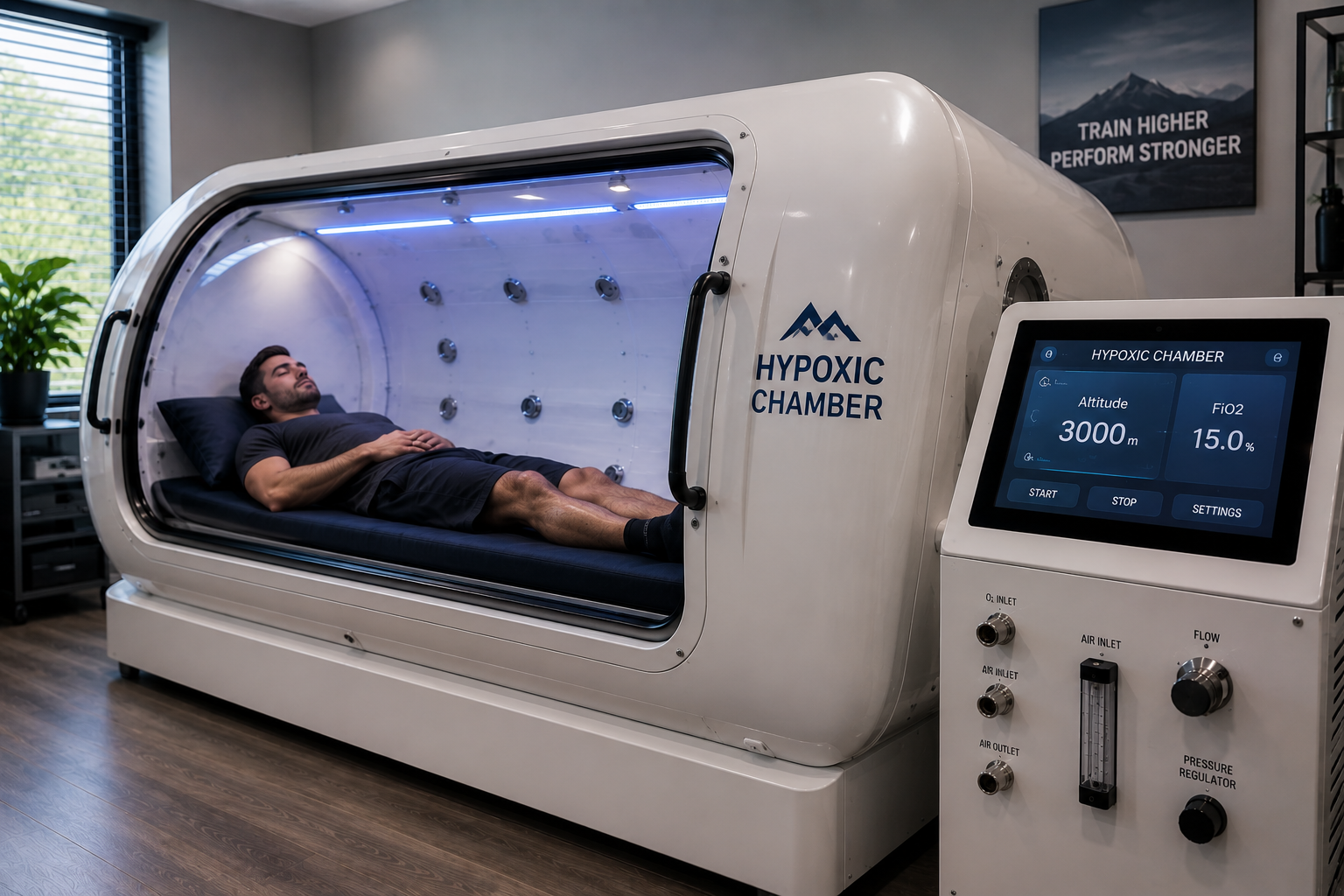
How a Hypoxic Chamber Works: The Air and Nitrogen Cycle
A hypoxic chamber is a technological system designed to recreate high-altitude-like conditions through controlled management of air composition. Behind an apparently simple environment lies a complex process involving filtration, molecular separation, gas control, and continuous management of environmental parameters.
To truly understand how a hypoxic chamber works, it is necessary to analyze the path taken by the air before it reaches the inside of the chamber. Operation does not simply consist of "removing oxygen", but of precisely modifying the composition of the breathed mixture through technologies designed to maintain stability and safety.
The air cycle represents the heart of the system: from the intake of ambient air to the production of a controlled hypoxic mixture, every phase contributes to the final quality of the experience. The underlying technology makes it possible to create an environment suited for training, athletic preparation, and simulated altitude adaptation protocols.
- The operating principle of a hypoxic chamber
- The air cycle within the hypoxic system
- Molecular oxygen extraction through membranes
- The role of nitrogen in generating the hypoxic environment
- The technical components that make the process possible
- Hypoxic chamber control and safety
- Technology applied to air management
- The evolution of professional hypoxic systems
The operating principle of a hypoxic chamber
The operation of a hypoxic chamber is based on the ability to modify the relative quantity of oxygen present in the air being breathed. Atmospheric air naturally contains a stable percentage of oxygen, but through dedicated technological systems it is possible to create a mixture with a lower concentration, simulating conditions typical of higher altitudes.
The process takes place through a system composed of air generation, separation of atmospheric components, electronic control, and distribution within the environment. Each phase must be managed with precision because even small variations can influence the stability of the set protocol.
A professional hypoxic chamber therefore does not work as a simple device that reduces oxygen, but as a controlled environment in which various parameters are continuously monitored and regulated.
Air as the raw material of the process
The cycle begins with ambient air, composed mainly of nitrogen, oxygen, and other gases present in smaller quantities.
The system uses this natural mixture as a starting point to obtain a different composition.
Creating a controlled mixture
The ultimate goal is to produce air with an oxygen availability compatible with the desired simulated altitude level.
The precision of the result depends on the quality of the separation and control technology.
The air cycle within the hypoxic system
The air cycle represents the complete path that allows the chamber to maintain stable hypoxic conditions. The air is aspirated, treated, modified, and subsequently distributed into the environment through a system designed to ensure uniformity.
During a session, the system must compensate for various variables, such as the presence of people, user breathing, and normal environmental variations. For this reason, airflow control is an essential element.
Effective management of the cycle makes it possible to maintain the set oxygen level without creating fluctuations that could compromise the quality of the experience.
Aspiration and initial filtration
Before the separation phase, the air is generally treated through filtration systems.
This phase makes it possible to improve the quality of the air used by the system.
Distribution in the hypoxic environment
After treatment, the air is introduced into the chamber through systems designed to distribute the flow evenly.
Proper distribution avoids differences between different areas of the environment.
Molecular oxygen extraction through membranes
One of the most important elements in modern hypoxic systems is the molecular air separation process. The technology uses materials and components capable of distinguishing the various gases present in the atmospheric mixture.
Membrane oxygen extraction is based on the principle that certain molecules pass through selective materials at different speeds compared to others. This makes it possible to obtain an air mixture with specific characteristics.
Molecular separation represents an advanced technological solution because it allows hypoxic air to be produced without using invasive methods or physically modifying the ambient pressure.
How selective membranes work
Membranes are designed to favor the differentiated passage of molecules present in the air.
This process makes it possible to modify the final composition of the mixture.
Precision of the molecular process
The quality of separation directly influences the system's ability to maintain constant conditions.
The greater the technological precision, the greater the control over the created environment.
The role of nitrogen in generating the hypoxic environment
Nitrogen represents the main component of atmospheric air and plays an important role in systems that produce hypoxic conditions. To create a mixture with less oxygen, the system must modify the ratio between the different gases present.
The fitness nitrogen generator is often associated with systems capable of managing air composition through gas separation and control processes. The goal is not simply to add a gas, but to obtain a precise and stable mixture.
Nitrogen management makes it possible to simulate environmental conditions characterized by a lower relative availability of oxygen, while maintaining complete control of the process.
Ratio between nitrogen and oxygen
The composition of the air depends on the ratio between the gases that make it up.
Modifying this balance makes it possible to create controlled hypoxic conditions.
Final mixture control
The system must continuously verify that the produced mixture corresponds to the required parameters.
Sensors and control software contribute to the stability of the result.
The technical components that make the process possible
A hypoxic chamber is the result of the integration of various components that work together. The generator represents only a part of the overall system, which also includes filters, sensors, electronic control units, and air distribution systems.
Each element contributes to the precision, reliability, and safety of the created environment. Proper design therefore considers the system as a coordinated whole.
The quality of the components directly affects the lifespan of the installation and the ability to maintain constant performance over time.
Sensors and monitoring
Sensors make it possible to know the conditions present in the chamber in real time.
This data is used to keep the system within programmed parameters.
Electronic control unit
The control unit coordinates the operation of the various components.
Through automatic systems, it is possible to manage the process with greater precision.
Hypoxic chamber control and safety
Safety represents a fundamental element in the design of any hypoxic system. Modifying the composition of the air indeed requires constant monitoring of parameters to ensure reliable use.
Hypoxic chamber safety depends on the integration between component quality, monitoring systems, and correct management procedures.
A controlled environment allows this technology to be used more consciously, reducing the risks linked to imprecise management.
Parameter monitoring
Continuous monitoring makes it possible to verify the correct functioning of the system.
Any variations can be detected and managed quickly.
Reliability over time
Maintenance and construction quality contribute to the lifespan of the installation.
A reliable system maintains constant performance even with frequent use.
Technology applied to air management
The technology behind a modern hypoxic chamber combines principles of engineering, gas control, and environmental management. The path of the air, from the initial phase up to distribution in the chamber, requires precise design to obtain a stable environment.
The technical explanation of the system makes it possible to understand why a professional solution does not depend only on reaching a certain percentage of oxygen, but on the ability to maintain it over time.
An engineering approach makes it possible to transform a complex process into a simple experience for the athlete, who can focus on training while the technology automatically manages the air cycle.
From technical complexity to ease of use
Behind an advanced hypoxic system lie numerous automated processes.
The end user only perceives a controlled and ready-to-use environment.
The value of design
Design quality determines safety, precision, and reliability.
These elements represent the basis of a professional hypoxic experience.
The evolution of professional hypoxic systems
The evolution of hypoxic technologies is leading toward increasingly precise, automated systems that are easily integrated into home and professional environments. Air cycle management represents one of the most important aspects of this development.
Understanding the internal workings of a hypoxic chamber allows for a better assessment of the quality of the chosen solution, considering not only the final result but also the process that makes it possible.
The combination of molecular separation, gas control, and technical safety makes it possible to create increasingly reliable simulated high-altitude environments, transforming technology into a true tool for performance and well-being.
Comments (0)