
Trolley
You have no items in your shopping cart

 Budgets
 Dumbers
 Discs
Discs
 Benches
 Racks and Rigs
 Weights Holders
 Isotonic machines
 Calisthenics
 Cardio
 Kettlebells
 Flooring
 Gym Set
 Accessories
 Combat
 ARTI MARZIALI
 CONTAINER GYM
 Tug-Of-War
 Used Gym Equipment
 PILATES MACCHINARI
 GINNASTICA ARTISTICA
 CAMPI DA PADEL
 Prodotti in Pronta Consegna
 Informazioni
 IRONMAN
 Gift Card
- Donatif
- General information
- 0 I like it
- 10 Views
- 0 comments
- gym flooring, safety flooring, gym safety, shock-absorbing materials
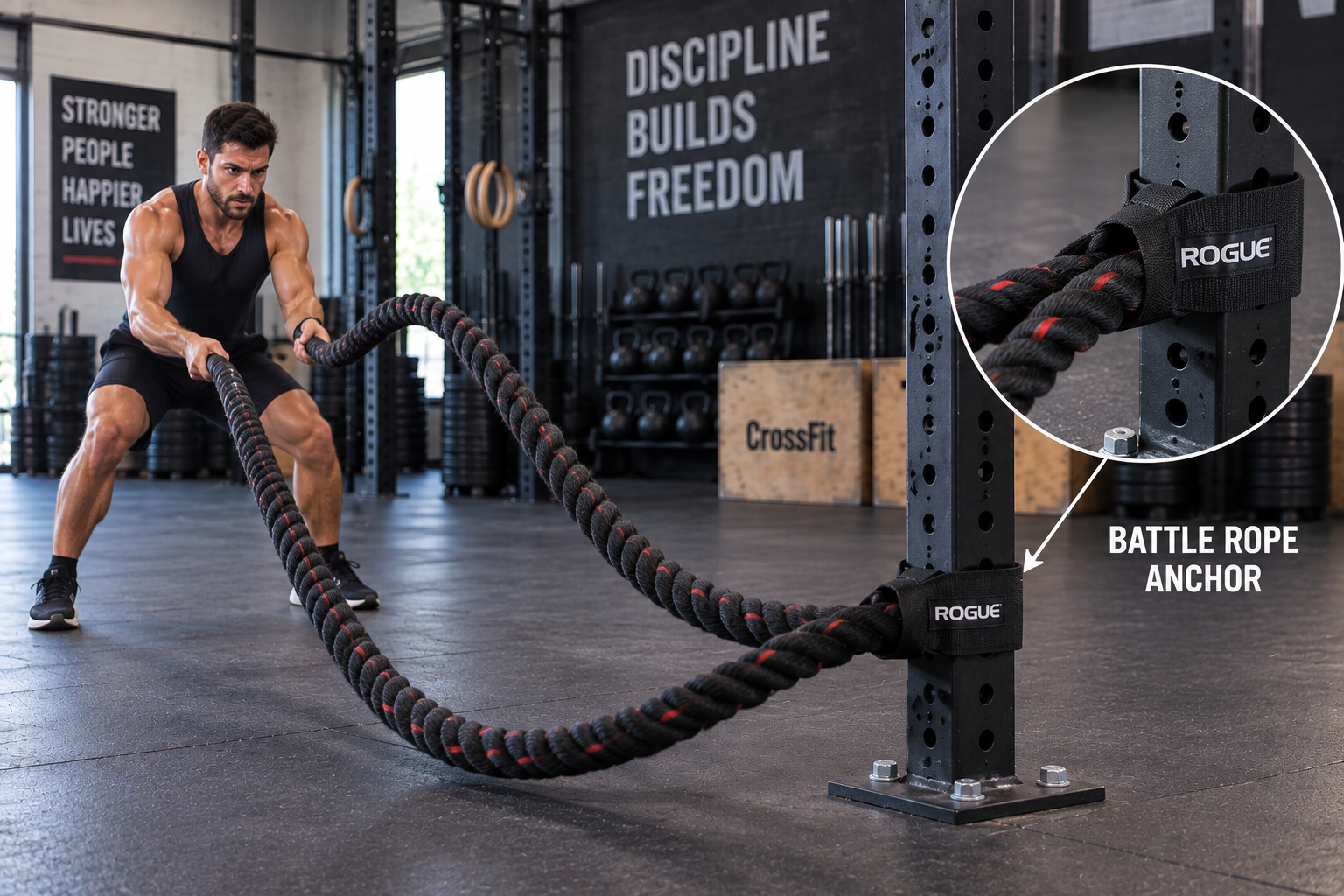
How to anchor a battle rope safely
To correctly anchor a battle rope, it is necessary to use a stable attachment point designed to withstand dynamic loads and installed on a suitable structure. A secure anchor allows the rope to work in line, reduces equipment wear, and helps perform exercises under controlled conditions both in home gyms and professional fitness facilities.
Safety does not depend exclusively on the support used. The correct positioning of the station, the quality of the flooring, the condition of the rope, and periodic checks also affect the reliability level of the entire system.
Before starting each workout, it is advisable to check the fastening, verify that the rope shows no signs of deterioration, and ensure that the work area is free of obstacles. A preventative approach helps reduce the risk of incidents and preserves the equipment over time.
- Quick answer
- What are the main risks
- What requirements must a secure anchor have
- Pre-use checks
- Verification table
- How to limit wear
- Errors to avoid
- FAQ
- How to evaluate station safety
How do you anchor a battle rope safely?
A battle rope should be fixed exclusively to a stable anchor point compatible with the dynamic loads generated during exercises. The system must keep the rope aligned, prevent unwanted movement of the support, and allow an even distribution of stress.
The surrounding area must be free of obstacles and the surface must provide stable footing throughout the training session.
Before each use, it is appropriate to check the integrity of the anchor and the rope, stopping the workout if visible damage or anomalies are present.
Why fastening is important
The waves generated by the rope produce repeated stress. A stable anchor helps maintain consistent rope behavior throughout the entire set.
Preparing the work area
An orderly station facilitates exercise execution and reduces the risk of interference with other equipment or present users.
What are the main risks?
The most frequent risks stem from unsuitable fastening points, slippery surfaces, rope wear, and improvised installations.
Incorrect positioning of the station can also create problems, especially when the rope comes into contact with walls, machinery, or edges during waves.
Periodic maintenance allows you to promptly identify any critical issues and schedule the replacement of worn components.
Rope wear
Continuous rubbing against abrasive surfaces accelerates the deterioration of the coating and can reduce the durability of the equipment.
Inadequate support
An anchor point not designed to support dynamic loads can compromise station stability.
What requirements must a secure anchor have?
The fastening system should be installed on a stable structure and keep the rope perfectly aligned with the working direction.
It is advisable to use accessories designed for this type of application and verify that all elements are assembled according to the manufacturer's instructions.
The accessibility of the anchor also facilitates periodic control and maintenance operations.
Importance of alignment
Proper alignment limits lateral friction and promotes better execution of the wave technique.
Using compatible accessories
Dedicated accessories help keep the rope in the intended position and help reduce wear during continuous use.
What checks to perform before use?
A preliminary check takes a few minutes and allows you to identify any anomalies before training begins.
Checks should cover the rope, the fastening system, the support surface, and the available operating space.
In professional gyms, it is useful to integrate these checks into normal functional area maintenance procedures.
Visual check
Verify that there are no fraying, obvious abrasions, or handle damage.
Area check
Ensure the area is free of obstacles and that no other activities interfere with the use of the battle rope.
Pre-workout verification table
This table summarizes the main recommended checks.
| Element | What to check | Objective |
|---|---|---|
| Anchor | Stability and absence of movement | Reliable fastening |
| Rope | Absence of obvious wear | Continuity of use |
| Handles | Coating integrity | Secure grip |
| Work area | Free space | Obstacle-free movement |
| Flooring | Stable surface | Reduce abrasion and slipping |
These checks do not replace the manufacturer's instructions but represent good practice in the daily management of the station.
How often to check?
A visual check before each use and more thorough checks at regular intervals help keep the safety level high.
Documenting maintenance
In professional facilities, it can be useful to record equipment control and replacement interventions.
How to limit battle rope wear?
The durability of the rope also depends on usage conditions. Avoiding abrasive surfaces and keeping the station clean helps reduce deterioration.
A surface designed for fitness activity protects both the rope and the floor during repeated workouts.
Timely replacement of worn components allows you to maintain consistent equipment performance.
Protecting the floor
An anti-shock gym flooring helps limit rope abrasion and protects the functional area surface.
Station cleaning
Removing dust and residue reduces friction and promotes greater equipment durability.
Which errors are best avoided?
One of the most common errors consists of securing the rope to elements not designed to support dynamic stresses.
Another critical issue concerns using the battle rope on unsuitable surfaces or in spaces that are too confined.
Ignoring signs of wear on the rope or anchor can compromise station safety.
Improvised anchors
Using non-specific supports increases the risk of instability during exercises.
Skipping checks
Even a quick inspection before training can help identify easily visible anomalies.
FAQ
Can I attach the battle rope to any support?
No. It is preferable to use exclusively anchor points designed to support the stresses generated during training.
How often should the rope be checked?
It is advisable to perform a visual check before each use and more thorough checks according to the intensity of use.
Does flooring affect safety?
Yes. An adequate surface improves station stability and helps limit rope wear.
How to recognize a worn rope?
Obvious signs of abrasion, fraying, or handle deterioration indicate the need for a thorough check or replacement.
How to evaluate station safety before use
A safe station stems from the combination of a stable anchor, a well-organized work area, periodic checks, and proper equipment maintenance. Evaluating these elements prior to installation allows you to reduce subsequent interventions and preserve the functionality of the battle rope over time.
For professional gyms, it is advisable to adopt standardized verification procedures, while in home gyms it is useful to dedicate a few minutes to checking the entire station before each workout.
An approach based on regular checks, the use of compatible components, and correct space management allows you to train more efficiently and maintain a high level of equipment reliability without introducing improvised practices.
Comments (0)