
Trolley
You have no items in your shopping cart

 Budgets
 Dumbers
 Discs
Discs
 Benches
 Racks and Rigs
 Weights Holders
 Isotonic machines
 Calisthenics
 Cardio
 Kettlebells
 Flooring
 Gym Set
 Accessories
 Combat
 ARTI MARZIALI
 CONTAINER GYM
 Tug-Of-War
 Used Gym Equipment
 PILATES MACCHINARI
 GINNASTICA ARTISTICA
 CAMPI DA PADEL
 Prodotti in Pronta Consegna
 Informazioni
 IRONMAN
 Gift Card
- Donatif
- General information
- 0 I like it
- 624 Views
- 0 comments
- gym flooring, safety flooring, gym safety, shock-absorbing materials
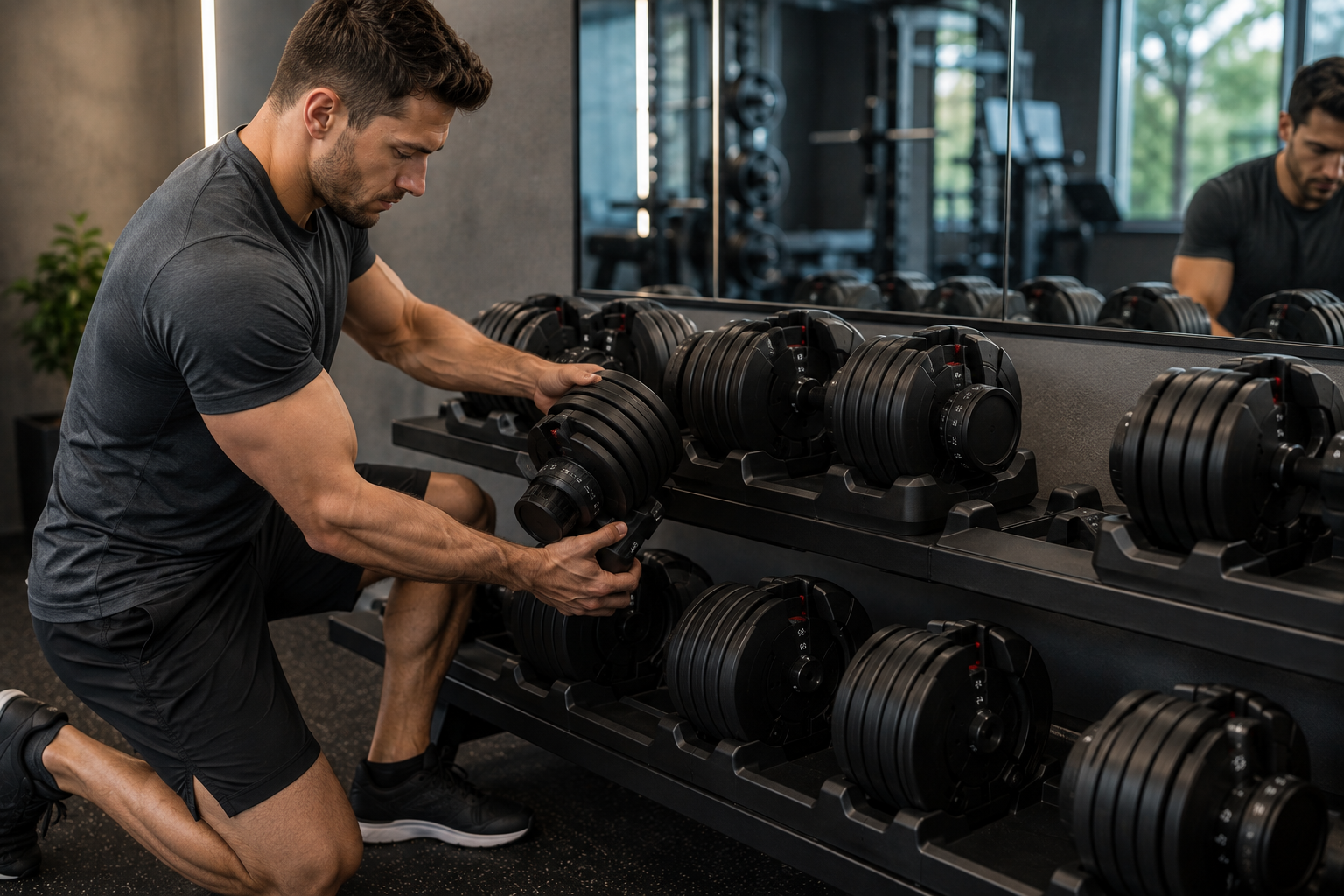
How to organize dumbbells in a small home gym: space-saving solutions to transform 2sqm into a complete gym
Creating an effective home gym does not necessarily mean having a huge room full of equipment. More and more people are choosing to work out at home to save time, maintain consistency, and build a personal space dedicated to wellness. The real challenge then becomes organizing every element intelligently, especially when square footage and order are limited resources.
Good planning allows you to transform even a small corner of a garage, a multi-purpose room, or a studio apartment into a functional environment. Choosing the right home gym dumbbell set plays a central role because weights represent one of the most versatile tools for training the entire body without occupying excessive surface area.
Organizing dumbbells does not just mean finding a place to store them, but creating a system that makes training simpler, faster, and more pleasant. From traditional racks to adjustable systems, there are various strategies to maintain order and get the most out of a few square meters.
- How to design a home gym in a small space
- The best solutions for organizing dumbbells
- Traditional racks and storage systems
- The advantage of space-saving dumbbells
- Home gym design and decor
- How to create a complete setup in 2 square meters
- How to choose the ideal configuration
How to design a home gym in a small space
When available space is limited, design becomes the most important element. An effective home gym is not born from the quantity of equipment present, but from the ability to choose multifunctional tools and organize them coherently.
Before purchasing new items, it is useful to analyze the available dimensions, the movements necessary for training, and how the space will be used. A zone dedicated to weights must allow for freedom of movement, safety, and ease of access to tools.
A small environment can become extremely functional if every component is chosen with a precise logic.
Analyze the available space
The first step consists of measuring the area intended for training and identifying any structural limitations. Ceiling height, door placement, and the presence of furniture can influence the final layout.
A correct initial assessment avoids impractical purchases and allows for the creation of a truly usable configuration.
Define the essential tools
In a compact home gym, it is not necessary to have every type of tool. It is more effective to choose tools capable of offering many exercise possibilities.
Dumbbells represent one of the most efficient solutions because they allow you to train numerous muscle groups with a single system.
The best solutions for organizing dumbbells
Weight organization directly influences the quality of the training experience. A cluttered environment makes it harder to start a session and can turn the home gym into an unpleasant space.
Conversely, a well-thought-out layout allows you to quickly find what you need and keep the area always ready for use.
There are various strategies for organizing dumbbells, each with specific advantages based on the space and the type of equipment used.
Utilize vertical space
When floor surface is limited, using vertical space represents an effective solution. Stands and raised systems allow you to free up useful area for exercises.
This strategy is particularly interesting in small environments where every centimeter must be utilized.
Create an intuitive system
Order should not only be aesthetic but also practical. The most used weights must be easily accessible, while less frequent tools can be placed in secondary areas.
A functional layout reduces time wasted in preparing for the session.
Traditional racks and storage systems
Racks represent one of the most common solutions for organizing dumbbells. They allow you to keep weights tidy, visible, and easily reachable during training.
However, in very small home gyms, they can present some limitations related to bulk. A complete set of traditional dumbbells requires significant surface area and careful space management.
The choice of rack must therefore be evaluated in relation to the dimensions of the home gym.
When to choose a rack
A rack can be a good solution for those who have sufficient space and desire an organization similar to that of professional gyms.
It offers visual order and allows you to have different loads immediately available.
Limitations in small environments
In reduced spaces, a full rack can occupy a significant part of the available area. This can limit freedom of movement and reduce general practicality.
For this reason, many users look for more compact alternatives.
The advantage of space-saving dumbbells
Space-saving dumbbells represent one of the most interesting solutions for those who want to maximize training possibilities without filling the room with equipment. An adjustable system allows you to have different load levels using a single product.
This feature is particularly useful in homes with little space, where every element must offer the maximum possible value.
Reducing bulk does not mean giving up training quality, but rather designing the space more intelligently.
Replace many pairs of weights
An adjustable system can replace numerous pairs of traditional dumbbells. This allows you to maintain a great variety of loads without occupying an entire wall.
The result is a gym that is tidier and easier to manage.
Adapt to different workouts
The ability to change the weight makes adjustable dumbbells suitable for many types of exercises.
A single tool can accompany the user through different phases of their fitness journey.
Home gym design and decor
A home gym should not only be functional but also pleasant to experience. The aesthetics of the space influence motivation and make it more natural to dedicate yourself to training consistently.
A well-curated project considers colors, materials, tool placement, and ease of maintaining order.
The modern concept of a home gym increasingly combines performance and design.
Integrate weights into the environment
Equipment must fit harmoniously into the available space. Compact and tidy solutions allow you to avoid the warehouse effect.
Good organization also improves the general perception of the environment.
Create a minimalist environment
A minimalist approach helps to keep only the truly useful tools. This reduces chaos and makes it easier to focus on training.
Functional design thus becomes part of the space utilization strategy.
How to create a complete setup in 2 square meters
One of the most interesting ideas for those with little space is to create an essential but complete training zone. With an intelligent selection of equipment, it is possible to cover many needs without occupying an entire room.
An area of about 2 square meters can become sufficient for numerous exercises if organized correctly.
The goal is not to accumulate tools, but to choose those with the best ratio between possibilities offered and space occupied.
Fundamental elements
An adjustable dumbbell system, an adequate surface, and a few selected accessories can represent a very effective base.
This configuration allows you to train strength, mobility, and conditioning.
Leave space for movement
Even in a small gym, it is important to maintain a free zone to perform exercises correctly.
The placement of tools must therefore favor movement and not hinder it.
How to choose the ideal configuration
The choice of the best configuration depends on your needs, training level, and available space. There is no single model valid for everyone, but there are solutions capable of adapting better to certain contexts.
Those who want to create a tidy home gym should evaluate versatility, bulk, and ease of management above all else.
Invest in efficient tools
Compact but versatile equipment allows you to get more value from every purchase.
Design a sustainable space
An effective home gym must be easy to use every day. A tidy and well-organized environment encourages consistency and makes training more pleasant over time.
Comments (0)